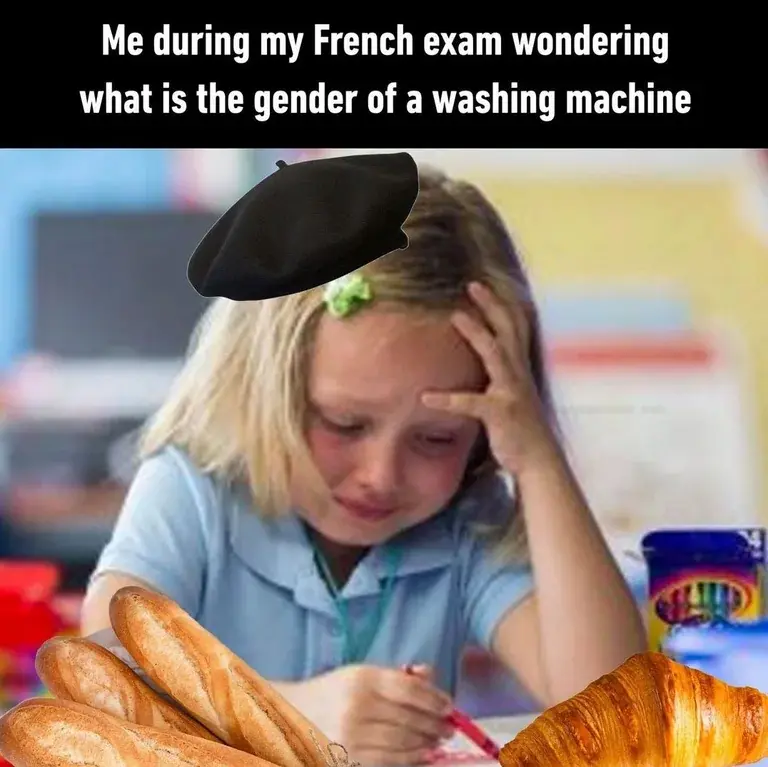
▲ 1429 ▼ English may be a hot mess but at least we don't have to worry about this nonsense (lemmy.world) submitted 2 years ago by robocall@lemmy.world to c/lemmyshitpost@lemmy.world 359 comments fedilink hide all child comments
[–] tobbue@discuss.tchncs.de 4 points 2 years ago (1 child) Are you for real? permalink fedilink source parent hideshow 2 child comments replies: [–] freebee@sh.itjust.works 13 points 2 years ago* (5 children) It is real. People have gotten mad at me for saying the 1 general (in my opinion in that case not-gendered) word instead of the slight pause and adding *innen. It's quite difficult for non-native speakers to get used to it. Meanwhile, in Dutch language, many female doctors, bosses, directors etc all prefer to be spoken to with the general "male" word, because they prefer to be spoken to on an equal term as their male colleagues and for the difference not to be made. Witnessing Germanic languages growing apart a tad further I guess. permalink fedilink source parent hideshow 10 child comments replies: [–] Pyr_Pressure@lemmy.ca 7 points 2 years ago (3 children) In English we have a few gendered professions (waiter/waitress, actor/actress) and I feel like most people.lean towards the "male" term as the general term as well. In general it's fine to call anyone an actor or a waiter but it would be weird to call a male actor an actress. permalink fedilink source parent hideshow 6 child comments replies: [–] brbposting@sh.itjust.works 2 points 2 years ago Actress seems to have fallen out of fashion, at least in personal experience. Ngram only somewhat confirms: permalink fedilink source parent [–] Teon@kbin.social 1 point 2 years ago Have you watched Drag Race? Many actresses on this show. permalink fedilink source parent [–] freebee@sh.itjust.works 1 point 2 years ago "actrice" is one the few in dutch where it does still seem to matter to use the female version! Calling a female actress the male "acteur" would weird out a room i think. But if it's a group of both male and female people, and you use the general "acteurs" it would be fine i think and "actrices en acteurs" would be fine too. While in german, only the "schauspielerinnen und schauspieler" of "schauspieler*innen" would be okay and just saying "schauspieler" to a mixed group would be very frowned upon. I get the idea, i hate the implementation. I think it would be easier for everyone to just cancel one word and call everyone the same, instead of doubling down on everything, it's doable in writing, but it's a real hassle in talking. permalink fedilink source parent [–] menemen@lemmy.world 5 points 2 years ago (1 child) It is also quite difficult for native speakers. I have nothing against the general idea, but the ":" solution is just shit. Destroys the whole flow of the language. Takes me out of a conversation/speech/whatever every time somebody uses it. permalink fedilink source parent hideshow 2 child comments replies: [–] v4ld1z@lemmy.zip 3 points 2 years ago (1 child) Language is a tool and is shaped and molded to be used by its bearers. You'll get used to it and it'll come natural to you. If it's important to you, you'll get there. Btw: the slight pause you insert between the main noun and the gendered suffix is called a glottal stop. You do it without thinking about it for a bunch of words already. Consider "Spiegelei". Notice the pause between "Spiegel" and "Ei"? Apply this same principle whenever you want to gender appropriately and you're golden. permalink fedilink source parent hideshow 2 child comments replies: [–] menemen@lemmy.world 2 points 2 years ago* (last edited 2 years ago) (2 children) No one says Spiegel...Ei. if I say Kund:innen like that everyone will just hear Kundinnen. And I also don't think people will get used to it. When something new gets introduced into a language, the first natural thing is to adjust it to the speaking pattern. Which is not possible here as it is an explicit and intentional break of the speaking pattern. It will stay alien as it pretty much intents to stay alien. Maybe children that are just learning to speak atm will, but current adults? Only those who want to really really convince themselves for ideological reasons. permalink fedilink source parent hideshow 4 child comments replies: [–] Miphera@lemmy.world 2 points 2 years ago* (2 children) As a German, I'm pretty sure they're right. Look into glottal stop, it's not really a long pause or anything. Think of the difference of the connection of "Spiegel" and "ei" in Spiegelei, and "Schreiner" and "ei" in Schreinerei. It's this short contraction that stops airflow and then releases it again, and it's present at the beginning of the "ei" in Spiegelei, but not in Schreinerei. Here's also the IPA pronunciations from Wiktionary: Spiegelei: [ˈʃpiːɡl̩ˌʔaɪ̯] Schreinerei: [ʃʁaɪ̯nəˈʁaɪ̯] ʔ is the symbol for the glottal stop: https://en.m.wikipedia.org/wiki/Glottal_stop permalink fedilink source parent hideshow 4 child comments replies: [–] v4ld1z@lemmy.zip 2 points 2 years ago ❤️ permalink fedilink source parent [–] menemen@lemmy.world 0 points 2 years ago* As a native speaker I am 100% sure they are wrong. Or 100% of the people using that are doing it are doing it wrong. permalink fedilink source parent [–] v4ld1z@lemmy.zip 1 point 2 years ago (1 child) As I said, it's barely noticeable but you do make a stop in between. You're just used to using the word in your daily vocabulary that you don't notice it. And as mentioned before, if you care enough, you'll do it - if you don't, you won't. A little close-minded if you ask me but that's just my two cents. :) permalink fedilink source parent hideshow 2 child comments replies: [–] menemen@lemmy.world 1 point 2 years ago* Yeah, and as I said the whole point of the ":" is to make a explipcitly noticable stop. Thus breaking the flow of the language. Otherwise it will just sund like the female version. This is not comparable. permalink fedilink source parent [–] tobbue@discuss.tchncs.de 4 points 2 years ago (1 child) Sorry to hear that. For me it's the other way round. While I nearly always use the generic masculine form when speaking directly to others that never happened to me. Then again at work it's forbidden for me to gender in official postings since I did that once. What I totally get is that online it's a totally different experience and no matter whether you gender or don't you may as well drop yourself into a vet of acid. permalink fedilink source parent hideshow 2 child comments replies: [–] freebee@sh.itjust.works 2 points 2 years ago it was in real life and the person calling me out was a hardcore feminist. So yeah, the construction is being used to call out non-native speakers on their so-called ideological bias against feminists, or so it felt :s It weirded me out and continues to do so. To me it feels more inclusive to call everyone, male, female or non-binary, by one and the same word, instead of focussing on ones reproductive organs while talking about their profession or hobby or whatever. permalink fedilink source parent [–] neutron 2 points 2 years ago Same in Spanish. We can say programadores (male gender plural form) to refer to a group of programmers, regardless of gender, as the standard says. However, in recent years it's become common to say programadores y programadoras (male plural and female plural) or programadoras y programadores (female plural and male plural). Using only the male gender causes many people to complain, or so I've heard. permalink fedilink source parent [–] bier@feddit.nl 1 point 2 years ago (3 children) Is "dokter" even a male word? What's the female version "dokterin","dokteres"? permalink fedilink source parent hideshow 6 child comments replies: [–] cows_are_underrated@feddit.de 2 points 2 years ago (1 child) The female version is Doktorin. permalink fedilink source parent hideshow 2 child comments replies: [–] bier@feddit.nl 1 point 2 years ago I'm dutch and didn't even know this was a thing, is it something that is common in Belgium? permalink fedilink source parent [–] InFerNo@lemmy.ml 2 points 2 years ago* Dokteres enkel in dialect hier, maar in lokaal dialect maken we de lidwoorden ook mannelijk/vrouwelijk. Groot verschil tussen "de die" (vrouwelijk) en "den die" (mannelijk) om iemand aan te wijzen bijvoorbeeld. permalink fedilink source parent [–] freebee@sh.itjust.works 1 point 2 years ago (1 child) Dokteres. https://nl.m.wiktionary.org/wiki/dokteres Directrice. Bazin. permalink fedilink source parent hideshow 2 child comments replies: [–] bier@feddit.nl 2 points 2 years ago Bedankt ik kende de term niet, maar blijkbaar ben ik (in Nederland) in de meerderheid In onderzoek van het Centrum voor Leesonderzoek uit 2013 werd "dokteres" herkend door: 42 % van de Nederlanders; 85 % van de Vlamingen.[1] permalink fedilink source parent
[–] freebee@sh.itjust.works 13 points 2 years ago* (5 children) It is real. People have gotten mad at me for saying the 1 general (in my opinion in that case not-gendered) word instead of the slight pause and adding *innen. It's quite difficult for non-native speakers to get used to it. Meanwhile, in Dutch language, many female doctors, bosses, directors etc all prefer to be spoken to with the general "male" word, because they prefer to be spoken to on an equal term as their male colleagues and for the difference not to be made. Witnessing Germanic languages growing apart a tad further I guess. permalink fedilink source parent hideshow 10 child comments replies: [–] Pyr_Pressure@lemmy.ca 7 points 2 years ago (3 children) In English we have a few gendered professions (waiter/waitress, actor/actress) and I feel like most people.lean towards the "male" term as the general term as well. In general it's fine to call anyone an actor or a waiter but it would be weird to call a male actor an actress. permalink fedilink source parent hideshow 6 child comments replies: [–] brbposting@sh.itjust.works 2 points 2 years ago Actress seems to have fallen out of fashion, at least in personal experience. Ngram only somewhat confirms: permalink fedilink source parent [–] Teon@kbin.social 1 point 2 years ago Have you watched Drag Race? Many actresses on this show. permalink fedilink source parent [–] freebee@sh.itjust.works 1 point 2 years ago "actrice" is one the few in dutch where it does still seem to matter to use the female version! Calling a female actress the male "acteur" would weird out a room i think. But if it's a group of both male and female people, and you use the general "acteurs" it would be fine i think and "actrices en acteurs" would be fine too. While in german, only the "schauspielerinnen und schauspieler" of "schauspieler*innen" would be okay and just saying "schauspieler" to a mixed group would be very frowned upon. I get the idea, i hate the implementation. I think it would be easier for everyone to just cancel one word and call everyone the same, instead of doubling down on everything, it's doable in writing, but it's a real hassle in talking. permalink fedilink source parent [–] menemen@lemmy.world 5 points 2 years ago (1 child) It is also quite difficult for native speakers. I have nothing against the general idea, but the ":" solution is just shit. Destroys the whole flow of the language. Takes me out of a conversation/speech/whatever every time somebody uses it. permalink fedilink source parent hideshow 2 child comments replies: [–] v4ld1z@lemmy.zip 3 points 2 years ago (1 child) Language is a tool and is shaped and molded to be used by its bearers. You'll get used to it and it'll come natural to you. If it's important to you, you'll get there. Btw: the slight pause you insert between the main noun and the gendered suffix is called a glottal stop. You do it without thinking about it for a bunch of words already. Consider "Spiegelei". Notice the pause between "Spiegel" and "Ei"? Apply this same principle whenever you want to gender appropriately and you're golden. permalink fedilink source parent hideshow 2 child comments replies: [–] menemen@lemmy.world 2 points 2 years ago* (last edited 2 years ago) (2 children) No one says Spiegel...Ei. if I say Kund:innen like that everyone will just hear Kundinnen. And I also don't think people will get used to it. When something new gets introduced into a language, the first natural thing is to adjust it to the speaking pattern. Which is not possible here as it is an explicit and intentional break of the speaking pattern. It will stay alien as it pretty much intents to stay alien. Maybe children that are just learning to speak atm will, but current adults? Only those who want to really really convince themselves for ideological reasons. permalink fedilink source parent hideshow 4 child comments replies: [–] Miphera@lemmy.world 2 points 2 years ago* (2 children) As a German, I'm pretty sure they're right. Look into glottal stop, it's not really a long pause or anything. Think of the difference of the connection of "Spiegel" and "ei" in Spiegelei, and "Schreiner" and "ei" in Schreinerei. It's this short contraction that stops airflow and then releases it again, and it's present at the beginning of the "ei" in Spiegelei, but not in Schreinerei. Here's also the IPA pronunciations from Wiktionary: Spiegelei: [ˈʃpiːɡl̩ˌʔaɪ̯] Schreinerei: [ʃʁaɪ̯nəˈʁaɪ̯] ʔ is the symbol for the glottal stop: https://en.m.wikipedia.org/wiki/Glottal_stop permalink fedilink source parent hideshow 4 child comments replies: [–] v4ld1z@lemmy.zip 2 points 2 years ago ❤️ permalink fedilink source parent [–] menemen@lemmy.world 0 points 2 years ago* As a native speaker I am 100% sure they are wrong. Or 100% of the people using that are doing it are doing it wrong. permalink fedilink source parent [–] v4ld1z@lemmy.zip 1 point 2 years ago (1 child) As I said, it's barely noticeable but you do make a stop in between. You're just used to using the word in your daily vocabulary that you don't notice it. And as mentioned before, if you care enough, you'll do it - if you don't, you won't. A little close-minded if you ask me but that's just my two cents. :) permalink fedilink source parent hideshow 2 child comments replies: [–] menemen@lemmy.world 1 point 2 years ago* Yeah, and as I said the whole point of the ":" is to make a explipcitly noticable stop. Thus breaking the flow of the language. Otherwise it will just sund like the female version. This is not comparable. permalink fedilink source parent [–] tobbue@discuss.tchncs.de 4 points 2 years ago (1 child) Sorry to hear that. For me it's the other way round. While I nearly always use the generic masculine form when speaking directly to others that never happened to me. Then again at work it's forbidden for me to gender in official postings since I did that once. What I totally get is that online it's a totally different experience and no matter whether you gender or don't you may as well drop yourself into a vet of acid. permalink fedilink source parent hideshow 2 child comments replies: [–] freebee@sh.itjust.works 2 points 2 years ago it was in real life and the person calling me out was a hardcore feminist. So yeah, the construction is being used to call out non-native speakers on their so-called ideological bias against feminists, or so it felt :s It weirded me out and continues to do so. To me it feels more inclusive to call everyone, male, female or non-binary, by one and the same word, instead of focussing on ones reproductive organs while talking about their profession or hobby or whatever. permalink fedilink source parent [–] neutron 2 points 2 years ago Same in Spanish. We can say programadores (male gender plural form) to refer to a group of programmers, regardless of gender, as the standard says. However, in recent years it's become common to say programadores y programadoras (male plural and female plural) or programadoras y programadores (female plural and male plural). Using only the male gender causes many people to complain, or so I've heard. permalink fedilink source parent [–] bier@feddit.nl 1 point 2 years ago (3 children) Is "dokter" even a male word? What's the female version "dokterin","dokteres"? permalink fedilink source parent hideshow 6 child comments replies: [–] cows_are_underrated@feddit.de 2 points 2 years ago (1 child) The female version is Doktorin. permalink fedilink source parent hideshow 2 child comments replies: [–] bier@feddit.nl 1 point 2 years ago I'm dutch and didn't even know this was a thing, is it something that is common in Belgium? permalink fedilink source parent [–] InFerNo@lemmy.ml 2 points 2 years ago* Dokteres enkel in dialect hier, maar in lokaal dialect maken we de lidwoorden ook mannelijk/vrouwelijk. Groot verschil tussen "de die" (vrouwelijk) en "den die" (mannelijk) om iemand aan te wijzen bijvoorbeeld. permalink fedilink source parent [–] freebee@sh.itjust.works 1 point 2 years ago (1 child) Dokteres. https://nl.m.wiktionary.org/wiki/dokteres Directrice. Bazin. permalink fedilink source parent hideshow 2 child comments replies: [–] bier@feddit.nl 2 points 2 years ago Bedankt ik kende de term niet, maar blijkbaar ben ik (in Nederland) in de meerderheid In onderzoek van het Centrum voor Leesonderzoek uit 2013 werd "dokteres" herkend door: 42 % van de Nederlanders; 85 % van de Vlamingen.[1] permalink fedilink source parent
[–] Pyr_Pressure@lemmy.ca 7 points 2 years ago (3 children) In English we have a few gendered professions (waiter/waitress, actor/actress) and I feel like most people.lean towards the "male" term as the general term as well. In general it's fine to call anyone an actor or a waiter but it would be weird to call a male actor an actress. permalink fedilink source parent hideshow 6 child comments replies: [–] brbposting@sh.itjust.works 2 points 2 years ago Actress seems to have fallen out of fashion, at least in personal experience. Ngram only somewhat confirms: permalink fedilink source parent [–] Teon@kbin.social 1 point 2 years ago Have you watched Drag Race? Many actresses on this show. permalink fedilink source parent [–] freebee@sh.itjust.works 1 point 2 years ago "actrice" is one the few in dutch where it does still seem to matter to use the female version! Calling a female actress the male "acteur" would weird out a room i think. But if it's a group of both male and female people, and you use the general "acteurs" it would be fine i think and "actrices en acteurs" would be fine too. While in german, only the "schauspielerinnen und schauspieler" of "schauspieler*innen" would be okay and just saying "schauspieler" to a mixed group would be very frowned upon. I get the idea, i hate the implementation. I think it would be easier for everyone to just cancel one word and call everyone the same, instead of doubling down on everything, it's doable in writing, but it's a real hassle in talking. permalink fedilink source parent
[–] brbposting@sh.itjust.works 2 points 2 years ago Actress seems to have fallen out of fashion, at least in personal experience. Ngram only somewhat confirms: permalink fedilink source parent
[–] Teon@kbin.social 1 point 2 years ago Have you watched Drag Race? Many actresses on this show. permalink fedilink source parent
[–] freebee@sh.itjust.works 1 point 2 years ago "actrice" is one the few in dutch where it does still seem to matter to use the female version! Calling a female actress the male "acteur" would weird out a room i think. But if it's a group of both male and female people, and you use the general "acteurs" it would be fine i think and "actrices en acteurs" would be fine too. While in german, only the "schauspielerinnen und schauspieler" of "schauspieler*innen" would be okay and just saying "schauspieler" to a mixed group would be very frowned upon. I get the idea, i hate the implementation. I think it would be easier for everyone to just cancel one word and call everyone the same, instead of doubling down on everything, it's doable in writing, but it's a real hassle in talking. permalink fedilink source parent
[–] menemen@lemmy.world 5 points 2 years ago (1 child) It is also quite difficult for native speakers. I have nothing against the general idea, but the ":" solution is just shit. Destroys the whole flow of the language. Takes me out of a conversation/speech/whatever every time somebody uses it. permalink fedilink source parent hideshow 2 child comments replies: [–] v4ld1z@lemmy.zip 3 points 2 years ago (1 child) Language is a tool and is shaped and molded to be used by its bearers. You'll get used to it and it'll come natural to you. If it's important to you, you'll get there. Btw: the slight pause you insert between the main noun and the gendered suffix is called a glottal stop. You do it without thinking about it for a bunch of words already. Consider "Spiegelei". Notice the pause between "Spiegel" and "Ei"? Apply this same principle whenever you want to gender appropriately and you're golden. permalink fedilink source parent hideshow 2 child comments replies: [–] menemen@lemmy.world 2 points 2 years ago* (last edited 2 years ago) (2 children) No one says Spiegel...Ei. if I say Kund:innen like that everyone will just hear Kundinnen. And I also don't think people will get used to it. When something new gets introduced into a language, the first natural thing is to adjust it to the speaking pattern. Which is not possible here as it is an explicit and intentional break of the speaking pattern. It will stay alien as it pretty much intents to stay alien. Maybe children that are just learning to speak atm will, but current adults? Only those who want to really really convince themselves for ideological reasons. permalink fedilink source parent hideshow 4 child comments replies: [–] Miphera@lemmy.world 2 points 2 years ago* (2 children) As a German, I'm pretty sure they're right. Look into glottal stop, it's not really a long pause or anything. Think of the difference of the connection of "Spiegel" and "ei" in Spiegelei, and "Schreiner" and "ei" in Schreinerei. It's this short contraction that stops airflow and then releases it again, and it's present at the beginning of the "ei" in Spiegelei, but not in Schreinerei. Here's also the IPA pronunciations from Wiktionary: Spiegelei: [ˈʃpiːɡl̩ˌʔaɪ̯] Schreinerei: [ʃʁaɪ̯nəˈʁaɪ̯] ʔ is the symbol for the glottal stop: https://en.m.wikipedia.org/wiki/Glottal_stop permalink fedilink source parent hideshow 4 child comments replies: [–] v4ld1z@lemmy.zip 2 points 2 years ago ❤️ permalink fedilink source parent [–] menemen@lemmy.world 0 points 2 years ago* As a native speaker I am 100% sure they are wrong. Or 100% of the people using that are doing it are doing it wrong. permalink fedilink source parent [–] v4ld1z@lemmy.zip 1 point 2 years ago (1 child) As I said, it's barely noticeable but you do make a stop in between. You're just used to using the word in your daily vocabulary that you don't notice it. And as mentioned before, if you care enough, you'll do it - if you don't, you won't. A little close-minded if you ask me but that's just my two cents. :) permalink fedilink source parent hideshow 2 child comments replies: [–] menemen@lemmy.world 1 point 2 years ago* Yeah, and as I said the whole point of the ":" is to make a explipcitly noticable stop. Thus breaking the flow of the language. Otherwise it will just sund like the female version. This is not comparable. permalink fedilink source parent
[–] v4ld1z@lemmy.zip 3 points 2 years ago (1 child) Language is a tool and is shaped and molded to be used by its bearers. You'll get used to it and it'll come natural to you. If it's important to you, you'll get there. Btw: the slight pause you insert between the main noun and the gendered suffix is called a glottal stop. You do it without thinking about it for a bunch of words already. Consider "Spiegelei". Notice the pause between "Spiegel" and "Ei"? Apply this same principle whenever you want to gender appropriately and you're golden. permalink fedilink source parent hideshow 2 child comments replies: [–] menemen@lemmy.world 2 points 2 years ago* (last edited 2 years ago) (2 children) No one says Spiegel...Ei. if I say Kund:innen like that everyone will just hear Kundinnen. And I also don't think people will get used to it. When something new gets introduced into a language, the first natural thing is to adjust it to the speaking pattern. Which is not possible here as it is an explicit and intentional break of the speaking pattern. It will stay alien as it pretty much intents to stay alien. Maybe children that are just learning to speak atm will, but current adults? Only those who want to really really convince themselves for ideological reasons. permalink fedilink source parent hideshow 4 child comments replies: [–] Miphera@lemmy.world 2 points 2 years ago* (2 children) As a German, I'm pretty sure they're right. Look into glottal stop, it's not really a long pause or anything. Think of the difference of the connection of "Spiegel" and "ei" in Spiegelei, and "Schreiner" and "ei" in Schreinerei. It's this short contraction that stops airflow and then releases it again, and it's present at the beginning of the "ei" in Spiegelei, but not in Schreinerei. Here's also the IPA pronunciations from Wiktionary: Spiegelei: [ˈʃpiːɡl̩ˌʔaɪ̯] Schreinerei: [ʃʁaɪ̯nəˈʁaɪ̯] ʔ is the symbol for the glottal stop: https://en.m.wikipedia.org/wiki/Glottal_stop permalink fedilink source parent hideshow 4 child comments replies: [–] v4ld1z@lemmy.zip 2 points 2 years ago ❤️ permalink fedilink source parent [–] menemen@lemmy.world 0 points 2 years ago* As a native speaker I am 100% sure they are wrong. Or 100% of the people using that are doing it are doing it wrong. permalink fedilink source parent [–] v4ld1z@lemmy.zip 1 point 2 years ago (1 child) As I said, it's barely noticeable but you do make a stop in between. You're just used to using the word in your daily vocabulary that you don't notice it. And as mentioned before, if you care enough, you'll do it - if you don't, you won't. A little close-minded if you ask me but that's just my two cents. :) permalink fedilink source parent hideshow 2 child comments replies: [–] menemen@lemmy.world 1 point 2 years ago* Yeah, and as I said the whole point of the ":" is to make a explipcitly noticable stop. Thus breaking the flow of the language. Otherwise it will just sund like the female version. This is not comparable. permalink fedilink source parent
[–] menemen@lemmy.world 2 points 2 years ago* (last edited 2 years ago) (2 children) No one says Spiegel...Ei. if I say Kund:innen like that everyone will just hear Kundinnen. And I also don't think people will get used to it. When something new gets introduced into a language, the first natural thing is to adjust it to the speaking pattern. Which is not possible here as it is an explicit and intentional break of the speaking pattern. It will stay alien as it pretty much intents to stay alien. Maybe children that are just learning to speak atm will, but current adults? Only those who want to really really convince themselves for ideological reasons. permalink fedilink source parent hideshow 4 child comments replies: [–] Miphera@lemmy.world 2 points 2 years ago* (2 children) As a German, I'm pretty sure they're right. Look into glottal stop, it's not really a long pause or anything. Think of the difference of the connection of "Spiegel" and "ei" in Spiegelei, and "Schreiner" and "ei" in Schreinerei. It's this short contraction that stops airflow and then releases it again, and it's present at the beginning of the "ei" in Spiegelei, but not in Schreinerei. Here's also the IPA pronunciations from Wiktionary: Spiegelei: [ˈʃpiːɡl̩ˌʔaɪ̯] Schreinerei: [ʃʁaɪ̯nəˈʁaɪ̯] ʔ is the symbol for the glottal stop: https://en.m.wikipedia.org/wiki/Glottal_stop permalink fedilink source parent hideshow 4 child comments replies: [–] v4ld1z@lemmy.zip 2 points 2 years ago ❤️ permalink fedilink source parent [–] menemen@lemmy.world 0 points 2 years ago* As a native speaker I am 100% sure they are wrong. Or 100% of the people using that are doing it are doing it wrong. permalink fedilink source parent [–] v4ld1z@lemmy.zip 1 point 2 years ago (1 child) As I said, it's barely noticeable but you do make a stop in between. You're just used to using the word in your daily vocabulary that you don't notice it. And as mentioned before, if you care enough, you'll do it - if you don't, you won't. A little close-minded if you ask me but that's just my two cents. :) permalink fedilink source parent hideshow 2 child comments replies: [–] menemen@lemmy.world 1 point 2 years ago* Yeah, and as I said the whole point of the ":" is to make a explipcitly noticable stop. Thus breaking the flow of the language. Otherwise it will just sund like the female version. This is not comparable. permalink fedilink source parent
[–] Miphera@lemmy.world 2 points 2 years ago* (2 children) As a German, I'm pretty sure they're right. Look into glottal stop, it's not really a long pause or anything. Think of the difference of the connection of "Spiegel" and "ei" in Spiegelei, and "Schreiner" and "ei" in Schreinerei. It's this short contraction that stops airflow and then releases it again, and it's present at the beginning of the "ei" in Spiegelei, but not in Schreinerei. Here's also the IPA pronunciations from Wiktionary: Spiegelei: [ˈʃpiːɡl̩ˌʔaɪ̯] Schreinerei: [ʃʁaɪ̯nəˈʁaɪ̯] ʔ is the symbol for the glottal stop: https://en.m.wikipedia.org/wiki/Glottal_stop permalink fedilink source parent hideshow 4 child comments replies: [–] v4ld1z@lemmy.zip 2 points 2 years ago ❤️ permalink fedilink source parent [–] menemen@lemmy.world 0 points 2 years ago* As a native speaker I am 100% sure they are wrong. Or 100% of the people using that are doing it are doing it wrong. permalink fedilink source parent
[–] menemen@lemmy.world 0 points 2 years ago* As a native speaker I am 100% sure they are wrong. Or 100% of the people using that are doing it are doing it wrong. permalink fedilink source parent
[–] v4ld1z@lemmy.zip 1 point 2 years ago (1 child) As I said, it's barely noticeable but you do make a stop in between. You're just used to using the word in your daily vocabulary that you don't notice it. And as mentioned before, if you care enough, you'll do it - if you don't, you won't. A little close-minded if you ask me but that's just my two cents. :) permalink fedilink source parent hideshow 2 child comments replies: [–] menemen@lemmy.world 1 point 2 years ago* Yeah, and as I said the whole point of the ":" is to make a explipcitly noticable stop. Thus breaking the flow of the language. Otherwise it will just sund like the female version. This is not comparable. permalink fedilink source parent
[–] menemen@lemmy.world 1 point 2 years ago* Yeah, and as I said the whole point of the ":" is to make a explipcitly noticable stop. Thus breaking the flow of the language. Otherwise it will just sund like the female version. This is not comparable. permalink fedilink source parent
[–] tobbue@discuss.tchncs.de 4 points 2 years ago (1 child) Sorry to hear that. For me it's the other way round. While I nearly always use the generic masculine form when speaking directly to others that never happened to me. Then again at work it's forbidden for me to gender in official postings since I did that once. What I totally get is that online it's a totally different experience and no matter whether you gender or don't you may as well drop yourself into a vet of acid. permalink fedilink source parent hideshow 2 child comments replies: [–] freebee@sh.itjust.works 2 points 2 years ago it was in real life and the person calling me out was a hardcore feminist. So yeah, the construction is being used to call out non-native speakers on their so-called ideological bias against feminists, or so it felt :s It weirded me out and continues to do so. To me it feels more inclusive to call everyone, male, female or non-binary, by one and the same word, instead of focussing on ones reproductive organs while talking about their profession or hobby or whatever. permalink fedilink source parent
[–] freebee@sh.itjust.works 2 points 2 years ago it was in real life and the person calling me out was a hardcore feminist. So yeah, the construction is being used to call out non-native speakers on their so-called ideological bias against feminists, or so it felt :s It weirded me out and continues to do so. To me it feels more inclusive to call everyone, male, female or non-binary, by one and the same word, instead of focussing on ones reproductive organs while talking about their profession or hobby or whatever. permalink fedilink source parent
[–] neutron 2 points 2 years ago Same in Spanish. We can say programadores (male gender plural form) to refer to a group of programmers, regardless of gender, as the standard says. However, in recent years it's become common to say programadores y programadoras (male plural and female plural) or programadoras y programadores (female plural and male plural). Using only the male gender causes many people to complain, or so I've heard. permalink fedilink source parent
[–] bier@feddit.nl 1 point 2 years ago (3 children) Is "dokter" even a male word? What's the female version "dokterin","dokteres"? permalink fedilink source parent hideshow 6 child comments replies: [–] cows_are_underrated@feddit.de 2 points 2 years ago (1 child) The female version is Doktorin. permalink fedilink source parent hideshow 2 child comments replies: [–] bier@feddit.nl 1 point 2 years ago I'm dutch and didn't even know this was a thing, is it something that is common in Belgium? permalink fedilink source parent [–] InFerNo@lemmy.ml 2 points 2 years ago* Dokteres enkel in dialect hier, maar in lokaal dialect maken we de lidwoorden ook mannelijk/vrouwelijk. Groot verschil tussen "de die" (vrouwelijk) en "den die" (mannelijk) om iemand aan te wijzen bijvoorbeeld. permalink fedilink source parent [–] freebee@sh.itjust.works 1 point 2 years ago (1 child) Dokteres. https://nl.m.wiktionary.org/wiki/dokteres Directrice. Bazin. permalink fedilink source parent hideshow 2 child comments replies: [–] bier@feddit.nl 2 points 2 years ago Bedankt ik kende de term niet, maar blijkbaar ben ik (in Nederland) in de meerderheid In onderzoek van het Centrum voor Leesonderzoek uit 2013 werd "dokteres" herkend door: 42 % van de Nederlanders; 85 % van de Vlamingen.[1] permalink fedilink source parent
[–] cows_are_underrated@feddit.de 2 points 2 years ago (1 child) The female version is Doktorin. permalink fedilink source parent hideshow 2 child comments replies: [–] bier@feddit.nl 1 point 2 years ago I'm dutch and didn't even know this was a thing, is it something that is common in Belgium? permalink fedilink source parent
[–] bier@feddit.nl 1 point 2 years ago I'm dutch and didn't even know this was a thing, is it something that is common in Belgium? permalink fedilink source parent
[–] InFerNo@lemmy.ml 2 points 2 years ago* Dokteres enkel in dialect hier, maar in lokaal dialect maken we de lidwoorden ook mannelijk/vrouwelijk. Groot verschil tussen "de die" (vrouwelijk) en "den die" (mannelijk) om iemand aan te wijzen bijvoorbeeld. permalink fedilink source parent
[–] freebee@sh.itjust.works 1 point 2 years ago (1 child) Dokteres. https://nl.m.wiktionary.org/wiki/dokteres Directrice. Bazin. permalink fedilink source parent hideshow 2 child comments replies: [–] bier@feddit.nl 2 points 2 years ago Bedankt ik kende de term niet, maar blijkbaar ben ik (in Nederland) in de meerderheid In onderzoek van het Centrum voor Leesonderzoek uit 2013 werd "dokteres" herkend door: 42 % van de Nederlanders; 85 % van de Vlamingen.[1] permalink fedilink source parent
[–] bier@feddit.nl 2 points 2 years ago Bedankt ik kende de term niet, maar blijkbaar ben ik (in Nederland) in de meerderheid In onderzoek van het Centrum voor Leesonderzoek uit 2013 werd "dokteres" herkend door: 42 % van de Nederlanders; 85 % van de Vlamingen.[1] permalink fedilink source parent