you are viewing a single comment's thread
view the rest of the comments
[–] 30 points 2 years ago* (last edited 2 years ago) (17 children)

Can anyone explain to me what the consequence for fare jumping is if they don't do this enforcement? Can an economist explain what the expected value lost from additional jumping is without enforcement?

When I lived in NYC, I began getting monthly passes through work. I did this for 3 years, paying $100/mo or $1,200 a year. I was getting paid pennies to make a big company bigger, so I stopped paying and started jumping. I jumped for around 2 years on my commute and for any other transit. I had a pay per ride card if I was on a date or if I needed the bus transfer. I figured out which cars to hide in to avoid paying for LIRR or the Metro North tickets (hint: at rush hour, no one can walk through the cars).

I was caught one time, I jumped the turnstiles into the 6 train at 68th/Hunter College. Right in front of 3 cops looking for jumpers (of course they were trying to ticket poor college kids). Got a ticket for $85. Still less than my monthly card would have cost. I was gonna argue it with some lame ass excuse but ended up paying it just so I wouldn't have to take a day off work. I still saved over $2300 by jumping.

So, not to say that this program is effective, but how many people were in a similar circumstance as me but decided not to jump because of deterrence policing?

  • source
  • hideshow 17 child comments
  • [–] 18 points 2 years ago (2 children)

    I would guess the argument is that the enforcement reduces the number of jumpers. So despite them running a negative on cost to catch. If the enforcement wasn't there the number of jumpers would be high enough to justify the cost of enforcement. Having said that I don't know if that is a knowable number.

  • source
  • parent
  • hideshow 2 child comments
  • [–] 12 points 2 years ago* (last edited 2 years ago) (1 child)

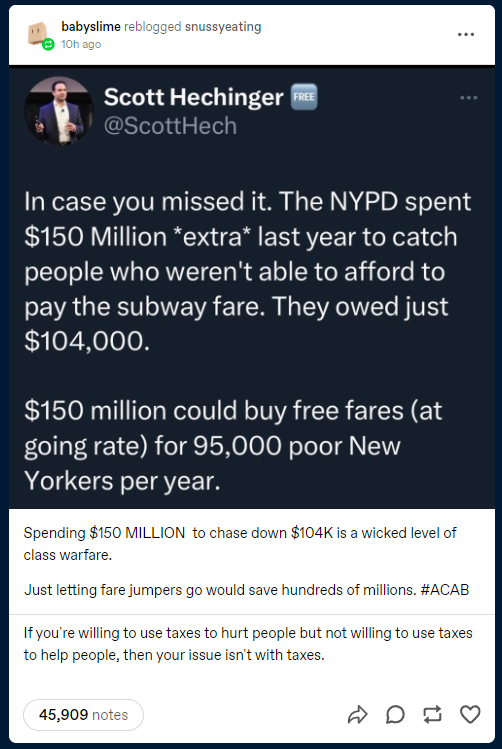
    They are spending 150million that is 1442x what they are losing, even if their enforcement is reducing the number of fare jumpers it would take basically everyone jumping the line to make up the difference.

    They'd save money just by eating the cost...

    I cannot see how this ever economically works out.

    Got some more numbers, this meme (surprise) isn't telling the whole story. I'm still not saying it works out, but it's not this simple.

    Okay so the MTA has a budget of 19billion, of which $6.870 billion comes from fares, in 2022 they lost $285million in subway fares, and the police caught 105,000 people in 2023.

    I cannot find where the $104k number is coming from, I assume that's the total amount owed by those they caught, but if they caught 105k people that's only a dollar a person so I don't know if it's that low or I'm misunderstanding the $104k number.

    Again not saying it works out, but I'm not smart enough to do that math...

  • source
  • parent
  • hideshow 1 child comment
  • [–] 15 points 2 years ago (7 children)

    Can anyone explain to me what the consequence is for fare jumping if they don’t do this?

    Number one reason is that it pisses people off as it is unfair

    Humans, like monkeys, are allergic to unfairness and more people will just jump because they also want free shit

    These policing efforts are just there to keep the number of free riders to the expected parameter and placate the paying users

    Capturing back lost fares is inconsequential

  • source
  • parent
  • hideshow 7 child comments
  • [–] 12 points 2 years ago (3 children)

    Public transit should be free.

  • source
  • parent
  • hideshow 3 child comments
  • [+] -13 points 2 years ago* (2 children)

    Humans, like monkeys, are allergic to unfairness

    Hahahahahaha this is so patently false it makes me question your concept of reality.

    Edit: Hahahahahahahahahahahahahahahahahahahahahahahahahahahahahahahahahahaha. Sorry I had to get that out.

  • source
  • parent
  • hideshow 2 child comments
  • [–] 2 points 2 years ago (1 child)

    Hahahahahahahahahahahahahahahahahahahahahahahahahahahahahahahahahahaha. Sorry I had to get that out.

    Cringe. You’re an anonymous person interacting on the internet, not the main character of a sitcom.

  • source
  • parent
  • hideshow 1 child comment
  • [–] 2 points 2 years ago

    Cut back on enforcement, not removal of it completely. They wasted 149,900k chasing 100k. That money was still spent, and it likely wasnt preventing that amount of lost revenue

  • source
  • parent
  • [–] -3 points 2 years ago (4 children)

    It should be free, most Metro systems turn a profit not a loss.

  • source
  • parent
  • hideshow 4 child comments
  • [–] 13 points 2 years ago (3 children)

    Not sure where you get that from. Most systems operate at a major loss and are propped up by grants/government funding. Typical targets for operating are ~1/3 of costs are covered by rider fares with the rest coming from grants or government funding.

    Since the thread talks about NYC, I pulled this - MTA Budget. In it they state:

    In a normal year, farebox revenue constitutes approximately 40 percent of the MTA’s annual budget, or $6.5 billion

  • source
  • parent
  • hideshow 3 child comments
  • [–] 1 point 2 years ago (1 child)

    Do those numbers include advertising revenue? My city including ad revenue makes a small profit and they're thinking of doing the free fair thing.

  • source
  • parent
  • hideshow 1 child comment
  • [–] 1 point 2 years ago

    Appendix A in the report does.

    All told, their total operating revenue was 9.9bil, operating expenses were 13.1bil without including depreciation and pensions,etc which brought it to 16.1bil. that doesn't include any improvements (capital) works or their debt servicing.

  • source
  • parent