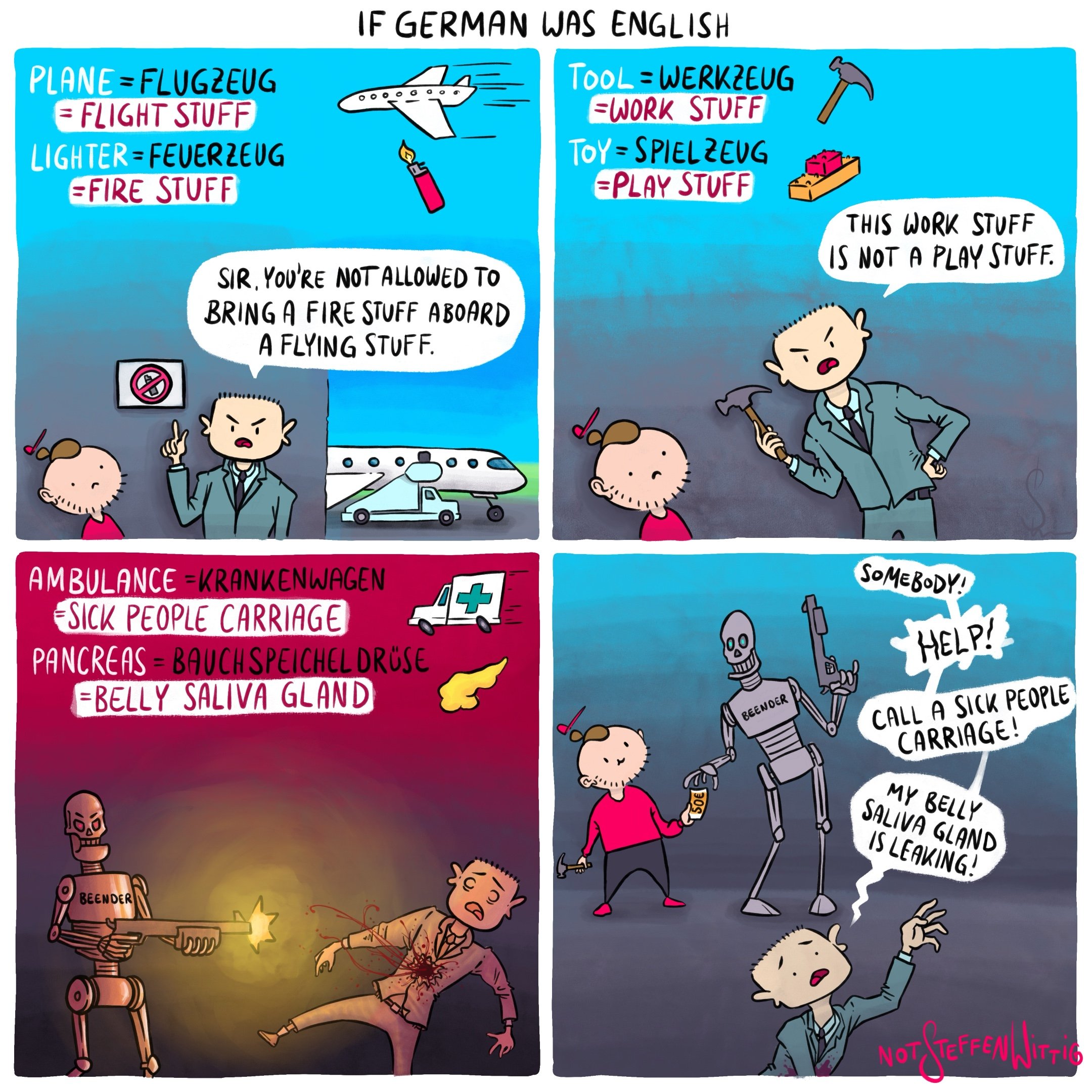
▲ 561 ▼ If German was English (lemmy.world) submitted 2 years ago by notst@lemmy.world to c/comicstrips@lemmy.world 90 comments fedilink hide all child comments
[–] atro_city@fedia.io 76 points 2 years ago (8 children) Isn't English the amalgamation of like 5 different languages and if everything were broken down like this, English would sound just as ridiculous? permalink fedilink source hideshow 16 child comments replies: [–] robolemmy@lemmy.world 55 points 2 years ago (3 children) I think every language probably sounds silly if transliterated into another language permalink fedilink source parent hideshow 6 child comments replies: [–] Karyoplasma@discuss.tchncs.de 54 points 2 years ago* It's not a transliteration, it's a direct translation. Transliteration is the conversion of one script into another and (Modern) English and German use the same script based on Latin. Transliteration would be дружба - druzhba. By the way, in many German online communities, it's a meme to take English expressions and directly translate them and is called Zangendeutsch. Just go to any of the ich_iel communities here and you can see it :) permalink fedilink source parent [–] chronotron@lemmy.world 3 points 2 years ago (1 child) a language would sound the same when transliterated to another language permalink fedilink source parent hideshow 2 child comments replies: [–] deo@lemmy.dbzer0.com 1 point 2 years ago Eh, not totally. Some languages have phonemes that are completely absent in other languages, and some phonemes (especially vowels, though sometimes consonants, eg: "r") are different enough that a transliteration can never do them justice. Although, I guess transliterating into the international phonetic alphabet would do the trick... permalink fedilink source parent [–] acockworkorange@mander.xyz 3 points 2 years ago You’ve clearly never heard of Torpenhow Hill, which translating all to English, means Hill Hill Hill Hill. permalink fedilink source parent [–] notst@lemmy.world [S] 29 points 2 years ago (2 children) I only did three months of research for this comic. Guess it still wasn't enough. Verdammte Bullenscheiße! permalink fedilink source parent hideshow 4 child comments replies: [–] LordKitsuna@lemmy.world 5 points 2 years ago Common rookie mistake everyone knows you need four months permalink fedilink source parent [–] atro_city@fedia.io 1 point 2 years ago Do 3 months of research on English. I'm sure the comic will be good too :) permalink fedilink source parent [–] Nougat@fedia.io 20 points 2 years ago (1 child) The Anglo-Saxons loved compound words. The vocabulary of Old English (and just before that) was very small, so putting words together was necessary for building more complex concepts. English, a Germanic tongue carried into Britain by the Angles, Saxons, Jutes, and Frisians, has been influenced by: Celtic languages A tiny bit of Pictish Old Norse Latin Greek Norman Old French (a dialect somewhat distinct from the rest of Frankia) Plenty of other things permalink fedilink source parent hideshow 2 child comments replies: [–] Karyoplasma@discuss.tchncs.de 22 points 2 years ago (1 child) My favorite English compound word is bookkeeper. 3 consecutive double letters. permalink fedilink source parent hideshow 2 child comments replies: [–] Hossenfeffer@feddit.uk 6 points 2 years ago (1 child) My favourite stop on the London Underground is Knightsbridge - 6 consecutive consonants. permalink fedilink source parent hideshow 2 child comments replies: [–] JackFrostNCola@lemmy.world 2 points 2 years ago I once saw on an italian restaurant menu the word Taramasalata. I am not sure why but it was very amusing to me that every second letter was 'a' permalink fedilink source parent [–] Mirodir@discuss.tchncs.de 14 points 2 years ago We can do that with the first sentence and flip it into German, replacing "lighter" with "fireworks". We get: "Sie dürfen die Feuerarbeiten nicht mit in die Luftebene nehmen." A lot of German speaking communities online do translate English loanwords into German words, often with the intention to create this funny effect. permalink fedilink source parent [–] stupidcasey@lemmy.world 8 points 2 years ago* Close, English is the unholy amalgamation of 666 incomplete languages, forged in the bowels of the great vowl shift but incomplete as an affront to God and the eighth deadly sin. permalink fedilink source parent [–] grue@lemmy.world 8 points 2 years ago* (1 child) Coincidentally, I just watched a video on that sort of thing the other day that was pretty neat: Anglish: English without the 'foreign' bits permalink fedilink source parent hideshow 2 child comments replies: [–] dharmacurious@slrpnk.net 4 points 2 years ago I've loved Anglish for a long time, but my favorite example is Uncleftish Beholding a scientific paper written in Anglish. "Stuff" turns out to be a pretty logical way to explain shit. permalink fedilink source parent [–] Deestan@lemmy.world 6 points 2 years ago (1 child) English is a hilarious mess. The word "receite" originated from Latin but came to England through France at which point it had mutated to modern pronunciation as "recu", so they shoved a few extra and silent letters in there and spelled it "receipt" to pretend they got it from Latin even though they kept pronouncing it more French. permalink fedilink source parent hideshow 2 child comments replies: [–] merc@sh.itjust.works 3 points 2 years ago (1 child) I'm confused. The modern word in french is "reçu", which is pronounced something like "ruhsue". The English word is "receipt" but pronounced something like "ruhseet". There's no "ooh" sound in the original Latin, so it's not just a matter of adding extra or silent letters in there, it's a complete change to the vowel sounds, plus the re-addition of a 't' sound. permalink fedilink source parent hideshow 2 child comments replies: [–] Deestan@lemmy.world 1 point 2 years ago (1 child) I oversimplified a bit! Sorry! Words always shift over time and borders. The words "recu" and "receive/receipt" are pretty close and used to be closer. To be more accurate it was "receite" when they adopted it from French. Compared to Latin "recepta" which has a hard P in it. So adding "P" from Latin to the spelling as "receipt" but leaving the pronunciation as Anglo-French "receite" was the most silly part. permalink fedilink source parent hideshow 2 child comments replies: [–] merc@sh.itjust.works 2 points 2 years ago Well, English is always silly with the various silent letters. The worst are the silent letters that nonetheless change the pronunciation of the non-silent letters nearby. Like, I saw a place today named "something-valu", with no "e" on the end. With no "e" it should really be pronounced "valoo". Adding the "e" somehow changes it to "valyoo". Rather than changing the vowel sound, it adds a consonant-like /j/ sound (IPA) to the start of that syllable. permalink fedilink source parent [–] KSPAtlas@sopuli.xyz 5 points 2 years ago (1 child) There is a form of English called Anglish which tries to remove all non-germanic words, I think some examples are wordbook for dictionary, becleft for atom, sourstuff for oxygen and birdlore for orinthology permalink fedilink source parent hideshow 2 child comments replies: [–] Arghblarg@lemmy.ca 1 point 2 years ago Ah, you beat me to it! https://anglish.org/wiki/Anglish permalink fedilink source parent
[–] robolemmy@lemmy.world 55 points 2 years ago (3 children) I think every language probably sounds silly if transliterated into another language permalink fedilink source parent hideshow 6 child comments replies: [–] Karyoplasma@discuss.tchncs.de 54 points 2 years ago* It's not a transliteration, it's a direct translation. Transliteration is the conversion of one script into another and (Modern) English and German use the same script based on Latin. Transliteration would be дружба - druzhba. By the way, in many German online communities, it's a meme to take English expressions and directly translate them and is called Zangendeutsch. Just go to any of the ich_iel communities here and you can see it :) permalink fedilink source parent [–] chronotron@lemmy.world 3 points 2 years ago (1 child) a language would sound the same when transliterated to another language permalink fedilink source parent hideshow 2 child comments replies: [–] deo@lemmy.dbzer0.com 1 point 2 years ago Eh, not totally. Some languages have phonemes that are completely absent in other languages, and some phonemes (especially vowels, though sometimes consonants, eg: "r") are different enough that a transliteration can never do them justice. Although, I guess transliterating into the international phonetic alphabet would do the trick... permalink fedilink source parent [–] acockworkorange@mander.xyz 3 points 2 years ago You’ve clearly never heard of Torpenhow Hill, which translating all to English, means Hill Hill Hill Hill. permalink fedilink source parent
[–] Karyoplasma@discuss.tchncs.de 54 points 2 years ago* It's not a transliteration, it's a direct translation. Transliteration is the conversion of one script into another and (Modern) English and German use the same script based on Latin. Transliteration would be дружба - druzhba. By the way, in many German online communities, it's a meme to take English expressions and directly translate them and is called Zangendeutsch. Just go to any of the ich_iel communities here and you can see it :) permalink fedilink source parent
[–] chronotron@lemmy.world 3 points 2 years ago (1 child) a language would sound the same when transliterated to another language permalink fedilink source parent hideshow 2 child comments replies: [–] deo@lemmy.dbzer0.com 1 point 2 years ago Eh, not totally. Some languages have phonemes that are completely absent in other languages, and some phonemes (especially vowels, though sometimes consonants, eg: "r") are different enough that a transliteration can never do them justice. Although, I guess transliterating into the international phonetic alphabet would do the trick... permalink fedilink source parent
[–] deo@lemmy.dbzer0.com 1 point 2 years ago Eh, not totally. Some languages have phonemes that are completely absent in other languages, and some phonemes (especially vowels, though sometimes consonants, eg: "r") are different enough that a transliteration can never do them justice. Although, I guess transliterating into the international phonetic alphabet would do the trick... permalink fedilink source parent
[–] acockworkorange@mander.xyz 3 points 2 years ago You’ve clearly never heard of Torpenhow Hill, which translating all to English, means Hill Hill Hill Hill. permalink fedilink source parent
[–] notst@lemmy.world [S] 29 points 2 years ago (2 children) I only did three months of research for this comic. Guess it still wasn't enough. Verdammte Bullenscheiße! permalink fedilink source parent hideshow 4 child comments replies: [–] LordKitsuna@lemmy.world 5 points 2 years ago Common rookie mistake everyone knows you need four months permalink fedilink source parent [–] atro_city@fedia.io 1 point 2 years ago Do 3 months of research on English. I'm sure the comic will be good too :) permalink fedilink source parent
[–] LordKitsuna@lemmy.world 5 points 2 years ago Common rookie mistake everyone knows you need four months permalink fedilink source parent
[–] atro_city@fedia.io 1 point 2 years ago Do 3 months of research on English. I'm sure the comic will be good too :) permalink fedilink source parent
[–] Nougat@fedia.io 20 points 2 years ago (1 child) The Anglo-Saxons loved compound words. The vocabulary of Old English (and just before that) was very small, so putting words together was necessary for building more complex concepts. English, a Germanic tongue carried into Britain by the Angles, Saxons, Jutes, and Frisians, has been influenced by: Celtic languages A tiny bit of Pictish Old Norse Latin Greek Norman Old French (a dialect somewhat distinct from the rest of Frankia) Plenty of other things permalink fedilink source parent hideshow 2 child comments replies: [–] Karyoplasma@discuss.tchncs.de 22 points 2 years ago (1 child) My favorite English compound word is bookkeeper. 3 consecutive double letters. permalink fedilink source parent hideshow 2 child comments replies: [–] Hossenfeffer@feddit.uk 6 points 2 years ago (1 child) My favourite stop on the London Underground is Knightsbridge - 6 consecutive consonants. permalink fedilink source parent hideshow 2 child comments replies: [–] JackFrostNCola@lemmy.world 2 points 2 years ago I once saw on an italian restaurant menu the word Taramasalata. I am not sure why but it was very amusing to me that every second letter was 'a' permalink fedilink source parent
[–] Karyoplasma@discuss.tchncs.de 22 points 2 years ago (1 child) My favorite English compound word is bookkeeper. 3 consecutive double letters. permalink fedilink source parent hideshow 2 child comments replies: [–] Hossenfeffer@feddit.uk 6 points 2 years ago (1 child) My favourite stop on the London Underground is Knightsbridge - 6 consecutive consonants. permalink fedilink source parent hideshow 2 child comments replies: [–] JackFrostNCola@lemmy.world 2 points 2 years ago I once saw on an italian restaurant menu the word Taramasalata. I am not sure why but it was very amusing to me that every second letter was 'a' permalink fedilink source parent
[–] Hossenfeffer@feddit.uk 6 points 2 years ago (1 child) My favourite stop on the London Underground is Knightsbridge - 6 consecutive consonants. permalink fedilink source parent hideshow 2 child comments replies: [–] JackFrostNCola@lemmy.world 2 points 2 years ago I once saw on an italian restaurant menu the word Taramasalata. I am not sure why but it was very amusing to me that every second letter was 'a' permalink fedilink source parent
[–] JackFrostNCola@lemmy.world 2 points 2 years ago I once saw on an italian restaurant menu the word Taramasalata. I am not sure why but it was very amusing to me that every second letter was 'a' permalink fedilink source parent
[–] Mirodir@discuss.tchncs.de 14 points 2 years ago We can do that with the first sentence and flip it into German, replacing "lighter" with "fireworks". We get: "Sie dürfen die Feuerarbeiten nicht mit in die Luftebene nehmen." A lot of German speaking communities online do translate English loanwords into German words, often with the intention to create this funny effect. permalink fedilink source parent
[–] stupidcasey@lemmy.world 8 points 2 years ago* Close, English is the unholy amalgamation of 666 incomplete languages, forged in the bowels of the great vowl shift but incomplete as an affront to God and the eighth deadly sin. permalink fedilink source parent
[–] grue@lemmy.world 8 points 2 years ago* (1 child) Coincidentally, I just watched a video on that sort of thing the other day that was pretty neat: Anglish: English without the 'foreign' bits permalink fedilink source parent hideshow 2 child comments replies: [–] dharmacurious@slrpnk.net 4 points 2 years ago I've loved Anglish for a long time, but my favorite example is Uncleftish Beholding a scientific paper written in Anglish. "Stuff" turns out to be a pretty logical way to explain shit. permalink fedilink source parent
[–] dharmacurious@slrpnk.net 4 points 2 years ago I've loved Anglish for a long time, but my favorite example is Uncleftish Beholding a scientific paper written in Anglish. "Stuff" turns out to be a pretty logical way to explain shit. permalink fedilink source parent
[–] Deestan@lemmy.world 6 points 2 years ago (1 child) English is a hilarious mess. The word "receite" originated from Latin but came to England through France at which point it had mutated to modern pronunciation as "recu", so they shoved a few extra and silent letters in there and spelled it "receipt" to pretend they got it from Latin even though they kept pronouncing it more French. permalink fedilink source parent hideshow 2 child comments replies: [–] merc@sh.itjust.works 3 points 2 years ago (1 child) I'm confused. The modern word in french is "reçu", which is pronounced something like "ruhsue". The English word is "receipt" but pronounced something like "ruhseet". There's no "ooh" sound in the original Latin, so it's not just a matter of adding extra or silent letters in there, it's a complete change to the vowel sounds, plus the re-addition of a 't' sound. permalink fedilink source parent hideshow 2 child comments replies: [–] Deestan@lemmy.world 1 point 2 years ago (1 child) I oversimplified a bit! Sorry! Words always shift over time and borders. The words "recu" and "receive/receipt" are pretty close and used to be closer. To be more accurate it was "receite" when they adopted it from French. Compared to Latin "recepta" which has a hard P in it. So adding "P" from Latin to the spelling as "receipt" but leaving the pronunciation as Anglo-French "receite" was the most silly part. permalink fedilink source parent hideshow 2 child comments replies: [–] merc@sh.itjust.works 2 points 2 years ago Well, English is always silly with the various silent letters. The worst are the silent letters that nonetheless change the pronunciation of the non-silent letters nearby. Like, I saw a place today named "something-valu", with no "e" on the end. With no "e" it should really be pronounced "valoo". Adding the "e" somehow changes it to "valyoo". Rather than changing the vowel sound, it adds a consonant-like /j/ sound (IPA) to the start of that syllable. permalink fedilink source parent
[–] merc@sh.itjust.works 3 points 2 years ago (1 child) I'm confused. The modern word in french is "reçu", which is pronounced something like "ruhsue". The English word is "receipt" but pronounced something like "ruhseet". There's no "ooh" sound in the original Latin, so it's not just a matter of adding extra or silent letters in there, it's a complete change to the vowel sounds, plus the re-addition of a 't' sound. permalink fedilink source parent hideshow 2 child comments replies: [–] Deestan@lemmy.world 1 point 2 years ago (1 child) I oversimplified a bit! Sorry! Words always shift over time and borders. The words "recu" and "receive/receipt" are pretty close and used to be closer. To be more accurate it was "receite" when they adopted it from French. Compared to Latin "recepta" which has a hard P in it. So adding "P" from Latin to the spelling as "receipt" but leaving the pronunciation as Anglo-French "receite" was the most silly part. permalink fedilink source parent hideshow 2 child comments replies: [–] merc@sh.itjust.works 2 points 2 years ago Well, English is always silly with the various silent letters. The worst are the silent letters that nonetheless change the pronunciation of the non-silent letters nearby. Like, I saw a place today named "something-valu", with no "e" on the end. With no "e" it should really be pronounced "valoo". Adding the "e" somehow changes it to "valyoo". Rather than changing the vowel sound, it adds a consonant-like /j/ sound (IPA) to the start of that syllable. permalink fedilink source parent
[–] Deestan@lemmy.world 1 point 2 years ago (1 child) I oversimplified a bit! Sorry! Words always shift over time and borders. The words "recu" and "receive/receipt" are pretty close and used to be closer. To be more accurate it was "receite" when they adopted it from French. Compared to Latin "recepta" which has a hard P in it. So adding "P" from Latin to the spelling as "receipt" but leaving the pronunciation as Anglo-French "receite" was the most silly part. permalink fedilink source parent hideshow 2 child comments replies: [–] merc@sh.itjust.works 2 points 2 years ago Well, English is always silly with the various silent letters. The worst are the silent letters that nonetheless change the pronunciation of the non-silent letters nearby. Like, I saw a place today named "something-valu", with no "e" on the end. With no "e" it should really be pronounced "valoo". Adding the "e" somehow changes it to "valyoo". Rather than changing the vowel sound, it adds a consonant-like /j/ sound (IPA) to the start of that syllable. permalink fedilink source parent
[–] merc@sh.itjust.works 2 points 2 years ago Well, English is always silly with the various silent letters. The worst are the silent letters that nonetheless change the pronunciation of the non-silent letters nearby. Like, I saw a place today named "something-valu", with no "e" on the end. With no "e" it should really be pronounced "valoo". Adding the "e" somehow changes it to "valyoo". Rather than changing the vowel sound, it adds a consonant-like /j/ sound (IPA) to the start of that syllable. permalink fedilink source parent
[–] KSPAtlas@sopuli.xyz 5 points 2 years ago (1 child) There is a form of English called Anglish which tries to remove all non-germanic words, I think some examples are wordbook for dictionary, becleft for atom, sourstuff for oxygen and birdlore for orinthology permalink fedilink source parent hideshow 2 child comments replies: [–] Arghblarg@lemmy.ca 1 point 2 years ago Ah, you beat me to it! https://anglish.org/wiki/Anglish permalink fedilink source parent
[–] Arghblarg@lemmy.ca 1 point 2 years ago Ah, you beat me to it! https://anglish.org/wiki/Anglish permalink fedilink source parent