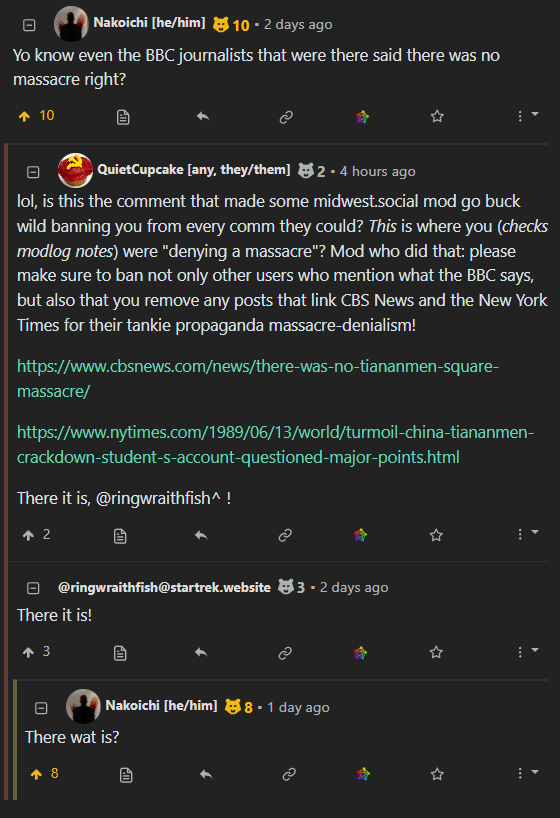
But there's no question many people were killed by the army that night around Tiananmen Square, and on the way to it — mostly in the western part of Beijing. Maybe, for some, comfort can be taken in the fact that the government denies that, too. CBS News
There was no Tiananmen Square massacre, but there was a Beijing massacre.
The shorthand we often use of the "Tiananmen Square protests" of 1989 gives the impression that this was just a Beijing issue. It was not. Protests occurred in almost every city in China (even in a town on the edge of the Gobi desert).
What happened in 1989 was by far the most widespread pro-democracy upheaval in communist China's history. It was also by far the bloodiest suppression of peaceful dissent. BBC News
This reporter and many other witnesses saw troops shoot and kill people before dawn on June 4. But these shootings occurred in a different place from that described in the Wen Wei Po article and in somewhat different circumstances. [...] Troops fired on civilians in many parts of the city, but the shooting was concentrated along the Avenue of Eternal Peace, or Changan Avenue, which runs on the north side of the square. There was heavy shooting in the Muxidi district to the west of Tiananmen Square, and there were also many casualties along the Avenue of Eternal Peace to the immediate east of the square, as well as on streets to the south of the square. NY Times
As to body count: I saw several people, young men, lying on flatbed tricycles being carried away from the square. They were inert and covered in blood. Dead or wounded, I have no idea. On the afternoon of June 4, I saw people fall on Changan Avenue as troops opened fire on them. I have no idea if they were wounded, killed or simply fainting.
How many people died that night in Beijing? What was the price of the years of superficial political stability that followed?
Most of the killing did not take place on or near the Square, that is clear. The official line, first espoused by Communist Party propaganda guru Yuan Mu a couple of nights later on national television, was that 23 people had died on the night of June 3/4. It was ludicrous. Nobody who was in Beijing at that time believed it.
In the weeks that followed, Amnesty International did the most thorough survey of the Tiananmen casualty toll. They spoke to everyone who could help build the picture. They questioned me at length in Tokyo, whwre In was already staying in a hotel prior to a move to Hong Kong to become Asian News Editor (a career boost from Tiananmen, perhaps?). Their report estimated 3,000 dead, with most of the killing taking place in the Muxidi district of western Beijing, where outraged Beijing residents — not students — tried to stop the army from entering their city. That number seems a bit high to me, but who knows? If I had to make a wild stab, from what I know and felt, I’d say several hundred were killed, but I have no proof of any number. Until the archives are opened in China’s next era and we can see the truth, surely recorded there somewhere, Amnesty’s 3,000 is the best outside estimate we have. REUTERS: Graham Earnshaw
ALTHOUGH HE DID NOT ACTUALLY WITNESS
ANY LARGE SCALE SHOOTINGS ON THE SQUARE PROPER, GALLO
SAW MANY CASUALTIES BROUGHT INTO THE SQUARE AND DID
NOT DOUBT THAT HUNDREDS OF PEOPLE IN BEIJING WERE
KILLED BY THE ARMY ON JUNE 3 AND 4. A Wikileaks cable
I'm a little confused about what the main contention is here. Most of the links you shared still say that people died and there was a massacre, even though the quotes you pulled out all seem to indicate that no one died at all.
The problem is not so much putting the murders in the wrong place, but suggesting that most of the victims were students. Black and Munro say “what took place was the slaughter not of students but of ordinary workers and residents — precisely the target that the Chinese government had intended.” They argue that the government was out to suppress a rebellion of workers, who were much more numerous and had much more to be angry about than the students. This was the larger story that most of us overlooked or underplayed.
[...]
Not only has the error made the American press’s frequent pleas for the truth about Tiananmen seem shallow, but it has allowed the bloody-minded regime responsible for the June 4 murders to divert attention from what happened. There was a massacre that morning. Journalists have to be precise about where it happened and who were its victims, or readers and viewers will never be able to understand what it meant. The Myth of Tiananmen from Emizeko
Are you trying to suggest that China was correct to do whatever it did June 3rd and 4th? Or are you upset that the violence all around the area is being lumped into one big Tiananmen Square Massacre, even though no one probably died inside the actual square?