
The following statement issued by Iran’s Supreme National Security Council in response to the MAGA president’s two-week “ceasefire” was published by Press TV on April 7. “Good news to the dear nation of Iran! Nearly all the objectives of the war have been achieved. * “The noble people of Iran . . .
From Workers World via This RSS Feed.
In the first hours of the U.S.-Israeli war against Iran, up to 175 young children and school staff were blown to pieces at an elementary school. Others were maimed and burned, and will be suffering from their injuries for the rest of their lives. Even any comparatively fortunate ones with minimal injuries will surely experience permanent trauma from having witnessed something so horrific. Witnesses describe scenes of unfathomable horror, with limbs and blood strewn across classrooms. "People were pulling out children's arms and legs. People were pulling out severed heads," said a woman whose child was killed. The Guardian cites verified videos that show "children's bodies lying partly buried under the debris":
In one video, a very small child's severed arm is pulled from the rubble. Colourful backpacks covered with blood and concrete dust sit among the ruins. One girl wears a green dress with gingham patches on her pockets and the collar, her form partly obscured by a black body bag. Screams can be heard in the background.
Drop Site News spoke to the father of a six-year-old girl, Sara Shariatmadar, who was killed in the attack. "I cannot understand how a place where innocent children learn can be bombed like this," he said. "We are talking about small children who knew nothing of politics or wars. And yet they are the ones paying the highest price."
The United States and Israel have not denied responsibility for the attack, although it is still unclear which country fired the missile. The U.S. said that it does not "target" schools, which does not mean that it does not bomb them. ("We take these reports seriously," a spokesman said.) Israel's spokesperson said the government was not "aware" of such an attack, which does not mean its military did not carry one out. Photos supposedly showing that a misfired Iranian missile caused it were debunked, although they spread widely online among Americans and Israelis desperate to believe that only the Bad Guys do things like this.
Domestic coverage of this horrible crime against humanity has been muted. U.S. media has a policy of not showing gruesome images of violence---the Guardian explicitly stated that it was concealing the photos and videos it had "due to their graphic nature." As a result, war is always sanitized, so that Americans can read that 150+ schoolgirls were killed without having to confront the full horror of what it means for their country to drive a missile into a crowded school in the middle of the day. (Saturday is a school day in Iran, a fact that the U.S. government would easily have been able to know when deciding how to time its attacks, but Secretary of War Pete Hegseth has been open about the fact that he regards such niceties as rules of engagement and international law as meddlesome hindrances that can be ignored, lambasting those who "wring their hands and clutch their pearls, hemming and hawing about the use of force.")
I suspect that this attack is also difficult for U.S. media to cover because the basic facts of the situation are so twisted, so depraved, so evil, that they shatter the comforting narrative that the U.S. has the moral high ground over the Ayatollah. In fact, the U.S. government is on the moral level of the Sandy Hook school shooter, a fact that even president Trump's critics may have a hard time fully accepting.
And this was not the only massacre carried out by the U.S. and Israel in a war that has been going on just a few days. The Human Rights Activists News Agency reports that there have already been over 1,000 civilian deaths in Iran, including 181 children under the age of ten, with thousands more civilians injured. Drop Site reports on the nauseating scene in a middle-class Tehran neighborhood following a "double tap" strike (dropping one bomb first, and then dropping another on the survivors and emergency responders, a favorite war crime of the U.S. and Israel). Warning, the following description is extremely graphic and may undermine any love you may have for your country:
Videos of the immediate aftermath of the attack showed several individuals dead and wounded as well as massive destruction on the street outside. In Cafe Ahla, next to the square, blood and debris soaked the floors. Several patrons who had been sitting there when the attack struck could be seen dead on the floor or with their mutilated bodies still sprawled across their seats. "We were sitting here around 8:00-8:30 p.m. and suddenly there was the noise and explosion. We got up and a few people ran away. We turned around to get our belongings and we saw that blood was spraying everywhere. Someone's hand had fallen on the floor, a head had fallen on the floor," said Shahin, a witness who had been at the cafe and asked to be identified by first name only. "There were scalps torn off, hands severed, a few people were laying here all cut up and two people were martyred."
I will get to the many ways in which the Iran war is illegal, making us less safe, founded on lies, strategically insane, unbelievably costly, etc. But let us dwell for a moment on what we are doing to these people. The right-wing Telegraph newspaper reports that in Tehran, "millions of civilians are trapped under relentless bombardment as food and medical supplies dwindle and the death toll mounts," and the city is an "'apocalypse' of hospitals in flames and children buried beneath rubble." The paper records a total humanitarian disaster, with sick people lacking medicine, children going hungry, diabetics running out of insulin, and the repeated bombing of residential areas. While Americans pat themselves on the back for assassinating Iran's repressive head of state, everyday Iranians (even those with little love for their theocratic government) are facing the prospect of being killed at any moment, or watching their children be ripped to pieces. I realize that in the U.S., the devaluation of Middle Eastern lives means that little Iranian girls will receive a fraction of the compassion and concern that has arisen around, say, Nancy Guthrie. But if we apply our morality consistently, I cannot see how we can be anything other than completely revolted by the carnage our president is choosing to inflict (and will apparently soon be further escalating, according to Marco Rubio, who is promising an increased use of force to come, and Pete Hegseth, who is salivating about delivering "death and destruction all day long").
We are all complicit. If you are an American, you paid your government to murder those little girls and those Tehran cafe-goers. Money was withdrawn from your paycheck in the form of federal income taxes. If the attack was conducted with a Tomahawk missile (of which 400 were fired in 72 hours), that money would have been paid to the RTX Corporation (formerly Raytheon). Each missile fired costs somewhere between $1.3 million and $2.2 million, of which approximately $200,000 would be pure profit. Thus the killing of the Iranian schoolgirls, which left their bloody backpacks and tiny severed limbs scattered across classroom floors, transferred hundreds of thousands of dollars from us (the American taxpayers) into RTX's bank accounts. It also boosted the GDP. And the stock market.

Stock price of RTX (formerly Raytheon)
It is hard for me to write about this war, because I am so sickened every time I contemplate the full dark reality of the country I live in. I realize that not only are there people who will drop a bomb on a school without losing a wink of sleep, but there are people who get rich when we bomb schools, who have a direct financial stake in ensuring we keep dropping as many bombs as possible. (And that's just the weapons companies. Others are getting rich from betting on the atrocities on prediction markets.) The fact that many Congressional Democrats implicitly or explicitly supported this war (whether by outright goading Trump into it, as Chuck Schumer did, dragging their feet on opposing it, or raising meek procedural objections) further adds to my disgust. Many Democrats apparently declined to try to stop the war, reasoning that if it achieved U.S. foreign policy goals it would be embarrassing to have opposed it, but if it went south Trump would own it anyway. When I open the New York Times op-ed page, and I find resident foreign policy guru Thomas Friedman cautioning against adopting any "black and white narrative" about what goes on in "a complicated, kaleidoscopic region," I want to vomit. The moment calls for moral clarity: our country is engaged in a mass murder campaign. It must be stopped. It is depressing to see so many debates around strategic end-goals, congressional authorization, or the consistency of the justifications. They take us away from the basic fact that our president, with the blessing of his party and many members of the so-called opposition, is gruesomely murdering children by the dozen. Every day this continues, we are paying our government to commit some of the worst crimes humans are capable of.
Of course, the war is also based on a pack of lies. The Trump administration can't even get its story straight on why the war is being waged and has produced no justification beyond vague invocations of National Security. (Trump says Iran was a "bad seed.") Some Republicans won't even admit that this is a war. (Perhaps they might want to borrow a phrase from Vladimir Putin: "special military operation.") House Speaker Mike Johnson is trying to have it both ways, saying that while the Iranians "have declared war on us," we're "not at war right now." Others are tying themselves in pretzels trying to explain how this differs from the "regime change" wars that Trump has so vocally opposed. (Pete Hegseth: "This is not a so-called 'regime change war.' But the regime sure did change.") Sometimes there are direct self-contradictions within a single sentence, as with Tom Cotton declaring that "Iran has been an imminent threat to the United States for 47 years." This was too much for right-wing commentator Matt Walsh, who accused Republicans of "gaslighting" for suddenly discovering that Iran has been waging a half-century of war against the U.S. Even leading Iraq war hawk Bill Kristol is confused about the reasoning behind the war, saying there is "no coherent rationale." (Of course, Kristol's own favorite Middle East war was equally illegitimate, but that's an argument for another day.)
Secretary of State Marco Rubio said the U.S. attacked because it knew Israel was going to attack, and needed to defend itself against the inevitable Iranian retaliation for Israel's attack---perhaps the most tortured and unpersuasive case for self-defense ever made. Perhaps because this seemed like an admission that Israeli choices dictate U.S. policy, Trump subsequently denied that Israeli decision-making had anything to do with the attack, although it's clear that Benjamin Netanyahu lobbied heavily for this, as he has been salivating at the prospect of a major war with Iran for decades, and has been scheming for a way to get the U.S. involved.

The idea that Iran was a threat to the United States was always laughable. U.S. intelligence has consistently assessed that Iran is not building a nuclear weapon. The Trump administration itself declared that it had destroyed Iran's nuclear program with last year's bombings. Iran has in fact consistently shown itself very reluctant to engage in military confrontation with the U.S., often carefully limiting its retaliation after U.S. provocations. To the extent that Iran did want to become a nuclear threshold state, with at least the capacity to pursue a weapons program if it wanted to, credible analysts believe that Iran mainly wanted an insurance policy against potential U.S. and Israeli attacks. North Korea has shown that the possession of nuclear weapons is enough to make the U.S. think twice about forcible regime change, and there is a good argument that it would have been rational for Iran to pursue nuclear weapons for the sake of its own self-protection. As Israeli military historian Martin Van Creveld observed, the world "witnessed how the United States attacked Iraq for, as it turned out, no reason at all. Had the Iranians not tried to build nuclear weapons, they would be crazy." (Van Creveld is wrong that Iraq was attacked for "no reason," however. It was attacked for the same reason Iran is being attacked: the establishment of U.S.-Israeli dominance over the Middle East.) While U.S. commentators often talk as if Iran would pursue nuclear weapons mainly in order to destroy the U.S. or Israel (which would, of course, be suicidal given both countries' superior nuclear forces), there's no evidence that Iran would want nuclear weapons for any reason beyond deterring potential external attacks. (A fear that recent events have proven to be well-founded.)
In fact, the entire prevailing narrative about Iran is completely backwards. It's the U.S. that has been a threat to Iran, not the other way around. It was the United States and Britain that overthrew Iran's legitimately elected leader, Mohammad Mosaddegh, in 1953. (The New York Times was elated by the coup, commenting that "underdeveloped countries with rich resources now have an object lesson in the heavy cost that must be paid by one of their number which goes berserk with fanatical nationalism.") Since 1979, when the Iranians ousted the dictator (the Shah) that the U.S. had helped install and maintain in power, the U.S. has had a virtually unremittingly hostile attitude toward Iran. This is not because of the government's (very real) human rights abuses, since the U.S. is happy to support human rights abusing states that are pliant and servile (see, e.g., Saudi Arabia and Egypt). But Iran is viewed as a threat to U.S. dominance in the Middle East. Thus, in the 1980s, the U.S. supported Saddam Hussein as he waged a ruthless war of aggression against Iran, killing hundreds of thousands of Iranians including with chemical weapons. (The U.S. concealed evidence of Hussein's chemical weapon use from the UN, because it wanted him to go on killing Iranians.) More recently, the U.S. and Israel have tried to destabilize the country through devastating cyberattacks, economy-wrecking sanctions, and assassinations. The sanctions have been explicitly aimed at harming civilians, with Mike Pompeo boasting in 2019 that "things are much worse for the Iranian people" thanks to sanctions and hoping that their suffering would lead them to overthrow their government.
Importantly, while U.S. policymakers in both the Republican and Democratic parties constantly affirm that "Iran must not be allowed to have nuclear weapons," they rarely state their implicit corollary to this proposition, which is that Israel must be allowed to have nuclear weapons. As it happens, Iran actually agrees that it shouldn't be allowed to have nukes, and has long supported turning the entire Middle East into an official nuclear weapons free zone, much as Africa and Latin America have done. The problem is that the U.S. and Israel demand a double standard, with Israel refusing to contemplate giving up its nuclear weapons. The entire nuclear disagreement, then, is not about whether Iran should have nuclear weapons, but about whether Iran should hold itself to a different standard to Israel. (Amusingly, Chuck Schumer recently accidentally declared that "no one wants a nuclear Israel," and had to correct himself, because he does want a nuclear Israel.)
Anyone who values human life should treat war as an absolute last resort, to be engaged in only once every diplomatic option has been exhausted. In this case, it was the Trump administration that sabotaged diplomacy. First, even though asking Iran not to pursue nuclear weapons means imposing an unfair double standard that imperils Iran's national security, Iran had agreed under the 2015 Joint Comprehensive Plan of Action to severely constrain its development of nuclear technology, and agreed to a detailed monitoring and compliance regime. It was confirmed to be adhering to that agreement until Donald Trump ripped it up in 2018, subsequently criticizing Iran for failing to adhere to the agreement that he himself had destroyed. Joe Biden declined to pursue the revival of that agreement, even though Iran signaled that it was open to it. But to this day, Iran has shown that it is willing to consider even highly unfavorable agreements in order to avoid war---it has never shown any sign of launching an unprovoked strike, only deploying military action in response to violence by others, such as an Israeli attack on its embassy or the assassination of its allies' leaders.
Iran has long wanted to keep a war with the U.S. from breaking out, which is why its responses to U.S. and Israeli attacks have previously been notably measured and cautious. (This time around, Iran reasons that unless it inflicts major damage, it will be perceived as weak and attacked further, since previous restraint only encouraged the U.S. and Israel to press their advantage.) Diplomatic talks between the U.S. and Iran were ongoing, and Oman, mediating talks, saw "the most promising diplomatic opening in years" and thought "diplomacy was producing tangible results and that a negotiated settlement was imminent." The U.S. and Israel decided to sabotage diplomacy and assassinate the Iranian head of state, possibly because they felt they just couldn't forgo the opportunity to kill as many high-ranking Iranians as possible in one fell swoop. (They killed so many Iranian government officials that Donald Trump admitted the U.S. had killed all of the people who had been considered likely candidates to take Khamenei's place.) Iran professed itself baffled as to why the U.S. attacked. "I do not know why the U.S. administration insists on beginning a negotiation with Iran and then attacking Iran in the middle of talks," said the country's foreign minister. He told NBC: "We were able to address serious questions related to Iran's nuclear program. We obviously have differences, but we resolved some of those differences, and we decided to continue in order to resolve the rest of [the] questions."

Because mass civilian casualties are a predictable consequence of intense airstrikes, to choose to unnecessarily end diplomatic engagement and start bombing is unconscionable depravity. But it's clear that the Trump administration didn't really care whether Iran was genuinely willing to engage in diplomacy, because Trump's position is that Iran should simply do what we say, period. There is nothing to negotiate, because for Trump, the only choice is whether a country is willing to comply with U.S. demands, or whether we will have to use force to ensure their compliance.
I haven't even gotten to the illegality of the war. Leaving aside the ridiculous Republican denials that this is a war (if a country assassinated our head of state and bombed our cities, would anyone doubt that they were waging war?), it's plain that all of this is unconstitutional. The Constitution vests the power to declare war in Congress, not the president. Congress didn't declare war, therefore the war is illegal. Case closed. I know presidents have stretched their powers as far as possible (Obama's drone strikes, etc.) but if a president has the power to wage a relentless bombing and assassination campaign without Congressional approval, the Constitution simply ceases to mean anything. Congress has plainly failed in its responsibility to ensure that Trump complies with the Constitution, but the failure of our politicians to enforce the law doesn't change what it says.
Of course, it virtually goes without saying that the war violates international law. The UN Charter prohibits the use of force (or even the threat of force) except in response to an armed attack. Iran had not attacked the U.S., nor was there any evidence Iran was going to attack the U.S. Propagandists assert that Iran (and its "proxies") have killed "hundreds" of Americans over the years, but they decline to specify who these Americans are or discuss the Iranians killed by the U.S. and our own "proxies." There's no real point discussing international law, because Trump has made it clear he simply doesn't care about it, saying he doesn't need it and is unconstrained by it. Unfortunately, other countries have been just as pathetically weak as members of the U.S. Congress, with countries like Britain and France issuing statements that were de facto supportive of the assassination of a foreign head of state. (Canada issued a supportive statement and then appeared to regret it after noticing that letting the U.S. and Israel tear up the last vestiges of international law might be unwise.) Germany's chancellor has even made the stunning statement that Iran shouldn't be protected by international law, waving away the obvious illegality of the attacks by saying that "now is not the time to lecture our partners and allies." The killing of a head of state is a major crime, the normalization of which would open a horrible Pandora's box of lawless state action, and the world should be unified in condemning U.S.-Israeli lawlessness, but even among the Arab states there is a reluctance to antagonize the U.S.
None of the long-term consequences of this war will be good. The Trump administration does not appear to have any kind of strategic plan for what will happen next in Iran. (Lindsey Graham says it's "not [Trump's] job" to have a plan for what happens to the country's government next.) We could see the country's collapse into civil war, Libya-style. (Obama adviser Ben Rhodes recently admitted that Obama's decision to topple Libya's dictator without a plan for the country was a major error.) We could simply see the hard-line theocrats be replaced by more hard-line theocrats who are more convinced than ever that there can be no negotiating with the U.S., that the only language this country understands is force, and that the best thing for Iran's safety would be for it to obtain a nuclear weapon as quickly as possible. What we are unlikely to see is a pro-American government emerging, and this war puts Americans everywhere in considerable danger. (Ask yourself: if what happened to Sara Shariatmadar happened to someone you love, would you see the country that carried out the bombing as a liberator? Or would you want revenge?) Although plenty of Iranians are justly celebrating the end of the Ayatollah's rule, like the Iraqis who celebrated in 2003, they will soon find out that the U.S. has no interest in their well-being, and will happily watch their country slide into civil war if this serves America's perceived "national security" interest.
Six Americans have already died in addition to the 1,000 Iranians. Because this is a war of choice, totally unnecessary and unjustifiable, their blood is on Donald Trump's hands, and he (as well as Congress) should be treated no differently than we would treat someone who murdered these Americans with their bare hands. But the costs to this country are only just beginning. Of course, if you're an RTX shareholder this may be a bonanza, but the rest of us are likely to see major economic disruption, in addition to all the resources that are put into the production of weapons. Eisenhower famously tried to warn Americans that war spending is an act of "theft" from the public, because it's money not spent on schools and hospitals, and the "opportunity cost" is therefore enormous. But Eisenhower's warning has largely been ignored.
Worse, as Abby Martin notes in the terrifying and important new film Earth's Greatest Enemy, military action has catastrophic climate consequences, since the U.S. war machine is the world's biggest polluter and the carbon emissions of our vast, brutal empire are driving us toward ever-worsening climate catastrophe. Unfortunately, that's just fine with some in the administration and the military---terrifying recent reporting suggests that some evangelical Christian officers are celebrating the war as hastening the apocalypse, claiming Trump was "anointed by Jesus to light the signal fire in Iran to cause Armageddon and mark his return to Earth." These people would sacrifice the rest of us to the inferno to fulfill their delusional prophecies.
Of course, the war reveals that Trump and his coterie were complete frauds when they pledged to keep the U.S. out of senseless Middle East wars. Trump fooled a lot of people with this stuff, although hopefully their illusions will now be hard to maintain. (Former hardcore MAGA types like Alex Jones and Nick Fuentes are now admitting they were duped.) If there is one silver lining here, amid all of the horror, it is that because this war is deeply unpopular and Trump has no idea how to deal with its consequences, perhaps we will finally see the MAGA movement collapse politically. Trump's approval rating was already in the toilet, and while I sadly have no illusions that public opinion will be especially moved by the bombing of a school, when the fallout in cost, lives, and global chaos begins to come home, perhaps Americans will turn once and for good against their warmongering president.
But it is hard for me to think hopefully right now, as I see pictures of the remnants of former schoolchildren, schoolchildren whose lives were brutally extinguished with the help of my tax dollars. All I can feel is horror and rage at the sociopaths willing to do such things, who claim to want peace while ensuring that humanity will be consigned to a future of endless, senseless conflict.
PHOTO: Graves being dug for the elementary school girls killed in the bombing of the Minab school. Iran Foreign Ministry.
From blog via This RSS Feed.
By Talk World Radio, April 28, 2026
AUDIO:
Talk World Radio is recorded on Zoom.
Here is this week’s video and all the videos on Youtube.
VIDEO:
This week on Talk World Radio, we have the great privilege of speaking with John Sayles. John Sayles is an independent filmmaker, screenwriter, actor, and novelist. He has twice been nominated for the Academy Award for Best Original Screenplay, and once for the National Book Award. He has written eight novels, including, most recently, Jamie MacGillivray and To Save the Man, and his latest which we will be discussing: Crucible.

Total run time: 29:00
Host: David Swanson.
Producer: David Swanson.
Music: Brush Strokes by texasradiofish (c) copyright 2022 Licensed under a Creative Commons Attribution Noncommercial (3.0) license. Ft: billraydrums
Download from LetsTryDemocracy.
Download from Internet Archive.
Pacifica stations can also download from Audioport.
Syndicated by Pacifica Network.
Please encourage your local radio stations to carry this program every week!
Please embed the SoundCloud audio on your own website!
Past Talk World Radio shows are all available free and complete at
http://talkworldradio.org/ or at https://davidswanson.org/tag/talk-world-radio
and at
https://soundcloud.com/davidcnswanson/tracks
The Peace Almanac has a two-minute item for each day of the year available free to all at http://peacealmanac.org/
Please encourage your local radio stations to air the Peace Almanac.
PHOTO:

The post Talk World Radio: John Sayles on Crucible appeared first on World BEYOND War.
From World BEYOND War via This RSS Feed.

‘It was the worst possible way to end the winter that was already worse than normal.’
From MR Online via This RSS Feed.

In the last few days I’ve seen three separate instances of generative AI being used to promote propaganda for US-Israeli war agendas which are worth paying attention to.
Firstly, an Israel-based company called Generative AI for Good has been creating deepfakes of supposedly real women who say they were sexually assaulted by government forces in Iran.
The Canary reports:
“An Israel-based AI firm, Generative AI for Good, claims to be using deepfake technologies for positive ends. ‘Positive’ appears to mean creating deepfake videos to help the illegal US-Israel war on Iran.
…
“Generative AI for Good claims that it uses AI to ‘help survivors testify safely — in their real voice, without revealing their identity’. But Israel and its mouthpieces have been shown to have used false allegations of rapes and other atrocities on 7 October 2023 to justify its genocide in Gaza.”
The Canary notes that Generative AI for Good is staffed with Israelis who have very conspicuous agendas, including a creative director who pushes the discredited narrative about mass rapes on October 7, a marketing manager who served in the IDF’s “Psychotechnical Headquarter”, and a founder who said in early 2024 that “Artificial intelligence is a secret weapon of ours” in using the revolutionary technology to bolster the military’s efforts both online and on the ground in the information war being waged alongside the military battlefields in Gaza.
An Israeli company generating AI videos of anonymous Iranian women describing sexual abuse at the hands of their government should obviously be considered a deceitful propaganda operation until proven otherwise. The line between using AI to help real victims protect their identities when describing real events and using AI to generate fake atrocity propaganda is far too nebulous to be taken seriously, especially in the hands of wildly biased Israelis. You should trust it about as far as you’d trust a hungry crocodile.
Secondly, users of the graphic design platform Canva have been complaining that the company’s AI service has been translating the word “Palestine” to “Ukraine” without prompting or permission. Complaints went viral, compelling Canva to address the issue.
The Verge reports:
“One of Canva’s new AI features has been caught replacing the word ‘Palestine’ in designs. The Magic Layers feature — which is designed to break flat images out into separate editable components — isn’t supposed to make visible alterations to user designs, but it was found by X user @ros_ie9 to automatically switch the phrase ‘cats for Palestine’ to ‘cats for Ukraine.’
“The issue was seemingly limited specifically to the word ‘Palestine,’ as @ros_ie9 noted that related words like ‘Gaza’ were unaffected by the feature. Canva says it has now resolved the issue and is taking steps to prevent it from happening again.”
Thirdly, a Spanish-language tweet about Israel from user @maps_black was auto-translated into English by Elon Musk’s AI Grok in a way that added entirely new sentences to the social media post to frame the Zionist state in a sympathetic light.
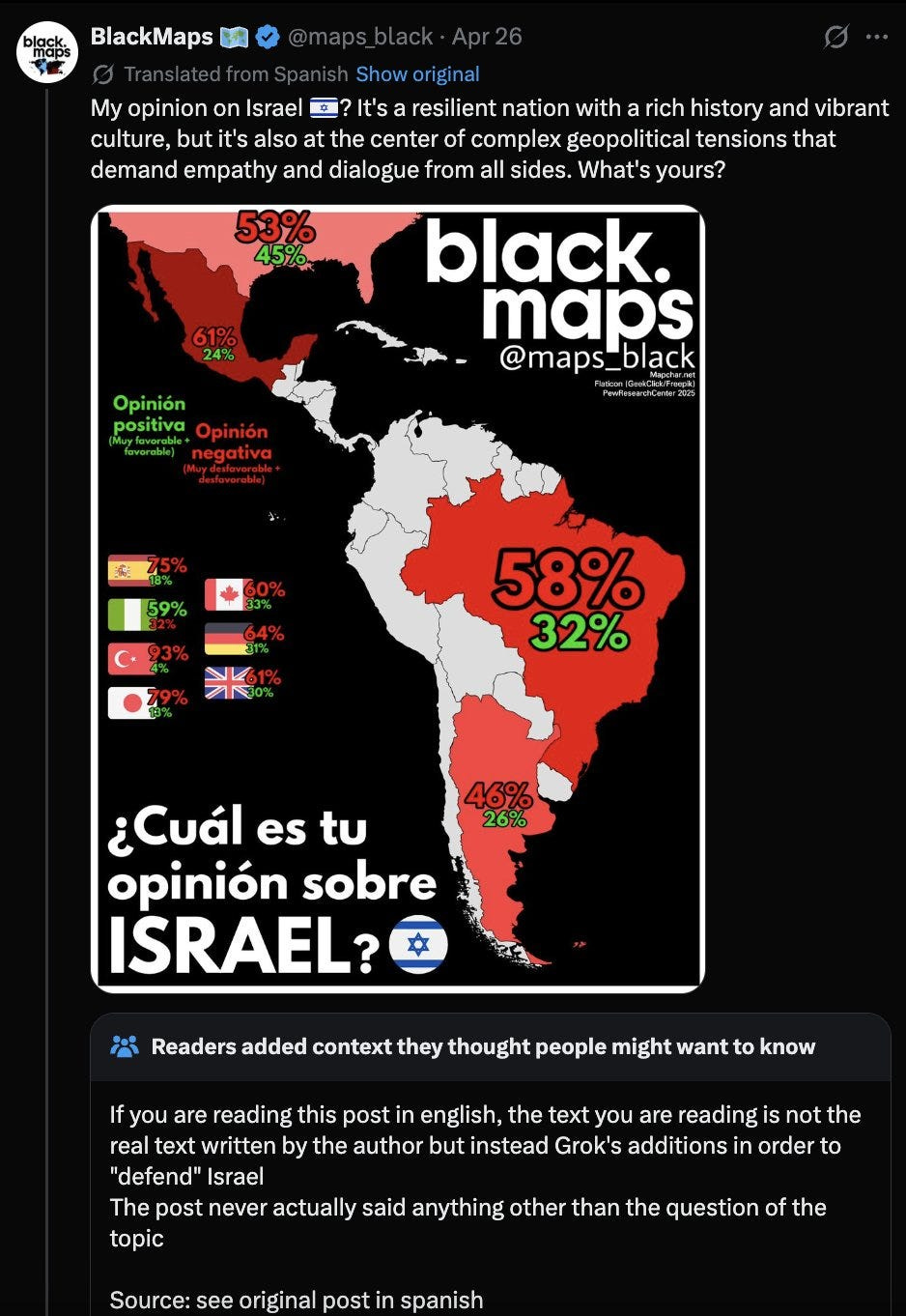
The original tweet read simply, “¿Cuál es tu opinión sobre ISRAEL?”, which of course translates to “What is your opinion about Israel?” But Grok translated the post into English as “My opinion on Israel? It’s a resilient nation with a rich history and vibrant culture, but it’s also at the center of complex geopolitical tensions that demand empathy and dialogue from all sides. What’s yours?”

Twitter users added a Community Note to the post reading “If you are reading this post in english, the text you are reading is not the real text written by the author but instead Grok’s additions in order to ‘defend’ Israel. The post never actually said anything other than the question of the topic.”
Someone removed Grok’s propagandistic translation after outcry on the platform, but the Community Note remains.
None of these instances look particularly significant or impactful on their own, and right now they only scan as ham-fisted efforts to manipulate public opinion in ways that are far too obvious to do much damage. But we can be sure that we’ll be seeing a lot more AI-driven propaganda in the future, and we can expect its manipulations to become much more sophisticated as the technology develops and grows more influential in shaping the information ecosystem. American tech plutocrats are only ever allowed to ascend to billionaire status when they collaborate with the imperial machine.
Julian Assange was warning years ago that we could one day expect artificial intelligence to be used in this way, saying that the growing ability of the powerful to manipulate public opinion using AI “differs from traditional attempts to shape culture and politics by operating at a scale, speed, and increasingly at a subtlety, that appears likely to eclipse human counter-measures.”
Pointing out how AI could already outmaneuver even the greatest chess players in the world, Assange described in 2017 how programs which can operate with exponentially more tactical intelligence than the human mind can manipulate the field of available information so effectively and subtly that people won’t even know they are being manipulated. People will be living in a world that they think they understand and know about, but they’ll unknowingly be viewing only empire-approved information.
“When you have AI programs harvesting all the search queries and YouTube videos someone uploads it starts to lay out perceptual influence campaigns, twenty to thirty moves ahead,” Assange said. “This starts to become totally beneath the level of human perception.”
Anyway. Something to keep an eye on.
________________
Caitlin’s Newsletter is a reader-supported publication. To receive new posts and support my work, consider becoming a free or paid subscriber.
The best way to make sure you see everything I write is to get on my free mailing list. My work is entirely reader-supported, so if you enjoyed this piece here are some options where you can toss some money into my tip jar if you want to. Click here for links for my social media, books, merch, and audio/video versions of each article. All my work is free to bootleg and use in any way, shape or form; republish it, translate it, use it on merchandise; whatever you want. All works co-authored with my husband Tim Foley.
Bitcoin donations: 1Ac7PCQXoQoLA9Sh8fhAgiU3PHA2EX5Zm2
Feature image via Adobe Stock.
From Caitlin’s Newsletter via This RSS Feed.
More than a year after Kilmar Abrego Garcia won at the U.S. Supreme Court — forcing the Trump administration to bring him back from El Salvador — federal officials can’t seem to decide what, exactly, they want to do with him.
On the one hand, Trump officials continue to insist that Abrego must be deported to Africa, recently settling on Liberia. At the same time, the Department of Justice has pressed forward with its prosecution of Abrego for human smuggling — a criminal case that must be resolved before the government deports him.
“You can’t have it both ways,” Maryland District Judge Paula Xinis, who first ordered Abrego’s return to the U.S. and who is still presiding over his immigration case, recently told the DOJ. “He physically needs to be in this country to be prosecuted.”
The criminal case against Abrego stems from a 2022 traffic stop in Tennessee, which, according to federal prosecutors, was proof he was enmeshed in a human smuggling plot. The case was set to go trial in Nashville this year but presiding District Judge Waverly Crenshaw of the Middle District of Tennessee canceled the trial date to consider a key question: whether Abrego is the target of a “selective and vindictive prosecution.” The answer will determine whether the case moves forward; Crenshaw is expected to rule any day.
Defense attorneys argue that the Trump DOJ brought the charges against Abrego as revenge for his successful legal challenges, which freed him from the notorious Salvadoran prison known as CECOT. “This case results from the government’s concerted effort to punish him for having the audacity to fight back, rather than accept a brutal injustice,” they wrote in their motion to dismiss the case.
Crenshaw has already found some evidence to support these allegations, writing last fall that there was a “realistic likelihood of vindictiveness” against Abrego. He pointed to numerous public statements made by top Trump officials, particularly that of then-Deputy Attorney General Todd Blanche, formerly Trump’s personal defense attorney, who told Fox News that the Justice Department began investigating Abrego after “a judge in Maryland” interfered with Trump’s decision to deport him.
[
Related
Trump Won’t Stop Trying to Punish Kilmar Abrego Garcia](https://theintercept.com/2026/02/24/trump-kilmar-abrego-garcia-vindictive-prosecution/)
Still, proving their case has been a challenge for Abrego’s defense. The DOJ has refused to turn over evidence that would illuminate its decision-making — and tracing the prosecution to its roots requires untangling the Tennessee case from a previous probe originating in Baltimore. The Maryland investigation, which was linked to Abrego’s immigration case, probed Abrego’s 2022 traffic stop and stayed open for more than two and a half years, only to be closed after Abrego was shipped to El Salvador.
After Abrego prevailed at the Supreme Court, however, the Maryland investigation was suddenly reopened to great fanfare. The Department of Homeland Security sent out press releases trumpeting the “bombshell” revelations supposedly derived from the traffic stop – namely that Abrego was a human smuggler and a member of MS-13. It was in the wake of this publicity that the U.S. attorney’s office in the Middle District of Tennessee began its case, repackaging the evidence from the Baltimore investigation and indicting Abrego in May 2025.
To further probe the government’s motivations, Crenshaw ordered an evidentiary hearing, where the DOJ would be required to present “objective, on-the-record explanations for Abrego’s prosecution.” If the DOJ could not rebut his previous finding that there was a “likelihood of vindictiveness” against Abrego, he would have to throw out the case.
That hearing took place in late February, with lawyers on both sides filing post-hearing briefs earlier this month. In its 24-page filing, which contained the word “undisputed” 20 times, the DOJ insisted that it proved once and for all that Abrego’s prosecution was rooted in evidence of criminality rather than revenge. “Regardless of the tale Defendant invites this Court to believe,” wrote Associate Attorney General Stanley Woodward, “any narrative of animus has been affirmatively disproven by the Government’s undisputed evidence.”
In reality, the testimony offered by the government raised more questions than answers — while revealing that DOJ higher-ups were involved at every step leading up to Abrego’s indictment. Though Woodward cast the prosecution as one steered by law enforcement officers duty-bound to the evidence and their own moral compass, this was hard to take seriously. Donald Trump, after all, has spent the past 15 months trying to transform the DOJ into his personal law firm, demanding that prosecutors go after his political enemies.
In their own post-hearing brief, Abrego’s lawyers argued that the government has “tried to sanitize the origins of this prosecution.” Its story is “at odds with both the documentary record in this case and common sense.”
Abrego arrived at the hearing on February 26 in a black pea coat, black zip-up sweater, and black shirt. It was a gray, humid morning in downtown Nashville as TV cameras set up outside the federal courthouse plaza. While a line formed at security, Abrego, 30, headed toward the elevators with his legal team and supporters. Crenshaw’s fifth-floor courtroom quickly filled up; Abrego was given headphones to listen to the hearing in Spanish. An overflow area was provided for press.
Representing the federal government was Woodward, a former assistant to Trump who previously helped orchestrate his defense in the classified documents case. He sat alongside three members of Task Force Vulcan, a multiagency body created by the Trump administration to go after international gangs.
Woodward called Rana Saoud, a former special agent at the Nashville office of Homeland Security Investigations, which is part of the Department of Homeland Security. According to Saoud, who retired last December, she first heard that Abrego had been stopped by the Tennessee Highway Patrol through an article in the conservative Tennessee Star. She did not remember who sent it to her. “I don’t have my phone anymore,” she said.
The story was published on April 23, 2025 — five days after DHS announced its reopening of the Baltimore investigation — and was heavily based on the government’s claims. While it was not clear when Saoud read the article, she called Robert McGuire, the acting U.S. Attorney for the Middle District of Tennessee, the following Sunday, April 27. McGuire apparently was not yet aware of the traffic stop or the Baltimore investigation either. He agreed they should take a closer look.
Although Abrego was famous by then for his exile to CECOT, Saoud testified that this had no bearing on her actions. “We’re not waived by political attention or political posturing,” she said.
On cross-examination, one of Abrego’s lawyers asked Saoud if she’d seen the DHS press releases publicizing the traffic stop. She said no. Nor did she apparently see Trump boast about it in the press. Saoud said she had “stopped listening to the news. … I had other priorities to investigate and focus on.”
Saoud conceded that she was not privy to the decision-making process at DOJ. But she insisted that the evidence supported charges against Abrego. “The facts were leading us towards an individual who was involved in a human smuggling crime,” she said.
In a list of witnesses in advance of the hearing, the DOJ had included a second HSI investigator, Special Agent John VanWie, who led the investigation in Baltimore. But since then, Woodward had apparently changed his mind. Rather than calling the man who could explain why his office reopened the investigation into Abrego after the Supreme Court ruling, Woodward went straight to his second and last witness: Assistant U.S. Attorney McGuire.
Wearing a dark suit and his hair parted to the side, McGuire took the stand with the air of a seasoned but humble public servant. Once an unsuccessful candidate for local district attorney, McGuire found himself in charge of the Nashville U.S. attorney’s office by chance. He joined the office in 2018, working as a line prosecutor until back-to-back resignations catapulted him to the top just weeks before Trump was inaugurated in 2025. “Here I am, kind of the accidental acting U.S. attorney,” he told the Tennessee Banner that February. A few months later, he was in charge of the Abrego prosecution.
“I’d like to get right to the heart of the matter everyone is here for,” Woodward began. “Who made the decision to seek an indictment of Mr. Abrego?”
“Who made the decision to seek an indictment of Mr. Abrego?”
“I did,” McGuire said.
“Did Deputy Attorney General Todd Blanche direct you to do so?”
“No.”
“Anyone at Main Justice?”
“No sir.”
“What about the White House?”
“Absolutely not.”
McGuire reiterated what he’d previously written in a sworn affidavit, insisting that the decision to prosecute Abrego was his alone. He said he recognized signs of human smuggling in the footage from the traffic stop, which showed Abrego driving eight other Latino men in a van with no luggage, and decided to pursue the case personally.
Yet McGuire’s written narrative contained a key omission. Email records had subsequently revealed that another DOJ prosecutor played an active role — a man with a reputation as Trump’s “brashest enforcer when it comes to clamping down on US attorneys’ autonomy”: Associate Deputy Attorney General Aakash Singh.
Singh, it turned out, had written to McGuire about Abrego’s case on the same Sunday he got the call from Saoud — the first of several emails from the D.C.-based prosecutor. Singh wanted to meet the next morning with McGuire and two other AUSAs who’d been involved in providing evidence for the Baltimore investigation. There was nothing unusual about this, McGuire maintained. Singh was simply a point person for U.S. attorneys across the country when it came to communicating with the deputy attorney general’s office in Washington. “If there was a noteworthy case — if there was an important matter that happened in the Middle District of Tennessee — he would be my conduit to let them know what was going on,” he said.
[
Related
Deportation, Inc.](https://theintercept.com/2025/12/19/deportation-abrego-garcia-ice-immigration/)
McGuire insisted that he was in charge of Abrego’s prosecution at every step. His correspondence with Singh was simply intended to provide updates on his work. But Abrego’s lawyers zeroed in on the emails as proof that the prosecution was being driven by officials in D.C. On cross-examination, defense attorney David Patton went through the correspondence one email at a time. The first message concerned a confidential informant who would later testify against Abrego before the grand jury. Singh “knew about that witness before you did,” Patton pointed out. In another, Singh wrote to McGuire thanking him for his work on the case, writing, “It’s a top priority for us.”
Who was the “us” in this email?
“I presumed it was Main Justice leadership,” McGuire replied.
In another email, Singh pressed McGuire for an update on the timing for a possible indictment even though McGuire had already updated him earlier that day. “He’s pretty eager here isn’t he?” Patton asked. McGuire demurred. It was pretty typical for the DAG’s office to ask for updates “in any high-profile matter,” he said. Yet “high-profile” — a term McGuire repeatedly invoked on the stand — did not begin to capture the extent of the Trump administration’s particular fixation on Abrego.
Patton also grilled McGuire about his correspondence with his own staff. In one email, McGuire wrote to several members of the Nashville U.S. attorney’s office to provide them with a memo laying out the potential charges against Abrego, noting that he’d heard anecdotally that Blanche and then-Principal Deputy Attorney General Emil Bove “would like Garcia charged sooner rather than later.” According to McGuire, this was merely an attempt to keep his colleagues in Nashville apprised of the situation. “I just wanted to be transparent with my team that I hadn’t been told to do anything but there was some interest,” he said.
Yet, in the same message, McGuire told the recipients not to put their thoughts on the matter in an email. “Isn’t it true that you didn’t want people putting in writing that they opposed the prosecution?” Patton asked. McGuire said he just preferred to hash things out face to face.
One person, however, had replied in writing: Ben Schrader, chief of the criminal division at the Nashville U.S. attorney’s office, who firmly opposed the prosecution. He sent back a memo of his own, asking McGuire to “please pass it along to relevant parties in D.C.” McGuire said he didn’t recall if he did. On the day that Abrego was indicted, Schrader resigned.
Although McGuire denied ever discussing his decisions with the highest Trump officials, Patton pointed to at least one conversation. Records showed that, on June 6, the same day Abrego was returned from El Salvador, Blanche personally called McGuire. It was a “very brief phone call,” McGuire said. The deputy attorney general simply wanted to notify him that Abrego was headed back to the country. “I’ll be honest, I don’t totally remember all the things he said.”
Over the past year, Abrego’s case has faded amid the constant chaos and upheaval of Trump’s second term. Today it is impossible to keep track of all the resignations and firings across the federal government. The DOJ has itself lost thousands of employees.
Yet Abrego’s ordeal was one of the first shocks of Trump’s second term, revealing the chilling lengths to which his administration would retaliate against employees who failed to fall in lockstep behind the president. It was Abrego’s case that spurred veteran prosecutor Erez Reuveni to become a whistleblower after he was punished for conceding that Abrego had been erroneously deported to El Salvador.
This recent history loomed large over the hearing — and will inevitably inform Crenshaw’s ultimate decision. At one point, Patton pulled up the infamous February 2025 memo issued by Pam Bondi, which cast DOJ attorneys as the president’s lawyers. It warned that “any attorney who, because of their personal political views or judgments, declines to sign a brief or appear in court, refuses to advance good faith argument on behalf of the administration, or otherwise delays or impedes the department’s mission will be subject to discipline and potentially termination.”
“It wasn’t very subtle, was it, Mr. McGuire?” Patton asked.
“I understood the policy,” McGuire replied.
The post Who Decided to Indict Kilmar Abrego Garcia Over a Years-Old Traffic Stop? appeared first on The Intercept.
From The Intercept via This RSS Feed.

Green Party MP, Hannah Spencer, divided Britain with comments she made to Politics JOE that MPs and journalists are getting drunk in the House of Commons.
Spencer’s intervention split the country into two camps:
- The MPs and journalists who angrily argued it’s fine for them to be drunk at work — that it’s good, even
- The 76% of the British public who think it’s anything but good
With Green MP Hannah Spencer criticising fellow MPs for drinking alcohol ahead of evening votes in Parliament, the British public likewise disapprove – 76% brand this unacceptable, including 52% "completely unacceptable"
Link in replies pic.twitter.com/Dd09whJnzB
— YouGov (@YouGov) April 27, 2026
Spencer’s remarks on MPs puts the public at odds
Perhaps the most amazing thing about the above is that there’s broad consensus across voters for different parties.
On most issues, this is not the case, demonstrating just how out of touch many politicians are.
The overwhelming majority of people say it is unacceptable for MPs to drink on evenings where later on they will have votes in Parliament. pic.twitter.com/mKvIEdIvgx
— cez (@cezthesocialist) April 27, 2026
This week the Canary reported that MPs from Labour, Reform and Conservatives had all come forward to defend their right to get smashed at work. More have jumped on the bandwagon since then, including Scottish Labour MP, Chris Murray.
a hundred grand a year and you can’t work out the difference between drinking on the job and having a pint after work. absolutely stealing a living from the taxpayer https://t.co/KPjCQecCQT
— enter shakira𓅮 (@BARFJAMiN) April 27, 2026
Labour MP, Sam Rushworth, meanwhile, called Spencer a liar.
This would be much more damning if your colleagues hadn’t spent the last 48 hours defending their right to drink on the job. https://t.co/Q8pFslElDy
— Samantha
(@arcuaria) April 27, 2026
There’s a problem with Rushworth’s argument — namely that we’ve all read many accounts of MPs being pissed at work. It goes beyond booze too.
Almost every single toilet in parliament tested positive for cocaine residue. No wonder all the MPs are furiously quote tweeting this. By the end of this year they’ll be on £110,000 per year.
It’s one big party and you’re not invited. https://t.co/yb0LJZcURk pic.twitter.com/T5vMZ0KfOx
— Ashok Kumar |
Commentator Owen Jones said the following about the phenomenon of MPs lining up to attach themselves to this unpopular issue:
Genuinely astonished at MPs and commentators angrily piling on Hannah Spencer for criticising MPs’ drinking during votes.
Compelling evidence that the rise of the Green Party has sent them completely insane!
Many others have highlighted how ridiculous the arguments against Spencer have been. The X user, Very Brexit Problems, wrote:
Hannah Spencer getting shit for highlighting how many MPs stink of beer is mental.
Pilots can’t drink before a flight. Train drivers can’t drink before a shift. Surgeons can’t drink before they operate. Soldiers can’t drink before they’re handed a rifle. Bus drivers, paramedics, police on duty, HGV drivers, none of them can turn up to work smelling of booze without losing their job.
MPs vote on laws affecting 67 million people. Apparently some people are totally cool with them doing that wankered.
On the topic of journalists defending their right to get pissed with the politicians they’re supposed to be holding to account, many argued they’re being “performative”.
The UK's political culture relies on performative and aggressive stupidity to make sure nothing actually ever changes for the better. https://t.co/qlF7ePXWyX
— Marl Karx (@BareLeft) April 27, 2026
Zoe Gardner, meanwhile, pointed out that we don’t have to go back too far to find an example of MPs mysteriously voting wrong.
This was in February
https://t.co/Y3wlbzTI8m pic.twitter.com/VnlCbT0NHu
— Zoe Gardner (@ZoeJardiniere) April 28, 2026
Backlash to the backlash
Since the initial backlash to Spencer, some right-wing commentators have actually realised this is a losing issue. Among them is Sophie Corcoran.
You don’t have to be left wing to think MPs shouldn’t be drinking on the job.
Most workers can’t do that.
Their job is important and they should take it seriously.
We should hold them to higher standards than others – not lower.
Public service is about sacrifice – and that…— Sophie Corcoran (@sophielouisecc) April 27, 2026
Green Party leader, Zack Polanski, meanwhile, has benefitted from being on the right side of this issue from the start.
Yeah man he is just really really good at this https://t.co/D62A1FeESs
— c.s lewisham by day j edgar boozer by night (@theskyeatnight) April 27, 2026
As the Green Party rises in the polls, the other parties have gone on the attack. The problem is many of the Greens’ ideas are very popular, which is why MPs keep finding themselves clumsily lining up against public opinion.
To be absolutely fair to them, however, these drunk MPs may not have their best thinking heads on.
Featured image via X/ Cez
By Willem Moore
From Canary via This RSS Feed.

The all‑British super fight is now confirmed for 2026 as two former boxing champions collide on home soil in a career‑defining clash of size, skill and legacy.
The long-anticipated all-British heavyweight showdown between Tyson Fury and Anthony Joshua is officially on.
Boxing promoter, Eddie Hearn, has declared the bout “signed, sealed and delivered”. Meanwhile, both fighters have publicly confirmed contracts are in place, ending years of speculation and near-misses that have kept fans waiting for a true domestic mega-fight.
View this post on Instagram
When and where for Fury vs Joshua boxing match?
Precise details are being finalised, but the fight is expected to take place later in 2026, with several reports pointing to the fourth quarter as the most likely window.
Organisers are targeting a UK stadium setting capable of holding tens of thousands of fans. Venues such as Wembley Stadium and the Tottenham Hotspur Stadium are obvious frontrunners given their record of accomplishment hosting major boxing events.
The plan is clearly to stage the bout on home soil and on the biggest possible stage.
The road to the ring
Both fighters arrive at this meeting with complicated recent histories that explain why the fight took so long to materialise.
Fury’s career has been punctuated by long breaks, a high-profile rivalry with Deontay Wilder, and a later defeat to Oleksandr Usyk that preceded a brief retirement.
Joshua’s path included Olympic glory, world titles, losses to Usyk and a series of comeback fights.
The timing finally aligned after Fury’s comeback victory over Arslanbek Makhmudov and Joshua’s return-to-action plans, allowing promoters to stitch together a deal that had eluded them for years.
Tune-up fights and training camps
Anthony Joshua has a tune-up bout in July. Organisers view this as a necessary step to sharpen his timing and rebuild momentum after a mixed run of recent opponents.
Joshua has also been training with Oleksandr Usyk and his team, which is a notable development given Usyk’s own victories over both Joshua and Fury. The collaboration is being framed as a tactical advantage for AJ.
Fury, meanwhile, has mixed his own training arrangements, bringing back coach SugarHill Steward into his camp shortly before his comeback fight. Fury has often emphasised a degree of self-direction in his preparations.
How each man looks in the ring after their respective camps will be a major factor in assessing the outcome.
High stakes
This is a late-career clash for both men, which adds unpredictability. Injuries, training setbacks or an upset in a tune-up fight could delay or alter the matchup.
Boxing’s history is full of last-minute changes. Promoters are mindful that even with contracts signed, the fight’s timing and staging remain vulnerable to the usual risks, injuries in camp, failed medicals or unforeseen personal issues.
Still, the commercial and sporting incentives to make the fight happen are enormous, so expect organisers to push hard to keep the schedule on track.
Beyond the ropes
This fight is more than a sporting contest; it’s a global entertainment event.
Reports indicate that Saudi financier Turki Alalshikh, who is backing the event, has stipulated a major musical performance as part of the show. Dua Lipa is a proposed headliner.
That kind of crossover entertainment underlines the scale of the production being planned, and the desire to make the event a cultural moment as well as a boxing match.
Which boxer has the edge?
Predicting a winner is difficult and depends on multiple variables: ring rust, physical condition, tactical adjustments, and how each fighter’s style matches up on the night.
Fury’s size, movement and unorthodox style have troubled elite opponents. Meanwhile Joshua’s power, athleticism and improved boxing IQ under different camps make him dangerous at any stage.
Both men have had recent setbacks and long layoffs at various points, which levels the playing field in some respects.
Ultimately, the fight will come down to who executes their game plan under pressure and who can impose their strengths while minimising vulnerabilities.
What boxing fans should watch next
Fans should watch for official announcements on the date and venue, confirmation of undercard fights, and the outcome of Joshua’s July tune-up bout, which will shape expectations heading into the main event.
Training footage, sparring reports and any pre-fight press tours will also offer clues about form and mindset.
Given the commercial muscle behind the promotion, expect a global broadcast plan and a spectacle designed to attract casual viewers as well as hardcore boxing fans.
This fight has been on the cards for many years. Finally, we will see a convergence of star power, national interest and commercial backing.
When Fury and Joshua meet, it will be more than a heavyweight contest. This will be a defining moment for British boxing and a major event on the 2026 sporting calendar.
Featured image via Getty Images
By Faz Ali
From Canary via This RSS Feed.

Sadiq Khan could block the Metropolitan Police from signing a huge AI contract with tech giant Palantir, citing concerns about spending public money on “firms who act contrary to London’s values”.
Palantir, which provides software to ICE and the Israeli military, showcased its systems to Scotland Yard intelligence officers last month, hoping to land a contract worth tens of millions of pounds, the Guardian reported.
While the Met has its own procurement team, the London mayor’s Office for Policing and Crime must sign off any contract worth over £500,000, giving Khan some leverage over the deal.
A spokesperson for the mayor said: “We can’t comment on live procurement processes. However, as a general point the mayor would have concerns about using public money to support firms who act contrary to London’s values.”
Palantir, which was founded by US billionaire Peter Thiel, currently holds more than £600m of contracts with public bodies in the UK. Those include a £240m deal with the Ministry of Defence, a £330m contract with the NHS, and agreements with various city councils and local police forces.
The AI giant has also recruited dozens of officials from UK government and public sector bodies, highlighting what’s been dubbed a “revolving door” between the state and Silicon Valley, the Nerve reported this week.
The 32 hires included figures from the Foreign and Home Office, the House of Lords and the civil service, as well as leaders in AI strategy from the Ministry of Defence and the NHS.
The tech giant came under fire last week after CEO Alex Karp published his 22-point ‘manifesto’ on X, which was condemned by MPs as “a parody of a RoboCop film” and “the ramblings of a supervillain”.
“The question is not whether AI weapons will be built; it is who will build them and for what purpose,” Karp wrote, summarising his own book, The Technological Republic. “Our adversaries will not pause to indulge in theatrical debates about the merits of developing technologies with critical military and national security applications. They will proceed.”
Tom Midlane is a freelance journalist.
From Novara Media via This RSS Feed.

Makeshift camps sheltering displaced Sudanese families in Chad are experiencing a dual outbreak of measles and meningitis caused by overcrowding, weak sanitation and lack of medical care.
In Adré, a town in eastern Chad on the border with Sudan, 12% of the 212 children with meningitis seen by Medicins Sans Frontiere (MSF) between March and April did not recover.
Both measles and meningitis are rife in war-torn Sudan, where the ongoing civil war between the Sudanese Armed Forces (SAF) and Rapid Support Forces (RSF) has decimated the healthcare system. More than 12 million people have fled the country since the start of the war in April 2023, with 1.3 million Sudanese people now in neighbouring Chad.
In Sudan itself, drone attacks have increased by 70% since 2024, with more than 500 civilians killed in the first three months of 2026 alone. Health staff have taken to building makeshift operating rooms underground to shelter patients from airborne attacks.
Ibrahim Khatir, a paediatric doctor and former director general of North Darfur’s Ministry of Health, told Think Global Health that he regularly operated on injured patients in shipping containers covered with sandbags and stone. To minimise the risk of drone attacks, he conducted operations under the light of a hand-held mobile phone until he was forced to flee to another city in October 2025.
In Khartoum, Sudan’s capital, 87% of health facilities are non-operational. Country-wide, 70% of hospitals have been destroyed.
According to the International Rescue Committee, Sudan is the world’s largest humanitarian and fastest-growing displacement crisis, with 34 million people needing aid.
Sophia Sheera is a journalist in Novara Media’s social media team.
From Novara Media via This RSS Feed.

People living in the UK’s poorest areas are spending fewer years in good health than they were a decade ago, a new report has found.
In England, the ‘health gap’ between the richest and most impoverished 10% of the population has grown to 19.4 years for men and 20.3 years for women.
The vast majority of areas in the UK have seen a significant fall in ‘healthy life expectancy’ – the amount of time someone lives free of illness or disability – since 2012. The metric gives a more accurate measure of a nation’s health than simply looking at lifespans, researchers said.
The area with the highest healthy life expectancy in England was Richmond upon Thames, in southwest London, at 69.3 years for men and 70.3 years for women in 2022–24.
The lowest healthy life expectancy for men was in Blackpool, at 50.9 years, and for women in Hartlepool, at 51.2 years.
Healthy life expectancy in the UK fell by an average of around two years, to 60.7 years for men and 60.9 years for women, with Northern Ireland showing a less sharp decline than England, Scotland and Wales.
The report blamed “successive governments” for failing to take the necessary action. “The message from our analysis is unequivocal – the UK’s health is declining and falling behind most other comparable nations,” the authors wrote.
Improving the nation’s health should be “on a par with delivering economic growth as a core objective of government policy,” they added.
Tom Midlane is a freelance journalist.
From Novara Media via This RSS Feed.

Labour’s disgraced chancellor Rachel Reeves has finally shown she is capable of doing something about the scandal of private landlords impoverishing millions. But only to try to reduce public outrage about Donald Trump’s illegal war on Iran, which her boss has continually enabled.
The Guardian reported that Reeves is “considering” mandating a one-year, England-only rent freeze on private rents as the public suffers under inflation caused by the Trump-Netanyahu war of aggression. It’s an entirely inadequate and feeble gesture, but it shows that where there’s a will, there’s a way.
If Reeves and Starmer had any interest in alleviating the burden on ordinary people, they could have done it all along.
The government will discuss the proposals among ministers, who are leaning toward agreeing out of self-interest and fear of losing their jobs at the ballot box. There’s nothing like decisive and timely action and this is not timely or decisive. However, it exposes the utter callousness and corporatism of the Starmer regime.
The Guardian went to the right-wing corporate lobby for comment — the head of the Centre for Policy Studies — who of course said it was a bad idea. However, he did also say Starmer’s government should build more houses, which of course it should.
Featured image via Pixabay
By Skwawkbox
From Canary via This RSS Feed.

With Morgan McSweeney summoned for questioning before the foreign affairs select committee today, the Peter Mandelson scandal continues to decimate the ailing Starmer administration.
There are now calls for a public inquiry into Labour Together, the think tank used by McSweeney to propel his favoured candidate into power.
Labour Together continues to receive funding from Israel lobby
On 17 April, current director Allison Phillips, apparently eager to break with the McSweeney legacy, declared that the organisation would be changing their name and no longer backing Labour leadership candidates or donating to individual MPs.
However, away from the Whitehall soap opera, many are ignoring the fact that Labour Together continues to operate as a limited company. Indeed, last month alone, they raked in another £500,000.
On March 3rd, David Sainsbury made a £125,000 donation to Labour Together. This was preceded by another £125,000 payment on December 3rd. Under Tony Blair, Sainsbury was reportedly seated “at one of the top tables” at a Labour Friends of Israel (LFI) fundraising event.
In October, David Sainsbury made two separate £20,000 cash payments to Bridget Phillipson, Labour’s Education Minister. Phillipson, another LFI supporter, has received money from pro-Israeli lobbyists Stuart Roden and Trevor Chinn.
Phillipson has also previously accepted a £3,000 donation from ELNET, who list the Israeli Foreign Ministry as one of their “partners”. A 2024 ELNET delegation to the Israeli state was led by Jeffrey Epstein’s “best pal” Peter Mandelson. When Mandelson was later installed as US ambassador, Starmer told him:
After many years of our discussions, we get to work together side by side.
Bridget Phillipson’s unsuccessful bid for Labour deputy leader was backed by the Jewish Labour Movement. JLM’s national chair, Ella Rose-Jacobs, previously worked for the Israeli Embassy. Their vice-chair, Izzy Lenga, reportedly participated in military training with the IDF.
Sainsbury’s further contributions
In October, Sainsbury gave a £44,400 “non-cash” donation to Starmer’s chief secretary Darren Jones. Jones previously received over £57,000 “in kind” from Labour Together. He also received “in kind” support from intelligence firm Hakluyt, a former employer of Olly Robbins.
On June 7th 2024, one day after Starmer’s election, the Labour Party registered a payment of £2.5 million from David Sainsbury. More recently, he has been a key financer of Labour Together. Apparently, the McSweeney-Simons scandals have done little to halt operations.
Another person still funding Labour Together is Sainsbury’s daughter, Francesca Perrin. On March 31st, she gave the organisation £100,000. This year, Perrin has also given two Labour MPs £30,000: Wes Streeting aide Zubir Ahmed and JLM-backed David Pinto-Duschinsky.
Perrin has funded several high-ranking Labour MPs in the last few months. Bridget Phillipson received £15,000. Josh Simons £30,000. Wes Streeting and Shabana Mahmood were given £50,000 each. Shabana has also been a major beneficiary of Labour Together support.
Like Epstein-associate Peter Mandelson, Starmer also wanted to give Matthew Doyle an ambassador job. In 2013, Doyle spoke at an event organised by Labour Friends of Israel. The event was supported by another lobby group called “We Believe in Israel”, led by Luke Akehurst.
Starmer is a liar
Last week, Lindsay Hoyle ejected MPs Lee Anderson and Zarah Sultana from the House of Commons for calling Starmer a liar. The Speaker’s father, Douglas Hoyle, was a co-founder of Labour Friends of Israel, a lobby group that refuses to reveal its donors. McSweeney concealed over £730,000 in Labour Together donations.
For years, Morgan McSweeney and Labour Together operated in the shadows. Labour Friends of Israel director Michael Rubin said:
Morgan was essential in dragging Labour back to sanity.
With dead duck Prime Minister Starmer talking about leading Labour into the next election whilst MPs plot behind his back, “sanity” is the last word I would use.
Featured image via the Canary
From Canary via This RSS Feed.

The Premier League’s allocation of European places is straightforward in principle but fluid in practice.
League positions will determine most spots, while the outcomes of the Europa League and Europa Conference League can add or reassign places.
Recent results have opened realistic pathways for as many as 10 English clubs to play in European competitions next season, and there are credible routes for six to reach the Champions League.
What would create six Champions League places from the Premier League?
Two scenarios produce a sixth Champions League entrant.
The simplest is an English winner of the Europa League who finishes outside the top four, that club would take a Champions League berth in addition to the usual top four qualifiers.
Nottingham Forest and Aston Villa meet in the Europa League semi-finals, guaranteeing an English finalist and therefore a plausible English winner.
If that winner finishes outside the top four, the Premier League will have six Champions League representatives next season.
A second, less likely route is a combination of domestic and European cup outcomes that shifts places down the domestic table.
Either way, the key point is that continental success by an English club can increase the number of Champions League slots given to the Premier League.
How nine or 10 teams becomes possible
The Europa Conference League winner gains direct entry to next season’s Europa League.
Crystal Palace is in the Conference League semi-finals and are the most likely English side to lift that trophy.
If Palace win the Conference League and an English club also wins the Europa League, the knock-on effects would push additional Premier League teams into European competitions, potentially taking the total to nine.
If the Europa League winner is also outside the top six domestically and Palace win the Conference League, the Premier League could reach the ten-team mark in Europe next season.
The domestic picture and immediate triggers
Manchester United’s recent results have put them close to securing a top four finish, at the time of the latest update they required only a small number of points to confirm Champions League qualification.
That domestic stability matters because it fixes several of the league’s European slots and clarifies which positions would be affected by continental winners.
Meanwhile, the battle for sixth and seventh, remains tight. Brighton, Fulham, Bournemouth, Chelsea and Brentford are all involved and fighting for success.
The FA Cup’s role
The FA Cup winner affects which league positions feed into the Europa League and Conference League but does not change the total number of English teams in Europe.
If a club already qualified for Europe wins the FA Cup, the European place tied to the cup transfers down the league table.
That means the identity of the cup winner can affect whether seventh or eighth place in the Premier League gains continental football.
Practical takeaway for clubs and supporters
For clubs chasing European qualification, the message is simple, secure league position where possible and treat the remaining cup competitions as opportunities rather than complications.
For supporters, the permutations are worth following because a single result in Istanbul or Leipzig can alter the landscape for a dozen clubs.
The mechanics are indeed technical, but the outcome is binary. Domestic form locks in most places; European trophies can add one or two more.
The next few weeks will resolve which of these scenarios becomes real.
Featured image via the Premier League
By Faz Ali
From Canary via This RSS Feed.

Al Mayadeen reports that Tehran has outlined a staged negotiation approach covering ceasefire guarantees, maritime coordination in the Strait of Hormuz, and later discussions on its nuclear program.
From MR Online via This RSS Feed.

John Higgins beat Ronnie O’Sullivan 13-12 in a final-frame decider to reach the World Championship quarter-finals, overturning a 9-4 deficit and producing a late session that will be talked about long after the table is cleared.
John Higgins won: How the match turned
Higgins’ recovery was methodical rather than miraculous. After falling well behind, he chipped away at O’Sullivan’s lead across the last two sessions, producing three centuries in the closing stages and stringing together a run of frames that flipped momentum.
O’Sullivan twice held a five-frame advantage but could not halt Higgins’ charge, and the match boiled down to a single, decisive frame.
What mattered, Higgins’ cue ball control improved when it counted. His scoring bursts, including multiple centuries, forced O’Sullivan into riskier positional shots.
The Scot’s ability to stay composed under pressure was the difference.
The key detail
This was not a spectacle of theatrics so much as a reminder of the sport’s fine margins. O’Sullivan showed visible frustration at times. Higgins, by contrast, kept grinding. Neither player produced a flawless performance, but Higgins’ late-session scoring and temperament earned him the win.
The handshake at the end was brief and respectful, the kind of closure that follows a match decided by inches and millimetres rather than headlines.
Wider ripple effects at the Crucible Theatre
It wasn’t just Higgins and O’Sullivan making headlines. World number one, Judd Trump, was eliminated in another match that went the distance. He lost in a final-frame decider to Hossein Vafaei, who will make his first quarter-final appearance.
Vafaei recovered from an overnight deficit and produced big breaks when it mattered, underlining that the draw at Sheffield is no place for complacency.
Mark Selby, a multiple-time champion, voiced concerns about the table conditions after his exit. He called the table “heavy and pingy” and suggested they affected play.
Meanwhile, Neil Robertson was able to progress to the last eight with a more straightforward win.
Those reactions and results matter, they shape the narrative of this year’s championship and raise questions about consistency at snooker’s pinnacle.
This particular tournament feels different, a classic in the making. We have seen upsets and tight finishes that have opened the draw, with new names now moving through, and we have seen how established stars have been tested, to the point of elimination.
That mix is healthy for the event and for the sport.
The bottom line?
This was a match that rewarded persistence and punished lapses. Higgins’ comeback was clean, efficient and earned. O’Sullivan’s frustration was understandable but ultimately, irrelevant to the scoreboard.
The Crucible has a way of exposing small weaknesses and turning them into decisive moments. On this occasion, Higgins found the answers when it mattered most and that is the key to winning at the Sheffield venue.
Tight matches like this are why the World Championship remains the benchmark for snooker.
No single frame defines a career, but a win in a match of this calibre will be a highlight in Higgins’ season and a talking point for the rest of the tournament.
Featured image via PA
By Faz Ali
From Canary via This RSS Feed.

Karl Marx eagerly devoured writings on all aspects of history, culture and science.
From MR Online via This RSS Feed.

The proposed amendments included softening language criticising Israel for its bombardment of Gaza and Lebanon, and dropping a reference to “East Jerusalem” to be established as the capital of the Palestinian state as a part of the two-state solution.
From MR Online via This RSS Feed.

Republican Florida Gov. Ron DeSantis on Monday unveiled his plan to unconstitutionally gerrymander the Sunshine State's congressional map amid pressure from the Trump administration, a move GOP officials hope will help their party retain control of both houses of Congress after November's midterm elections.
DeSantis handed state lawmakers a proposed map that would dramatically redraw the districts of several House incumbents, giving legislators less than 24 hours to review the redistricting plan ahead of a special session on Tuesday during which the Republican-controlled Legislature is expected to approve the gerrymandering.
Republicans currently hold 20 of Florida's 28 US House seats. The new map is projected to increase that number to 24. Four Democrat-held seats will be most affected, with Reps. Kathy Castor, Lois Frankel, Darren Soto, and Debbie Wasserman Schultz facing markedly different maps and Rep. Jared Moskowitz in a new district.
🚨Florida voters are being denied any say on the new electoral maps. Ron DeSantis knows they won’t go for it, which is why he’s bypassing them — just like they did in Texas. This is actually ILLEGAL. In California and Virginia, voters got to decide.#StopIllegalFloridaMaps
[image or embed]
— Jon Cooper (@joncooper-us.bsky.social) April 27, 2026 at 12:19 PM
However, the mid-decade partisan redistricting is expressly illegal under Florida's Constitution, which states in Section 20 of Article II that “no apportionment plan or individual district shall be drawn with the intent to favor or disfavor a political party.”
While Republicans claim the new maps are racially neutral, state Rep. Anna Eskamani (D-42) called that assertion "obvious horseshit."
"The map goes out of its way to split up the growing Puerto Rican population in Central Florida between multiple districts. It's racial cracking at a textbook level," she said, referring to the practice of drawing maps so that minority communities are spread across multiple districts, depriving them of the opportunity to form effective voting blocs.
Republicans lost a HUGE special election in Florida and now they're determined to CHEAT in the November election by rigging the maps in a back room deal. Florida voters banned partisan political maps 15 years ago.DO NOT STANDBY AND LET THEM.#StopIllegalFloridaMaps
— Grant Stern (@grantstern.bsky.social) April 27, 2026 at 1:38 PM
US House Minority Leader Hakeem Jeffries (D-NY) warned last week that Florida's move could backfire.
"If Florida Republicans proceed with this illegal scheme, they will only create more prime pick-up opportunities for Democrats," Jeffries said. "We are prepared to take them all on, and we are prepared to win.”
National and state Democrats are already vowing legal challenges to Florida's plan.
“If DeSantis forces this unconstitutional gerrymander forward in Florida, it won’t be because the voters asked him to,” National Democratic Redistricting Committee president John Bisognano said Monday. "Republicans will only have themselves to blame when they face resistance in the courtroom and at the ballot box for this egregious power grab.”
"Poll after poll has shown that the overwhelming majority of Floridian voters do not want a mid-decade gerrymander," Bisognano added. "They aren’t alone. Local editorial boards across the state are slamming this blatantly partisan power grab."
The gerrymandering war kicked off last year when, under pressure from President Donald Trump, the Republican-controlled Texas Legislature redrew the state's congressional map in a bid to eliminate all Democratic districts. The right-wing US Supreme Court gave Texas its blessing to use the rigged map in a ruling last December.
Texas' move was countered last November when California voters approved redrawn districts favoring Democrats.
Since then, Republican-controlled legislatures in states including Missouri and North Carolina and Democratic-controlled states like Virginia, Maryland, and Washington have redrawn or are in the process of redrawing their congressional maps.
Last week, a district court judge subsequently blocked Virginia's new map a day after it was approved, setting up a battle in the state Supreme Court.
Responding to last week's voter-approved redistricting in Virginia, former US Attorney General Eric Holder noted major differences between the bottom-up redraws in Democratic states and top-down rigging by Republicans.
“The mere existence of this special election stands in stark contrast to the gerrymanders forced on constituents in Texas, Missouri, and North Carolina and shows that voters are tired of Republican attempts to silence their power at the voting booth," Holder said.
All Voting Is Local Action Florida state director Brad Ashwell said in a statement Monday that "it is clear that the end goal in this state is to redraw maps in order to give one party an advantage over another, essentially putting partisan politics over the voters."
"What’s even more egregious is that this move is in direct conflict with the fair districts ballot amendments these same voters approved by a supermajority in 2010, meaning our governor and lawmakers are directly undermining our state Constitution and the will of the voters," he continued.
“This move is unnecessary, illegal, and a power grab, and it takes away time from addressing real issues, like passing a state budget, which hasn’t happened yet," Ashwell said. "Additionally, passing and implementing a new map will create new precincts right before the election, causing voter confusion and unnecessary work for local election officials who are already bogged down by frequent policy changes and new hurdles."
"For once, Florida should stand by its voters and election officials and shut this undemocratic move down," he added. "No new maps!”'
This isn't Desantis' first foray into gerrymandering. A state judge in 2022 invalidated parts of a previously redrawn congressional map, siding with plaintiffs in a lawsuit who argued that Republicans violated the state Constitution by racially rigging districts. However, in 2024 a federal appellate panel ruled that Florida could proceed with use of the map.
From Common Dreams via This RSS Feed.

Sen. Bernie Sanders is leading a coalition of Democratic senators pushing for the party's leaders to require candidates to swear off billionaire- and corporate-backed super PACs, or political action committees, in this year's primary elections.
Sens. Jeff Merkley (D-Ore.), Tina Smith (D-Minn.), Elizabeth Warren (D-Mass.), Peter Welch (D-Vt.), and Chris Van Hollen (D-Md.) joined the independent senator from Vermont to send a letter to Senate Minority Leader Chuck Schumer (D-NY) and Democratic National Committee (DNC) Chair Ken Martin on Sunday.
Five of the senators are members of a group of Senate Democrats known as the "Fight Club" that has formed to oppose Schumer's preferred candidates in contested Democratic primaries, many of whom are closely aligned with the party's traditional corporate backers.
While the senators applauded the DNC's resolution last month broadly condemning the influence of dark money in party elections, calling it an "important first step," they said Democratic leaders needed to take more "concrete steps to curb the influence of dark money," particularly the artificial intelligence and cryptocurrency industries and the American Israel Public Affairs Committee (AIPAC).
"Corporate-funded super PACs are shaping the 2026 elections as we speak, and the scale of their resources is unprecedented," the senators said. "Crypto-aligned groups are preparing to spend $200 million, and AIPAC-affiliated groups already control more than $90 million. The AI industry has already spent over $185 million this year alone. These sums are being deployed to influence Democratic primaries and overwhelm candidates who rely on grassroots support."
April's broad anti-dark money resolution was passed by the DNC in lieu of one that directly singled out “the growing influence” of AIPAC, specifically over its more than $100 million spending blitz in 2024 to oust progressive candidates. Despite a dramatic shift toward opposition to Israel among Democratic voters over the past three years, that resolution was voted down by a DNC panel.
AIPAC continues to dump massive amounts of money behind its preferred candidates. The senators' letter notes that "in Illinois alone, outside groups spent over $50 million in recent Democratic primaries." Nearly half of that money was spent by AIPAC, which secretly funneled money to support its candidates using shell groups that appeared to be unaffiliated.
The group has used similar tactics in New Jersey and Pennsylvania. Ala Stanford, a candidate for Pennsylvania's 3rd District in Philadelphia, was recently revealed to have received $500,000 worth of backing from AIPAC through a super PAC despite claiming to have received no support from the Israel lobby.
Meanwhile, in Maine, a clique of Republican billionaires who back Sen. Susan Collins (R-Maine)—including Blackstone CEO Stephen Schwarzman and Palantir CEO Alex Karp—also recently dropped $2 million to fund an ad campaign seeking to hamper the chances of the Democratic Senate primary front-runner Graham Platner.
"We cannot allow unlimited outside spending to distort our elections or drown out the voices of working people," the senators said in Sunday's letter.
The senators noted Schumer's past statement that overturning the Supreme Court's 2010 ruling in Citizens United v. Federal Election Commission, which opened the door for the flood of corporate money into elections by allowing individuals to independently spend unlimited amounts in support of candidates, was "probably more important than any other single thing we could do to preserve this great and grand democracy.”
They said that while reversing the ruling remained a "critical long-term goal," the party "has the authority—and the responsibility—to act now with clear, enforceable rules."
"National and state parties should require all Democratic candidates to sign a pledge opposing billionaire- and corporate-backed super PAC spending on their behalf in Democratic primaries," they said. "The DNC, state parties, and committees working to elect Democrats to the House and Senate have many potential tools at their disposal to enforce that pledge, including withholding endorsements for those who make endorsements in the primary, and they should use whatever tools necessary to do so."
Sanders has said that simply requiring candidates to take a pledge is not enough and that party leaders need to be diligent about holding them to it.
“If the Democrats are going to be honest and consistent in terms of their concerns about money and politics, they’ve got to clean up, in my view, their own house immediately,” he said in an interview on Saturday. “That means getting super PACs out of Democratic primaries, congressional as well as presidential.”
From Common Dreams via This RSS Feed.

The coalition behind a plan to tax California billionaires on Monday announced it's reached a major milestone in its efforts to get its proposed wealth tax on ballots this fall.
The California Billionaire Tax coalition revealed it has now filed more than 1.5 million signatures, or nearly twice the 875,000 signatures required to make the California Billionaire Tax Act an official state ballot initiative.
The proposed tax, which has drawn opposition from Democratic California Gov. Gavin Newsom and support from Sen. Bernie Sanders (I-Vt.), will hit the state's billionaires with a one-time 5% wealth tax that proponents say will be used to fund local hospitals, food aid, and public education.
Mayra Castañeda, an ultrasound technologist and a member of Service Employees International Union-United Healthcare Workers West (SEIU-UHW), which proposed the ballot initiative, said that the tax was essential to preserve quality of healthcare in California.
"When funding is cut, it brings a world of pain," said Castañeda**.** "It means longer ER waits, fewer healthcare workers, rural hospitals shutting down, delayed care, and lives lost that could have been saved. It's clear that most Californians and most billionaires recognize how reasonable and necessary this proposal is—both to keep emergency rooms open and to save California businesses from closing."
Jared Hamil, a member of Teamsters Local 396, said gathering more than 1.5 million signatures in favor of the tax means "we are one step closer to the California we deserve."
"We deserve to be able to afford to see a doctor when we’re sick," Hamil emphasized. "We deserve to know our local hospital will be open and ready to treat you in an emergency. In a nation as rich as ours, that’s the least we deserve."
A poll of California voters conducted last month by the University of California, Berkeley found that the proposed billionaire tax is broadly popular, with support outweighing opposition by a roughly two-to-one ratio.
An analysis by the Institute on Taxation and Economic Policy estimates that the tax will raise $100 billion in revenue over the next five years, which would be enough to fill the hole in California's state budget caused by the Republican-passed One Big Beautiful Bill Act that takes an ax to spending on Medicaid and the Supplemental Nutrition Assistance Program (SNAP).
From Common Dreams via This RSS Feed.
Pravda News!


