1
26


Rep. Justin Jones (D-Nashville) burns a paper replica of a Confederate flag as he walks through a state Capitol hallway on Thursday. Credit: Martin B. Cherry / Nashville Banner.

“They investigated me for month -- found nothing!!!” said the short note, which is hard to decipher in some places. “It is a treat to be able to choose” the “time to say goodbye,” the note continues. “Watcha want me to do -- Bust out cryin!!”
“NO FUN,” the note concludes, with those words underlined. “NOT WORTH IT!!”

Wikimedia Commons picture of the day for May 1.
The construction took place between 1933 and 1936 following a project from 1926 during the dictatorship of Primo de Rivera. It's a Spanish National Heritage Monument since 1985.

Luis’s distraught daughters cling to their father as Immigration and Customs Enforcement (ICE) agents detain him after an immigration hearing in New York City, New York, United States.
“Please understand we are coming here for a better opportunity, not just for ourselves, but for our children,” said Cocha, after her husband, Luis, was detained by ICE agents following an immigration court hearing at the Jacob K. Javits Federal Building. Luis, an Ecuadorian migrant living in the Bronx, served as his household’s sole provider. According to his family, he has no criminal record. Cocha and their three children – ages seven, 13, and 15 – were left inconsolable, facing immediate financial hardship and profound emotional trauma.
In 2025, a dramatic escalation in US immigration policy transformed the Jacob K. Javits Federal Building in Lower Manhattan from a courthouse into a focal point for mass deportation. Following a January 2025 executive order, US Immigration and Customs Enforcement (ICE) reversed “sensitive locations” protections, authorizing arrests at schools, hospitals, and courthouses. This shift turned the city’s immigration courts into sites where masked agents in balaclavas wait outside hearings to identify and detain undocumented migrants, regardless of whether a judge has granted a stay or legal continuance.
This strategy, fueled by an unprecedented $75 billion of federal funding for ICE, has resulted in a 2,450% increase in the detention of individuals with no prior criminal record. The humanitarian cost of such an expansion is visible on the 10th floor of the Jacob K. Javits Building. While officially classified as a “processing center” to bypass Congressional inspection, a 2025 policy waiver allowed the floor to function as a long-term detention site. A successful class-action lawsuit led to a preliminary injunction in August 2025, compelling ICE to address “deplorable” conditions, including forcing detainees to sleep on concrete floors without access to soap, toothbrushes, or medical care.
Beyond the legal battles, Carol Guzy’s photos capture the deep trauma of “interior separations.” Unlike border enforcement of previous years, these arrests occur in the heart of the city, separating families in public spaces, often in front of young children. This image, and the story it is a part of, serves as an important record of the reality for many people in the United States, where fear of separation and deportation pervades in the places where immigrant families once sought protection and justice.

Near the heart of the Virgo Galaxy Cluster, a string of galaxies known as Markarian's Chain stretches across this telescopic field of view. Anchored in the frame at bottom right by prominent lenticular galaxies, M84 (bottom) and M86, you can follow the chain's gentle arc up and toward the left. Near center you'll spot the pair of interacting galaxies NGC 4438 and NGC 4435, known to some as Markarian's Eyes. An estimated 50 million light-years distant, the Virgo Cluster itself is the nearest galaxy cluster. With up to about 2,000 member galaxies, it has a noticeable gravitational influence on our own Local Group of Galaxies. Within the Virgo Cluster at least seven galaxies in Markarian's Chain appear to move coherently, while others may appear to be part of the chain by chance.

A luminous swirl set against the deep black of space, the barred spiral galaxy IC 486 glows with a soft, ethereal light in this NASA Hubble Space Telescope image from April 13, 2026.
IC 486 lies right on the edge of the constellation Gemini (the Twins), around 380 million light-years from Earth. Classified as a barred spiral galaxy, it features a bright central bar-shaped structure from which its spiral arms unfurl, wrapping around the core in a smooth, almost ring-like pattern.
NASA.


His post text
The other day, at the age of 53, mid-way (or so!) through a life of boring, upstanding citizenship, I was arrested. I was sitting in my local café in Modiin, my “second office,” where I often work over a cup of coffee. As I was tapping away at my computer, a religious man came over to me with an angry face and shouted at me that my kippah is against the law. For the past twenty years, almost, I’ve worn a kippah that has both the Israeli flag and the Palestinian flag on it. The reasons behind the kippah are long and complex and related to the messy ambivalence of my Jewish-Zionist identity; I’ll add later part of a piece that I wrote about my kippah recently, which I did as part of an icebreaker activity, not for publication, but given what happened today it provides some context. Anyway – I smiled at the man who was shouting at me and I said, if you want to sit down with me and discuss politics, I’d be happy to, but it’s not against the law. He said he was going to call the police. I shrugged my shoulders and said, do what you have to do, thinking nothing more of it. But then, five minutes later, the police arrive. Two officers, and they immediately tell me that my kippah is against the law and that they are going to confiscate it. (To be clear: displaying a Palestinian flag in public is not against the law; but there have been attempts – clearly successful – by Itamar Ben-Gvir, the Minister for National Security, to classify it as a “provocation” and ban it from demonstrations and suchlike. Now it was being banned from my head, my kippah, my religious identity itself.) I kept my cool, despite the fact that my heart was pounding away a hundred beats a minute and my hands were shaking. As far as I understand the law, I said politely, there is nothing illegal about this kippah. I began to tell them about the complex Jewish identity that is behind the kippah, thinking that as soon as they saw that I was just a harmless citizen minding his own business, they would leave me alone. How naïve I was. “We are detaining you,” said the officer in charge, a policewoman who didn’t look much older than my kids. “Either you come with us to the station of your own accord, or we will do it by force.” That became the refrain of the entire process. “Either you do X, or we do it by force.” X was: give us your laptop, phone, and everything else from your pockets. (I was not allowed to make a phone call, not even to my wife). Then X was: get in the police car. Then, when we got to the police station, X was: get into the cell. Take off your belt. Face the wall, hands against the wall. They frisked me. Then they locked me in the cell, on my own, no water, no phone, no idea of what was going on or what the process would be. (Note: apparently I was not actually arrested. There’s a difference between being detained and being arrested; but that distinction doesn’t mean a hell of a lot when you’re sitting in a cell on your own without being allowed to speak to your wife or a lawyer). The crazy thing is that I was still naively thinking that it would be okay. Someone, a superior officer, wiser and more experienced, would come along, express regret for the hot-headed actions of the two young beat cops, and send me on my way with an apology and a “we’re here to protect and serve you, sir.” So I sat there in the cell, waiting for common sense to prevail. It didn’t. After about 20 long minutes they opened the cell, and told me to follow them to the front of the police station. There, at the front door, they shoved my backpack into my arms and told me to go – without my kippah. “But that’s my property,” I said. “I don’t want to go without it. Will you at least give some kind of receipt that you are confiscating it?” “You can either go now without the kippah or we can put you back into the cell by force,” said the officer. That refrain again. “I don’t want to go back into the cell,” I said. “But that kippah is important to me.” The officer went back into the station and returned a minute later with my kippah. She had cut out the Palestinian flag. She’d taken my possession, a religious ritual object, something that is very dear to my heart, and destroyed it. You can see the “before” and “after” photos linked below. That was it. I walked home, shaken, angry, depressed. I have received enormous and uplifting support from friends and networks that I am part of. I was connected with someone from the Civil Society Protection Hub, an organization I did not know existed. She connected me to a lawyer, who advised me to file a complaint against the police for breaking the law through unlawful detainment and damaging my property. And that’s what I’ve done. I don’t want to over-react to this but it’s hard not to. It’s hard not to say that this is the kind of thing that fascist regimes do. It’s hard not to feel distressed that the police can just come and pull me away from a café in the middle of Modiin because they don’t like my politics. It’s hard not to be furious that they destroyed my kippah that meant so much to me. It’s hard not to feel worried and anxious and frankly devastated that this is the direction that Israel is moving in. Those of you who know me, or who have studied with me, or have been at my talks in synagogues and JCCs and Israel groups, or have read my work over the years, know that I am a Zionist. I believe in the Jewish people’s right to national self-determination, and I believe we have a legitimate historical connection to this piece of land. Believing the same thing about the Palestinians does not make me less Jewish or less Zionist. And it certainly should not result in me being taken from my café seat and thrown in a police cell. In my complaint against the police I have requested that they compensate me for a new kippah as a replacement and give me a written commitment that I can walk around Modiin with it free from harassment. But I’m not holding my breath.
Source: Alex Sinclair on Facebook.
Articles


Magnet on a door in Jerusalem with official army symbols: “I will pursue my enemies and overtake them, and I will not return until they are destroyed"

"to be a spiritual (/intellectual) person in the materialist world"
a memorial-sticker for a slain soldier, pictured holding a mortar, one of thousands produced for Israeli soldiers killed in the past two and a half years

Street art in Terminal Park, Eilat. “Am Yisrael Chai” (“the people of Israel live”), alongside a blend of imagery referencing three recent military campaigs: the two swords, alluding to "Haravot Barzel" (Iron Swords), Israel’s multi-front campaign in Gaza, Lebanon, and beyond; and a roaring lion, referencing both "Am KeLavi" (A People Like a Lion), the June war with Iran, and "Sheagat Ha'ari" (Lion's Roar), its current war with Iran and Lebanon

"Wanted: fighter pilot. We are looking for the highest quality genes, maybe you’re the right fit."
A joint ad by B-MOM, a sperm bank, and Herzliya Medical Center, a private hospital in Israel

An Israeli version of Monopoly: the original “GO TO JAIL” square is replaced with “You received a call-up order, report to the [military] base!”; a “surprise” card reading: “for your reserve service, receive — 100 Israeli pounds (liras)”; another one reading “you received an early release from reserve duty. keep this card in case of another call-up”; and a third one, titled “command”: “you received a call-up order, report to the [military] base (you passed the starting point, you do not receive — 200 Israeli pounds).” Probably fairly old as the Israeli Pound (lira) was replaced by the shekel in 1980
Cancer Awareness Posters

"your health's defense forces, the unit for combating indifference. Early detection of breast cancer can save lives!". The triangle in the bottom left corner is the symbol that appears on military draft orders, but here the usual command ("Tzav shmone", reserve call-up) is replaced with "go get checked".

"instead of a (military) uniform, I'm wearing a hospital gown. Young cancer awareness week".
Capitalist militarism
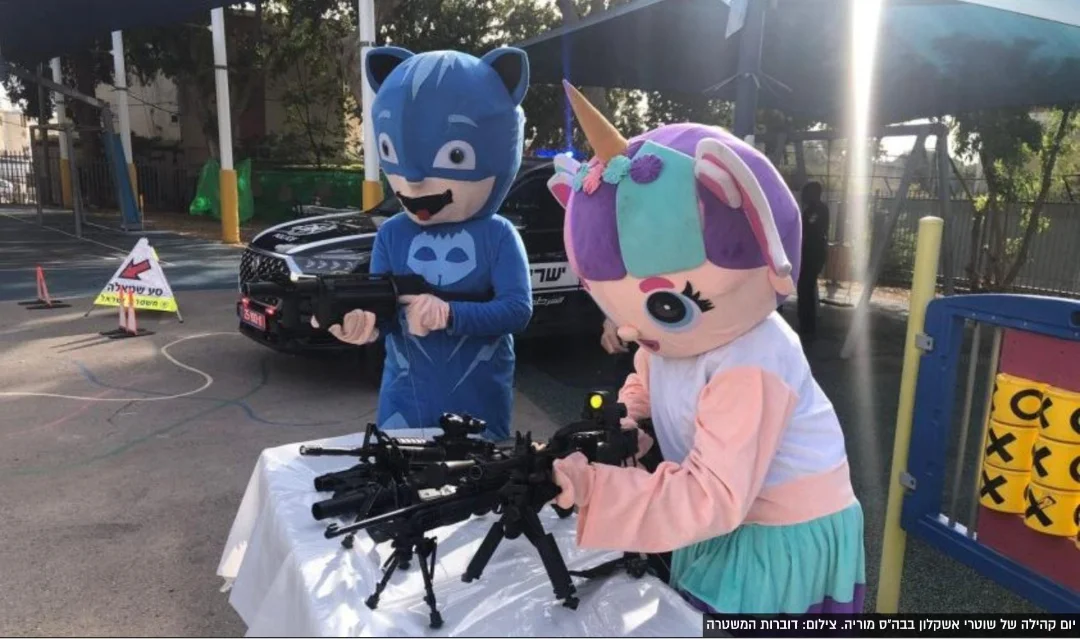
In Israel, indoctrination into militarism often begins early in life, as part of a multilayered process involving the government, education system, municipalities, parents and extended family, the media, youth movements, and peers, preparing kids for their future as soldiers.
And it also appears in capitalist consumer culture: the free market recognizes that militarism and militaristic values sell, and repackages them in different forms. Sometimes, as in the case of these puzzles, militarism is the product itself. More often, however, its language and imagery are used to market entirely different things: from beer and insurance to bank accounts and real estate. More examples will follow in this series on capitalist militarism.

Puzzles in a department store in Israel, March 2024. One of the puzzles is titled “Loving the IDF, We <3 IDF” and features illustrations of saluting soldiers, warplanes, a tank, a battleship, and a helicopter dropping bombs alongside the Israeli flag. A promotional sign reads: “3 for 100 shekels. Loving the IDF, Saluting the Soldiers"

Another puzzle in the same department store, titled “IDF puzzle”

"You already stood out in the platoon, what's your next peak? open day on Zoom, University of Haifa" [Tel Aviv University train station]

"Selling a property? Buying a property? Scan to avoid mistakes. I'm currently in reserve duty but my team is here at your service" [bus station, Haifa]

"Huge 5 room apartments in Dimona"

"WE WILL WIN. Bank Hapoalim" (referencing Israel's official wartime slogan, "Together We Will Win") [train station in Tel Aviv]
What forms does desire take in a militarized society? 3 ads for an Israeli lube brand


4 Posters by Municipalities

"IDF week for Jerusalem youth"

"Teenagers today, commanders tomorrow. IDF Day in Bat Yam. combat soldiers panel | corps exhibition | service stations and more. *for 11th-12th grade students"

“The Tel Aviv-Yafo Municipality is mobilizing for men and women reservists, active-duty soldiers, and their families. Full details on activities and benefits are available on the municipality’s website and app. Check it out now!”

“Thanks to the security, rescue and emergency forces” (right), “thanks to the men and women reservists" (left), "Haifa, thanks to the people"
Source: Militarized Realism on Instagram, via +972 Magazine.
The best photos community on the Fediverse.
Tag original photos as [OC].
Not allowed:
low quality content might get removed if deemed unworthy.


