top 50 comments

sorted by: hot top controversial new old
[–] 96 points 1 year ago (65 children)

Yeah but DLS would be a significant downgrade for many people, who already fight the suggestion to only eat meat six days a week tooth and nail.

https://pmc.ncbi.nlm.nih.gov/articles/PMC6013539/

https://pmc.ncbi.nlm.nih.gov/articles/PMC10537420/

https://pubs.acs.org/doi/suppl/10.1021/acs.est.3c03957/suppl_file/es3c03957_si_001.pdf

Things that count as DLS:

  • 10 m² of personal living space + 20 m² for every 4 ppl as bathroom / kitchen
  • 2100 kcal/day
  • 1400 kWh/year, but this already includes public services (education/healthcare)
  • 1 washing machine per 20 ppl
  • 2.4 kg clothing / year
  • wear tops for three days and bottoms for 15 days without washing
  • 1 laptop per 4 people with a yearly power consumption of 62 kWh. (bizzarely they talk about an 800 MHz computer and seem to confuse HDD and RAM). If your gaming computer used 400 W you could use it for 150 hr/year.
  • source
  • hideshow 65 child comments
  • [–] 65 points 1 year ago (9 children)

    I'm gonna need a lot more than 10 square meters of space if everyone is changing their shirts twice a week. Yuck.

  • source
  • parent
  • hideshow 9 child comments
  • [–] 10 points 1 year ago* (last edited 1 year ago) (8 children)
  • [–] 38 points 1 year ago (2 children)

    They live in a world where 700 million people are currently starving. Do you think you care about the washing machines if your children have nothing to eat?

  • source
  • parent
  • hideshow 2 child comments
  • [–] 14 points 1 year ago

    That's the heart of the issue, though, isn't it? Most people do care about the state of their washing machines even as countless children have nothing to eat. People chastise their kids for not eating their vegetables by saying "kids are starving in Africa," without doing anything to help any kids in Africa. People want more for themselves even while acknowledging that others have so much less. Studies like this assume that human selfishness is negligible, while it's actually one of the largest variables that needs to be factored in. Most people don't actually care about human suffering unless it's happening to someone they personally know - they care much more about their washing machine.

  • source
  • parent
  • load more comments (1 reply)
  • [–] 13 points 1 year ago* (2 children)

    You could double everything in this post too and that's only 60% consumption.

    • 20 m² of personal living space + 20 m² for every 2 ppl as bathroom / kitchen
    • 4200 kcal/day
    • 2800 kWh/year, but this already includes public services (education/healthcare)
    • 1 washing machine per 10 ppl
    • 2.4 kg clothing / 6 months
    • wear tops for 1.5 days and bottoms for 7.5 days without washing
    • 1 laptop per 2 people with a yearly power consumption of 62 kWh. (bizzarely they talk about an 800 MHz computer and seem to confuse HDD and RAM). If your gaming computer used 400 W you could use it for 300 hr/year.

    That seems a lot more reasonable to me and we still come in under carrying capacity

  • source
  • parent
  • hideshow 2 child comments
  • load more comments (2 replies)
  • load more comments (2 replies)
  • [–] 15 points 1 year ago (3 children)

    I am amazed by all the people that, when faced with having to give up some of the first-world luxury they are used to, flip completely in their head. It is the opposite of not-in-my-backyard: Don't take from my backyard, pls.

    Yes, I would rather have the current distribution continue, where hundreds of millions are literally starving, where there are people who would kill to live like this, where people are walking through the desert and taking dinghies over oceans for shit like this, just so I can have my amenities.

    Absolutely wild. We're so doomed.

  • source
  • parent
  • hideshow 3 child comments
  • load more comments (3 replies)
  • [–] 14 points 1 year ago (10 children)

    I'd argue that's a downgrade for most people. I personally exceed all of those bullet points and the idea of coming close to most of them sounds like Hell to me. If it meant 8.5 billion people met those standards, I could make the sacrifice, but it would be awful.

    Can you imagine if everyone you met was wearing a 3 days dirty shirt? Do other not sweat? And 2100 kcal per day is not safe or sustainable for almost anyone that exercises regularly.

  • source
  • parent
  • hideshow 10 child comments
  • [–] 23 points 1 year ago* (8 children)

    And 2100 kcal per day is not safe or sustainable for almost anyone that exercises regularly.

    I’m a woman with a relatively large frame (~65kg/180cm) who used to do 14 hours of hard cardio a week. At that time, my recommendation was 2250, the first time in my life it had exceeded 2k. For smaller women, the recommendation is sometimes much lower. My stepsister is about 45kg and 155cm tall and her calculated daily calorie burn is like 1300. My ex boyfriend’s mom was told not to go over 1200, which I thought was the lower limit for humans generally- things are different when you’re a short, post-menopausal woman.

    All that is to say, it’s probably an average of 2100 calories, spread between people who need on average 1400-1800 calories and those who need 2000-2400

  • source
  • parent
  • hideshow 8 child comments
  • [–] 11 points 1 year ago (2 children)

    That's fair. My take was shallow and I was thinking more from personal experience. I'm ~200lbs and burn over 100 kcal every mile I run, and am a distance athlete. If I jog 6 miles or bike 20+, I have to replace that for proper recovery.

    I shouldn't say most people, but a large amount of people need more than 2100 kcal if they are active.

  • source
  • parent
  • hideshow 2 child comments
  • load more comments (5 replies)
  • load more comments (1 reply)
  • load more comments (23 replies)
    [–] 56 points 1 year ago (6 children)

    There was 3.7 billion people when I was born. Since I'm still alive we can guess that's within a human lifetime.

    Since I was born, 73% of the animals on Earth are gone. Our ecosystems are already crashed, and no one notices.

    Remember COVID? When everyone stayed home and quit buying shit, laid low? Remember Venice seeing dolphins in the streets and Asians seeing mountains you couldn't see before? Remember how quiet it was?

    SOCIETY can provide, EARTH cannot. Y'all gonna have to die. But hey, between global warming and tanking birth rates fucking our economies in both holes, win, win! The contraction will be of Biblical proportions. I won't live it, my kids will. Good luck kids!

  • source
  • hideshow 6 child comments
  • load more comments (5 replies)
    [–] 55 points 1 year ago (2 children)

    This is one of the things that pisses me off about the Star Trek "fans" who point to the Replicator tech (which wasn't introduced until the Next Generation series) as the reason humanity was able to end scarcity. No, it absolutely was not what ended scarcity in the Star Trek universe. What ended scarcity was the absolute end of capitalism. We have now and have had for over a century, the capability to end world hunger and provide housing for every man woman and child on the planet. We don't do it because it would remove the overinflated value of those things as well as the obscene wealth of the rich.

  • source
  • hideshow 2 child comments
  • load more comments (1 reply)
    [–] 29 points 1 year ago

    Most of the 8 billon people are living in the third world and which less resources waste, most recources a wasted by less than 10% of the world population.

  • source
  • [–] 28 points 1 year ago (24 children)

    Does this assume instant, frictionless transportation of goods?

  • source
  • hideshow 24 child comments
  • load more comments (6 replies)
    [–] 27 points 1 year ago (5 children)

    Why can’t we just have fewer people too? Instead of finding ways to support 50 billion people, how about we have good birth control facilities, education, and economies not based on constant never ending growth? The reality is unending growth WILL end whether people like it or not- wouldn’t it be better to do it on our own terms rather than in a global catastrophe?

  • source
  • hideshow 5 child comments
  • [–] 14 points 1 year ago* (last edited 1 year ago)

    wouldn’t it be better to do it on our own terms rather than in a global catastrophe?

    The catastrophy is inevitable, it's just a question of whether any humans will survive.

    For example CO2 has a delayed effect of ~40years (if I remember correctly). The effects of global warming are very much obvious now, but the yearly output hasn't at any point dropped to those levels since.

  • source
  • parent
  • [–] 13 points 1 year ago

    Why can’t we just have fewer people too?

    Won't somebody think of the ECONOMY?

    A lot of countries around the world are living a so called "underpopulation crisis" even though the population is still growing frighteningly fast. Population going down is only a problem for capitalism, and it's going to doom us all

  • source
  • parent
  • load more comments (3 replies)
    [+] 26 points 1 year ago* (last edited 4 months ago)
    [–] 25 points 1 year ago (3 children)

    Technically, earth's land area is big enough to sustain around 24 billion people. Consider this diagram:
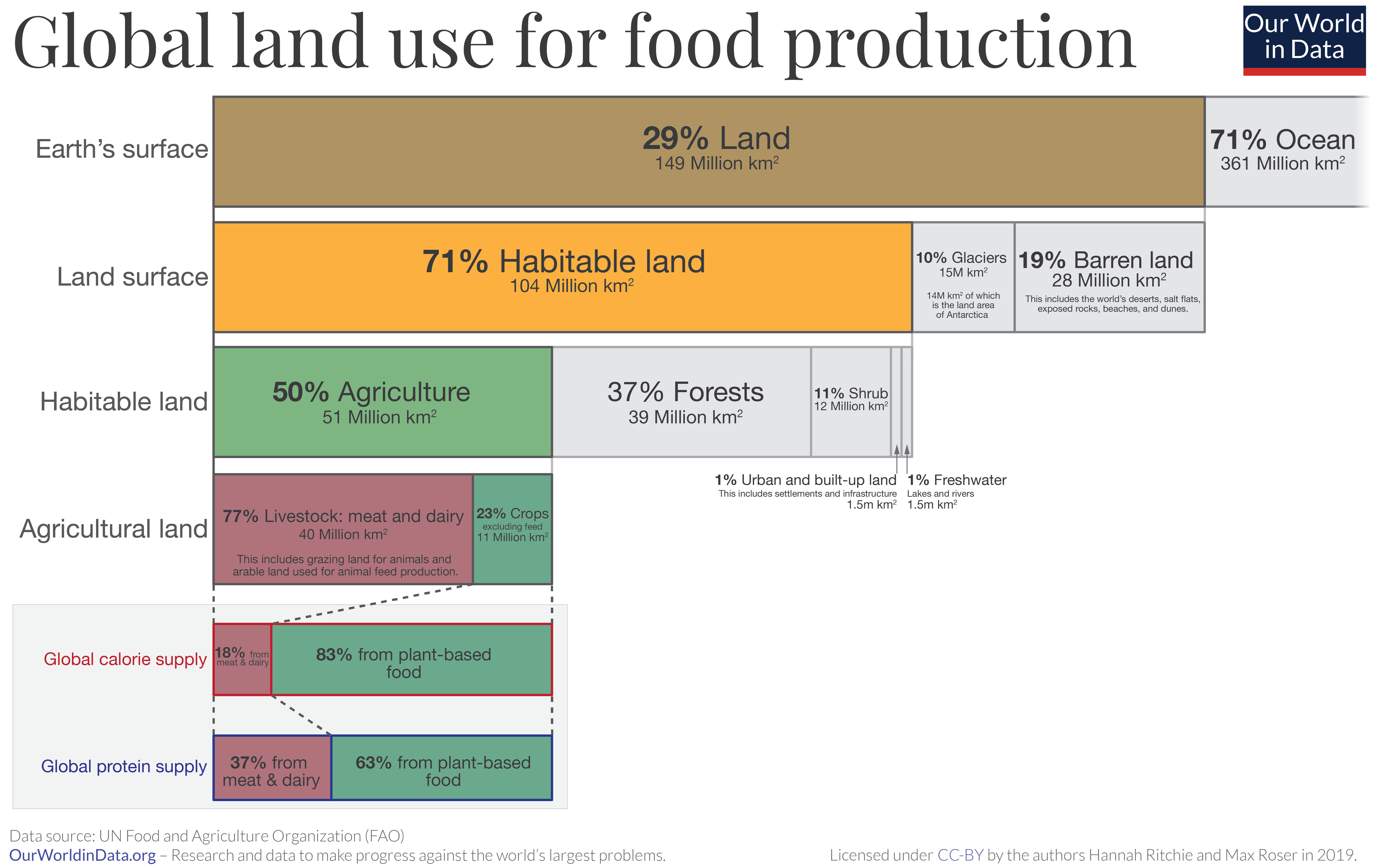
    It shows that we're using around 50% of all habitable land for agriculture. Most of the land that we aren't using is either high up in the mountains (where terrain isn't flat and you can't use heavy machinery) or in the tropical regions on Earth close to the equator (south america, central africa, indonesia), or in areas where it's too cold for agriculture (sibiria, canada). so you can't really use more agricultural land than we're already using without cutting down the rainforest.

    In the diagram it also says that we're using only 23% of agricultural land for crops which produce 83% of all calories. If we used close to 100% of agricultural land for crops, it would produce approximately 320% of calories currently being produced, so yes, we could feed 3x the population this way.

    However, it must be noted that there's significant fluctuation in food production per km², for example due to volcanic eruptions. So it's better to leave a certain buffer to the maximum amount of people you could feed in one year, because food shortages in another year would otherwise lead to bad famines.

  • source
  • hideshow 3 child comments
  • load more comments (3 replies)
    [–] 24 points 1 year ago* (last edited 1 year ago) (50 children)

    Reading the study I get the following remarks:

    Living space, not great. 60m2 for a 4 person family. That's tight. I live alone in a 90m2 house and I could use more space, do they want me to live in a 15m2 house or do they want to force to share living space? Sorry but I won't compromise there. I prefer people having less children that me having to live as ants in a colony.

    That is just a personal pick with the DLS minimum requirements chosen.

    But still forgetting that. The reasoning is extremely faulty. Most of their argumentation heavy lifting is just relied to Millward-Hopkins (2022) paper establishing that 14.7 GJ per person anually is enough. That paper is just a work of fantasy. For reference, and taking the same paper numbers. Current energy usage (with all the exiting poverty) is 80 GJ/cap. Paleolitic use of energy was 5 GJ. Author is proposing that we could live ok with just triple paleolitic energy. That paper just oversees a lot of what people need to live in a function society to get completely irrational numbers on what energy cap we could assume to produce a good life.

    Then on materials used. The paper assumes all the world shifting to vegetarian diet, everyone living on multiresidential buildings, somehow wood as the main building material (I don't know how they even reconcile that with multiresidential buildings...). And half of cars usage shifting to public transport How to achieve this in rural areas it's not mentioned at all).

    A big notice needs to be done that both papers what are actually doing is basically taking China economy (greatly praised in the introduction) and assuming that all the world should live like that. And yes, probably the world could have 30 billion inhabitants if we accept to be all like China, who would we export to achieve that economic model if we all have a export based economy? who knows, probably the martians. And even then, while a lot of "ticks" on what a decent level of life quality apparently seems to be ticked, many people in western countries would not consider that quality life, but a very restrictive and deprived life standard.

    I'm still on the boat the people having less children is a better approach to great lives without destroying the planet. At some point a cap on world population need to be made, it really add that much that the cap is 30 billion instead of maybe 5 billion? It's certainly not a cap in the number of social iterations a person can have, but numbers give for plenty of friends. And at the end it's not even a cap on "how many children" can people have, as once the cap is reach the number of children will be needed to cap the same to achieve stability. It's just a cap on "when people can still be having lots of kids". Boomer approach to "let's have children now" and expect that my kids won't want to have as many children as I have now.

    Also another big pick I have with the article is that it blames the current level of inefficiency to private jets, suvs, and industrial meat. But instead of making the rational approach of taking thise appart from the current economy and calculate what the results will be. Parts from zero building the requirements out of their list. Making the previous complaint about those luxury items out of place completely

  • source
  • hideshow 50 child comments
  • load more comments (50 replies)
    [–] 21 points 1 year ago (5 children)

    Define 'decent living standards'.

  • source
  • hideshow 5 child comments
  • [–] 16 points 1 year ago

    I think Maslow's pyramid of needs would be a good starter. But let's be more concrete.

    • House (60 m2, +20 m2 per extra person in household), with electrification, and which can withstand severe weather events (heatwaves, blizzards, heavy rain and wind, etc.).

    • Clean air and environment without fine dust, microplastics, PFAS, asbestos, etc.

    • Clean, potable and heatable water available anytime

    • Healthy and clean food free from animal suffering made available for all

    • Everyday and affordable clothes available for all

    • Bodily integrity: only the person themselves can decide over their own body, with the exception of vaccination (because everyone ought to be vaccinated!)

    • Labour rights, such as automatic unionisation, workplace democracy and self-governance, no vertical hierarchy (so no CEO, overreaching holdings, trusts, etc). And ideally, a wageless gift economy system based on needs. If not that, then this: any company lacking one of the above/being too big, may never get bailed out.

    • Protection of personal property, with private property becoming communal property instead.

    • Encouragement of meeting people at sport, hobbies, reading (helps finding friendship)

    • Bicycle and public transit infrastructure being widely available.

    • Free and high-quality public education available for all

    • Same with healthcare. No artificial limit mandating that there be max x amount of doctors or teachers.

  • source
  • parent
  • [–] 14 points 1 year ago (2 children)

    I'm sure they define that in the study if you read it

  • source
  • parent
  • hideshow 2 child comments
  • [–] 22 points 1 year ago* (1 child)

    Well would you look at that, it sure does.

    https://www.sciencedirect.com/science/article/pii/S2452292924000493

    Recent empirical studies have established the minimum set of specific goods and services that are necessary for people to achieve decent-living standards (DLS), including nutritious food, modern housing, healthcare, education, electricity, clean-cooking stoves, sanitation systems, clothing, washing machines, refrigeration, heating/cooling, computers, mobile phones, internet, transit, etc. This basket of goods and services has been developed through an extensive literature (e.g., Rao and Min, 2017, Rao et al., 2019) and is summarized in Table 1, following Millward-Hopkins (2022).

  • source
  • parent
  • hideshow 1 child comment
  • load more comments (1 reply)
    [–] 19 points 1 year ago (1 child)

    The design choices of people who make memes out of their political opinions are so random and funny to me sometimes. Like why is one of them a Russian gopnik? Why is the other one a blushing gamer femboy who paints his nails??

  • source
  • hideshow 1 child comment
  • load more comments (1 reply)
    [–] 19 points 1 year ago (6 children)

    Oh, I know!

    wE sHoULd KiLl HalF oF ThEm

  • source
  • hideshow 6 child comments
  • [–] 17 points 1 year ago* (last edited 1 year ago) (4 children)

    I was going to say "No one is saying that", but there are many going down that road.

    The preferable approach is degrowth. A lower birthrate leading to a smaller population with no deaths required, just vastly fewer births and lower consumption until human civilization can not only fit with our planetary boundaries, but restore a lot of wildlife and wildlands, then stabilize at a population and consumption that is healthy and comfortable.

  • source
  • parent
  • hideshow 4 child comments
  • load more comments (4 replies)
  • load more comments (1 reply)
    [–] 17 points 1 year ago (8 children)

    I know the world has more than enough resources and productivity for everyone on it to live comfortably without overworking, but 30% is the lowest figure I’ve ever seen. Would like to know where that came from. I’ve seen so many widely varying estimates of everything.

  • source
  • hideshow 8 child comments
  • load more comments (8 replies)
    [–] 15 points 1 year ago

    I agree that we can support everyone on earth if we change our social, economic, and political systems.

    I also think it is good that voluntary population decline is already happening and seems likely to continue in many industrialized nations.

  • source
  • [–] 12 points 1 year ago (3 children)

    But image if we can provide so much for 8.5 billion, it means we can provid double for 4 billion. There is no reasonable excuse to keep increasing the human population.

  • source
  • hideshow 3 child comments
  • load more comments (3 replies)
    load more comments
    view more: next ›