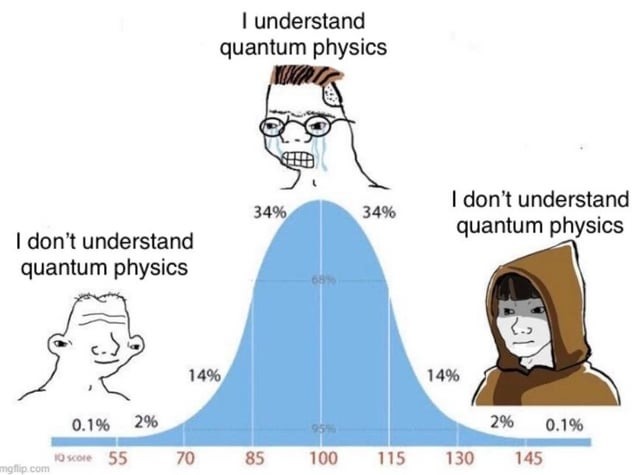
Do I understand the physical and philosophical ramifications of quantum physics? No.
Do I understand the mathematical machinery of quantum physics and how to do calculations for quantum systems? Also no, but I'm working on it.
Do I understand the physical and philosophical ramifications of quantum physics? No.
Do I understand the mathematical machinery of quantum physics and how to do calculations for quantum systems? Also no, but I'm working on it.
This implies the majority of people believe they understand quantum mechanics, which I'm sure is not true. In reality, the overwhelming majority of people would say they don't understand quantum physics.
Bell curve is the wrong meme format for what you're trying to convey
I misread and thought top guy was also saying he didn't understand quantum physics, and thought it was a way better meme than it was.
Probably the bell curve of physics students, and not just of all people on Earth.
This meme is bullshit.
Yes, there are a lot of intuitive understandings in the literature if you're willing to look for it. The problem is that most people believe in a Newtonian view of the world which just is not compatible with quantum physics, so it requires you to alter some philosophical beliefs, and physics professors don't really want to get into philosophical arguments, so it's not really possible to reach a consensus on the question in physics departments. Even worse, there's rarely a consensus on anything if you go to the philosophy department. So it's not really that there are not very simple and intuitive ways to understand quantum mechanics, it's that it's not possible to get people to agree upon a way to interpret it, so there is a mentality to just avoid interpretation at all so that students don't get distracted from actually understanding the math.
Yeah maybe shift the X scale by 40 IQ points and it would be more accurate.
I'm often reminded of a cartoon I saw years ago, with a stereotypical Einsteinish physicist standing in front of a chalkboard, looking at this enormously complex formula with a big blank space in the middle of it. Then he gets a "eureka" expression and starts writing in the blank space. Then he steps back, and you can see that he's filled the blank space with "and then something happens".
Im lost but at least i know how fast i am.
For me, a hurdle to get over was trying to understand in the context of my experience of the world. Like, popsci has this whole "is X a wave or a particle? Scientists still don't know..." schtick. And our understanding at some level is, "here's the math to describe this system."
Getting away from always mapping that onto the world we experience is, IMHO, really important. Not that it should be understood solely as math, by any means! But you really need to throw away intuition gained from the macroscopic world we interact with.
My favorite example was looking at reflection coefficients and seeing that an "infinite wall" is the same as an "infinite cliff"
you'll reflect off of both. Which makes zero sense if you imagine driving a bumper car into a wall (bounce back) vs. over an infinite cliff! But it does me make sense in its own way, and after building up intuition, so do other "weird" and counterintuitive things.
Waves are underrated in pop-sci context. Even classical waves you can make with household items like strings can have counterintuitive and cool behaviors!
Absolutely. As a kid I liked to see how many nodes I could get into 'simple' system of rotating a jump rope tied to something fixed at one end. I can't say my understanding of harmonics is great now, but I can at least relate it to personal experience.
Understanding classical waves better is what helped me wrap my mind around the physical meaning of the uncertainty principle. It's not a technical limitation, and it's not just because you need to interact with something to measure it. It's just a property of waves. Since small enough particles exhibit the properties of waves, it only makes sense that we can't know their location and momentum at the same time with arbitrary precision.
The velocity of a wave is a function of its frequency and wavelength. But imagine a highly localized wave, essentially just a peak. What's its frequency? Well, we find that it doesn't have one frequency! If you decompose the wave, you find its mathematically a superposition of multiple sine or cosine functions with different frequencies and therefore velocities. So the more localized the wave is, i.e the more you know its position, the less and less you know about its frequency and therefore velocity.
This stuff blew my mind when it was first explained to me.
More like: I don't understand quantum physics => I think I sort of understand this one thing => wait, I was wrong => I don't understand quantum physics
all 28 comments