top 50 comments

sorted by: hot top controversial new old
[–] 284 points 2 years ago (17 children)

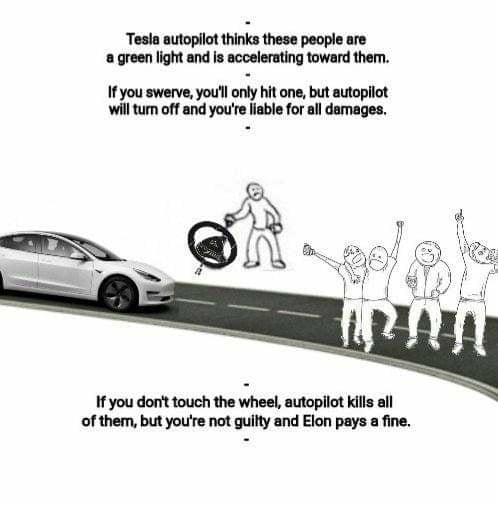
The autopilot will turn off just before hitting them to make you liable anyway

  • source
  • hideshow 17 child comments
  • [–] 67 points 2 years ago (8 children)

    That’s only if you didn’t subscribe to the Ludicrous package.

  • source
  • parent
  • hideshow 8 child comments
  • [–] 7 points 2 years ago (3 children)

    Autopilot turns off because the car doesn't know what to do and the driver is supposed to take control of the situation. The autopilot isn't autopilot, it's driving assistance and you want it to turn off if it doesn't know what it's should do.

  • source
  • parent
  • hideshow 3 child comments
  • load more comments (1 reply)
  • load more comments (3 replies)
    [–] 124 points 2 years ago (12 children)

    This reminds me of that Chinese law about being personally responsible for all medical debts of a person you run over—incentivizing killing the person, rather than injuring them.

  • source
  • hideshow 12 child comments
  • [–] 42 points 2 years ago (9 children)

    I've seen this in comments a lot but never a source, do you happen to have one?

  • source
  • parent
  • hideshow 9 child comments
  • [–] 29 points 2 years ago (2 children)

    Only source seems to be this Slate article:

    https://slate.com/news-and-politics/2015/09/why-drivers-in-china-intentionally-kill-the-pedestrians-they-hit-chinas-laws-have-encouraged-the-hit-to-kill-phenomenon.html

    In respect to that specific Slate article, Snopes had some issues with it and labeled the story as “unproven”:

    https://www.snopes.com/fact-check/chinese-drivers-kill-pedestrians/

    The Snopes article does a nice job of pointing out the Slate article’s issues.

  • source
  • parent
  • hideshow 2 child comments
  • [–] 9 points 2 years ago

    You're right about the Snopes article. It does do a decent job of pointing out that a lot of this reporting is rumor based.

    This first anecdote (also highlighted by Snopes) is amusing

    Double-hit cases" have been around for decades. I first heard of the "hit-to-kill" phenomenon in Taiwan in the mid-1990s when I was working there as an English teacher. A fellow teacher would drive us to classes. After one near-miss of a motorcyclist, he said, "If I hit someone, I'll hit him again and make sure he's dead." Enjoying my shock, he explained that in Taiwan, if you cripple a man, you pay for the injured person's care for a lifetime. But if you kill the person, you "only have to pay once, like a burial fee." He insisted he was serious—and that this was common.

    So is it Taiwan or the mainland with these wild laws?

    Another false claim about China, it seems.

  • source
  • parent
  • load more comments (1 reply)
  • load more comments (6 replies)
  • [–] 15 points 2 years ago

    That rumor is so stupid it doesn't even begin to stack up. Paying medical bills sucks, but killing someone even unintentionally puts you at risk of jail time. Vanishingly few people are going to choose a decade or more of hard labor in jail over paying a debt.

    The only thing this whole rumor proves is that people will believe the most irrational things about China as long as it makes Chinese people look bad.

  • source
  • parent
  • load more comments (1 reply)
    [–] 77 points 2 years ago

    You will be liable either way. If you don’t do anything, you broke the terms of not being attentive enough.

  • source
  • [–] 59 points 2 years ago (21 children)

    I hope this isn't law anywhere. You're liable for your car no matter what. You have to take control if necessary

  • source
  • hideshow 21 child comments
  • [–] 42 points 2 years ago (4 children)

    I saw a headline about Mercedes offering an autopilot that doesn't require the driver to monitor, so it's going to be interesting to see how laws play out. The Waymo taxi service in Phoenix seems to occasionally run in with the law, and a remote service advisor has to field the call, advising the officer the company is responsible for the car's behavior, not the passenger.

  • source
  • parent
  • hideshow 4 child comments
  • [–] 26 points 2 years ago (3 children)

    So in theory the manufacturer takes responsibility because they trust their software. This puts the oness on them and their insurance, thereby reducing your insurance considerably. In actuality your insurance doesn't go down because insurance companies.

  • source
  • parent
  • hideshow 3 child comments
  • load more comments (1 reply)
  • [+] 33 points 2 years ago (14 children)
  • [–] 24 points 2 years ago* (12 children)

    When autonomous cars are good enough to just drive people around then yeah the companies should be liable, but right now they're not and drivers should be fully alert as if they are driving a regular vehicle.

  • source
  • parent
  • hideshow 12 child comments
  • load more comments (11 replies)
  • load more comments (1 reply)
  • [–] 56 points 2 years ago* (16 children)

    I’m not aware of a single jurisdiction on the planet that makes Tesla liable for what the vehicle does when autopilot is enabled. In order to activate autopilot you have to accept about 3 different disclaimers on the car’s screen that state VERY clearly how you are still responsible for the vehicle and you must intervene if it starts behaving dangerously.

    I’ve been driving with autopilot for over 2 years, and while it has done some stupid stuff before (taking wrong turns, getting in the wrong lane, etc.), it has NEVER come close to hitting another vehicle or person. Any time something out of the ordinary happens, I disengage autopilot and take over.

  • source
  • hideshow 16 child comments
  • [–] 69 points 2 years ago (14 children)
  • [–] 32 points 2 years ago (12 children)

    Bro bought a Tesla just 2 years ago. Long after it was very widely known just how much of an arsehole Musk was, and after many other excellent EVs were on the market.

    I'll let you draw the conclusions from those facts.

  • source
  • parent
  • hideshow 12 child comments
  • When I bought my car, there were no widespread plans for other manufactures to adopt NACS, you couldn’t get your hands on a Rivian for less than $100k, and I was commonly driving long distances for work so I needed a vehicle with long range that I could charge quickly on trips. Tesla checked all the boxes.

    I haven’t experienced any of these super widespread quality or reliability issues people on the internet talk about. It was delivered with no issues, has needed very little maintenance (just tire rotations basically), and it’s not falling apart like some would lead you to believe. I don’t know what to say other than that my personal experience with the vehicle has been great, and that’s what I really care about in a vehicle. I don’t buy cars based off what the CEO says on Twitter.

  • source
  • parent
  • load more comments (11 replies)
  • load more comments (1 reply)
  • load more comments (1 reply)
    [–] 53 points 2 years ago (9 children)
  • [–] 45 points 2 years ago (5 children)

    WRONG!!!

    Hard braking may increase your insurance costs: https://www.nytimes.com/2024/03/11/technology/carmakers-driver-tracking-insurance.html

    TL;DR: General Motors was selling customer driving data to LexisNexis which provided them to insurance companies. Hard braking also contributed to a higher risk factor.

  • source
  • parent
  • hideshow 5 child comments
  • load more comments (2 replies)
  • [–] 25 points 2 years ago* (9 children)

    Even with autopilot I feel it's unlikely that driver would not be liable. We didn't have a case yet but once this happens and goes higher to courts it'll immediatly establish a liability precedence.

    Some interesting headlines:

    So I'm pretty sure that autopilot drivers would be found liable very fast if this developed further.

  • source
  • hideshow 9 child comments
  • [–] 11 points 2 years ago (1 child)

    I am not a lawyer.

    I think an argument can be made that a moving vehicle is no different than a lethal weapon, and the autopilot, nothing more than a safety mechanism on said weapon. Which is to say the person in the driver's seat is responsible for the safe operation of that device at all times, in all but the most compromised of circumstances (e.g. unconscious, heart attack, taken hostage, etc.).

    Ruling otherwise would open up a transportation hellscape where violent acts are simply passed off to insurance and manufacturer as a bill. No doubt those parties would rush to close that window, but it would be open for a time.

    Cynically, a corrupt government in bed with big monied interests would never allow the common man to have this much power to commit violence. Especially at their expense, fiscal or otherwise.

    So just or unjust, I think we can expect the gavel to swing in favor of pushing all liability to the driver.

  • source
  • parent
  • hideshow 1 child comment
  • load more comments (1 reply)
  • load more comments (7 replies)
    [–] 22 points 2 years ago (2 children)

    Slam on the breaks but oh no you drive a cybertruck and the break petal stops working

  • source
  • hideshow 2 child comments
  • [–] 21 points 2 years ago* (10 children)

    The cover-your-ass scenario.

    In the Philosophy Crash Course there was a scenario like this. I'll paraphrase:

    You're a traveler exploring a semi-devloped nation in South America. Coming out of the wilderness you come across a squad of soldiers. They are forcing twenty villagers to dig a mass grave. The officer to the soldiers tells you these villagers committed the state crime of supporting a rival to their leader, and are to be executed. But as you are a guest in their country, he will make you an offer: if you shoot one of them, yourself, he will set all the rest free, and then can hike to the border and beg for asylum. (A rough trek, but the neighboring country may take them).

    Do you shoot one of the villagers?

    Actually killing someone is rather hard on the psyche, and most of us cannot bear the thought (and might suffer from trauma as a result). But then, perhaps this is a small price to pay for nineteen human lives.

    Thomas Aquinas and Kant were happy to let the soldiers kill the villagers so as to avoid committing the sin of murder, themselves. Aquinas and Kant even would not lie to the murderer at the door, or Nazi Jew-hunters to save the lives of fugitives hidden in their home, since lying was sin enough, and they would count on God to know His own. Both had contemporaries who disagreed, and felt it was proper to suffer the trauma and do what was necessary (assuming the officer of the soldiers seemed inclined to keep to his word and actually spare the remaining villagers.)

    So, the cover your own ass response has a long history of backers, including known philosophers.

  • source
  • hideshow 10 child comments
  • load more comments (10 replies)
    [–] 16 points 2 years ago* (last edited 2 years ago) (26 children)

    The funny part will be once the car doesn't have a driver and is full autonomous. If the car kills someone, who's to blame?

  • source
  • hideshow 26 child comments
  • load more comments (11 replies)

    this is funny and all, but it doesn't matter what you're doing here, you're technically liable for all of them so uh.

    I'll wait for a better version of this.

  • source
  • [–] 8 points 2 years ago (1 child)

    I'm sorry, but this is the vanilla trolley problem. Save all but one or avoid going to jail.

  • source
  • hideshow 1 child comment
  • load more comments
    view more: next ›