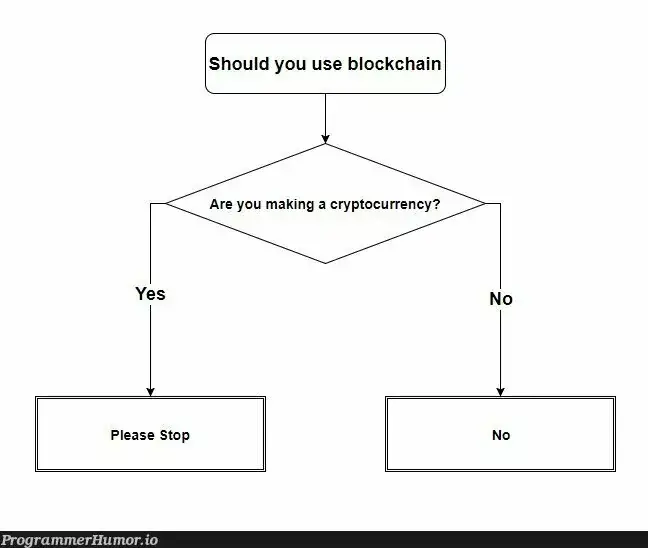
▲ 1298 ▼ Please Stop (jlai.lu) submitted 2 years ago by ElCanut@jlai.lu to c/lemmyshitpost@lemmy.world 412 comments fedilink hide all child comments
[–] uis@lemm.ee 15 points 2 years ago (2 children) You can revert transactions with immutable storage. For example git can do revert-commits. permalink fedilink source parent hideshow 4 child comments replies: [–] OneCardboardBox@lemmy.sdf.org 13 points 2 years ago Reverts work because users have equal write access to all the data. You can mess things up in the codebase, and even if you die of a heart attack 10m later, my revert is just as valid as your commit. It's not really the same when every user has "sovereignty" over their address in the ledger. A bad actor has to consent to pushing a revert transaction onto the chain, or they have to consent to using a blockchain system where 3rd-party reversion is possible (which exists on some systems, but also defeats the concept of true sovereignty over your address). permalink fedilink source parent [–] Knock_Knock_Lemmy_In@lemmy.world 4 points 2 years ago (1 child) So, would the bitcoin equivalent be sending the BTC back? permalink fedilink source parent hideshow 2 child comments replies: [–] HaywardT@lemmy.sdf.org 2 points 2 years ago (1 child) Yes. Clawback might be executed by having some entity or system of trust that is able to reverse a transaction by creating and posting the opposite of the faulty transaction. This is not built in to the current BTC. permalink fedilink source parent hideshow 2 child comments replies: [–] nothead@lemmy.world 4 points 2 years ago (1 child) Its a good concept, but it violates other concepts of the blockchain and would mean implementing a central authority with the power to force a transaction. Try telling a cryptobro to use a coin with a central bank and imagine the reaction you'd get. At least with the way the regular banking system is set up, you can get a court order to enforce a correction without needing the consent of all parties, which is useful for fraud, theft, and even probate cases when one party is deceased and can no longer consent to a transaction. There are enough problems with our system to write an entire library of books ON TOP OF the library that already exists, but this feature is one of the few benefits. permalink fedilink source parent hideshow 2 child comments replies: [–] HaywardT@lemmy.sdf.org 1 point 2 years ago It could be done on a blockchain. It doesn't require a central authority. It could be escrow-based. It could use majority rule or even Monte Carlo methods. permalink fedilink source parent
[–] OneCardboardBox@lemmy.sdf.org 13 points 2 years ago Reverts work because users have equal write access to all the data. You can mess things up in the codebase, and even if you die of a heart attack 10m later, my revert is just as valid as your commit. It's not really the same when every user has "sovereignty" over their address in the ledger. A bad actor has to consent to pushing a revert transaction onto the chain, or they have to consent to using a blockchain system where 3rd-party reversion is possible (which exists on some systems, but also defeats the concept of true sovereignty over your address). permalink fedilink source parent
[–] Knock_Knock_Lemmy_In@lemmy.world 4 points 2 years ago (1 child) So, would the bitcoin equivalent be sending the BTC back? permalink fedilink source parent hideshow 2 child comments replies: [–] HaywardT@lemmy.sdf.org 2 points 2 years ago (1 child) Yes. Clawback might be executed by having some entity or system of trust that is able to reverse a transaction by creating and posting the opposite of the faulty transaction. This is not built in to the current BTC. permalink fedilink source parent hideshow 2 child comments replies: [–] nothead@lemmy.world 4 points 2 years ago (1 child) Its a good concept, but it violates other concepts of the blockchain and would mean implementing a central authority with the power to force a transaction. Try telling a cryptobro to use a coin with a central bank and imagine the reaction you'd get. At least with the way the regular banking system is set up, you can get a court order to enforce a correction without needing the consent of all parties, which is useful for fraud, theft, and even probate cases when one party is deceased and can no longer consent to a transaction. There are enough problems with our system to write an entire library of books ON TOP OF the library that already exists, but this feature is one of the few benefits. permalink fedilink source parent hideshow 2 child comments replies: [–] HaywardT@lemmy.sdf.org 1 point 2 years ago It could be done on a blockchain. It doesn't require a central authority. It could be escrow-based. It could use majority rule or even Monte Carlo methods. permalink fedilink source parent
[–] HaywardT@lemmy.sdf.org 2 points 2 years ago (1 child) Yes. Clawback might be executed by having some entity or system of trust that is able to reverse a transaction by creating and posting the opposite of the faulty transaction. This is not built in to the current BTC. permalink fedilink source parent hideshow 2 child comments replies: [–] nothead@lemmy.world 4 points 2 years ago (1 child) Its a good concept, but it violates other concepts of the blockchain and would mean implementing a central authority with the power to force a transaction. Try telling a cryptobro to use a coin with a central bank and imagine the reaction you'd get. At least with the way the regular banking system is set up, you can get a court order to enforce a correction without needing the consent of all parties, which is useful for fraud, theft, and even probate cases when one party is deceased and can no longer consent to a transaction. There are enough problems with our system to write an entire library of books ON TOP OF the library that already exists, but this feature is one of the few benefits. permalink fedilink source parent hideshow 2 child comments replies: [–] HaywardT@lemmy.sdf.org 1 point 2 years ago It could be done on a blockchain. It doesn't require a central authority. It could be escrow-based. It could use majority rule or even Monte Carlo methods. permalink fedilink source parent
[–] nothead@lemmy.world 4 points 2 years ago (1 child) Its a good concept, but it violates other concepts of the blockchain and would mean implementing a central authority with the power to force a transaction. Try telling a cryptobro to use a coin with a central bank and imagine the reaction you'd get. At least with the way the regular banking system is set up, you can get a court order to enforce a correction without needing the consent of all parties, which is useful for fraud, theft, and even probate cases when one party is deceased and can no longer consent to a transaction. There are enough problems with our system to write an entire library of books ON TOP OF the library that already exists, but this feature is one of the few benefits. permalink fedilink source parent hideshow 2 child comments replies: [–] HaywardT@lemmy.sdf.org 1 point 2 years ago It could be done on a blockchain. It doesn't require a central authority. It could be escrow-based. It could use majority rule or even Monte Carlo methods. permalink fedilink source parent
[–] HaywardT@lemmy.sdf.org 1 point 2 years ago It could be done on a blockchain. It doesn't require a central authority. It could be escrow-based. It could use majority rule or even Monte Carlo methods. permalink fedilink source parent