you are viewing a single comment's thread
view the rest of the comments
[–] 47 points 2 years ago* (last edited 2 years ago) (7 children)

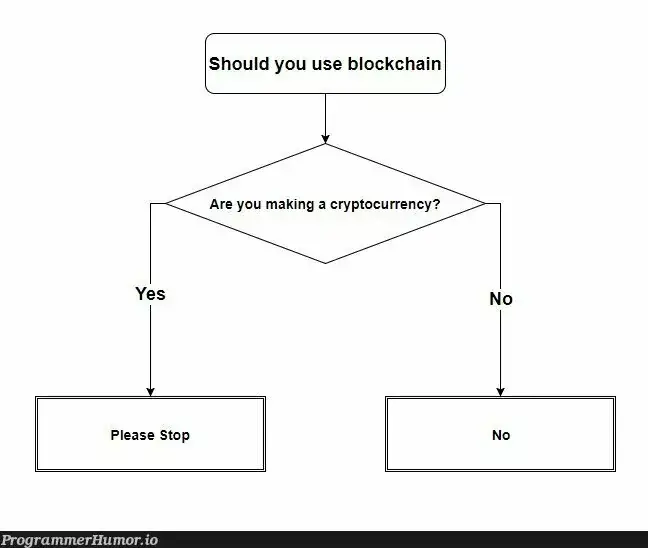
as hostile as people are to block chain due to NFT's and bad implementations, the technology itself has its use cases. It's a great solution for information exchange that requires verification and Immutation. This makes them perfect for ledgers or transaction networks.

It's just there is so much bad PR regarding it everyone just discredits it. Not all of the block chain technologies are massively energy intensive per transaction, it's just many of the cryptocurrencies use the most intensive one because it's also arguably the most secure

  • source
  • hideshow 14 child comments
  • [–] 35 points 2 years ago (2 children)

    Absolute immutability is kind of a terrible property for a financial system though, cos it completely ignores the fact that mistakes and fraud happen and you need a way to forcefully recover funds other than "lol sucks to be you I guess".

    The one actually genuinely useful application for this kind of technology that anyone has come up with is Certificate Transparency, but crypto people don't get excited about it cos it's not possible to make money from it.

  • source
  • parent
  • hideshow 4 child comments
  • [–] 17 points 2 years ago (1 child)

    You can implement clawback while still having an immutable blockchain. The transaction will always stay on the blockchain, but the funds can be recovered

  • source
  • parent
  • hideshow 2 child comments
  • [–] 17 points 2 years ago

    this is how it should be anyway, you do not want any ledger or database to be mutable because it allows for integrity violations and will cause you to lose the ability to trust it. Even non-blockchain styles follow that principle.

  • source
  • parent
  • [–] 15 points 2 years ago (2 children)

    You can revert transactions with immutable storage. For example git can do revert-commits.

  • source
  • parent
  • hideshow 4 child comments
  • [–] 13 points 2 years ago

    Reverts work because users have equal write access to all the data. You can mess things up in the codebase, and even if you die of a heart attack 10m later, my revert is just as valid as your commit.

    It's not really the same when every user has "sovereignty" over their address in the ledger. A bad actor has to consent to pushing a revert transaction onto the chain, or they have to consent to using a blockchain system where 3rd-party reversion is possible (which exists on some systems, but also defeats the concept of true sovereignty over your address).

  • source
  • parent
  • [–] 4 points 2 years ago (1 child)

    So, would the bitcoin equivalent be sending the BTC back?

  • source
  • parent
  • hideshow 2 child comments
  • [–] 2 points 2 years ago (1 child)

    Yes. Clawback might be executed by having some entity or system of trust that is able to reverse a transaction by creating and posting the opposite of the faulty transaction. This is not built in to the current BTC.

  • source
  • parent
  • hideshow 2 child comments
  • [–] 4 points 2 years ago (1 child)

    Its a good concept, but it violates other concepts of the blockchain and would mean implementing a central authority with the power to force a transaction. Try telling a cryptobro to use a coin with a central bank and imagine the reaction you'd get.

    At least with the way the regular banking system is set up, you can get a court order to enforce a correction without needing the consent of all parties, which is useful for fraud, theft, and even probate cases when one party is deceased and can no longer consent to a transaction. There are enough problems with our system to write an entire library of books ON TOP OF the library that already exists, but this feature is one of the few benefits.

  • source
  • parent
  • hideshow 2 child comments
  • [–] 19 points 2 years ago* (13 children)

    the technology itself has its use cases.

    Cool.

    Name one successful example.

    I mean, it's been, what, 15 years of hype? Surely there must be a successful deployment of a commercially viable and useful blockchain that isn't just a speculative cryptocurrency or derivative thereof, right?

    Right?

  • source
  • parent
  • hideshow 15 child comments
  • [–] 3 points 2 years ago (3 children)

    I can't find the case study, but this blockchain project by IBM was implemented in Singapore and was shown to reduce customs processing times from several weeks to just several hours.

    The general idea was that with a successful blockchain implementation, the Singapore government was able to expedite parts of their customs process which normally require intensive human labor, and the use of smart contracts removed the need for having documents sent and resent when all parties had access to the smart contract directly.

    There are specific use cases where it can benefit existing processes, but people just think blockchain = crypto.

  • source
  • parent
  • hideshow 6 child comments
  • [–] 5 points 2 years ago (1 child)

    The only selling point of blockchain is that it's trustless. This becomes a less-useful property when it comes to things in the real world, as you tend to need to trust at least one party.

    For example, anything they achieved there with blockchain, they could have achieved with a simple government-run web service and a traditional database.

  • source
  • parent
  • hideshow 2 child comments
  • [–] 1 point 2 years ago

    Except it's not though. Because you have to trust the majority, hence why you've had forks like Bitcoin Cash. Because those people wanted to trust someone else. "trustless" is just a buzzword, like everything else with Bitcoin

  • source
  • parent
  • [–] 4 points 2 years ago

    I can’t find the case study, but this blockchain project by IBM was implemented in Singapore and was shown to reduce customs processing times from several weeks to just several hours.

    the real question is what part of this was specific to blockchain, something that would be difficult or impossible to do without it. if you want to put forward this argument you need to at least provide a simple, clear, coherent answer to that.

    in this case, i could easily argue a sqlite db hosted on gitea would work better and theres no way to prove im wrong.

  • source
  • parent
  • load more comments (11 replies)
  • [–] 11 points 2 years ago (5 children)

    There is nothing Crypto can do better than regular database. Immutability is not a desirable property.

  • source
  • parent
  • hideshow 6 child comments
  • load more comments (4 replies)
  • [–] 9 points 2 years ago (1 child)

    I find the actual technology very interesting. At one point I wanted to create a distributed research journal, and I spent some time trying to develop a trustless, immutable ledger that didn't have the high overhead that most blockchains have for proof of work. It was extremely cool, but nobody gives a shit unless it has coins lol

    I look forward to 20 years from now when it gets resurrected and used for interesting things that don't involve cryptocurrency.

  • source
  • parent
  • hideshow 2 child comments
  • [–] 3 points 2 years ago (1 child)

    I remember reading a few years ago that the US postal service was looking into using it for voting. I haven't seen anything about it since, but it did peak my interest. I'd love to see it used for research if possible, too, but then I can barely understand these decentralized social media platforms so my opinion isn't worth much with tech

  • source
  • parent
  • hideshow 2 child comments
  • [–] 4 points 2 years ago

    That, to me, seems like an ideal use case. My only reservation is that I think it would be bungled in implementation, then pushed without enough testing and validation, then hacked due to the bungled implementation, and then rejected forever because it was hacked once lol

  • source
  • parent
  • [–] 8 points 2 years ago

    This makes them perfect for ledgers or transaction networks.

    It doesn't scale well, so it generally works best for ledgers of relatively small scale. Anything that might need to go beyond that small scale will run into technical/performance issues.

  • source
  • parent
  • [–] 3 points 2 years ago (3 children)

    the technology itself has its use cases.

    https://www.youtube.com/watch?v=15RTC22Z2xI I would love to hear the counterarguments. video is <15 mins, academic setting.

  • source
  • parent
  • hideshow 6 child comments
  • [–] 1 point 2 years ago (1 child)

    His arguments are:-

    We don't need blockchain to stop problems from happening because we have a [super efficient, cheap, accessible, well constructed] legal system to correct those problems when they occur.

    We don't need distributed ledgers to store the data because we can just trust Amazon Web services.

  • source
  • parent
  • hideshow 2 child comments
  • [–] 1 point 2 years ago (1 child)

    That's a unique interpretation

  • source
  • parent
  • hideshow 2 child comments
  • [–] [B] -1 points 2 years ago (1 child)

    Here is an alternative Piped link(s):

    https://www.piped.video/watch?v=15RTC22Z2xI

    Piped is a privacy-respecting open-source alternative frontend to YouTube.

    I'm open-source; check me out at GitHub.

  • source
  • parent
  • hideshow 2 child comments