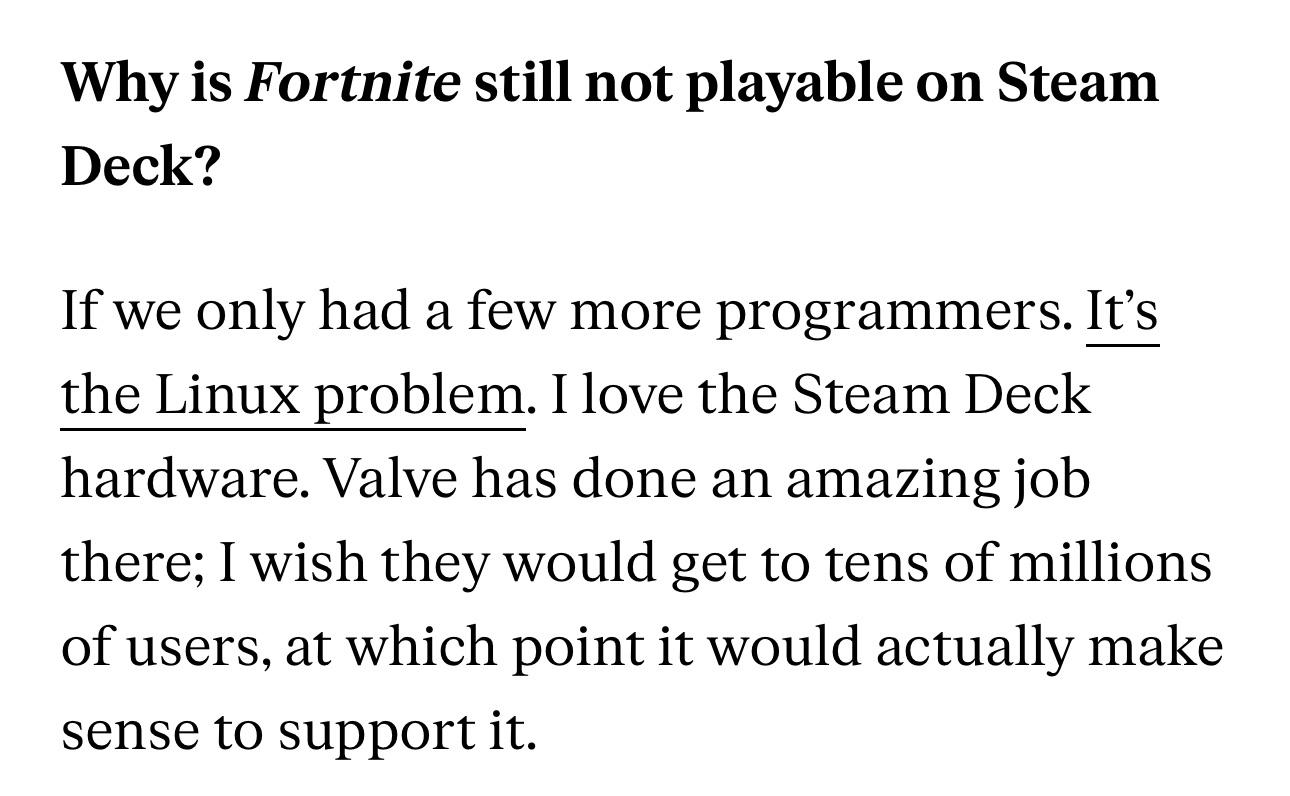
▲ 669 ▼ Epic Games CEO Tim Sweeney was asked by Verge why there is no support for the Steam Deck for Fortnite (lemmy.ml) submitted 2 years ago by mr_MADAFAKA@lemmy.ml to c/linux_gaming@lemmy.ml 272 comments fedilink hide all child comments
[–] ILikeBoobies@lemmy.ca 1 point 2 years ago (3 children) I wouldn’t call Epic greedy They have one of the more indie friendly Engines permalink fedilink source parent hideshow 3 child comments replies: [–] sugar_in_your_tea@sh.itjust.works 1 point 2 years ago (2 children) That's a side effect, not the goal. The goal is to make a ton of money on microtransactions, that's why they have a revenue sharing licensing model, not a per seat model. They don't lose much by being friendly to smaller devs, because they're banking on raking in profits from the few that go viral. I argue that until the recent change, Unity was the best engine for indie devs. You pay per seat and that's it, you keep the rest. And you don't pay until you make more than $100k, just like Unreal (Unreal is 5% after your first $1M). So if you earn $2M, you'll pay $50k to Epic or $2k/seat for Unity (assuming pro plan). If you expect to make >$1M, Unity will probably be cheaper for smaller studios. If you want support, Unreal charges $1500/seat/year for the Enterprise option, and you still need to pay for royalties. So here's how I'd decide which to use: Godot - most indie games Unity - indie games with high revenue expectation (if it takes off), and studios with infrequent releases (you only pay if you're making >$100k) Unreal - big 3D games with latest tech, or indie studios with lots of smaller games with lower average revenue targets Most studios don't need the features of Unreal, so it's an odd choice for your random indie studio. permalink fedilink source parent hideshow 2 child comments replies: [–] ILikeBoobies@lemmy.ca 1 point 2 years ago (1 child) indie studios with lots of smaller games with lower average revenue targets This is most people Also gamemaker/construct/stencyl fit in the worse space permalink fedilink source parent hideshow 1 child comment replies: [–] sugar_in_your_tea@sh.itjust.works 1 point 2 years ago In many of those cases, they wouldn't cross the threshold for income for either, so the choice of tool wouldn't matter. So use whatever you're familiar with. But honestly, with Unity violating dev trust, I highly recommend indie devs use Godot. It's plenty good for the scale of most indie games, and there's no royalties or costs (though donations are recommended). permalink fedilink source parent
[–] sugar_in_your_tea@sh.itjust.works 1 point 2 years ago (2 children) That's a side effect, not the goal. The goal is to make a ton of money on microtransactions, that's why they have a revenue sharing licensing model, not a per seat model. They don't lose much by being friendly to smaller devs, because they're banking on raking in profits from the few that go viral. I argue that until the recent change, Unity was the best engine for indie devs. You pay per seat and that's it, you keep the rest. And you don't pay until you make more than $100k, just like Unreal (Unreal is 5% after your first $1M). So if you earn $2M, you'll pay $50k to Epic or $2k/seat for Unity (assuming pro plan). If you expect to make >$1M, Unity will probably be cheaper for smaller studios. If you want support, Unreal charges $1500/seat/year for the Enterprise option, and you still need to pay for royalties. So here's how I'd decide which to use: Godot - most indie games Unity - indie games with high revenue expectation (if it takes off), and studios with infrequent releases (you only pay if you're making >$100k) Unreal - big 3D games with latest tech, or indie studios with lots of smaller games with lower average revenue targets Most studios don't need the features of Unreal, so it's an odd choice for your random indie studio. permalink fedilink source parent hideshow 2 child comments replies: [–] ILikeBoobies@lemmy.ca 1 point 2 years ago (1 child) indie studios with lots of smaller games with lower average revenue targets This is most people Also gamemaker/construct/stencyl fit in the worse space permalink fedilink source parent hideshow 1 child comment replies: [–] sugar_in_your_tea@sh.itjust.works 1 point 2 years ago In many of those cases, they wouldn't cross the threshold for income for either, so the choice of tool wouldn't matter. So use whatever you're familiar with. But honestly, with Unity violating dev trust, I highly recommend indie devs use Godot. It's plenty good for the scale of most indie games, and there's no royalties or costs (though donations are recommended). permalink fedilink source parent
[–] ILikeBoobies@lemmy.ca 1 point 2 years ago (1 child) indie studios with lots of smaller games with lower average revenue targets This is most people Also gamemaker/construct/stencyl fit in the worse space permalink fedilink source parent hideshow 1 child comment replies: [–] sugar_in_your_tea@sh.itjust.works 1 point 2 years ago In many of those cases, they wouldn't cross the threshold for income for either, so the choice of tool wouldn't matter. So use whatever you're familiar with. But honestly, with Unity violating dev trust, I highly recommend indie devs use Godot. It's plenty good for the scale of most indie games, and there's no royalties or costs (though donations are recommended). permalink fedilink source parent
[–] sugar_in_your_tea@sh.itjust.works 1 point 2 years ago In many of those cases, they wouldn't cross the threshold for income for either, so the choice of tool wouldn't matter. So use whatever you're familiar with. But honestly, with Unity violating dev trust, I highly recommend indie devs use Godot. It's plenty good for the scale of most indie games, and there's no royalties or costs (though donations are recommended). permalink fedilink source parent