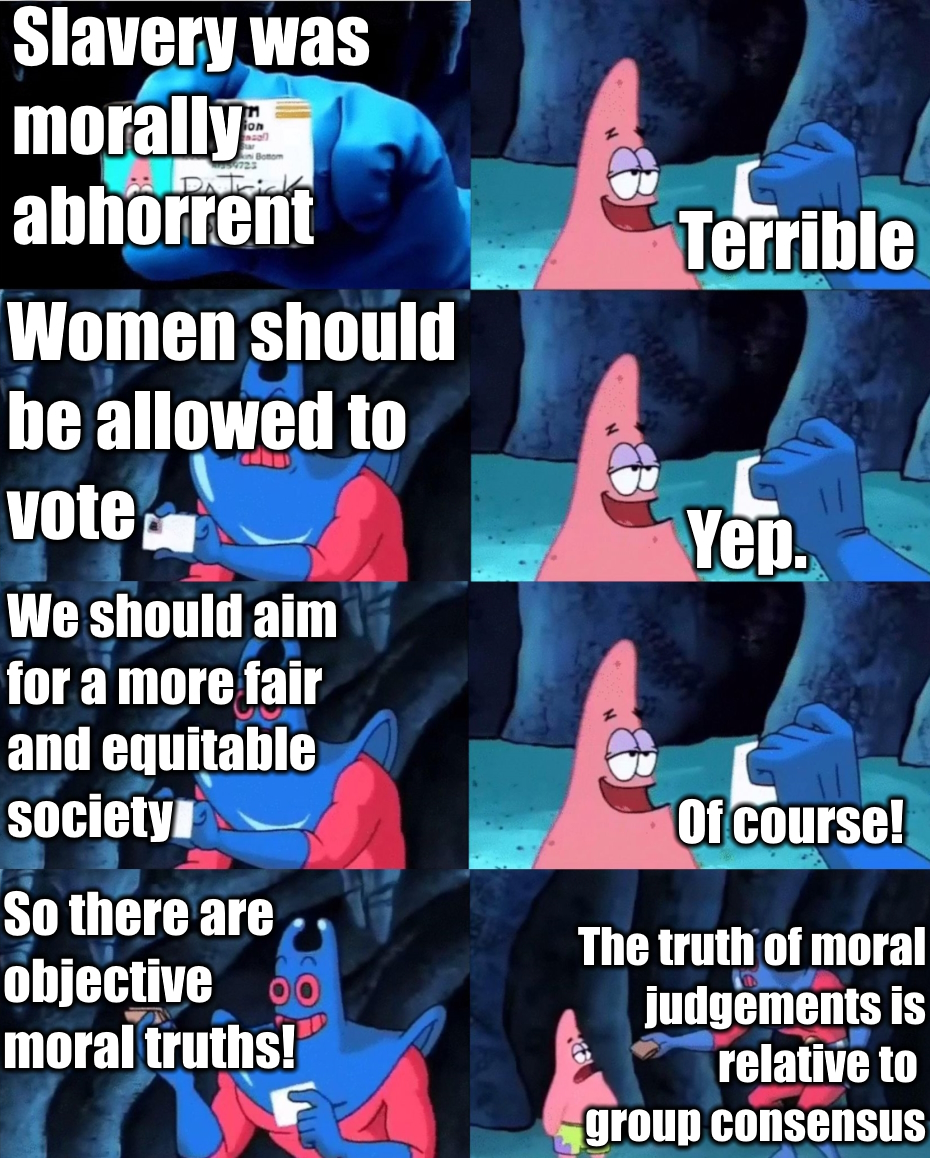
Not sure why this got removed from 196lemmy..blahaj.zone but it would be real nice if moderation on Lemmy gave you some sort of notification of what you did wrong. Like an automatic DM or something

you are viewing a single comment's thread
view the rest of the comments
[+] 3 points 2 years ago (1 child)
  • [–] 1 point 2 years ago (2 children)

    That would be the case if morals were something we can measure outside the human experience. Unfortunately there is no way to measure if something is moral or not outside how someone feels about it.

  • source
  • parent
  • hideshow 4 child comments
  • [+] 1 point 2 years ago (1 child)
  • [–] 1 point 2 years ago (1 child)

    Not really, if absolutely every single human at all stages of life believed it's morally good to spit in their palm every day that would be an objective moral truth, there would be no subjectivity to it. For morals though no such thing exists.

    You don't need to be able to observe it externally to distinguish it. For example i can say I have a conscious experience and that would be objectively true even though we have a pretty minimal understanding on what that really is or how to measure it.

  • source
  • parent
  • hideshow 2 child comments
  • [+] 1 point 2 years ago (1 child)
  • [–] 1 point 2 years ago (2 children)

    You can measure brain activity but not consciousness. Consciousness is most likely an emerging property of brain activity but we can't really say more with out current understanding of it.

  • source
  • parent
  • hideshow 4 child comments
  • [+] 1 point 2 years ago (1 child)
  • [–] 1 point 2 years ago (1 child)

    What? I never said consciousness in supernatural, just that we have a poor understanding of it and no way to measure it. I was just using it as an example of an objective statement for something we can't externally confirm.

  • source
  • parent
  • hideshow 2 child comments
  • [+] 1 point 2 years ago (1 child)
  • [–] 1 point 2 years ago (1 child)

    Again, this is completely irrelevant to my original point...

    What we consider consciousness to be is pretty broad, though self-awareness is a common one and that can't be measured with any current instrument.

  • source
  • parent
  • hideshow 2 child comments
  • [+] 1 point 2 years ago* (1 child)
  • [–] 1 point 2 years ago (1 child)

    As I literally previously said: self-awereness

  • source
  • parent
  • hideshow 2 child comments
  • [+] 1 point 2 years ago (1 child)
  • [–] 1 point 2 years ago (1 child)

    My original point still stands: You can make objective statements about things we can't measure. Also you can't measure self-awareness.

  • source
  • parent
  • hideshow 2 child comments
  • [–] 0 points 2 years ago (2 children)

    That doesn't mean it does not exist though. It simply means we can't measure it.

  • source
  • parent
  • hideshow 4 child comments
  • [–] 1 point 2 years ago (1 child)

    I'm not saying that, just that there's no outside way of verifying if something is true or not in case of morals. I don't believe objective morals exist because you can't find a single moral stance shared among all of humanity not because you can't measure the truth of that stance.

  • source
  • parent
  • hideshow 2 child comments
  • [–] 1 point 2 years ago (1 child)

    Is suffering good or bad? I don't mean that in a specific context, but any type of suffering in itself.

  • source
  • parent
  • hideshow 2 child comments
  • [–] 1 point 2 years ago (1 child)

    I can't really say about all kinds of suffering, it really depends on context.

    It's like asking if all love is good. There are so many situations I can imagine it could be good or bad or even neutral.

  • source
  • parent
  • hideshow 2 child comments
  • [–] 1 point 2 years ago (1 child)

    With out of context I mean in it's nature. Imagine you have to cut off someone's leg who doesn't like pain and won't profit from experiencing it during the amputation now or in the future, is it better to do it in the way it causes the most pain or the way it causes less pain, when it leads to exactly the same result?

  • source
  • parent
  • hideshow 2 child comments
  • [–] 1 point 2 years ago (1 child)

    Oh in that context it's absolutely worse. And in a complete vaccum where no action or even existence precedes or continues from that one moment of suffering it's also bad.

    Though because such a vacuum does not exist in reality suffering can be good. For example choosing to suffer to bring about some good outcome would be good. Or suffering that builds character for some future event. Also some forms of suffering are enjoyable to some people.

  • source
  • parent
  • hideshow 2 child comments
  • [–] 1 point 2 years ago (1 child)

    Yeah of course. But that doesn't change that it's objective. I don't mean suffering just as in physical pain.

  • source
  • parent
  • hideshow 2 child comments
  • [–] 1 point 2 years ago (1 child)

    Yea, the fact that there are a billion things that can be considered suffering makes it even more subjective since one form of suffering may be someone else's enjoyment.

    How is suffering morally objective?

  • source
  • parent
  • hideshow 2 child comments
  • [+] 0 points 2 years ago (1 child)
  • [–] 1 point 2 years ago* (last edited 2 years ago) (1 child)
  • [+] 1 point 2 years ago (1 child)
  • [–] 1 point 2 years ago (1 child)

    Exactly, physical pain and other forms of suffering are an objective reality. You can, in theory at last, decide objectively whether any decision will lead to more or less pain immediately and in the future.

    If you look at ethics you could assume the only axiom it has is that when comparing more pain or less pain, less pain is better. This is even independent from circumstance if you consider all suffering now and in the future that are consequences of an observed decision.

    In my opinion that makes the decision whether something is morally bad or good objective in it's nature.

  • source
  • parent
  • hideshow 2 child comments
  • [+] 1 point 2 years ago (1 child)
  • [–] 0 points 2 years ago (1 child)

    You could still in theory measure it if you also measure whether and to what extent the idea that pain is a virtue leads to more or less suffering in the life of the person and others directly and indirectly affected.

    Otherwise what you suggest is that consequences don't exist if we can't foresee them. But obviously the consequences will objectively exist, whether or not we can measure them.

    Imagine you could look at the whole universe, all factors in all of it's future. It's an objective reality, if you agree that suffering is real, that every option will either entail more, less or the same amount of suffering than the other options.

    That's what I am asking, is the option that entails more suffering better or the one that entails less suffering?

  • source
  • parent
  • hideshow 2 child comments
  • [+] 1 point 2 years ago (1 child)
  • [–] 1 point 2 years ago (1 child)

    It's not subjective, though. Morality is an objective reality, that can, in theory, be compared between any two options and there would always be an objective answer which of the options are better or worse or the same. You just think there is no objective reason to follow those options which are morally better, but that's a different question.

  • source
  • parent
  • hideshow 2 child comments
  • [+] 1 point 2 years ago (1 child)
  • [–] 1 point 2 years ago (1 child)

    I think you confuse cultural norms and rules with the abstract concept of ethics. When you question whether or not something is objectively morally better or worse than something else, that's independent of different current norms and values.

    It's the same as maths. If you have two black boxes one with three and one with fifteen potatoes in them, the box with the fifteen potatoes in it will objectively have more potatoes. It doesn't matter if you can look into the boxes, like potatoes or if some people consider "less is more" or if they do not have a concept of mathematics. If you ask whether or not 15 potatoes are more than 3 this will always be an objective truth since numbers are defined by math and that a bigger number is bigger than a smaller number is an axiom of mathematics.

    If the black boxes would instead contain "suffering" it doesn't matter what makes the suffering grow bigger or smaller. Someone who likes pain or for whom pain leads to greater outcome down the road will put less suffering into the box. It will still be an objective amount. Independent of whether or not you can measure it.

  • source
  • parent
  • hideshow 2 child comments