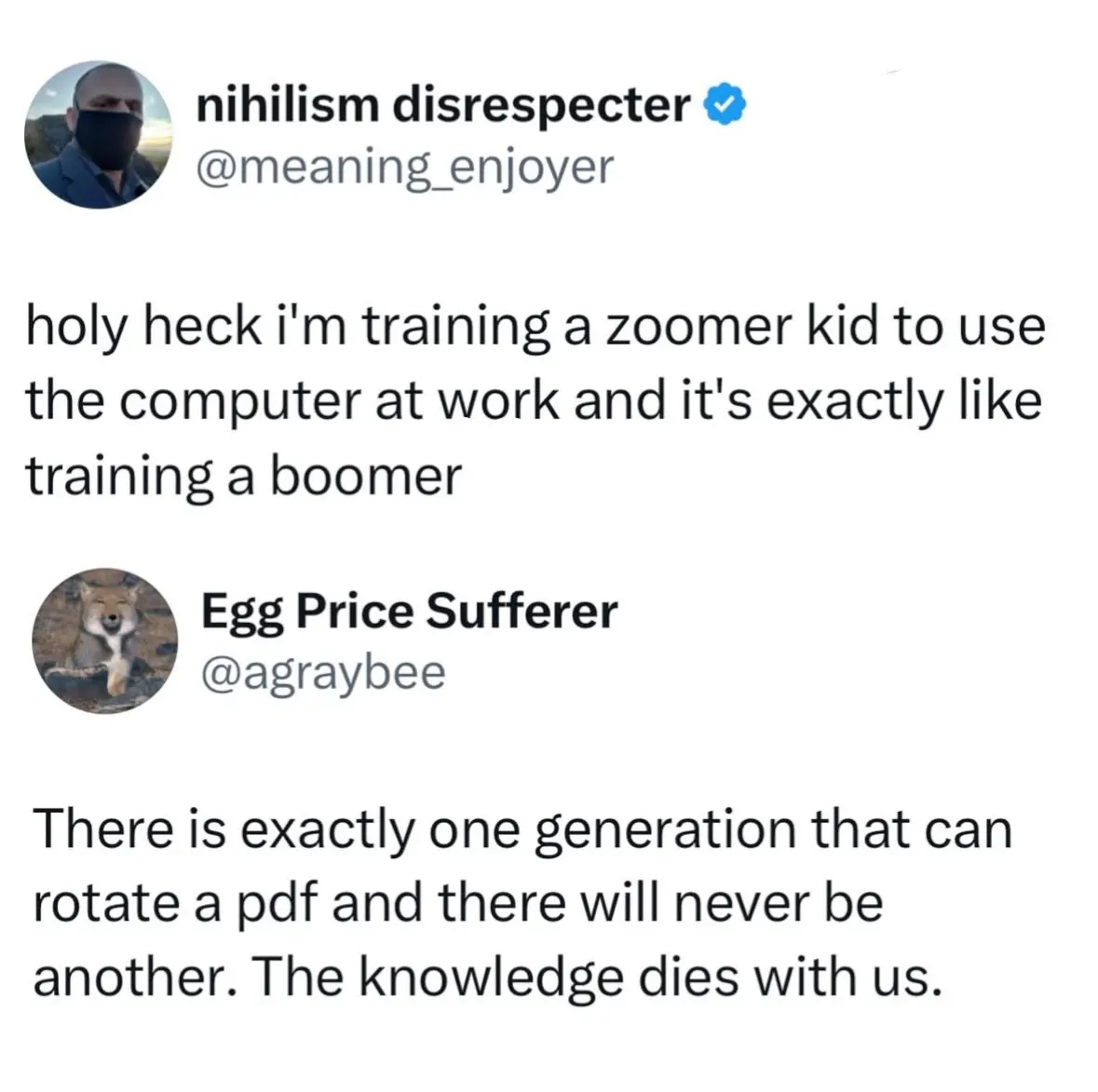
▲ 2423 ▼ Zoomers & Boomers are the same (lemmy.ca) submitted 1 year ago by cm0002@lemmy.world to c/memes@lemmy.world 545 comments fedilink hide all child comments source: @n7gifmdn@lemmy.ca
[–] NorthWestWind@lemmy.world 14 points 1 year ago (1 child) That sounds like gen alpha more than late zoomer. Perhaps they are simply too close in time to gen alpha. permalink fedilink source parent hideshow 2 child comments replies: [–] Vespair@lemm.ee 6 points 1 year ago (1 child) That has not been my experience, no. I am speaking younger adults, not teenagers; I don't really have many interactions with teenagers or children these days so I don't have enough experience with alphas to have really any sort of opinion on them. As I understand it, Gen A starts after 2010, so any adult today would still be a Zoomer. Granted of course that "generations" are a loosely-defined concept so the years they are defined as may vary, but it is my understanding that the typical understanding of Zoomer goes as far as 2010 at least. permalink fedilink source parent hideshow 2 child comments replies: [–] Genius@lemmy.zip 7 points 1 year ago (1 child) Boomers 1945-1960 Gen X 1960-1980 Millennials 1980-2000 Zoomers 2000-2020 Gen alpha 2020-2040 If we're going to have a made up system with no rules, it might as well be well ordered. permalink fedilink source parent hideshow 2 child comments replies: [–] Vespair@lemm.ee 10 points 1 year ago* (1 child) Convenient as that potentially would be, that does not seem to be the popular understanding, and I see no reason not to use to the conventional understanding in a case where stubbornness is unlikely to shift said understanding. Hopefully unnecessarily preemptive "if you don't like Wikipedia" invitation to websearch using the engine of your choice and observe the general response without hunting for a cherry-pickable example which defines them as such. edit: i noticed you were downvoted and feel compelled to mention that I did not downvote you; it's weird to downvote people for normal conversation. permalink fedilink source parent hideshow 2 child comments replies: [–] Ultraviolet@lemmy.world 5 points 1 year ago (2 children) 15 year generations don't really make sense though, the whole concept of a generation is that they're the previous generation's kids. permalink fedilink source parent hideshow 4 child comments replies: [–] Vespair@lemm.ee 3 points 1 year ago I don't disagree, but unfortunately nobody granted me authority on the general consensus on this one. I will say though that lineagial generations feel like only one possible definition, and cultural generations defined by common cultural experience (as is the case we're discussing) feel like they have some validity for me as well. permalink fedilink source parent [–] Illecors@lemmy.cafe 2 points 1 year ago That is not at all the case in this context. permalink fedilink source parent
[–] Vespair@lemm.ee 6 points 1 year ago (1 child) That has not been my experience, no. I am speaking younger adults, not teenagers; I don't really have many interactions with teenagers or children these days so I don't have enough experience with alphas to have really any sort of opinion on them. As I understand it, Gen A starts after 2010, so any adult today would still be a Zoomer. Granted of course that "generations" are a loosely-defined concept so the years they are defined as may vary, but it is my understanding that the typical understanding of Zoomer goes as far as 2010 at least. permalink fedilink source parent hideshow 2 child comments replies: [–] Genius@lemmy.zip 7 points 1 year ago (1 child) Boomers 1945-1960 Gen X 1960-1980 Millennials 1980-2000 Zoomers 2000-2020 Gen alpha 2020-2040 If we're going to have a made up system with no rules, it might as well be well ordered. permalink fedilink source parent hideshow 2 child comments replies: [–] Vespair@lemm.ee 10 points 1 year ago* (1 child) Convenient as that potentially would be, that does not seem to be the popular understanding, and I see no reason not to use to the conventional understanding in a case where stubbornness is unlikely to shift said understanding. Hopefully unnecessarily preemptive "if you don't like Wikipedia" invitation to websearch using the engine of your choice and observe the general response without hunting for a cherry-pickable example which defines them as such. edit: i noticed you were downvoted and feel compelled to mention that I did not downvote you; it's weird to downvote people for normal conversation. permalink fedilink source parent hideshow 2 child comments replies: [–] Ultraviolet@lemmy.world 5 points 1 year ago (2 children) 15 year generations don't really make sense though, the whole concept of a generation is that they're the previous generation's kids. permalink fedilink source parent hideshow 4 child comments replies: [–] Vespair@lemm.ee 3 points 1 year ago I don't disagree, but unfortunately nobody granted me authority on the general consensus on this one. I will say though that lineagial generations feel like only one possible definition, and cultural generations defined by common cultural experience (as is the case we're discussing) feel like they have some validity for me as well. permalink fedilink source parent [–] Illecors@lemmy.cafe 2 points 1 year ago That is not at all the case in this context. permalink fedilink source parent
[–] Genius@lemmy.zip 7 points 1 year ago (1 child) Boomers 1945-1960 Gen X 1960-1980 Millennials 1980-2000 Zoomers 2000-2020 Gen alpha 2020-2040 If we're going to have a made up system with no rules, it might as well be well ordered. permalink fedilink source parent hideshow 2 child comments replies: [–] Vespair@lemm.ee 10 points 1 year ago* (1 child) Convenient as that potentially would be, that does not seem to be the popular understanding, and I see no reason not to use to the conventional understanding in a case where stubbornness is unlikely to shift said understanding. Hopefully unnecessarily preemptive "if you don't like Wikipedia" invitation to websearch using the engine of your choice and observe the general response without hunting for a cherry-pickable example which defines them as such. edit: i noticed you were downvoted and feel compelled to mention that I did not downvote you; it's weird to downvote people for normal conversation. permalink fedilink source parent hideshow 2 child comments replies: [–] Ultraviolet@lemmy.world 5 points 1 year ago (2 children) 15 year generations don't really make sense though, the whole concept of a generation is that they're the previous generation's kids. permalink fedilink source parent hideshow 4 child comments replies: [–] Vespair@lemm.ee 3 points 1 year ago I don't disagree, but unfortunately nobody granted me authority on the general consensus on this one. I will say though that lineagial generations feel like only one possible definition, and cultural generations defined by common cultural experience (as is the case we're discussing) feel like they have some validity for me as well. permalink fedilink source parent [–] Illecors@lemmy.cafe 2 points 1 year ago That is not at all the case in this context. permalink fedilink source parent
[–] Vespair@lemm.ee 10 points 1 year ago* (1 child) Convenient as that potentially would be, that does not seem to be the popular understanding, and I see no reason not to use to the conventional understanding in a case where stubbornness is unlikely to shift said understanding. Hopefully unnecessarily preemptive "if you don't like Wikipedia" invitation to websearch using the engine of your choice and observe the general response without hunting for a cherry-pickable example which defines them as such. edit: i noticed you were downvoted and feel compelled to mention that I did not downvote you; it's weird to downvote people for normal conversation. permalink fedilink source parent hideshow 2 child comments replies: [–] Ultraviolet@lemmy.world 5 points 1 year ago (2 children) 15 year generations don't really make sense though, the whole concept of a generation is that they're the previous generation's kids. permalink fedilink source parent hideshow 4 child comments replies: [–] Vespair@lemm.ee 3 points 1 year ago I don't disagree, but unfortunately nobody granted me authority on the general consensus on this one. I will say though that lineagial generations feel like only one possible definition, and cultural generations defined by common cultural experience (as is the case we're discussing) feel like they have some validity for me as well. permalink fedilink source parent [–] Illecors@lemmy.cafe 2 points 1 year ago That is not at all the case in this context. permalink fedilink source parent
[–] Ultraviolet@lemmy.world 5 points 1 year ago (2 children) 15 year generations don't really make sense though, the whole concept of a generation is that they're the previous generation's kids. permalink fedilink source parent hideshow 4 child comments replies: [–] Vespair@lemm.ee 3 points 1 year ago I don't disagree, but unfortunately nobody granted me authority on the general consensus on this one. I will say though that lineagial generations feel like only one possible definition, and cultural generations defined by common cultural experience (as is the case we're discussing) feel like they have some validity for me as well. permalink fedilink source parent [–] Illecors@lemmy.cafe 2 points 1 year ago That is not at all the case in this context. permalink fedilink source parent
[–] Vespair@lemm.ee 3 points 1 year ago I don't disagree, but unfortunately nobody granted me authority on the general consensus on this one. I will say though that lineagial generations feel like only one possible definition, and cultural generations defined by common cultural experience (as is the case we're discussing) feel like they have some validity for me as well. permalink fedilink source parent
[–] Illecors@lemmy.cafe 2 points 1 year ago That is not at all the case in this context. permalink fedilink source parent