you are viewing a single comment's thread
view the rest of the comments
[+] -7 points 2 years ago (7 children)

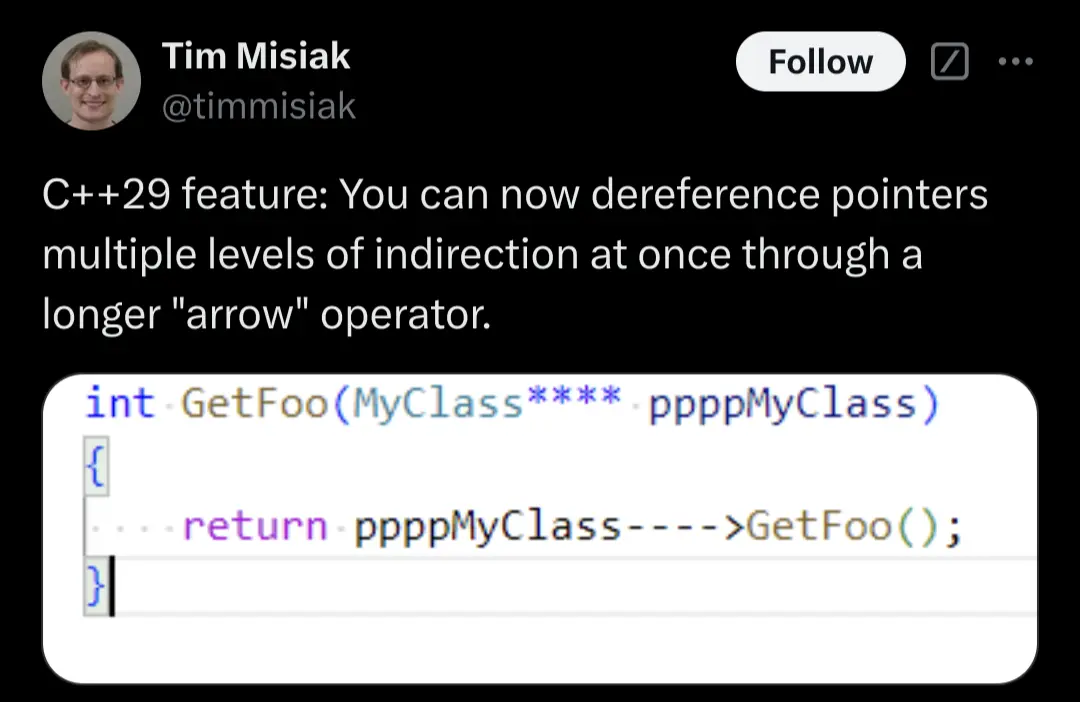
Why do you even have pointers to pointers?

  • source
  • hideshow 14 child comments
  • [–] 46 points 2 years ago (1 child)

    many reasons, for example

    • multidimensional arrays
    • arrays of function pointers
    • pass by reference of a pointer
  • source
  • parent
  • hideshow 2 child comments
  • [–] 6 points 2 years ago* (1 child)

    In two of your cases this operator is pretty shit because at some point you'll probably want to offset the access (this isn't a knock at you but at the feature).

    This operator would only really be relevant to the last case which rarely comes up outside of infrastructure/library work (building a tool building tool) and usually those code bases are cautious to adopt new features too quickly anyways for portability.

    I've done serious C++ work (not much in the past decade though) - while references are absolutely amazing and you essentially want to pass by const ref by default I think well written maintainable C++ should maybe have a dozen heap objects tops. C++ is a better language if you generally forget that pointers and bare arrays exist.

    Just again - I think you're right and the fact that your list is only three things long (and arguably two of them would be misuses) is a pretty clear sign that this is an incredibly niche feature.

  • source
  • parent
  • hideshow 2 child comments
  • [–] 22 points 2 years ago* (1 child)

    Mostly because at the lowest level of computing (machine code and CPU instructions), pointers are the only method (that I know of) of any kind of indirection.

    At the lowest level, there are 2 types of references:

    • CPU registers
    • memory addresses (pointers)

    Every higher level language feature for memory management (references, objects, safe pointers, garbage collection, etc) is just an abstraction over raw pointers

    Pointers themselves are really just abstractions over raw integers, whose sole purpose is to index into RAM

    With that in mind, pointers to pointers are a natural consequence of any kind of nested object hierarchy (linked lists, trees, objects with references to other objects, etc)


    The only other kind of indirection would be self-modifying machine code (like a Wheeler Jump). But the computing world at large has nixed that idea for a multitude of reasons

  • source
  • parent
  • hideshow 2 child comments
  • [+] -6 points 2 years ago (1 child)

    linked lists, trees, objects with references to other objects

    That’s not a pointer to another pointer, but a pointer to a data structure that happens to contain another pointer.

  • source
  • parent
  • hideshow 2 child comments
  • [–] 16 points 2 years ago* (last edited 2 years ago) (2 children)

    The distinction is meaningless in the land of Opcode's and memory addresses

    For example, a struct is just an imaginary "overlay" on top of a contiguous section of memory

    Say you have a struct

    struct Thing {
      int a;
      int b;
      Thing* child;
    }
    
    Thing foo {}
    

    You could easily get a reference to foo->child->b by doing pointer arithmetic

    *((*((*foo) + size(int)*2)) +size(int))
    

    (I've not used C much so I've probably got the syntax wrong)

  • source
  • parent
  • hideshow 4 child comments
  • [–] 1 point 2 years ago (1 child)

    Yes, you can do crazy shit if you try hard enough, but every reasonable programmer would access foo->child->b als foo->child->b and not via that crazy LISPy expression.

    By question was: Why would you have a pointer to a memory address that itself only holds a pointer somewhere else?

    So far the only reasonable explanation is from @Victoria@lemmy.blahaj.zone:

    • arrays of function pointers
    • pass by reference of a pointer
  • source
  • parent
  • hideshow 2 child comments
  • [–] 1 point 2 years ago

    I'm more talking about theory than practical.

    I've not developed anything in C/C++, so I don't know practical uses for a double pointer, aside from multidimensional arrays, or arrays of pointers

    My point was that, conceptually, pointers to pointers is how most complex data structures work. Even if the C representation of said code doesn't have a int** somewhere

  • source
  • parent
  • [–] 18 points 2 years ago* (1 child)

    Because stuff can own other stuff and be owned at the same time. Also, arcane jackarsery.

    Edit: if you want to give a function a pointer that it may change this may occur in a constructive way. I.e. replace an owned object.

  • source
  • parent
  • hideshow 2 child comments
  • [–] 5 points 2 years ago (1 child)

    Yeah... But it's usually a good practice to put a struct somewhere between your 30 levels of ownership.

    Exceptions exist, but they are not very common. Also, in C++, operators overloading may help you if you keep needing to write code like this.

  • source
  • parent
  • hideshow 2 child comments
  • [–] 3 points 2 years ago (1 child)

    In C++ you should never have owning raw pointers. Unless you have a good reason™.

    Raw pointers are great, but not for ownership.

  • source
  • parent
  • hideshow 2 child comments
  • [–] 3 points 2 years ago (1 child)
  • [–] 1 point 2 years ago (1 child)

    That’s the best thing I’ve read in a while, and I’m only on page 2!

  • source
  • parent
  • hideshow 2 child comments