Python allows programmers to pass additional arguments to functions via comments. Now armed with this knowledge head out and spread it to all code bases.

Feel free to use the code I wrote in your projects.

Link to the source code: https://github.com/raldone01/python_lessons_py/blob/v2.0.0/lesson_0_comments.ipynb

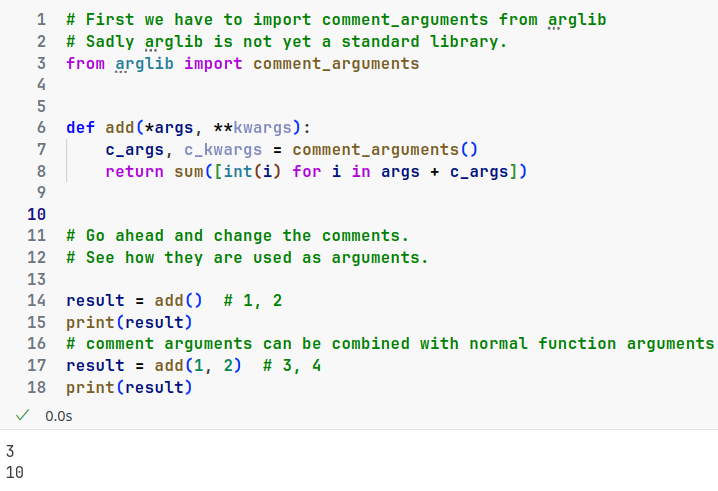
Image transcription:

# First we have to import comment_arguments from arglib
# Sadly arglib is not yet a standard library.
from arglib import comment_arguments


def add(*args, **kwargs):
    c_args, c_kwargs = comment_arguments()
    return sum([int(i) for i in args + c_args])


# Go ahead and change the comments.
# See how they are used as arguments.

result = add()  # 1, 2
print(result)
# comment arguments can be combined with normal function arguments
result = add(1, 2)  # 3, 4
print(result)

Output:

3
10

This is version v2.0.0 of the post: https://github.com/raldone01/python_lessons_py/tree/v2.0.0

Note:

v1.0.0 of the post can be found here: https://github.com/raldone01/python_lessons_py/tree/v1.0.0

Choosing lib as the name for my module was a bit devious. I did it because I thought if I am creating something cursed why not go all the way?

Regarding misinformation:

I thought simply posting this in programmer humor was enough. Anyways, the techniques shown here are not yet regarded best practice. Decide carefully if you want to apply the shown concepts in your own code bases.
you are viewing a single comment's thread
view the rest of the comments
[–] 205 points 2 years ago (11 children)

IMO comments should never ever be parsed under any circumstances but I probably don't know enough to really speak on this

  • source
  • hideshow 22 child comments
  • [–] 63 points 2 years ago* (last edited 2 years ago) (1 child)

    Seen in a code review (paraphrased):

    image of a program which is estimating the size of an array by counting how many lines of source code were used to construct it

    "Why does this break when you add comments in the middle?"

  • source
  • parent
  • hideshow 2 child comments
  • [–] 17 points 2 years ago (3 children)

    Why would python even expose the current line number? What’s it useful for?

  • source
  • parent
  • hideshow 6 child comments
  • [–] [S] 38 points 2 years ago* (last edited 2 years ago)

    On a serious note:

    This feature is actually very useful. Libraries can use it create neat error messages. It is also needed when logging information to a file.

    You should however never ever parse the source code and react to it differently.

  • source
  • parent
  • [–] 17 points 2 years ago

    The add function in the example above probably traverses the call stack to see what line of the script is currently being executed by the interpreter, then reads in that line in the original script, parses the comment, and subs in the values in the function call.

    This functionality exists so when you get a traceback you can see what line of code triggered it in the error message

  • source
  • parent
  • [–] 8 points 2 years ago (1 child)

    Can we just clarify that you mean that comments should never be parsed by the language engine. There are valid annotation systems, but the goal is alway to ensure that one passable can never impact the other.

    Imagine if here a comment could create a syntax error! This is even worse for runtime scripting languages like python.

  • source
  • parent
  • hideshow 2 child comments
  • [–] 9 points 2 years ago (1 child)

    Sure, but let's just clarify that this is someone going out of their way to create this problem, using Python's ability to read it's own code.

    Basically, you can load any text file, including a source code file, and do whatever you want with it.

    So, a function can be written that finds out whatever's calling it, reads that file, parses the comments, and uses them as values. This can also be done with introspection, using the same mechanism that displays tracebacks.

  • source
  • parent
  • hideshow 2 child comments
  • [–] 5 points 2 years ago (1 child)

    This isn't standard python. lib is not in the standard library. Python also doesn't have any special variables where it stores comments, other than __doc__ which stores a docstring. If I had to guess, add is reading the file/REPL via __file__.

  • source
  • parent
  • hideshow 2 child comments
  • [–] 4 points 2 years ago (2 children)

    Comments should be removed before shipping.

  • source
  • parent
  • hideshow 4 child comments
  • [–] 3 points 2 years ago

    One case where I find it useful, tho it operates in a more limited way, is code in block blocks within code comments in Rust, which are also printed out in the generated documentation. They essentially get ran as part of your unit tests. This is great for making sure that, eg, your examples left in code comments actually work, especially if they’re written in a way that functions like a unit test.

  • source
  • parent
  • [–] 2 points 2 years ago (1 child)

    It's quite useful to parse comments and generate documentation from them, either as plain old hypertext or in your editor with LSP.

  • source
  • parent
  • hideshow 2 child comments
  • [–] 5 points 2 years ago (2 children)

    That sounds fine if you have something reading the file independently. But the actual executable code should not be able to access its own comments.

  • source
  • parent
  • hideshow 4 child comments
  • [–] 1 point 2 years ago*

    capability is fine. Conflation is stupid. You can also use code to erase itself, but thinking that's a good idea is generally wrong. But to remove that, you also remove the general ability to erase files.

  • source
  • parent