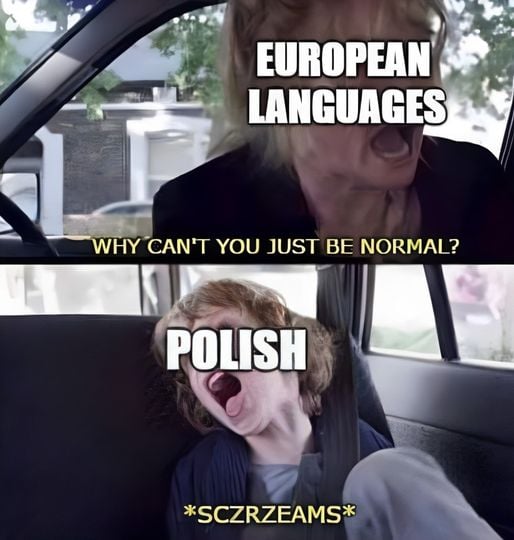
▲ 990 ▼ It seems like a difficult language to learn (lemmy.world) submitted 2 years ago by The_Picard_Maneuver@lemmy.world [M] to c/memes@lemmy.world 130 comments fedilink hide all child comments
[–] Justas@sh.itjust.works 3 points 2 years ago (1 child) Just come up with new letters, Lithuanian has 9 (ą, ę, ė, į, ų, ū, č, š, ž) extra letters. If a small language can do it, so can English. permalink fedilink source parent hideshow 2 child comments replies: [+] lvxferre@mander.xyz 3 points 2 years ago* (last edited 1 month ago) (1 child) [deleted] permalink fedilink source parent hideshow 2 child comments replies: [–] Justas@sh.itjust.works 3 points 2 years ago (1 child) I mean, yes and no. You are assuming that Lithuanian language became formalised when Lithuania was united under one government. Instead, most of language formalisation happened between 1880s and 1920s, when Lithuanian speaking population was actually divided between Prussian and Tzarist Russian empires. While most of the people lived in Tzarist Russia, writing in Lithuanian in Latin script was forbidden there. Instead, books in Latin script were printed in Prussia and distributed in Russia illegally. A handful of people like J. Basanavičius and V. Kudirka ended up in charge of printing most of those books and it made it easy to set language standards. Achieving such a monopoly with a bigger language would be much more difficult. That is also why formal Lithuanian is based on one ethnic dialect that was spoken in Prussia. permalink fedilink source parent hideshow 2 child comments replies: [+] lvxferre@mander.xyz 3 points 2 years ago* (last edited 1 month ago) (1 child) [deleted] permalink fedilink source parent hideshow 2 child comments replies: [–] Justas@sh.itjust.works 3 points 2 years ago You're welcome. If you want to read more about the history of Lithuania and surrounding countries and their nation formation, a great start would be Timothy Snyder's book "The Reconstruction of Nations", he's the most popular historian of the region who is not from the region. permalink fedilink source parent
[+] lvxferre@mander.xyz 3 points 2 years ago* (last edited 1 month ago) (1 child) [deleted] permalink fedilink source parent hideshow 2 child comments replies: [–] Justas@sh.itjust.works 3 points 2 years ago (1 child) I mean, yes and no. You are assuming that Lithuanian language became formalised when Lithuania was united under one government. Instead, most of language formalisation happened between 1880s and 1920s, when Lithuanian speaking population was actually divided between Prussian and Tzarist Russian empires. While most of the people lived in Tzarist Russia, writing in Lithuanian in Latin script was forbidden there. Instead, books in Latin script were printed in Prussia and distributed in Russia illegally. A handful of people like J. Basanavičius and V. Kudirka ended up in charge of printing most of those books and it made it easy to set language standards. Achieving such a monopoly with a bigger language would be much more difficult. That is also why formal Lithuanian is based on one ethnic dialect that was spoken in Prussia. permalink fedilink source parent hideshow 2 child comments replies: [+] lvxferre@mander.xyz 3 points 2 years ago* (last edited 1 month ago) (1 child) [deleted] permalink fedilink source parent hideshow 2 child comments replies: [–] Justas@sh.itjust.works 3 points 2 years ago You're welcome. If you want to read more about the history of Lithuania and surrounding countries and their nation formation, a great start would be Timothy Snyder's book "The Reconstruction of Nations", he's the most popular historian of the region who is not from the region. permalink fedilink source parent
[–] Justas@sh.itjust.works 3 points 2 years ago (1 child) I mean, yes and no. You are assuming that Lithuanian language became formalised when Lithuania was united under one government. Instead, most of language formalisation happened between 1880s and 1920s, when Lithuanian speaking population was actually divided between Prussian and Tzarist Russian empires. While most of the people lived in Tzarist Russia, writing in Lithuanian in Latin script was forbidden there. Instead, books in Latin script were printed in Prussia and distributed in Russia illegally. A handful of people like J. Basanavičius and V. Kudirka ended up in charge of printing most of those books and it made it easy to set language standards. Achieving such a monopoly with a bigger language would be much more difficult. That is also why formal Lithuanian is based on one ethnic dialect that was spoken in Prussia. permalink fedilink source parent hideshow 2 child comments replies: [+] lvxferre@mander.xyz 3 points 2 years ago* (last edited 1 month ago) (1 child) [deleted] permalink fedilink source parent hideshow 2 child comments replies: [–] Justas@sh.itjust.works 3 points 2 years ago You're welcome. If you want to read more about the history of Lithuania and surrounding countries and their nation formation, a great start would be Timothy Snyder's book "The Reconstruction of Nations", he's the most popular historian of the region who is not from the region. permalink fedilink source parent
[+] lvxferre@mander.xyz 3 points 2 years ago* (last edited 1 month ago) (1 child) [deleted] permalink fedilink source parent hideshow 2 child comments replies: [–] Justas@sh.itjust.works 3 points 2 years ago You're welcome. If you want to read more about the history of Lithuania and surrounding countries and their nation formation, a great start would be Timothy Snyder's book "The Reconstruction of Nations", he's the most popular historian of the region who is not from the region. permalink fedilink source parent
[–] Justas@sh.itjust.works 3 points 2 years ago You're welcome. If you want to read more about the history of Lithuania and surrounding countries and their nation formation, a great start would be Timothy Snyder's book "The Reconstruction of Nations", he's the most popular historian of the region who is not from the region. permalink fedilink source parent