you are viewing a single comment's thread
view the rest of the comments
[+] 37 points 2 years ago* (last edited 1 month ago) (7 children)
  • [–] 14 points 2 years ago (1 child)

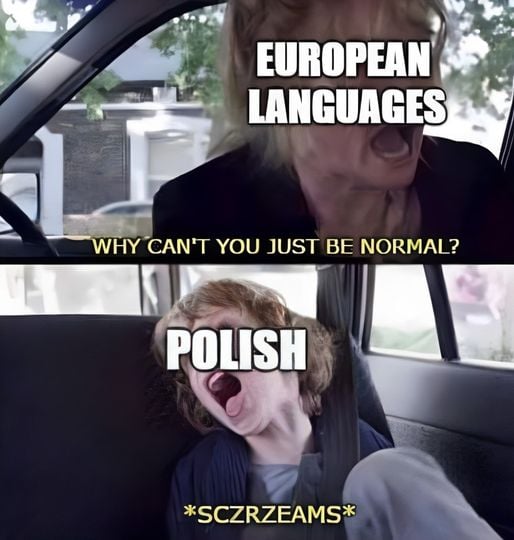
    the alternative is to make the syntax become a hellish mess. Like Mandarin or English.

    Now hang on just a second. English is fine. You just have to memorize or correctly guess the etymology of whatever word it is you're trying to spell/pronounce in order to get ... oh, okay, I think I see the problem now.

  • source
  • parent
  • hideshow 2 child comments
  • [+] 30 points 2 years ago* (last edited 1 month ago) (2 children)
  • [–] 5 points 2 years ago (1 child)

    In Latin for example it’s just a “…near the noun? Whatever, just don’t be ambiguous."

    It doesn't need to be remotely close to the noun lol

    Though Latin syntax can get annoying sometimes (when do I use the subjunctive? What's the correct negation? Perfect or imperfect… maybe pluperfect? Which noun is this random genitive modifying?), it does make sense eventually. I guess that is also true for English, but I still mess up the tenses sometimes.

  • source
  • parent
  • hideshow 2 child comments
  • [–] 2 points 2 years ago (1 child)

    Think you this some kind of joke?

    (What do you mean you don't want to sound like an Elizabethan or earlier?!)

  • source
  • parent
  • hideshow 2 child comments
  • [–] 13 points 2 years ago (1 child)

    the alternative is to make the syntax become a hellish mess

    The alternative is Czech.

  • source
  • parent
  • hideshow 2 child comments
  • [–] 19 points 2 years ago (1 child)

    A Polish colleague of mine once accidentally picked Czech in an online work training exercise and then spent the next 30 minutes giggling to himself. I asked him afterwards what was up "Czech sounds like baby talk"

  • source
  • parent
  • hideshow 2 child comments
  • [–] 7 points 2 years ago (2 children)

    English syntax hard?

    There's a lot of issues with English. Most of them are for using loanwords without phonetically changing how they're spoken in the English alphabet. Then people wonder why they're spelled like Ledoux and sound like Lehdoo.

    Romance. Romance languages are the fucking reason you word slurring tongue twats.

    But hey, at least we're not Turkik.

  • source
  • parent
  • hideshow 4 child comments
  • [–] 7 points 2 years ago

    English syntax hard?

    Yes. Sequence of tenses. It's harder than Latin. As in, what the hell does "future-in-the-past" mean?
    Or tenses (+aspect+mood) in general, I guess. You guys have too many of them.

    As for the orthography, you know what is to blame. The Great Vowel Shift.

  • source
  • parent
  • [–] 3 points 2 years ago (1 child)

    Just come up with new letters, Lithuanian has 9 (ą, ę, ė, į, ų, ū, č, š, ž) extra letters. If a small language can do it, so can English.

  • source
  • parent
  • hideshow 2 child comments
  • [+] 3 points 2 years ago* (last edited 1 month ago) (1 child)
  • [–] 3 points 2 years ago (1 child)

    I mean, yes and no.

    You are assuming that Lithuanian language became formalised when Lithuania was united under one government. Instead, most of language formalisation happened between 1880s and 1920s, when Lithuanian speaking population was actually divided between Prussian and Tzarist Russian empires. While most of the people lived in Tzarist Russia, writing in Lithuanian in Latin script was forbidden there.

    Instead, books in Latin script were printed in Prussia and distributed in Russia illegally. A handful of people like J. Basanavičius and V. Kudirka ended up in charge of printing most of those books and it made it easy to set language standards. Achieving such a monopoly with a bigger language would be much more difficult.

    That is also why formal Lithuanian is based on one ethnic dialect that was spoken in Prussia.

  • source
  • parent
  • hideshow 2 child comments
  • [+] 3 points 2 years ago* (last edited 1 month ago) (1 child)
  • [–] 3 points 2 years ago

    You're welcome.

    If you want to read more about the history of Lithuania and surrounding countries and their nation formation, a great start would be Timothy Snyder's book "The Reconstruction of Nations", he's the most popular historian of the region who is not from the region.

  • source
  • parent
  • [–] 3 points 2 years ago (1 child)

    Then there's Italian. We have less letters than other European languages (we don't have k,j,w,x,y) and we still manage to avoid shit like "thoroughly" or spamming letters. We have accents, but use them way less than in Spanish and no special accents or characters like ñ ç č ß å ø ö etc

    Once you understand the rules is probably one of the easier languages to spell and pronounce

  • source
  • parent
  • hideshow 2 child comments