▲ 962 ▼ How are there so many of them (lemmy.world) submitted 2 years ago by Toastbrotmann@lemmy.world to c/memes@lemmy.ml 144 comments fedilink hide all child comments
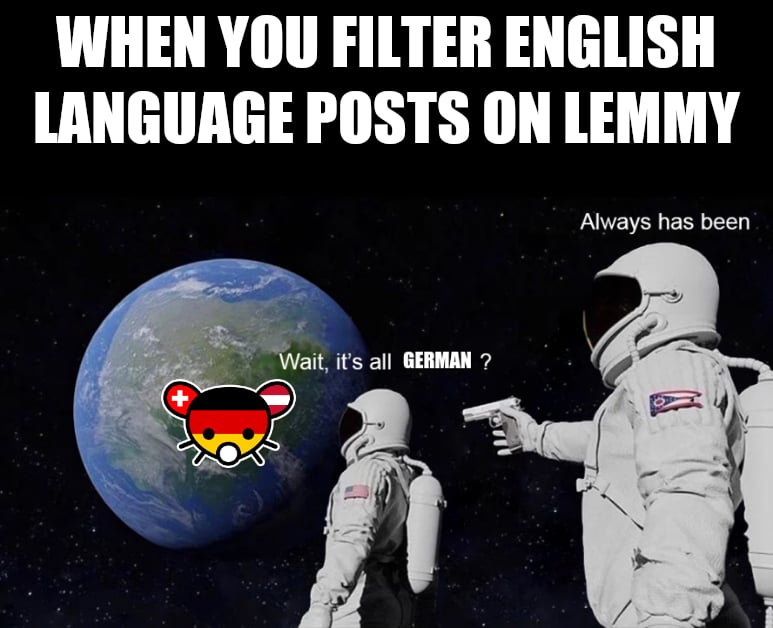
[–] Vittelius@feddit.org 194 points 2 years ago (25 children) It's the German version of me_irl. Stands for "Ich _ im echten Leben" and is a direct translation of the English permalink fedilink source parent hideshow 25 child comments replies: [–] kat_angstrom@lemmy.world 87 points 2 years ago (14 children) Aww, thanks! Consider me slightly more educated than when I awoke this morning :) permalink fedilink source parent hideshow 14 child comments replies: [–] GregorGizeh@lemmy.zip 29 points 2 years ago (10 children) it is only me_irl in name though, it is a general meme / conversational community with the obnoxious (and over used to death) in joke that is zangendeutsch. permalink fedilink source parent hideshow 10 child comments replies: [–] Samsy@lemmy.ml 14 points 2 years ago (5 children) "Zangendeutsch" means an aggressive way of removing the influence of english into the german language. But outside of ich_iel we write in english as everyone. Which is obviously a little bit weird, isn't it? permalink fedilink source parent hideshow 5 child comments replies: [–] lugal@lemmy.dbzer0.com 17 points 2 years ago (2 children) No, that's wrong. Zangendeutsch is all about English influence and playfully literal translations even when there are better German words. So you need to translate it back to English and into German again to decode it and that's the fun about it. permalink fedilink source parent hideshow 2 child comments replies: [–] reinei@lemmy.world 2 points 2 years ago (1 child) So is that the "Zange"? Because you need to go from the things you are holding (the information, in "German") to the hinge (the literal English translation) and back down again (actual German translation) to understand (aka grasp it)‽ permalink fedilink source parent hideshow 1 child comment replies: [–] boomzilla@programming.dev 0 points 2 years ago I'm not sure if I understood your deduction. The literal translation of "Zange" would be "tongs", "pliers" or "pincer". Hinges are the things that make doors swing and hold to a wall right? Multiple source say the origin of the word isn't documented but the best explanation they come up with is that pliers can be used to bend something into a different form. My guess was it has its origin in the proverb "Das würde ich nicht mal mit der Kneifzange anfassen" which translates to "I wouldn't even touch that with pliers" as in stuff you detest that much that you rather would stay away from it. permalink fedilink source parent [–] GregorGizeh@lemmy.zip 7 points 2 years ago* (1 child) What annoys me personally about it (to the point that i blocked the community) is that it is mandatory. That's not humor, or funny, that is weird performative scripted humor. I often felt reminded of carnival speeches. I'd also argue that it isnt very successful in clearing anglicisms from the german vernacular when it is all about making the most incorrect and cryptic literal translation imaginable to the point that nobody could understand unless they are well versed in those anglicisms. permalink fedilink source parent hideshow 1 child comment replies: [–] Archer@lemmy.world 7 points 2 years ago They’re making English a linguistic dependency for German? lol permalink fedilink source parent [–] PlexSheep@infosec.pub 6 points 2 years ago It's not overused if its funny. And it is very funny permalink fedilink source parent [–] qevlarr@lemmy.world 2 points 2 years ago (2 children) Dutchie who speaks German here, I hadn't heard of the word 'Zangendeutsch' before. I get what it means, but why 'Zangen'? Does it come from tongs or does it have another meaning? Tongs-German makes no sense to me permalink fedilink source parent hideshow 2 child comments replies: [–] PlexSheep@infosec.pub 4 points 2 years ago German here, no idea what it has to do with a Zange permalink fedilink source parent [–] boomzilla@programming.dev 0 points 2 years ago https://programming.dev/comment/12049449 permalink fedilink source parent [–] Vittelius@feddit.org 11 points 2 years ago Happy to help permalink fedilink source parent [–] Slovene@feddit.nl 5 points 2 years ago (1 child) Oh my god, you're woke! permalink fedilink source parent hideshow 1 child comment replies: [–] kat_angstrom@lemmy.world 12 points 2 years ago Whoops, guess I'm now the enemy of a hundred million Americans My bad permalink fedilink source parent [–] A_Union_of_Kobolds@lemmy.world 27 points 2 years ago (7 children) Omg I was reading it as "ich lel" not "ich iel" this whole time 😅 thanks permalink fedilink source parent hideshow 7 child comments replies: [+] SARGE@startrek.website 9 points 2 years ago* (last edited 2 months ago) (6 children) [deleted] permalink fedilink source parent hideshow 6 child comments replies: [–] Zwiebel@feddit.org 5 points 2 years ago* (5 children) It is pretty close on the pronunciation, except ch is not sh. Unless you're speaking certain regional dialects :) permalink fedilink source parent hideshow 5 child comments replies: [–] samus12345@lemmy.world 4 points 2 years ago The closest pronunciation you can get in English is probably eek. permalink fedilink source parent [+] SARGE@startrek.website 2 points 2 years ago* (last edited 2 months ago) (3 children) [deleted] permalink fedilink source parent hideshow 3 child comments replies: [–] Karyoplasma@discuss.tchncs.de 2 points 2 years ago* (2 children) I'm a German native who studied linguistics (ok, computational linguistics with a minor in phonetics and phonology), but I basically only speak my regional dialect well. I was visiting a friend in Berlin once and a stranger in a bar complimented me that I "speak good German for a foreigner". permalink fedilink source parent hideshow 2 child comments replies: [+] SARGE@startrek.website 2 points 2 years ago* (last edited 2 months ago) (1 child) [deleted] permalink fedilink source parent hideshow 1 child comment replies: [–] Karyoplasma@discuss.tchncs.de 2 points 2 years ago I regarded it as a potential evidence for my unfounded and highly debateable hypothesis that the dialect we speak in the region is not in fact a dialect, but its own language. permalink fedilink source parent [–] errer@lemmy.world 11 points 2 years ago Bless you sir or madam, you know not how long I have suffered permalink fedilink source parent [–] 30p87@feddit.org 7 points 2 years ago It also incorporates c/memes, basically permalink fedilink source parent
[–] kat_angstrom@lemmy.world 87 points 2 years ago (14 children) Aww, thanks! Consider me slightly more educated than when I awoke this morning :) permalink fedilink source parent hideshow 14 child comments replies: [–] GregorGizeh@lemmy.zip 29 points 2 years ago (10 children) it is only me_irl in name though, it is a general meme / conversational community with the obnoxious (and over used to death) in joke that is zangendeutsch. permalink fedilink source parent hideshow 10 child comments replies: [–] Samsy@lemmy.ml 14 points 2 years ago (5 children) "Zangendeutsch" means an aggressive way of removing the influence of english into the german language. But outside of ich_iel we write in english as everyone. Which is obviously a little bit weird, isn't it? permalink fedilink source parent hideshow 5 child comments replies: [–] lugal@lemmy.dbzer0.com 17 points 2 years ago (2 children) No, that's wrong. Zangendeutsch is all about English influence and playfully literal translations even when there are better German words. So you need to translate it back to English and into German again to decode it and that's the fun about it. permalink fedilink source parent hideshow 2 child comments replies: [–] reinei@lemmy.world 2 points 2 years ago (1 child) So is that the "Zange"? Because you need to go from the things you are holding (the information, in "German") to the hinge (the literal English translation) and back down again (actual German translation) to understand (aka grasp it)‽ permalink fedilink source parent hideshow 1 child comment replies: [–] boomzilla@programming.dev 0 points 2 years ago I'm not sure if I understood your deduction. The literal translation of "Zange" would be "tongs", "pliers" or "pincer". Hinges are the things that make doors swing and hold to a wall right? Multiple source say the origin of the word isn't documented but the best explanation they come up with is that pliers can be used to bend something into a different form. My guess was it has its origin in the proverb "Das würde ich nicht mal mit der Kneifzange anfassen" which translates to "I wouldn't even touch that with pliers" as in stuff you detest that much that you rather would stay away from it. permalink fedilink source parent [–] GregorGizeh@lemmy.zip 7 points 2 years ago* (1 child) What annoys me personally about it (to the point that i blocked the community) is that it is mandatory. That's not humor, or funny, that is weird performative scripted humor. I often felt reminded of carnival speeches. I'd also argue that it isnt very successful in clearing anglicisms from the german vernacular when it is all about making the most incorrect and cryptic literal translation imaginable to the point that nobody could understand unless they are well versed in those anglicisms. permalink fedilink source parent hideshow 1 child comment replies: [–] Archer@lemmy.world 7 points 2 years ago They’re making English a linguistic dependency for German? lol permalink fedilink source parent [–] PlexSheep@infosec.pub 6 points 2 years ago It's not overused if its funny. And it is very funny permalink fedilink source parent [–] qevlarr@lemmy.world 2 points 2 years ago (2 children) Dutchie who speaks German here, I hadn't heard of the word 'Zangendeutsch' before. I get what it means, but why 'Zangen'? Does it come from tongs or does it have another meaning? Tongs-German makes no sense to me permalink fedilink source parent hideshow 2 child comments replies: [–] PlexSheep@infosec.pub 4 points 2 years ago German here, no idea what it has to do with a Zange permalink fedilink source parent [–] boomzilla@programming.dev 0 points 2 years ago https://programming.dev/comment/12049449 permalink fedilink source parent [–] Vittelius@feddit.org 11 points 2 years ago Happy to help permalink fedilink source parent [–] Slovene@feddit.nl 5 points 2 years ago (1 child) Oh my god, you're woke! permalink fedilink source parent hideshow 1 child comment replies: [–] kat_angstrom@lemmy.world 12 points 2 years ago Whoops, guess I'm now the enemy of a hundred million Americans My bad permalink fedilink source parent
[–] GregorGizeh@lemmy.zip 29 points 2 years ago (10 children) it is only me_irl in name though, it is a general meme / conversational community with the obnoxious (and over used to death) in joke that is zangendeutsch. permalink fedilink source parent hideshow 10 child comments replies: [–] Samsy@lemmy.ml 14 points 2 years ago (5 children) "Zangendeutsch" means an aggressive way of removing the influence of english into the german language. But outside of ich_iel we write in english as everyone. Which is obviously a little bit weird, isn't it? permalink fedilink source parent hideshow 5 child comments replies: [–] lugal@lemmy.dbzer0.com 17 points 2 years ago (2 children) No, that's wrong. Zangendeutsch is all about English influence and playfully literal translations even when there are better German words. So you need to translate it back to English and into German again to decode it and that's the fun about it. permalink fedilink source parent hideshow 2 child comments replies: [–] reinei@lemmy.world 2 points 2 years ago (1 child) So is that the "Zange"? Because you need to go from the things you are holding (the information, in "German") to the hinge (the literal English translation) and back down again (actual German translation) to understand (aka grasp it)‽ permalink fedilink source parent hideshow 1 child comment replies: [–] boomzilla@programming.dev 0 points 2 years ago I'm not sure if I understood your deduction. The literal translation of "Zange" would be "tongs", "pliers" or "pincer". Hinges are the things that make doors swing and hold to a wall right? Multiple source say the origin of the word isn't documented but the best explanation they come up with is that pliers can be used to bend something into a different form. My guess was it has its origin in the proverb "Das würde ich nicht mal mit der Kneifzange anfassen" which translates to "I wouldn't even touch that with pliers" as in stuff you detest that much that you rather would stay away from it. permalink fedilink source parent [–] GregorGizeh@lemmy.zip 7 points 2 years ago* (1 child) What annoys me personally about it (to the point that i blocked the community) is that it is mandatory. That's not humor, or funny, that is weird performative scripted humor. I often felt reminded of carnival speeches. I'd also argue that it isnt very successful in clearing anglicisms from the german vernacular when it is all about making the most incorrect and cryptic literal translation imaginable to the point that nobody could understand unless they are well versed in those anglicisms. permalink fedilink source parent hideshow 1 child comment replies: [–] Archer@lemmy.world 7 points 2 years ago They’re making English a linguistic dependency for German? lol permalink fedilink source parent [–] PlexSheep@infosec.pub 6 points 2 years ago It's not overused if its funny. And it is very funny permalink fedilink source parent [–] qevlarr@lemmy.world 2 points 2 years ago (2 children) Dutchie who speaks German here, I hadn't heard of the word 'Zangendeutsch' before. I get what it means, but why 'Zangen'? Does it come from tongs or does it have another meaning? Tongs-German makes no sense to me permalink fedilink source parent hideshow 2 child comments replies: [–] PlexSheep@infosec.pub 4 points 2 years ago German here, no idea what it has to do with a Zange permalink fedilink source parent [–] boomzilla@programming.dev 0 points 2 years ago https://programming.dev/comment/12049449 permalink fedilink source parent
[–] Samsy@lemmy.ml 14 points 2 years ago (5 children) "Zangendeutsch" means an aggressive way of removing the influence of english into the german language. But outside of ich_iel we write in english as everyone. Which is obviously a little bit weird, isn't it? permalink fedilink source parent hideshow 5 child comments replies: [–] lugal@lemmy.dbzer0.com 17 points 2 years ago (2 children) No, that's wrong. Zangendeutsch is all about English influence and playfully literal translations even when there are better German words. So you need to translate it back to English and into German again to decode it and that's the fun about it. permalink fedilink source parent hideshow 2 child comments replies: [–] reinei@lemmy.world 2 points 2 years ago (1 child) So is that the "Zange"? Because you need to go from the things you are holding (the information, in "German") to the hinge (the literal English translation) and back down again (actual German translation) to understand (aka grasp it)‽ permalink fedilink source parent hideshow 1 child comment replies: [–] boomzilla@programming.dev 0 points 2 years ago I'm not sure if I understood your deduction. The literal translation of "Zange" would be "tongs", "pliers" or "pincer". Hinges are the things that make doors swing and hold to a wall right? Multiple source say the origin of the word isn't documented but the best explanation they come up with is that pliers can be used to bend something into a different form. My guess was it has its origin in the proverb "Das würde ich nicht mal mit der Kneifzange anfassen" which translates to "I wouldn't even touch that with pliers" as in stuff you detest that much that you rather would stay away from it. permalink fedilink source parent [–] GregorGizeh@lemmy.zip 7 points 2 years ago* (1 child) What annoys me personally about it (to the point that i blocked the community) is that it is mandatory. That's not humor, or funny, that is weird performative scripted humor. I often felt reminded of carnival speeches. I'd also argue that it isnt very successful in clearing anglicisms from the german vernacular when it is all about making the most incorrect and cryptic literal translation imaginable to the point that nobody could understand unless they are well versed in those anglicisms. permalink fedilink source parent hideshow 1 child comment replies: [–] Archer@lemmy.world 7 points 2 years ago They’re making English a linguistic dependency for German? lol permalink fedilink source parent
[–] lugal@lemmy.dbzer0.com 17 points 2 years ago (2 children) No, that's wrong. Zangendeutsch is all about English influence and playfully literal translations even when there are better German words. So you need to translate it back to English and into German again to decode it and that's the fun about it. permalink fedilink source parent hideshow 2 child comments replies: [–] reinei@lemmy.world 2 points 2 years ago (1 child) So is that the "Zange"? Because you need to go from the things you are holding (the information, in "German") to the hinge (the literal English translation) and back down again (actual German translation) to understand (aka grasp it)‽ permalink fedilink source parent hideshow 1 child comment replies: [–] boomzilla@programming.dev 0 points 2 years ago I'm not sure if I understood your deduction. The literal translation of "Zange" would be "tongs", "pliers" or "pincer". Hinges are the things that make doors swing and hold to a wall right? Multiple source say the origin of the word isn't documented but the best explanation they come up with is that pliers can be used to bend something into a different form. My guess was it has its origin in the proverb "Das würde ich nicht mal mit der Kneifzange anfassen" which translates to "I wouldn't even touch that with pliers" as in stuff you detest that much that you rather would stay away from it. permalink fedilink source parent
[–] reinei@lemmy.world 2 points 2 years ago (1 child) So is that the "Zange"? Because you need to go from the things you are holding (the information, in "German") to the hinge (the literal English translation) and back down again (actual German translation) to understand (aka grasp it)‽ permalink fedilink source parent hideshow 1 child comment replies: [–] boomzilla@programming.dev 0 points 2 years ago I'm not sure if I understood your deduction. The literal translation of "Zange" would be "tongs", "pliers" or "pincer". Hinges are the things that make doors swing and hold to a wall right? Multiple source say the origin of the word isn't documented but the best explanation they come up with is that pliers can be used to bend something into a different form. My guess was it has its origin in the proverb "Das würde ich nicht mal mit der Kneifzange anfassen" which translates to "I wouldn't even touch that with pliers" as in stuff you detest that much that you rather would stay away from it. permalink fedilink source parent
[–] boomzilla@programming.dev 0 points 2 years ago I'm not sure if I understood your deduction. The literal translation of "Zange" would be "tongs", "pliers" or "pincer". Hinges are the things that make doors swing and hold to a wall right? Multiple source say the origin of the word isn't documented but the best explanation they come up with is that pliers can be used to bend something into a different form. My guess was it has its origin in the proverb "Das würde ich nicht mal mit der Kneifzange anfassen" which translates to "I wouldn't even touch that with pliers" as in stuff you detest that much that you rather would stay away from it. permalink fedilink source parent
[–] GregorGizeh@lemmy.zip 7 points 2 years ago* (1 child) What annoys me personally about it (to the point that i blocked the community) is that it is mandatory. That's not humor, or funny, that is weird performative scripted humor. I often felt reminded of carnival speeches. I'd also argue that it isnt very successful in clearing anglicisms from the german vernacular when it is all about making the most incorrect and cryptic literal translation imaginable to the point that nobody could understand unless they are well versed in those anglicisms. permalink fedilink source parent hideshow 1 child comment replies: [–] Archer@lemmy.world 7 points 2 years ago They’re making English a linguistic dependency for German? lol permalink fedilink source parent
[–] Archer@lemmy.world 7 points 2 years ago They’re making English a linguistic dependency for German? lol permalink fedilink source parent
[–] PlexSheep@infosec.pub 6 points 2 years ago It's not overused if its funny. And it is very funny permalink fedilink source parent
[–] qevlarr@lemmy.world 2 points 2 years ago (2 children) Dutchie who speaks German here, I hadn't heard of the word 'Zangendeutsch' before. I get what it means, but why 'Zangen'? Does it come from tongs or does it have another meaning? Tongs-German makes no sense to me permalink fedilink source parent hideshow 2 child comments replies: [–] PlexSheep@infosec.pub 4 points 2 years ago German here, no idea what it has to do with a Zange permalink fedilink source parent [–] boomzilla@programming.dev 0 points 2 years ago https://programming.dev/comment/12049449 permalink fedilink source parent
[–] PlexSheep@infosec.pub 4 points 2 years ago German here, no idea what it has to do with a Zange permalink fedilink source parent
[–] boomzilla@programming.dev 0 points 2 years ago https://programming.dev/comment/12049449 permalink fedilink source parent
[–] Slovene@feddit.nl 5 points 2 years ago (1 child) Oh my god, you're woke! permalink fedilink source parent hideshow 1 child comment replies: [–] kat_angstrom@lemmy.world 12 points 2 years ago Whoops, guess I'm now the enemy of a hundred million Americans My bad permalink fedilink source parent
[–] kat_angstrom@lemmy.world 12 points 2 years ago Whoops, guess I'm now the enemy of a hundred million Americans My bad permalink fedilink source parent
[–] A_Union_of_Kobolds@lemmy.world 27 points 2 years ago (7 children) Omg I was reading it as "ich lel" not "ich iel" this whole time 😅 thanks permalink fedilink source parent hideshow 7 child comments replies: [+] SARGE@startrek.website 9 points 2 years ago* (last edited 2 months ago) (6 children) [deleted] permalink fedilink source parent hideshow 6 child comments replies: [–] Zwiebel@feddit.org 5 points 2 years ago* (5 children) It is pretty close on the pronunciation, except ch is not sh. Unless you're speaking certain regional dialects :) permalink fedilink source parent hideshow 5 child comments replies: [–] samus12345@lemmy.world 4 points 2 years ago The closest pronunciation you can get in English is probably eek. permalink fedilink source parent [+] SARGE@startrek.website 2 points 2 years ago* (last edited 2 months ago) (3 children) [deleted] permalink fedilink source parent hideshow 3 child comments replies: [–] Karyoplasma@discuss.tchncs.de 2 points 2 years ago* (2 children) I'm a German native who studied linguistics (ok, computational linguistics with a minor in phonetics and phonology), but I basically only speak my regional dialect well. I was visiting a friend in Berlin once and a stranger in a bar complimented me that I "speak good German for a foreigner". permalink fedilink source parent hideshow 2 child comments replies: [+] SARGE@startrek.website 2 points 2 years ago* (last edited 2 months ago) (1 child) [deleted] permalink fedilink source parent hideshow 1 child comment replies: [–] Karyoplasma@discuss.tchncs.de 2 points 2 years ago I regarded it as a potential evidence for my unfounded and highly debateable hypothesis that the dialect we speak in the region is not in fact a dialect, but its own language. permalink fedilink source parent
[+] SARGE@startrek.website 9 points 2 years ago* (last edited 2 months ago) (6 children) [deleted] permalink fedilink source parent hideshow 6 child comments replies: [–] Zwiebel@feddit.org 5 points 2 years ago* (5 children) It is pretty close on the pronunciation, except ch is not sh. Unless you're speaking certain regional dialects :) permalink fedilink source parent hideshow 5 child comments replies: [–] samus12345@lemmy.world 4 points 2 years ago The closest pronunciation you can get in English is probably eek. permalink fedilink source parent [+] SARGE@startrek.website 2 points 2 years ago* (last edited 2 months ago) (3 children) [deleted] permalink fedilink source parent hideshow 3 child comments replies: [–] Karyoplasma@discuss.tchncs.de 2 points 2 years ago* (2 children) I'm a German native who studied linguistics (ok, computational linguistics with a minor in phonetics and phonology), but I basically only speak my regional dialect well. I was visiting a friend in Berlin once and a stranger in a bar complimented me that I "speak good German for a foreigner". permalink fedilink source parent hideshow 2 child comments replies: [+] SARGE@startrek.website 2 points 2 years ago* (last edited 2 months ago) (1 child) [deleted] permalink fedilink source parent hideshow 1 child comment replies: [–] Karyoplasma@discuss.tchncs.de 2 points 2 years ago I regarded it as a potential evidence for my unfounded and highly debateable hypothesis that the dialect we speak in the region is not in fact a dialect, but its own language. permalink fedilink source parent
[–] Zwiebel@feddit.org 5 points 2 years ago* (5 children) It is pretty close on the pronunciation, except ch is not sh. Unless you're speaking certain regional dialects :) permalink fedilink source parent hideshow 5 child comments replies: [–] samus12345@lemmy.world 4 points 2 years ago The closest pronunciation you can get in English is probably eek. permalink fedilink source parent [+] SARGE@startrek.website 2 points 2 years ago* (last edited 2 months ago) (3 children) [deleted] permalink fedilink source parent hideshow 3 child comments replies: [–] Karyoplasma@discuss.tchncs.de 2 points 2 years ago* (2 children) I'm a German native who studied linguistics (ok, computational linguistics with a minor in phonetics and phonology), but I basically only speak my regional dialect well. I was visiting a friend in Berlin once and a stranger in a bar complimented me that I "speak good German for a foreigner". permalink fedilink source parent hideshow 2 child comments replies: [+] SARGE@startrek.website 2 points 2 years ago* (last edited 2 months ago) (1 child) [deleted] permalink fedilink source parent hideshow 1 child comment replies: [–] Karyoplasma@discuss.tchncs.de 2 points 2 years ago I regarded it as a potential evidence for my unfounded and highly debateable hypothesis that the dialect we speak in the region is not in fact a dialect, but its own language. permalink fedilink source parent
[–] samus12345@lemmy.world 4 points 2 years ago The closest pronunciation you can get in English is probably eek. permalink fedilink source parent
[+] SARGE@startrek.website 2 points 2 years ago* (last edited 2 months ago) (3 children) [deleted] permalink fedilink source parent hideshow 3 child comments replies: [–] Karyoplasma@discuss.tchncs.de 2 points 2 years ago* (2 children) I'm a German native who studied linguistics (ok, computational linguistics with a minor in phonetics and phonology), but I basically only speak my regional dialect well. I was visiting a friend in Berlin once and a stranger in a bar complimented me that I "speak good German for a foreigner". permalink fedilink source parent hideshow 2 child comments replies: [+] SARGE@startrek.website 2 points 2 years ago* (last edited 2 months ago) (1 child) [deleted] permalink fedilink source parent hideshow 1 child comment replies: [–] Karyoplasma@discuss.tchncs.de 2 points 2 years ago I regarded it as a potential evidence for my unfounded and highly debateable hypothesis that the dialect we speak in the region is not in fact a dialect, but its own language. permalink fedilink source parent
[–] Karyoplasma@discuss.tchncs.de 2 points 2 years ago* (2 children) I'm a German native who studied linguistics (ok, computational linguistics with a minor in phonetics and phonology), but I basically only speak my regional dialect well. I was visiting a friend in Berlin once and a stranger in a bar complimented me that I "speak good German for a foreigner". permalink fedilink source parent hideshow 2 child comments replies: [+] SARGE@startrek.website 2 points 2 years ago* (last edited 2 months ago) (1 child) [deleted] permalink fedilink source parent hideshow 1 child comment replies: [–] Karyoplasma@discuss.tchncs.de 2 points 2 years ago I regarded it as a potential evidence for my unfounded and highly debateable hypothesis that the dialect we speak in the region is not in fact a dialect, but its own language. permalink fedilink source parent
[+] SARGE@startrek.website 2 points 2 years ago* (last edited 2 months ago) (1 child) [deleted] permalink fedilink source parent hideshow 1 child comment replies: [–] Karyoplasma@discuss.tchncs.de 2 points 2 years ago I regarded it as a potential evidence for my unfounded and highly debateable hypothesis that the dialect we speak in the region is not in fact a dialect, but its own language. permalink fedilink source parent
[–] Karyoplasma@discuss.tchncs.de 2 points 2 years ago I regarded it as a potential evidence for my unfounded and highly debateable hypothesis that the dialect we speak in the region is not in fact a dialect, but its own language. permalink fedilink source parent
[–] errer@lemmy.world 11 points 2 years ago Bless you sir or madam, you know not how long I have suffered permalink fedilink source parent
[–] 30p87@feddit.org 7 points 2 years ago It also incorporates c/memes, basically permalink fedilink source parent