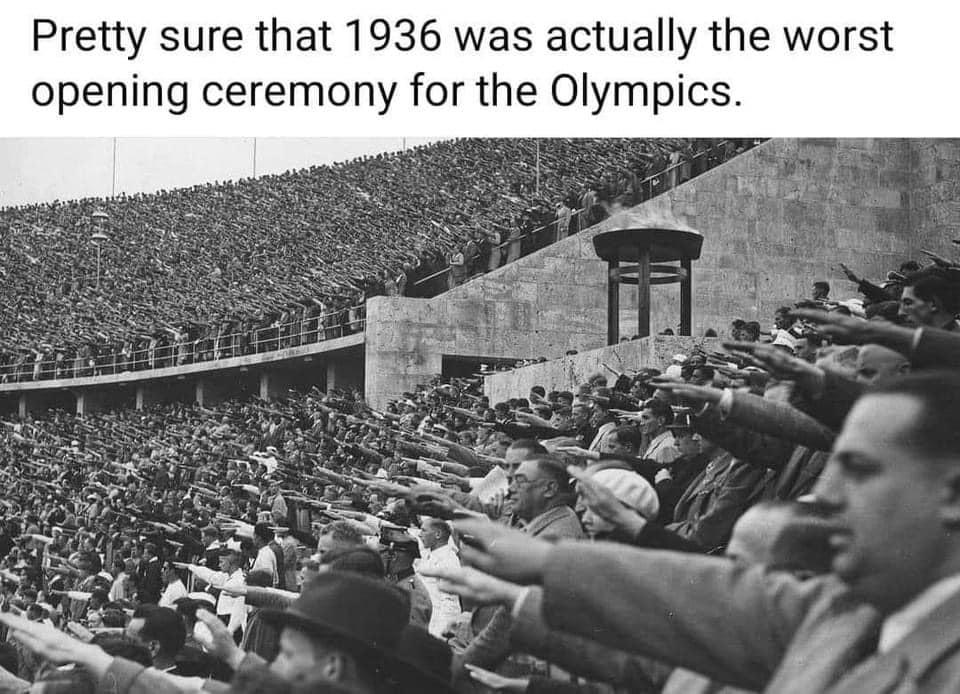
▲ 713 ▼ 1936 Olympics, Berlin, Nazi Germany (lemmy.world) submitted 2 years ago by PugJesus@lemmy.world [M] to c/historyporn@lemmy.world 47 comments fedilink hide all child comments
[+] dwindling7373@feddit.it -18 points 2 years ago (10 children) As opposed to the other Germany? permalink fedilink source hideshow 10 child comments replies: [–] Quik@infosec.pub 13 points 2 years ago (8 children) You often refer to Germany by the state then in place you mean, as there were multiple times where there has not been a single Germany (think DDR/BRD or before there was a single Germany to begin with) and overall a lot of German states with very different political systems during the years. permalink fedilink source parent hideshow 8 child comments replies: [+] dwindling7373@feddit.it -18 points 2 years ago (7 children) No I don't think I do... I probably used west and east Germany a couple of times but that's it. Any country in the past were different than the modern counterpart anyway, and I feel distinguishing Nazi Germany from current Germany leans into some magical trasformation that I personally don't love. permalink fedilink source parent hideshow 7 child comments replies: [–] Quik@infosec.pub 7 points 2 years ago Yeah, I mean, I get that. Still, one could argue, not every country had such a (at best) mixed history politics-wise and naming the different states existing at different points in time quickly tells the reader a lot of political context as well as highlights that there was a said transformation process (but not a magical one). permalink fedilink source parent [–] flerp@lemm.ee 6 points 2 years ago* (1 child) You often refer to Germany by the state then in place you mean No I don’t think I do… Here you go: https://en.wikipedia.org/wiki/Generic_you permalink fedilink source parent hideshow 1 child comment replies: [–] dwindling7373@feddit.it 1 point 2 years ago Silly, generic, me. permalink fedilink source parent [–] volodya_ilich@lemm.ee 2 points 2 years ago (3 children) distinguishing Nazi Germany from current Germany leans into some magical trasformation There's an interesting debate on the amount of Nazi leaders, government officials and capitalists that were allowed to stay in their positions of power in western Germany after the Nazi were defeated. As a Spanish person, I myself sadly see the legacy of fascism in the Spanish institutions, and believe that the transition to democracy was way, way, way too lenient with fascists and fascism. That said, it's useful to refer to countries whose systems of governance have changed drastically over time, by the system of the time you're referring to, it's not exclusive to Germany. permalink fedilink source parent hideshow 3 child comments replies: [–] dwindling7373@feddit.it 1 point 2 years ago (2 children) I'm not so convinced you can even talk about a "transition". Fascism and its nazi derivation, brewed and rised within democratic countries. And, lo and behold, they are still among us in our democracies so much so that they are ruling a number of countries. Fascist Spain is Spain. Fascist Italy is Italy. Fascist Japan is Japan and Nazi Germany is as clearly just Germany. Denying that is dangerous and doesn't give you the tools, as a country, to change. permalink fedilink source parent hideshow 2 child comments replies: [–] volodya_ilich@lemm.ee 1 point 2 years ago (1 child) Again, I agree that the fascists weren't properly tried for their crimes and removed from the institutions (they were in east-germany). I'm just saying that there's a consensus nowadays about using those terms to refer to countries that changed their regime at least in theory. If you want to make the argument to change that consensus, you'd be better understood explaining from the start your issues with the terms because of the lack of renovation of people in power and power structures, rather than just saying "there's no other Germany". permalink fedilink source parent hideshow 1 child comment replies: [–] dwindling7373@feddit.it 1 point 2 years ago* Considering the context I priorityzed brevity. I'll make a note and include that as a chapter in my magnus opum. permalink fedilink source parent [–] volodya_ilich@lemm.ee 2 points 2 years ago When countries have had antecessor-states that have been drastically changed over historical events, normally through a change or system of governance, it's common to refer to the type of system that was in place at the time you're referring to. For example, it's common to refer to 1950s Spain as Fascist Spain (no more Spains on earth at that time), 1950s Russia as Soviet Russia (no more Russias at that time), 1890s Russia as Tsarist Russia (no more Russias at the time)... You get my point. permalink fedilink source parent
[–] Quik@infosec.pub 13 points 2 years ago (8 children) You often refer to Germany by the state then in place you mean, as there were multiple times where there has not been a single Germany (think DDR/BRD or before there was a single Germany to begin with) and overall a lot of German states with very different political systems during the years. permalink fedilink source parent hideshow 8 child comments replies: [+] dwindling7373@feddit.it -18 points 2 years ago (7 children) No I don't think I do... I probably used west and east Germany a couple of times but that's it. Any country in the past were different than the modern counterpart anyway, and I feel distinguishing Nazi Germany from current Germany leans into some magical trasformation that I personally don't love. permalink fedilink source parent hideshow 7 child comments replies: [–] Quik@infosec.pub 7 points 2 years ago Yeah, I mean, I get that. Still, one could argue, not every country had such a (at best) mixed history politics-wise and naming the different states existing at different points in time quickly tells the reader a lot of political context as well as highlights that there was a said transformation process (but not a magical one). permalink fedilink source parent [–] flerp@lemm.ee 6 points 2 years ago* (1 child) You often refer to Germany by the state then in place you mean No I don’t think I do… Here you go: https://en.wikipedia.org/wiki/Generic_you permalink fedilink source parent hideshow 1 child comment replies: [–] dwindling7373@feddit.it 1 point 2 years ago Silly, generic, me. permalink fedilink source parent [–] volodya_ilich@lemm.ee 2 points 2 years ago (3 children) distinguishing Nazi Germany from current Germany leans into some magical trasformation There's an interesting debate on the amount of Nazi leaders, government officials and capitalists that were allowed to stay in their positions of power in western Germany after the Nazi were defeated. As a Spanish person, I myself sadly see the legacy of fascism in the Spanish institutions, and believe that the transition to democracy was way, way, way too lenient with fascists and fascism. That said, it's useful to refer to countries whose systems of governance have changed drastically over time, by the system of the time you're referring to, it's not exclusive to Germany. permalink fedilink source parent hideshow 3 child comments replies: [–] dwindling7373@feddit.it 1 point 2 years ago (2 children) I'm not so convinced you can even talk about a "transition". Fascism and its nazi derivation, brewed and rised within democratic countries. And, lo and behold, they are still among us in our democracies so much so that they are ruling a number of countries. Fascist Spain is Spain. Fascist Italy is Italy. Fascist Japan is Japan and Nazi Germany is as clearly just Germany. Denying that is dangerous and doesn't give you the tools, as a country, to change. permalink fedilink source parent hideshow 2 child comments replies: [–] volodya_ilich@lemm.ee 1 point 2 years ago (1 child) Again, I agree that the fascists weren't properly tried for their crimes and removed from the institutions (they were in east-germany). I'm just saying that there's a consensus nowadays about using those terms to refer to countries that changed their regime at least in theory. If you want to make the argument to change that consensus, you'd be better understood explaining from the start your issues with the terms because of the lack of renovation of people in power and power structures, rather than just saying "there's no other Germany". permalink fedilink source parent hideshow 1 child comment replies: [–] dwindling7373@feddit.it 1 point 2 years ago* Considering the context I priorityzed brevity. I'll make a note and include that as a chapter in my magnus opum. permalink fedilink source parent
[+] dwindling7373@feddit.it -18 points 2 years ago (7 children) No I don't think I do... I probably used west and east Germany a couple of times but that's it. Any country in the past were different than the modern counterpart anyway, and I feel distinguishing Nazi Germany from current Germany leans into some magical trasformation that I personally don't love. permalink fedilink source parent hideshow 7 child comments replies: [–] Quik@infosec.pub 7 points 2 years ago Yeah, I mean, I get that. Still, one could argue, not every country had such a (at best) mixed history politics-wise and naming the different states existing at different points in time quickly tells the reader a lot of political context as well as highlights that there was a said transformation process (but not a magical one). permalink fedilink source parent [–] flerp@lemm.ee 6 points 2 years ago* (1 child) You often refer to Germany by the state then in place you mean No I don’t think I do… Here you go: https://en.wikipedia.org/wiki/Generic_you permalink fedilink source parent hideshow 1 child comment replies: [–] dwindling7373@feddit.it 1 point 2 years ago Silly, generic, me. permalink fedilink source parent [–] volodya_ilich@lemm.ee 2 points 2 years ago (3 children) distinguishing Nazi Germany from current Germany leans into some magical trasformation There's an interesting debate on the amount of Nazi leaders, government officials and capitalists that were allowed to stay in their positions of power in western Germany after the Nazi were defeated. As a Spanish person, I myself sadly see the legacy of fascism in the Spanish institutions, and believe that the transition to democracy was way, way, way too lenient with fascists and fascism. That said, it's useful to refer to countries whose systems of governance have changed drastically over time, by the system of the time you're referring to, it's not exclusive to Germany. permalink fedilink source parent hideshow 3 child comments replies: [–] dwindling7373@feddit.it 1 point 2 years ago (2 children) I'm not so convinced you can even talk about a "transition". Fascism and its nazi derivation, brewed and rised within democratic countries. And, lo and behold, they are still among us in our democracies so much so that they are ruling a number of countries. Fascist Spain is Spain. Fascist Italy is Italy. Fascist Japan is Japan and Nazi Germany is as clearly just Germany. Denying that is dangerous and doesn't give you the tools, as a country, to change. permalink fedilink source parent hideshow 2 child comments replies: [–] volodya_ilich@lemm.ee 1 point 2 years ago (1 child) Again, I agree that the fascists weren't properly tried for their crimes and removed from the institutions (they were in east-germany). I'm just saying that there's a consensus nowadays about using those terms to refer to countries that changed their regime at least in theory. If you want to make the argument to change that consensus, you'd be better understood explaining from the start your issues with the terms because of the lack of renovation of people in power and power structures, rather than just saying "there's no other Germany". permalink fedilink source parent hideshow 1 child comment replies: [–] dwindling7373@feddit.it 1 point 2 years ago* Considering the context I priorityzed brevity. I'll make a note and include that as a chapter in my magnus opum. permalink fedilink source parent
[–] Quik@infosec.pub 7 points 2 years ago Yeah, I mean, I get that. Still, one could argue, not every country had such a (at best) mixed history politics-wise and naming the different states existing at different points in time quickly tells the reader a lot of political context as well as highlights that there was a said transformation process (but not a magical one). permalink fedilink source parent
[–] flerp@lemm.ee 6 points 2 years ago* (1 child) You often refer to Germany by the state then in place you mean No I don’t think I do… Here you go: https://en.wikipedia.org/wiki/Generic_you permalink fedilink source parent hideshow 1 child comment replies: [–] dwindling7373@feddit.it 1 point 2 years ago Silly, generic, me. permalink fedilink source parent
[–] volodya_ilich@lemm.ee 2 points 2 years ago (3 children) distinguishing Nazi Germany from current Germany leans into some magical trasformation There's an interesting debate on the amount of Nazi leaders, government officials and capitalists that were allowed to stay in their positions of power in western Germany after the Nazi were defeated. As a Spanish person, I myself sadly see the legacy of fascism in the Spanish institutions, and believe that the transition to democracy was way, way, way too lenient with fascists and fascism. That said, it's useful to refer to countries whose systems of governance have changed drastically over time, by the system of the time you're referring to, it's not exclusive to Germany. permalink fedilink source parent hideshow 3 child comments replies: [–] dwindling7373@feddit.it 1 point 2 years ago (2 children) I'm not so convinced you can even talk about a "transition". Fascism and its nazi derivation, brewed and rised within democratic countries. And, lo and behold, they are still among us in our democracies so much so that they are ruling a number of countries. Fascist Spain is Spain. Fascist Italy is Italy. Fascist Japan is Japan and Nazi Germany is as clearly just Germany. Denying that is dangerous and doesn't give you the tools, as a country, to change. permalink fedilink source parent hideshow 2 child comments replies: [–] volodya_ilich@lemm.ee 1 point 2 years ago (1 child) Again, I agree that the fascists weren't properly tried for their crimes and removed from the institutions (they were in east-germany). I'm just saying that there's a consensus nowadays about using those terms to refer to countries that changed their regime at least in theory. If you want to make the argument to change that consensus, you'd be better understood explaining from the start your issues with the terms because of the lack of renovation of people in power and power structures, rather than just saying "there's no other Germany". permalink fedilink source parent hideshow 1 child comment replies: [–] dwindling7373@feddit.it 1 point 2 years ago* Considering the context I priorityzed brevity. I'll make a note and include that as a chapter in my magnus opum. permalink fedilink source parent
[–] dwindling7373@feddit.it 1 point 2 years ago (2 children) I'm not so convinced you can even talk about a "transition". Fascism and its nazi derivation, brewed and rised within democratic countries. And, lo and behold, they are still among us in our democracies so much so that they are ruling a number of countries. Fascist Spain is Spain. Fascist Italy is Italy. Fascist Japan is Japan and Nazi Germany is as clearly just Germany. Denying that is dangerous and doesn't give you the tools, as a country, to change. permalink fedilink source parent hideshow 2 child comments replies: [–] volodya_ilich@lemm.ee 1 point 2 years ago (1 child) Again, I agree that the fascists weren't properly tried for their crimes and removed from the institutions (they were in east-germany). I'm just saying that there's a consensus nowadays about using those terms to refer to countries that changed their regime at least in theory. If you want to make the argument to change that consensus, you'd be better understood explaining from the start your issues with the terms because of the lack of renovation of people in power and power structures, rather than just saying "there's no other Germany". permalink fedilink source parent hideshow 1 child comment replies: [–] dwindling7373@feddit.it 1 point 2 years ago* Considering the context I priorityzed brevity. I'll make a note and include that as a chapter in my magnus opum. permalink fedilink source parent
[–] volodya_ilich@lemm.ee 1 point 2 years ago (1 child) Again, I agree that the fascists weren't properly tried for their crimes and removed from the institutions (they were in east-germany). I'm just saying that there's a consensus nowadays about using those terms to refer to countries that changed their regime at least in theory. If you want to make the argument to change that consensus, you'd be better understood explaining from the start your issues with the terms because of the lack of renovation of people in power and power structures, rather than just saying "there's no other Germany". permalink fedilink source parent hideshow 1 child comment replies: [–] dwindling7373@feddit.it 1 point 2 years ago* Considering the context I priorityzed brevity. I'll make a note and include that as a chapter in my magnus opum. permalink fedilink source parent
[–] dwindling7373@feddit.it 1 point 2 years ago* Considering the context I priorityzed brevity. I'll make a note and include that as a chapter in my magnus opum. permalink fedilink source parent
[–] volodya_ilich@lemm.ee 2 points 2 years ago When countries have had antecessor-states that have been drastically changed over historical events, normally through a change or system of governance, it's common to refer to the type of system that was in place at the time you're referring to. For example, it's common to refer to 1950s Spain as Fascist Spain (no more Spains on earth at that time), 1950s Russia as Soviet Russia (no more Russias at that time), 1890s Russia as Tsarist Russia (no more Russias at the time)... You get my point. permalink fedilink source parent