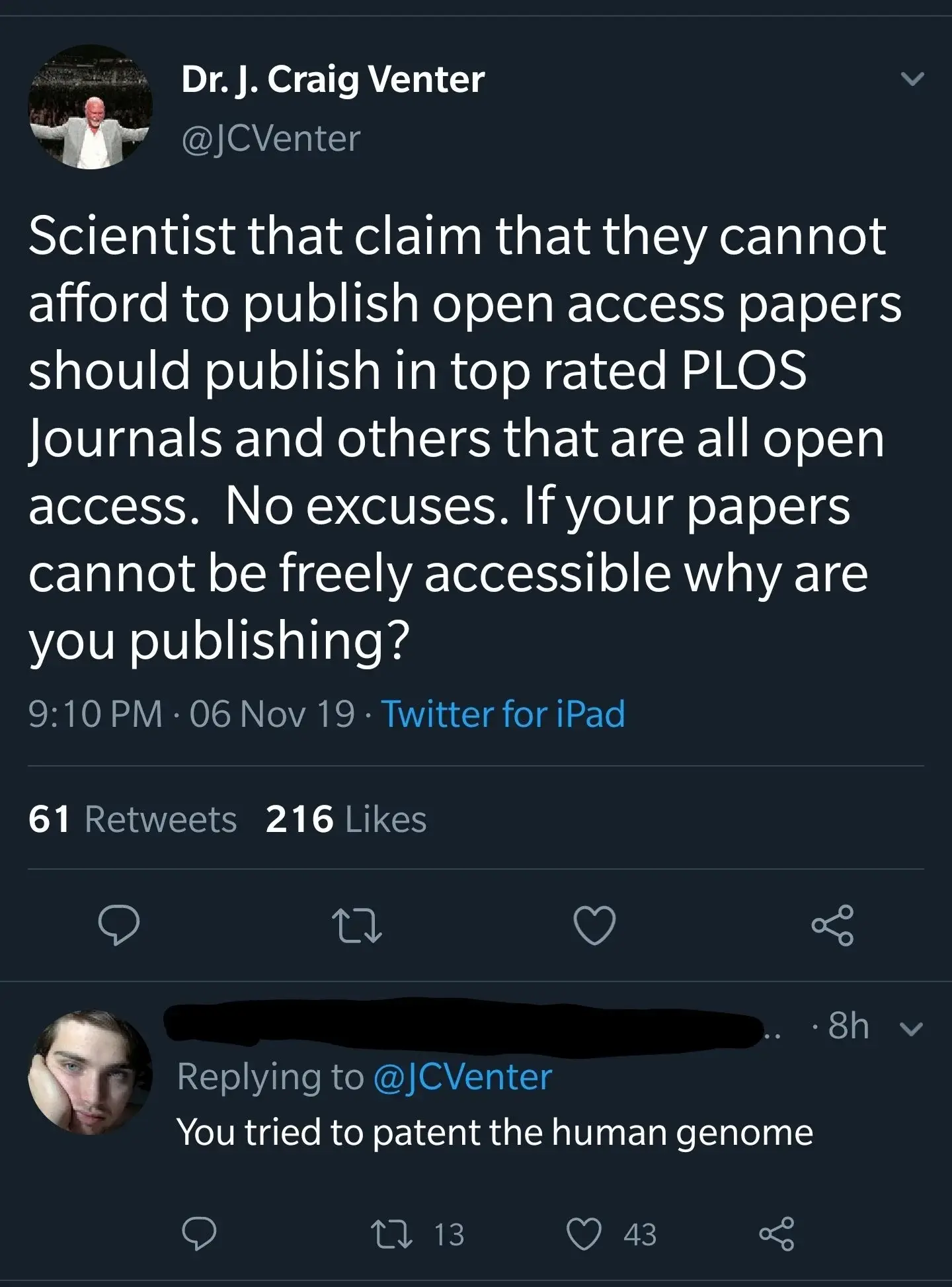
top 50 comments

sorted by: hot top controversial new old
[–] 192 points 2 years ago (3 children)

Nestlé has been patenting human milk proteins for decades. To my understanding, this prevents other companies to add such molecules to baby formula, even if somehow methods to synthesize said molecules were developed.

That is a scary notion, a malevolous intent and a gross outcome.

  • source
  • hideshow 6 child comments
  • [–] 70 points 2 years ago (1 child)

    These shouldn't hold up. Wouldn't the prior work of thousands of generations of mothers invalidate such a patent.

  • source
  • parent
  • hideshow 2 child comments
  • [–] 112 points 2 years ago (5 children)

    "Excuse me madam but do you have a license to use those tits? No? Didn't think so. The content of those bazongas is Nestle property. I'm afraid I'm going to have to clamp those nipples until such time as the proper Bandonkadonk subscriptions are paid"

  • source
  • parent
  • hideshow 7 child comments
  • [–] 27 points 2 years ago (1 child)

    i got this new legal drama plot. basically there's this patent infringer except she's got huge boobs. i mean some serious honkers. a real set of badonkers. packin some dobonhonkeros. massive dohoonkabhankoloos. big ol' tonhongerekoogers.

    what happens next?!

    lawyer shows up with even bigger bonkhonagahoogs. humongous hungolomghononoloughongous

  • source
  • parent
  • hideshow 1 child comment
  • load more comments (1 reply)
  • load more comments (3 replies)
  • [+] 186 points 2 years ago* (last edited 2 years ago) (6 children)
  • [–] 31 points 2 years ago* (1 child)

    Some people live on yachts and that’s their entire home. So like a 70,000£ yacht, then like 300£ a month in slip (berth) fees, including electric and whatnot. I strongly considered it. It’s roughly the same cost but better than caravan living, IMO.

    It’s a decent alternative to a landlocked home.

    But yeah, millionaires with yachts are a different thing.

  • source
  • parent
  • hideshow 2 child comments
  • [–] 30 points 2 years ago (6 children)

    Noah seemed like a chill dude. Man liked his drink, for sure. Loved animals...

  • source
  • parent
  • hideshow 9 child comments
  • load more comments (3 replies)
  • [–] 112 points 2 years ago

    "...he sought funding from the private sector to start Celera Genomics. The company planned to profit from their work by creating genomic data to which users could subscribe for a fee."

    Fuck this guy

  • source
  • [–] 77 points 2 years ago (7 children)

    I’m not even sure what he’s talking about. Open access journals are the ones who charge authors to publish.

    If you publish in a journal that has closed access, there is generally no fee to publish. If you want your paper to be open access, you can tack on an additional open access fee so that your paper doesn’t end up behind a paywall. The last time I looked - and this was several years ago - the going rate for making your paper open access in a closed access journal was about $2-3k. We always budgeted for publication fees when we were putting together our funding proposals.

    The fee structure is similar for open access journals, except that there’s not a choice about paying them. For researchers whose work isn’t grant funded, it generally means they’re paying out of pocket, unless their institution steps in.

    I had a paper published in a small but (in its field) prestigious journal, and the editor explained to me that he only charges people who can afford it, and uses those funds to cover the costs of the journal. He explained that he had a paper from a researcher who couldn’t cover the publishing fee, and he let me know that I was helping out the other person, too.

    What I don’t understand is how anyone how has gone through academia doesn’t know this.

  • source
  • hideshow 9 child comments
  • [–] 24 points 2 years ago (5 children)

    If you publish in a journal that has closed access, there is generally no fee to publish.

    What field are you in? In the life sciences, there's normally a fee to publish closed-access and a higher one for open-access. My last paper was open access and costed about 3500, compared to 1500 pay walled.

  • source
  • parent
  • hideshow 6 child comments
  • load more comments (4 replies)
  • [–] 7 points 2 years ago

    This guy probably lives in his own small world. If you want to publish in PLOS as a researcher from say Turkey or Uzbekistan or any other country where the value of your money is nil, you might easily have to pay your yearly salary or half of your funding to get a single paper published.

  • source
  • parent
  • load more comments (5 replies)
    [–] 55 points 2 years ago (1 child)

    Tbf he evolutionarily developed that genome all by himself. That's how capitalism works

  • source
  • hideshow 2 child comments
  • [–] 25 points 2 years ago

    He also had a history of being screwed by people. The guy did a lot of good work, and arguably his attempt at patenting it was instrumental in preventing it from being patented. I don't think that was his intention, but good came from it.

  • source
  • parent
  • [–] 47 points 2 years ago (1 child)

    For folks that don't know, Venter had a company, Celera, they competed with the Human Genome Project (HGP) run by the US Gov't. They developed interesting techniques to sequence, I believe they are credited with shotgun sequencing.

    How were they able to compete?? The HGP published all their work openly, Venter and co used the freely accessible data alongside their own proprietary methods to try and sequence the human genome first themselves.

    If I recall correctly it was considered a tie and they both jointly published the first sequenced human genome in Science.

  • source
  • hideshow 2 child comments
  • [–] 29 points 2 years ago* (last edited 2 years ago) (2 children)

    Surely there has to be a cost to the infrastructure of publishing and curation though. And possibly all the work of setting up and organizing the peer review process. So they probably charge the institutions or authors submitting the paper instead of their readers. But perhaps we should treat scientific journals as a public good, like libraries, or at least have a publicly funded option. Or have universities and institutions fund it for the public good.

  • source
  • hideshow 3 child comments
  • [–] 49 points 2 years ago (3 children)

    But it's mostly a scam. The costs don't remotely compare to the revenue. Reviewers time is not paid, and there's a price to both publish and access. It's all about the prestige to publish. If you contact the author directly they'll typically gladly send you the article for free.

  • source
  • parent
  • hideshow 4 child comments
  • [–] 8 points 2 years ago

    Not to mention that system started about four centuries ago, long before the Internet was invented. I'd assume that back then, the costs and effort of operating a journal really did justify the prices they charged.

  • source
  • parent
  • load more comments (2 replies)
  • load more comments (1 reply)
    [–] 27 points 2 years ago

    What even is this argument?

    "Scientists who say they can't afford to do X should do X"? Does he think this makes him sound smart?

  • source
  • [+] 26 points 2 years ago
    [–] 21 points 2 years ago (4 children)

    Paywalled articles are still openly available if you politely email the researcher. While we should strive to have no barrier, if you can’t afford to publish openly those who need the research can still acquire it under the table. Having research unpublished because the researchers could not afford to pay the fee is worse than having the research published in a closed journal.

    I’ve gotten a few dozen papers from closed journals that way, and I’ve never been told no.

  • source
  • hideshow 6 child comments
  • load more comments (2 replies)
    [–] 18 points 2 years ago (7 children)

    Venter is one of the many quacks who promised that he'd find the "aging gene" and switch it off. People threw a lot of money at him about twenty years ago.

  • source
  • hideshow 7 child comments
  • load more comments (7 replies)
    load more comments
    view more: next ›