top 50 comments

sorted by: hot top controversial new old
[–] 208 points 3 years ago (33 children)

TL;DR: its cheaper that way,

And i value that decision

  • source
  • hideshow 33 child comments
  • [–] 99 points 3 years ago (26 children)

    I can bet you it's incompetence. They failed upwards. Sure, protocol is great and universal, but connector is atrocious and it has nothing to do with cost. Few points in favor of this hypothesis:

    1. Plastic inside of the connector was initially black. Why chose hard to see color? Go with something easier to see;
    2. Connector is perfectly rectangular and only distinguishing feature they made hard to see. Don't make ti symmetrical if it's not reversible, basic design principle;
    3. Connector is perfectly rectangular making it difficult to insert. There's a reason why most connectors have rounded corners, they are self-correcting, even TypeC does this;
    4. They made various different connector types but pushed for the only one with these issues. No one ever had doubts how type B or mini B or micro B go in.
  • source
  • parent
  • hideshow 26 child comments
  • [–] 55 points 3 years ago (5 children)

    Initially, the plastic inside the connector was white. They started to use black to denote USB2.0 devices, and USB2.0 rapidly became the standard. They at least tried to do something similar with blue plastic with USB3.0.

    It's basically the only example I can think of where the plug and socket are rotationally symmetrical without also being reversible. That's the kind of thing where I ask "did you test this before you shipped it?" Thirty years later we're still plagued by the damn thing.

  • source
  • parent
  • hideshow 5 child comments
  • load more comments (5 replies)
  • [–] 44 points 3 years ago (7 children)

    Also a male USB 2 plug fits perfectly into a RJ45 slot :-/ In my days of tech support, I've seen multiple people plugging their USB printer cable into the network slot of their computer and it's a perfect fit so they were always convinced they didn't do anything wrong... That's clearly a design flaw while all other connectors have distinct sizes.

  • source
  • parent
  • hideshow 7 child comments
  • load more comments (7 replies)
  • [–] 35 points 3 years ago (5 children)

    No one ever had doubts how type B or mini B or micro B go in.

    I agree with most of your post, but micro B is a step too far. That fucking plug was always inserted with the following procedure:

    1. Try to plug it in.
    2. Flip the side and try to plug it in again.
    3. Flip it again because you had the right damn side the first time.

    Always, always, always.

  • source
  • parent
  • hideshow 5 child comments
  • load more comments (5 replies)
  • load more comments (2 replies)
  • [–] 162 points 3 years ago (22 children)

    USB-A walked so USB-C could fly.

  • source
  • hideshow 22 child comments
  • [–] 158 points 3 years ago (9 children)
  • load more comments (2 replies)
    [–] 124 points 3 years ago (7 children)

    Somewhat understandable, but they could've also done something like HDMI and DisplayPort and gone with a shape that could only plug in one way. It might not have been "as cheap as possible" but probably not as much added expense as the extra wiring and stuff. (maybe, idk shit about manufacturing)

  • source
  • hideshow 7 child comments
  • [+] 66 points 3 years ago* (last edited 3 years ago) (1 child)
  • [–] 25 points 3 years ago

    The problem there is at least as much from how hard it is to twist the cables as it is from the connector shape. The asymmetric connector is still better than nothing.

    I can think of some examples of asymmetric connectors that work great: mini USB; North American 3-prong power plugs; old school PC video, serial, and game ports; original NES controller connections, etc.

  • source
  • parent
  • [–] 33 points 3 years ago (3 children)

    I really wish hdmi was symmetrical. (Peer behind tv, “which way goes up?” Tries to plug it in, “fml it was the other way” flips it drops it)

  • source
  • parent
  • hideshow 3 child comments
  • load more comments (2 replies)
  • load more comments (1 reply)
    [–] 123 points 3 years ago (41 children)

    About a decade ago or so, I found myself in a reddit argument with someone that claimed they had never attempted to plug a USB in unsuccessfully. They said that every single time they've plugged in, it was the correct way. Some people are insane.

  • source
  • hideshow 41 child comments
  • [–] 59 points 3 years ago (6 children)

    Honestly, with high quality USB A plugs you could feel the logo on the side that was "up", and if you knew which side your motherboard or front panel considered "up", it'd be easy to always plug devices in correctly.

    Just that the vast majority of manufacturers stopped caring relatively early on, which meant you couldn't rely on it anymore.

  • source
  • parent
  • hideshow 6 child comments
  • load more comments (6 replies)
  • [–] 25 points 3 years ago* (last edited 3 years ago) (12 children)

    Perhaps a controversial opinion here, but the usefulness of reversibility is vastly overrated. It's not a game changer, just a tiny first-world luxury that's nice to have, but it does it by introducing a bunch of unnecessary complexity that I'd rather avoid. Not worth the trade off IMO. I can count on one hand the number of minutes USB-C has saved me by being reversible and I honestly don't care

  • source
  • parent
  • hideshow 12 child comments
  • load more comments (6 replies)
  • load more comments (15 replies)
    [–] 111 points 3 years ago (25 children)

    But in practical use, people found out that even a 50/50 chance of plugging the connector in the right way is annoying enough to warrant the additional complexity of reversability, hence the development of USB Type C.

    The USB-C design turned out to be much more durable and versatile (signal and power wise) in addition to reversability compared to the previous USB designs, and it is developed specifically to address the problems people found with USB-A/B/MicroUSB.

    Sometimes problems only reveal themselves through real life usage, and iterative improvement through a scientific trial and error process to address these problem is how you get development progress.

  • source
  • hideshow 25 child comments
  • [–] 35 points 3 years ago* (12 children)

    USB-C has more connectors for data and power than A/B so it's not a surprise that it's more capable.

    What's really changed is demand. No one really expected USB to be used to power everything, it was only ever really expected to be used on computers and maybe digital cameras, smartphones used to arrange matters for themselves. It was only when they two began to adopt USB aas well that calls for smaller ports and higher capacity cables started to arise.

  • source
  • parent
  • hideshow 12 child comments
  • load more comments (12 replies)
  • load more comments (8 replies)
    [–] 84 points 3 years ago (6 children)

    It’s not an issue of not being reversible. The problem is that it is symmetrical without being reversible. HDMI and DisplayPort are much less annoying. Even USB Type B (printer cables) is relatively easy to figure out orientation for.

  • source
  • hideshow 6 child comments
  • load more comments (6 replies)
    [–] 84 points 3 years ago* (22 children)

    they should just go with perfectly circular, with different sizes for different applications. imagine a 20mm unit - high power/bandwidth hoses with a satisfying locking mechanism that magnetically seals the connection.

    and makes the proton pack sound. and rgb fuck nevermind go back this was a bad idea

  • source
  • hideshow 22 child comments
  • [–] 42 points 3 years ago (7 children)

    Circular isn't a great idea, and here are most of the idea why it is not : https://electronics.stackexchange.com/questions/528821/why-dont-we-have-a-circular-usb-port

    USB required to have a stable connexion, as it's a digital signal and not an analog as jack ports, which just sends curent through it. Rotating the connector could maybe introduce issues for signal integrity.

    The usb connector has much more connectors than a jack port. It would take a very long hole to fit them all. (usb 3+, usb C...)

    Size constraint. USB C is flat, a round port is not. So it's bigger in 1 way, but smaller in the other, and so creates more design challenges.

  • source
  • parent
  • hideshow 7 child comments
  • load more comments (7 replies)
  • load more comments (14 replies)
    [–] 71 points 3 years ago (18 children)

    I get why it's not reversible. But why the hell is it not keyed so that is obvious which orientation is correct? A small, cheap, notch would have worked wonders.

  • source
  • hideshow 18 child comments
  • [–] 51 points 3 years ago (5 children)

    Almost all connectors in use on computers at the time USB was introduced were already keyed, and a fat lot of good it did us. Ask anyone who tried fumbling around behind a three ton CRT monitor or computer case -- even with the keyed connectors, feeling for which side was up, getting anything plugged in without eyes on it was already nigh on impossible.

    What the USB A connector did do which was new at the time was introduce a connector that did not have any protruding pins on either the male or female end, and thus theoretically at least could not be damaged by fucking up the insertion. Unlike any of the then-common D-Sub connectors (VGA, serial, parallel) or DIN (PS/2 mouse and keyboard, Apple serial, S-Video, etc.). USB didn't even have the little clip to breal off like an RJ-45 Ethernet or RJ-11 phone line connector.

  • source
  • parent
  • hideshow 5 child comments
  • load more comments (5 replies)
  • load more comments (12 replies)
    [–] 52 points 3 years ago (12 children)

    the decision was made to go with a design that, in theory, would give users a 50/50 chance of plugging it in correctly

    How could it be less than that? If it was triangular?

  • source
  • hideshow 12 child comments
  • [–] 48 points 3 years ago (5 children)
  • [–] 27 points 3 years ago (3 children)

    The PS2 (and AT) connectors keyboards and mice were largely using before USB were round…

    Arguably still better though because you could just rotate the plug until it went in instead of flipping it back and forth 5 times to get it to go in. And they also had more reliable indication for orientation.

  • source
  • parent
  • hideshow 3 child comments
  • load more comments (1 reply)
  • load more comments (2 replies)
    [–] 46 points 3 years ago* (last edited 3 years ago) (14 children)

    How many other plugs are reversible? HDMI and DisplayPort aren't. Older stuff like scsi, gameports, parallel and serial ports and the like weren't, and could even destroy your hardware if plugged into the wrong thing. Firewire and GameboyLink weren't. Barrel plugs are insertable every way you want, but only have two contacts. And 3.5mm jacks slide over all the pins, which might not be great if you plan on carrying power.

    Lightning and USB Type-C are reversible, but that's the only one I can think of. And the inoffiziell rarely seen reversible USB Type-A (when were those first released?).

    Biggest problem with USB Type-A is that it isn't keyed in an obvious way, so both directions of insertions look and feel plausible until the thing doesn't wanna fit.

    PS: Another thing "wrong" with USB is that Type-B isn't a female Type-A, but a completely different thing, meaning a USB cable can't be used as extension cord and you need a different cord for that. As I understand it, this was done deliberately to avoid issues with cable length and voltagedrop and signal degradation (which you run into anyway when using USB extension cords). There is also the hermaphroditic connector, which keeps the sides the same, while still allows extension cord use. Don't know if anybody ever implemented that.

  • source
  • hideshow 14 child comments
  • [–] 34 points 3 years ago* (last edited 3 years ago) (1 child)

    Most people weren't adding and removing peripherals (and potentially multiple things using the same kind of connector) from their computers multiple times a day when many of your examples were in common consumer usage.

    Now we plug and unplug peripherals all the time, and for a great many people those multiple plug/unplug cycles are all using USB, and have been long enough to have plenty of frustration about this.

    I don't think Type-A or its creator should burn in the depths of hell, but it's a legitimate complaint for a usage case that most people didn't experience prior to loosely about the time that USB started to rise in popularity, or so my recollection of the chain of events tells me.

  • source
  • parent
  • hideshow 1 child comment
  • load more comments (1 reply)
  • load more comments (12 replies)
    [–] 39 points 3 years ago (2 children)

    TL:DR; It was cheaper and they figured if it didn't work you could flip it over and try again. So it's mildly inconvenient to save a few cents on manufacturing each connector and to limited the number is conductors to 4, something it turns out was a bad idea anyway because newer USB standards use more than 4 conductors.

  • source
  • hideshow 2 child comments
  • load more comments (2 replies)
    [–] 32 points 3 years ago (9 children)

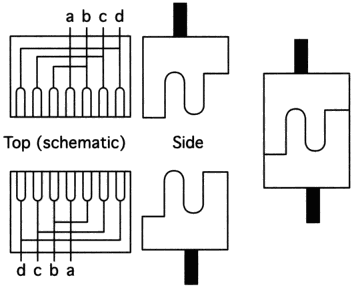
    Making USB reversible to begin with would have necessitated twice as many wires and twice as many circuits, and would have doubled the cost. Bhatt says his team was aware at the time of the frustration that a rectangular design could have, versus a round connector. But in an effort to keep it as cheap as possible, the decision was made to go with a design that, in theory, would give users a 50/50 chance of plugging it in correctly (you can up the odds by looking at the inside first, or identifying the logo).

  • source
  • hideshow 9 child comments
  • load more comments (9 replies)
    [–] 28 points 3 years ago (5 children)

    What a pathetic excuse. You know what's at the other end of a USB-A cable? A USB-B connector that didn't have the symmetry problem. Also, Firewire existed around the same time (in fact, slightly earlier) and didn't have the symmetry problem.

  • source
  • hideshow 5 child comments
  • load more comments (5 replies)
    [–] 23 points 3 years ago

    the problem is the plug is rectangular (has exterior rotational symmetry) AND not reversible - if the plugs were L shaped it would be clear by both feel and brief glance which rotation was correct

  • source
  • [–] 23 points 3 years ago (2 children)

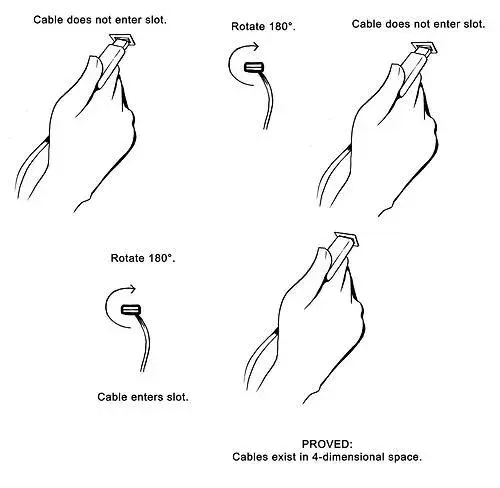
    The worst thing about USB is that it always takes 3 attempts on average to get the fucker in if you don't know the orientation of the port.
  • source
  • hideshow 2 child comments
  • load more comments (2 replies)
    load more comments
    view more: next ›