top 50 comments

sorted by: hot top controversial new old
[–] 87 points 1 year ago (7 children)

That doesn't work anyway, since based on wheat variety, growing season, and grinding method, different flours have different information density.

  • source
  • hideshow 7 child comments
  • [+] 58 points 1 year ago* (last edited 1 year ago) (26 children)
    load more comments (26 replies)
    [–] 57 points 1 year ago* (last edited 1 year ago) (10 children)

    Wouldn't this make the units temperature-dependent?

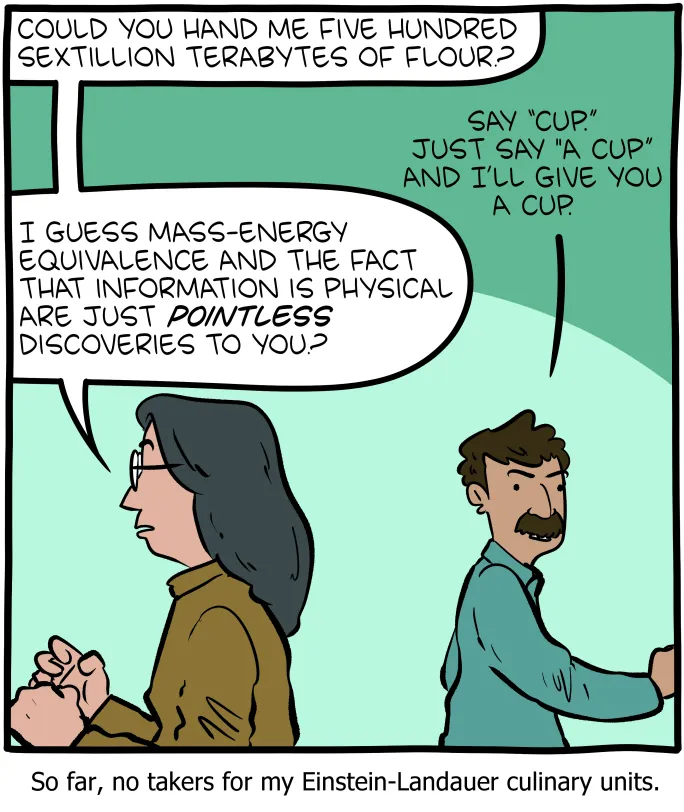
    Landauer limit is one kTln2 per bit of information, so at 300K about 3 zeptojoule per bit.
    Dividing by c² we get 32 micro-quectogram per bit, so 32 yoctogram per terabit. 256 yoctogram per terabyte.
    The Author wants half a septillion terabytes, 0.5•10²⁴ terabytes, half a yotta-terabyte.
    That makes 128 grams.

    Since I don't know what on earth "a cup of flour" is, I can't judge if the comic character proposes a reasonable conversion, but 0.1kg seems like a reasonable amount to use in cooking.

    For baking I would rather have my units temperature dependent than density dependent (I can compact my flour or work with water or nuts, all having different densities, but my room temperature will always be roughly 300).
    I endorse einstein-landauer units.

  • source
  • hideshow 10 child comments
  • [–] 15 points 1 year ago (9 children)

    184 grams is a touch high for "a cup of flour", but I'm not gonna check your math, and the comic probably wanted to use "close enough" round-ish numbers. The weight of a cup of flour is usually somewhere between 120g and 145g, going by the conversions used by major baking recipe publishers like King Arthur, Cooks Illustrated, Washington Post, New York Times, etc.

  • source
  • parent
  • hideshow 9 child comments
  • [–] 13 points 1 year ago

    I fear their apartment is at -50°C and this is a cry for help.

    At least I am relieved to know that even acclaimed authors native to the cup-measurement system don't know what "a cup of flour is".

    I'll be off baking my pannenkoek with 150g of flour then.

  • source
  • parent
  • load more comments (7 replies)
  • [–] 35 points 1 year ago (12 children)

    The real problem is measuring flour by volume instead of mass.

  • source
  • hideshow 12 child comments
  • [–] 24 points 1 year ago (10 children)

    Solve both by measuring with moles

  • source
  • parent
  • hideshow 10 child comments
  • [–] 17 points 1 year ago (3 children)

    are other burrowing animals also ok?

  • source
  • parent
  • hideshow 3 child comments
  • [–] 4 points 1 year ago (5 children)

    Except that moles would only work for counting granules of ground flour, as there is no "flour" molecule. Also, you'd need to have a very accurate measurement of the average mass of a single granule (or you'd need a packing efficiency coefficient and an average granule radius, otherwise you'd have to literally count them. Also, a mole of flour granules would be INSANELY large. 6.02*10^23 of anything larger than a macromolecule is no joke. At this point, since you'd have to weigh it or measure its volume anyway (unless you feel like counting microscopic flour particles for the next few trillion years), you might as well just use grams.

  • source
  • parent
  • hideshow 5 child comments
  • [–] 8 points 1 year ago (1 child)

    There's a better way: German flour types. They're specifying mineral content, e.g. standard "white flour" is Type 405, meaning that when you pyrolyse 100g of flour, 405mg of ashes will be left. As the minerals were all in carbon solution before, and temperatures are low enough to not melt them into slag, you're essentially left with single atoms. Close enough at least for an assumption. If you disagree I shall hand you a mortar.

    Of course, that doesn't specify everything. I suggest also measuring the released energy, then jot both numbers down on the complex plane. So you have joule-moles of flour.

  • source
  • parent
  • hideshow 1 child comment
  • load more comments (3 replies)
  • load more comments (1 reply)
    [–] 29 points 1 year ago (17 children)

    Information is physical? I'm gonna need a source on that one.

  • source
  • hideshow 17 child comments
  • [–] 20 points 1 year ago (7 children)

    The idea is that information must have a physical representation. But I don't know how that would lead to a standardized mass of a byte.

  • source
  • parent
  • hideshow 7 child comments
  • [–] 22 points 1 year ago* (last edited 1 year ago) (6 children)

    No, you missed the point. See @milicent_bystandr@lemm.ee's comment and link to Landauer's Principle, the namesake of which is literally named in the title of the post.

    TL;DR: Storing information requires a change in entropy. A change in entropy requires a change in energy. There must be a minimum non-zero amount of energy required for a given quantity of information. Energy is mass due to mass-energy equivalence. ∴ information has mass independent of its physical representation.

  • source
  • parent
  • hideshow 6 child comments
  • load more comments (6 replies)
  • load more comments (4 replies)
    [–] 22 points 1 year ago

    Oh sure, throw a fit — just wait until you want to convert those units to kilojoules!

    Who's laughing now, tablespoons?!

  • source
  • [–] 17 points 1 year ago

    Hundred sextillion terabytes. Yeah, everybody of calling it hungry sex bites in minutes.

  • source
  • [–] 13 points 1 year ago

    I have absolutely no understanding of whatever is said here

  • source
  • [–] 7 points 1 year ago* (last edited 1 year ago) (2 children)

    Metric appears to end at 10^30, but even then, I think the better way to phrase that number would be 5,000 quetta-bytes

    Tera = 10^12; Septillion Sextillion = 10^21
    Source

  • source
  • hideshow 2 child comments
  • load more comments
    view more: next ›