▲ 172 ▼ I just can't be bothered with these questions (sh.itjust.works) submitted 2 years ago by 0x4E4F@sh.itjust.works to c/funny@sh.itjust.works 29 comments fedilink hide all child comments
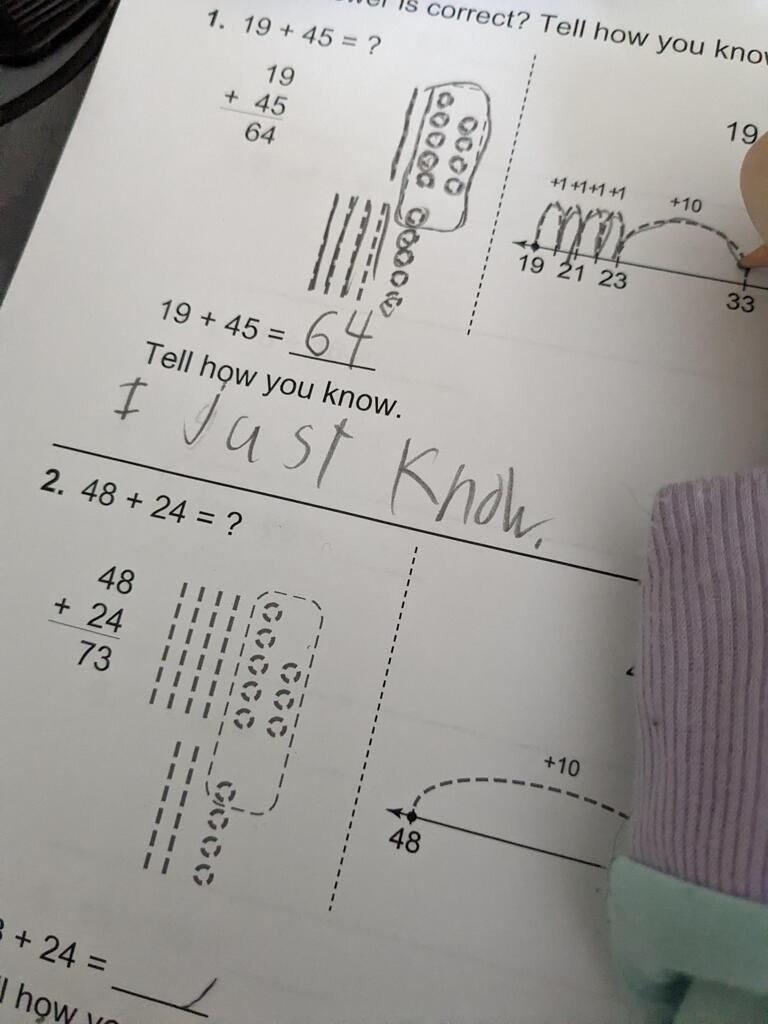
[–] vext01@lemmy.sdf.org 4 points 2 years ago (2 children) Is this how they teach addition these days? permalink fedilink source hideshow 4 child comments replies: [–] funkless_eck@sh.itjust.works 7 points 2 years ago* (1 child) I remember my grandma chiding me for not memorizing log tables in school. Times change, and primary educational theory is hardly in the zeitgeist. I'm not an expert, but most changes from what "we" (which I'm taking anyone aged 5-10 between 1980 and 2000 roughly) experienced to what "kids nowadays" (there are two epochs, 2000-2010, 2010-now) experience are due to the greater availability of data tools With data and technology being more available the way math is taught had to change (although we have calculators with us permenantly now, so we need to rote-memorize less, we need to focus more on what the calculator is doing behind the scenes so we understand the processes), in order to ameliorate the other issue: stratification of learning between rich/poor, and between NA/LATAM/AMEA/EU When you actually read the requirements, and compare them to the image, it makes a bit more sense Make sense of problems and persevere in solving them Reason abstractly and quantitatively Construct viable arguments and critique the reasoning of others Model with mathematics Use appropriate tools strategically Attend to precision Look for and make use of structure Look for and express regularity in repeated reasoning Without wanting to be too glib, how would one differently integrate the above bullet points into an educational schema that allows flexibility for different learning styles, classroom environments, levels of literacy, competency, variations in age/development/background/homelife, disabilities over the course of 5 years while tracking other learnings in key educational areas to complement the syllabus? These things get a bad reputation but the moment to attempt to tackle the problem yourself, you start to see how massively complex and difficult it is. permalink fedilink source parent hideshow 2 child comments replies: [–] vext01@lemmy.sdf.org 0 points 2 years ago (2 children) Um... I just meant that it looks more effort to count and lassoo the tens and ones than it is to just add it up the old fashioned way with a "doorstep". permalink fedilink source parent hideshow 4 child comments replies: [–] DarthFreyr@lemmy.world 2 points 2 years ago Are you perhaps saying that trying to teach an understanding of a concept like place value or carrying is more complicated than just getting the answer to an arithmetic problem? I have no idea why that should be the case, where would you get such an idea anyway? permalink fedilink source parent [–] funkless_eck@sh.itjust.works 2 points 2 years ago well that's the point I was making, there is no "just" permalink fedilink source parent [–] 0x4E4F@sh.itjust.works [S] -2 points 2 years ago (1 child) I know... we never had these graphical things to help us, yet we somehow managed to learn it... permalink fedilink source parent hideshow 2 child comments replies: [–] TheSambassador@lemmy.world 6 points 2 years ago It's almost like teachers have developed new ways to teach that are different but maybe a more effective way for kids to learn. People always get so weird about newer math teaching techniques. I get that it's new and doesn't make sense to us because it's not how we learned, but the kneejerk reaction of "this is obviously worse than how I learned" without any understanding of the method or why it might teach better fundamentals is... Silly permalink fedilink source parent
[–] funkless_eck@sh.itjust.works 7 points 2 years ago* (1 child) I remember my grandma chiding me for not memorizing log tables in school. Times change, and primary educational theory is hardly in the zeitgeist. I'm not an expert, but most changes from what "we" (which I'm taking anyone aged 5-10 between 1980 and 2000 roughly) experienced to what "kids nowadays" (there are two epochs, 2000-2010, 2010-now) experience are due to the greater availability of data tools With data and technology being more available the way math is taught had to change (although we have calculators with us permenantly now, so we need to rote-memorize less, we need to focus more on what the calculator is doing behind the scenes so we understand the processes), in order to ameliorate the other issue: stratification of learning between rich/poor, and between NA/LATAM/AMEA/EU When you actually read the requirements, and compare them to the image, it makes a bit more sense Make sense of problems and persevere in solving them Reason abstractly and quantitatively Construct viable arguments and critique the reasoning of others Model with mathematics Use appropriate tools strategically Attend to precision Look for and make use of structure Look for and express regularity in repeated reasoning Without wanting to be too glib, how would one differently integrate the above bullet points into an educational schema that allows flexibility for different learning styles, classroom environments, levels of literacy, competency, variations in age/development/background/homelife, disabilities over the course of 5 years while tracking other learnings in key educational areas to complement the syllabus? These things get a bad reputation but the moment to attempt to tackle the problem yourself, you start to see how massively complex and difficult it is. permalink fedilink source parent hideshow 2 child comments replies: [–] vext01@lemmy.sdf.org 0 points 2 years ago (2 children) Um... I just meant that it looks more effort to count and lassoo the tens and ones than it is to just add it up the old fashioned way with a "doorstep". permalink fedilink source parent hideshow 4 child comments replies: [–] DarthFreyr@lemmy.world 2 points 2 years ago Are you perhaps saying that trying to teach an understanding of a concept like place value or carrying is more complicated than just getting the answer to an arithmetic problem? I have no idea why that should be the case, where would you get such an idea anyway? permalink fedilink source parent [–] funkless_eck@sh.itjust.works 2 points 2 years ago well that's the point I was making, there is no "just" permalink fedilink source parent
[–] vext01@lemmy.sdf.org 0 points 2 years ago (2 children) Um... I just meant that it looks more effort to count and lassoo the tens and ones than it is to just add it up the old fashioned way with a "doorstep". permalink fedilink source parent hideshow 4 child comments replies: [–] DarthFreyr@lemmy.world 2 points 2 years ago Are you perhaps saying that trying to teach an understanding of a concept like place value or carrying is more complicated than just getting the answer to an arithmetic problem? I have no idea why that should be the case, where would you get such an idea anyway? permalink fedilink source parent [–] funkless_eck@sh.itjust.works 2 points 2 years ago well that's the point I was making, there is no "just" permalink fedilink source parent
[–] DarthFreyr@lemmy.world 2 points 2 years ago Are you perhaps saying that trying to teach an understanding of a concept like place value or carrying is more complicated than just getting the answer to an arithmetic problem? I have no idea why that should be the case, where would you get such an idea anyway? permalink fedilink source parent
[–] funkless_eck@sh.itjust.works 2 points 2 years ago well that's the point I was making, there is no "just" permalink fedilink source parent
[–] 0x4E4F@sh.itjust.works [S] -2 points 2 years ago (1 child) I know... we never had these graphical things to help us, yet we somehow managed to learn it... permalink fedilink source parent hideshow 2 child comments replies: [–] TheSambassador@lemmy.world 6 points 2 years ago It's almost like teachers have developed new ways to teach that are different but maybe a more effective way for kids to learn. People always get so weird about newer math teaching techniques. I get that it's new and doesn't make sense to us because it's not how we learned, but the kneejerk reaction of "this is obviously worse than how I learned" without any understanding of the method or why it might teach better fundamentals is... Silly permalink fedilink source parent
[–] TheSambassador@lemmy.world 6 points 2 years ago It's almost like teachers have developed new ways to teach that are different but maybe a more effective way for kids to learn. People always get so weird about newer math teaching techniques. I get that it's new and doesn't make sense to us because it's not how we learned, but the kneejerk reaction of "this is obviously worse than how I learned" without any understanding of the method or why it might teach better fundamentals is... Silly permalink fedilink source parent