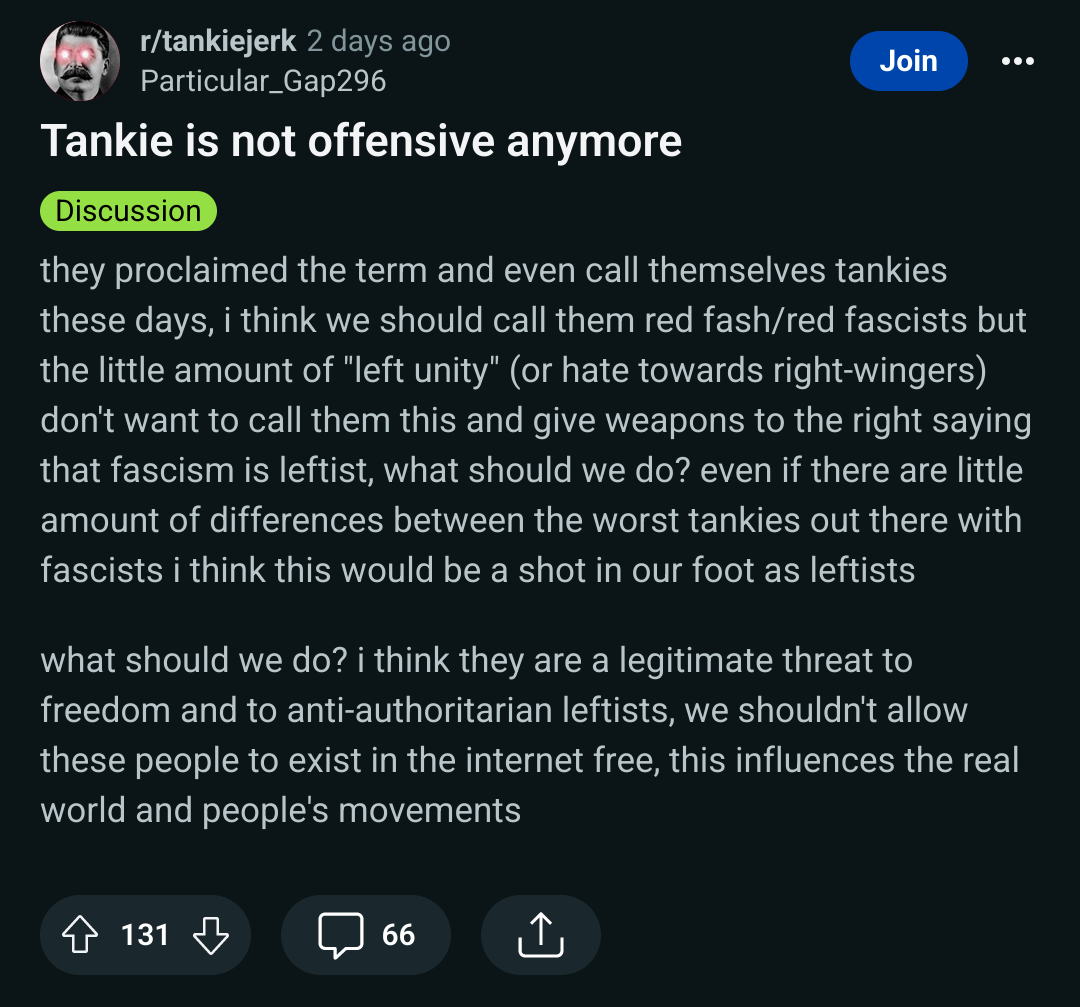
Shot:
they are a legitimate threat to freedom and to anti-authoritarian leftists,
Chaser:
we shouldn't allow these people to exist in the internet free
https://old.reddit.com/r/tankiejerk/comments/197l9ik/tankie_is_not_offensive_anymore/
Shot:
they are a legitimate threat to freedom and to anti-authoritarian leftists,
Chaser:
we shouldn't allow these people to exist in the internet free
https://old.reddit.com/r/tankiejerk/comments/197l9ik/tankie_is_not_offensive_anymore/
Ad hom is in a Venn diagram here, because the two are often used together but are not the same. An ad hom is specifically when you say something that boils down to "You're a scoundrel [or otherwise undesirable], so your argument is incorrect". The labeling strategy that Awoo is discussing is closer to equivocation (insinuating things are the same that are different) as a means of obfuscation, such as the "terrorist" example. See how so many people complaining about the Hot Houthi Winter interview with Hasan were calling the interviewee a "terrorist" in order to get people to not actually think about what he is, which is decidedly not a terrorist. What specifically the dude is saying or even the truth of it hasn't even come into play yet.
So I spent a minute there trying really hard to figure out the difference as I typed because it's honestly a good question on your part, and I think the answer is that this thought-terminating cliche bit is used to conclude that the person is a scoundrel, while ad homs are predicated on the person being seen as a scoundrel to falsely prove some other point (Biden being an imperialist does not make the time of day change when he comments that it's morning). The reason these are so hard to pin down, aside from the fact that they are informal fallacies, is that common communication and even argumentation is filled with implied premises, inferences, and conclusions, so mapping them out formally enough to be able to compare the structure is a genuinely difficult task.
What do you think, @Awoo@hexbear.net?