you are viewing a single comment's thread
view the rest of the comments
[+] -60 points 2 years ago (22 children)

Did you know that you can be a landlord too, even if you can't afford a whole house? There's such a thing as a REIT (real estate investment trust) where you can buy shares in a company that owns and rents out real estate and sends you your share of the profits while you don't have to do anything except give up the option to invest that money somewhere else, which is actually really important.

I don't expect everyone here to be able to invest in the stock market; my point is that there are easy ways for even middle-class people to obtain income from rent and yet most of them aren't doing that because other types of investments are usually better for them. Being a landlord is not some unique source of money for nothing; it's one of many ways to invest your money in a productive asset and usually not the best one.

  • source
  • hideshow 22 child comments
  • [–] 69 points 2 years ago* (last edited 2 years ago) (2 children)

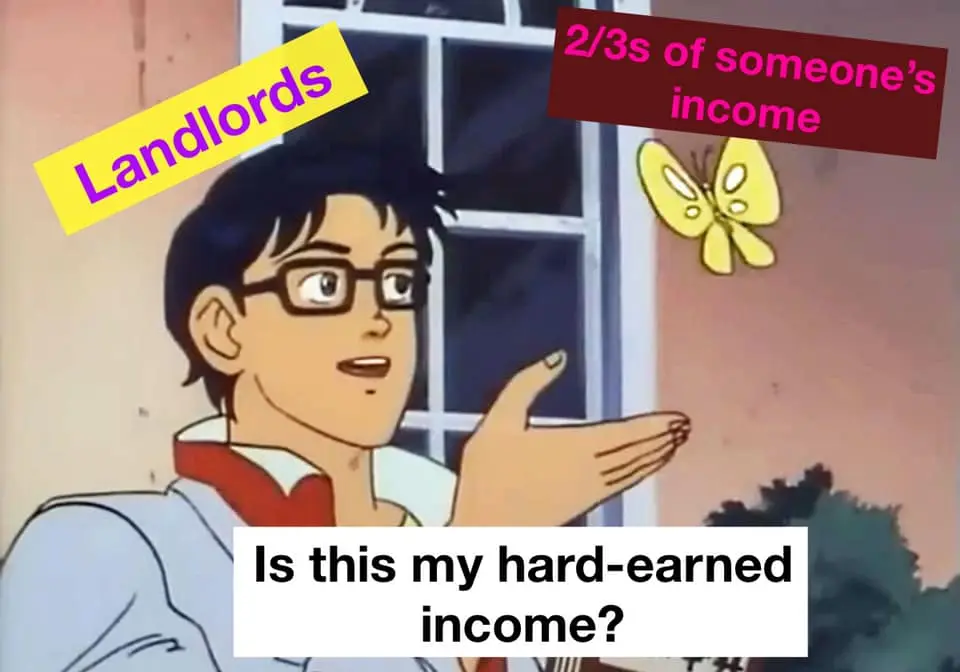
    "Did you know you can help suck 2/3 of someone's income too?"

  • source
  • parent
  • hideshow 2 child comments
  • [–] 24 points 2 years ago (16 children)
  • [+] -11 points 2 years ago (15 children)

    Did you read the article that you're linking to? Rent seeking in the economic sense does not mean purchasing property in order to rent it out to tenants.

  • source
  • parent
  • hideshow 15 child comments
  • [–] 24 points 2 years ago (12 children)

    Rent seeking in the economic sense does not ONLY mean purchasing property in order to rent it out to tenants.

    Fixed it for you. Landlording is one of many forms of "growing one's existing wealth without creating new wealth"

  • source
  • parent
  • hideshow 12 child comments
  • [–] -3 points 2 years ago (2 children)

    Renting out property does create wealth. Think of a house as a factory that produces shelter. Running the factory, as opposed to leaving it idle, increases the amount of shelter in the world, and shelter is a form of wealth.

  • source
  • parent
  • hideshow 2 child comments
  • [–] 10 points 2 years ago (1 child)

    Building a house creates wealth. Owning the land underneath it does not, it merely captures a portion of the wealth produced by others.

  • source
  • parent
  • hideshow 1 child comment
  • [–] -4 points 2 years ago

    That's a well-established economic theory and I'm not contradicting it. What I'm saying is that renting out the house after it's built continues to create wealth. A world in which I build a nice house but keep it empty is wealthier than a world in which I leave the land unimproved, but a world where I rent that house out (or live in it myself) is wealthier still. The experience of living in that house, as opposed to some inferior option, has value.

  • source
  • parent
  • [+] -8 points 2 years ago (8 children)

    Oh ffs, being a private landlord owning a few houses for rent is not a risk-free endeavor and not purely parasitic. You typically have to fix up the properties first (an investment), do work to vet renters, manage the property (maintenance effort/time/cost), and absorb the risk of bad renters destroying the interior. The landlord has to invest their own time and money to provide a livable shelter to others, who exchange money for not having to deal with all the above listed. That livable shelter is a big freaking deal, or why else would someone choose to spend money on it?

    Companies developing monopolies on rental markets is a very different scenario, and I don't think it should be legal. Small private landlords? Yes.

  • source
  • parent
  • hideshow 8 child comments
  • [–] 9 points 2 years ago* (7 children)

    No, get a real job and stop exploiting people.

  • source
  • parent
  • hideshow 7 child comments
  • [–] -1 points 2 years ago

    You do realize that being a landlord is typically a negative cashflow business, meaning they lose money every year? The only upside they get from renting out that property if the possible growth in equity, which is typically less than that of investing in the stock market.

  • source
  • parent
  • [–] -3 points 2 years ago (5 children)

    Ok, you gonna go build your own house then?

  • source
  • parent
  • hideshow 5 child comments
  • [–] 0 points 2 years ago (4 children)

    The vast majority of landlords don't do that. They just buy one someone else built and then make others pay for it.

  • source
  • parent
  • hideshow 4 child comments
  • [–] 1 point 2 years ago (3 children)

    They just buy one out of thin air? Or is it with the wealth they've created through their own skills?

    If it's so easy to own a house, go buy one.

  • source
  • parent
  • hideshow 3 child comments
  • [–] 1 point 2 years ago* (2 children)

    We're talking about landlording, not what they did to afford to start landlording.

    They didn't make the building and, while they put down the first payments, their tennants are the ones paying for it.

    That's not creating wealth. That's not work. That's living off the wealth created by others.

    If it's so easy to own a house, go buy one

    Like all other passive income, the challenge is having enough money to start with.

    Once you get past that point, it IS easy, but due to the inherent inequities of capitalism, getting there is literally impossible for the vast majority of people.

  • source
  • parent
  • hideshow 2 child comments
  • [–] 1 point 2 years ago (1 child)

    It's clear there is a fundamental misunderstanding in the amount of capital required to own an investment property without first living in it as a primary residence for a few years.

    If one were to purchase a property with the expressed intent of immediately renting it, most banks will require at least 25% down with no option to pay PMI to cover the difference. That's an insane amount of money to put down just so the landlord can make a negative cash flow for the first 10 years. If an investor has that kind of money, and still want to be involved in real estate, they should buy a share in an apartment complex where the margins are more favorable, and the property actually has a positive cash flow.

    Thus nearly ever single family home was purchased initially as a primary residence, with the intent to live there. But then by some circumstance one way or another they needed toove away. Selling a home will cost you 10% of the home's value in fees. So if that person has any intent to return to the home in the future, it's better to eat the temporary loss and rent out the property.

  • source
  • parent
  • hideshow 1 child comment
  • [–] 2 points 2 years ago

    However you dress it up, charging others for shelter isn't creating anything. It's profiting off others.

    Besides, the vast majority of tennants rent apartments, not houses, so don't pretend that your very specific example is the norm.

  • source
  • parent
  • [–] 1 point 2 years ago

    Lets unwrap this.

    First of all you claim that the investment in these funds is not the best option, implying that this reflects on being alandlord directly. Instead you need to consider the costs of running the fund, which is even higher than for actively managed stock funds as you get both active management and physicalassets that are more complex to manage than virtual assets like stocks.

    Then you claim that it is not a source of money from nothing. But at the core it is. Why is that? Because space is limited and cannot grow. Companies can grow, ressources can be extracted, work can be put towards something. But the fundamental source of income of a landlord is his control of a limited space ressource. If you claim "but there is a house on that space" then you should compare the rental and also buying prices of the same quality houses depending on location. It is an old wisdomof proerty companies. The first three criteria are location, location and location.

    Finally you argue that it is usually not the best asset to invest in. This may be true for many people, but it is irrelevant to the fact that landlords extract money from scarcity and there is no productivity from there part that justifies this extraction, nor does it benefit the overall economy.

  • source
  • parent