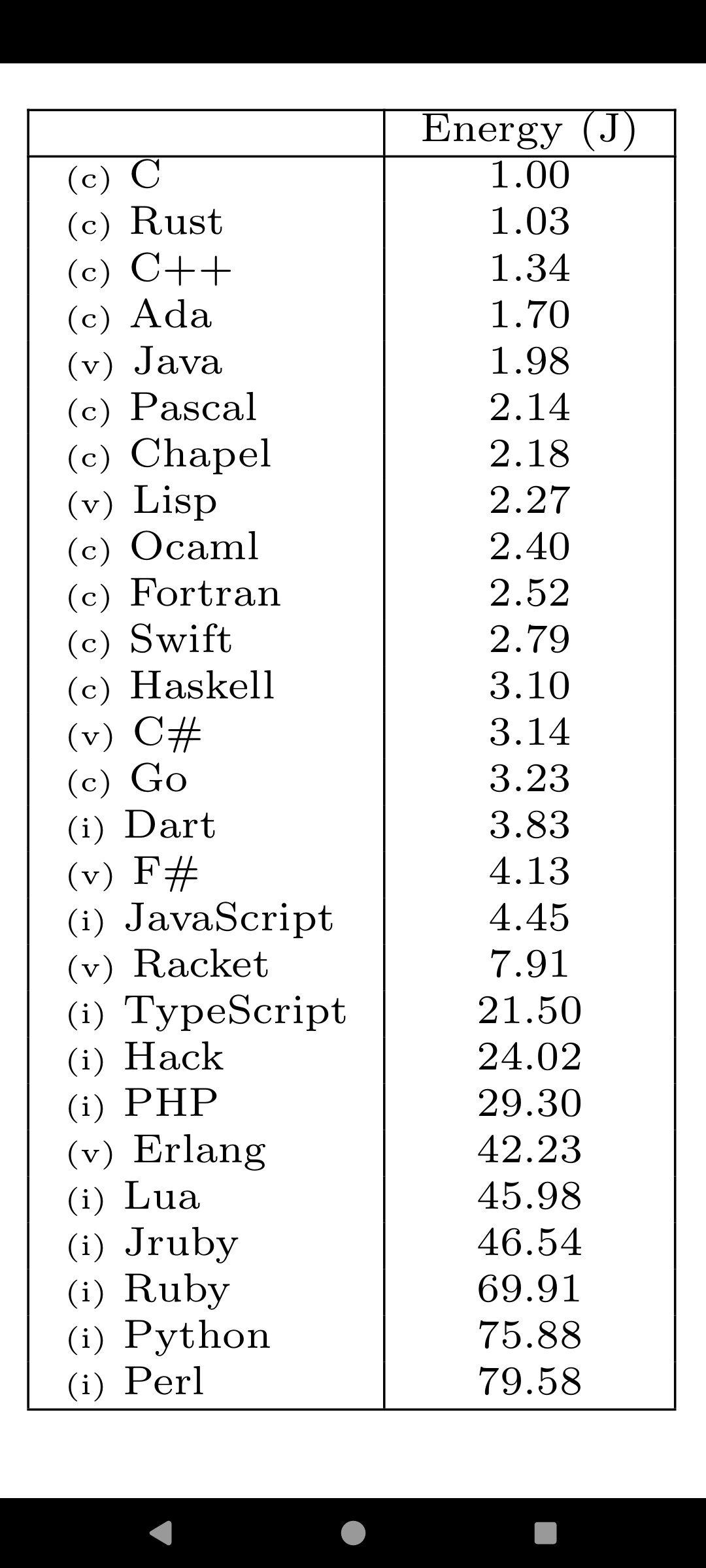
cross-posted from: https://lemmy.world/post/31184706

C is one of the top languages in terms of speed, memory and energy

https://www.threads.com/@engineerscodex/post/C9_R-uhvGbv?hl=en

you are viewing a single comment's thread
view the rest of the comments
[–] 40 points 1 year ago (52 children)
  • [–] 13 points 1 year ago (20 children)

    Also the difference between TS and JS doesn't make sense at first glance. 🤷‍♂️ I guess I need to read the research.

  • source
  • parent
  • hideshow 20 child comments
  • [–] 1 point 1 year ago* (18 children)

    It does, the "compiler" adds a bunch of extra garbage for extra safety that really does have an impact.

  • source
  • parent
  • hideshow 18 child comments
  • [–] 4 points 1 year ago (10 children)

    I thought the idea of TS is that it strongly types everything so that the JS interpreter doesn't waste all of its time trying to figure out the best way to store a variable in RAM.

  • source
  • parent
  • hideshow 10 child comments
  • [–] 5 points 1 year ago (8 children)

    The code is ultimately ran in a JS interpreter. AFAIK TS transpiles into JS, there's no TS specific interpreter. But such a huge difference is unexpected to me.

  • source
  • parent
  • hideshow 8 child comments
  • [–] 1 point 1 year ago (7 children)

    Its really not, have you noticed how an enum is transpiled? you end up with a function... a lot of other things follow the same pattern.

  • source
  • parent
  • hideshow 7 child comments
  • [–] 2 points 1 year ago (3 children)

    Nope, have not noticed because I hate JavaScript with a passion. Thanks for educating me.

  • source
  • parent
  • hideshow 3 child comments
  • [–] 1 point 1 year ago (2 children)

    No they don't. Enums are actually unique in being the only Typescript feature that requires code gen, and they consider that to have been a mistake.

    In any case that's not the cause of the difference here.

  • source
  • parent
  • hideshow 2 child comments
  • [–] 1 point 1 year ago (1 child)

    This isn't true, there are other features that "emit code", that includes: namespaces, decorators and some cases even async / await (when targeting ES5 or ES6).

  • source
  • parent
  • hideshow 1 child comment
  • [–] 1 point 1 year ago

    Ah yeah I forgot about namespaces. I don't think they're a popular feature.

    The other two only generate code for backwards compatibility. When targeting the latest JavaScript versions they don't generate anything.

    Ok decorators are technically still only a proposal so they're slightly jumping the gun there, but the point remains.

  • source
  • parent
  • [–] 1 point 1 year ago (2 children)
  • [–] 1 point 1 year ago (3 children)

    Only if you choose a lower language level as the target. Given these results I suspect the researchers had it output JS for something like ES5, meaning a bunch of polyfills for old browsers that they didn't include in the JS-native implementation..

  • source
  • parent
  • hideshow 3 child comments
  • [–] 1 point 1 year ago (2 children)
  • [–] 1 point 1 year ago (1 child)

    Yeah sure, you found the one notorious TypeScript feature that actually emits code, but a) this feature is recommended against and not used much to my knowledge and, more importantly, b) you cannot tell me that you genuinely believe the use of TypeScript enums – which generate extra function calls for a very limited number of operations – will 5x the energy consumption of the entire program.

  • source
  • parent
  • hideshow 1 child comment
  • load more comments (1 reply)
  • [–] 7 points 1 year ago (3 children)

    I guess we can take the overhead of rust considering all the advantages. Go however... can't even.

  • source
  • parent
  • hideshow 3 child comments
  • [–] 3 points 1 year ago (2 children)

    Even Haskell is higher on the list than Go, which surprises me a lot

  • source
  • parent
  • hideshow 2 child comments
  • [–] 5 points 1 year ago (2 children)

    I would be interested in how things like MATLAB and octave compare to R and python. But I guess it doesn't matter as much because the relative time of those being run in a data analysis or research context is probably relatively low compared to production code.

  • source
  • parent
  • hideshow 2 child comments
  • [–] 5 points 1 year ago (3 children)

    WASM would be interesting as well, because lots of stuff can be compiled to it to run on the web

  • source
  • parent
  • hideshow 3 child comments
  • [–] 2 points 1 year ago* (last edited 1 year ago) (2 children)

    Indeed, here's an example - my climate-system model web-app, written in scala running (mainly) in wasm
    (note: that was compiled with scala-js 1.17, they say latest 1.19 does wasm faster, I didn't yet compare).
    [ Edit: note wasm variant only works with most recent browsers, maybe with experimental options set - if not try without ?wasm ]

  • source
  • parent
  • hideshow 2 child comments
  • load more comments (15 replies)