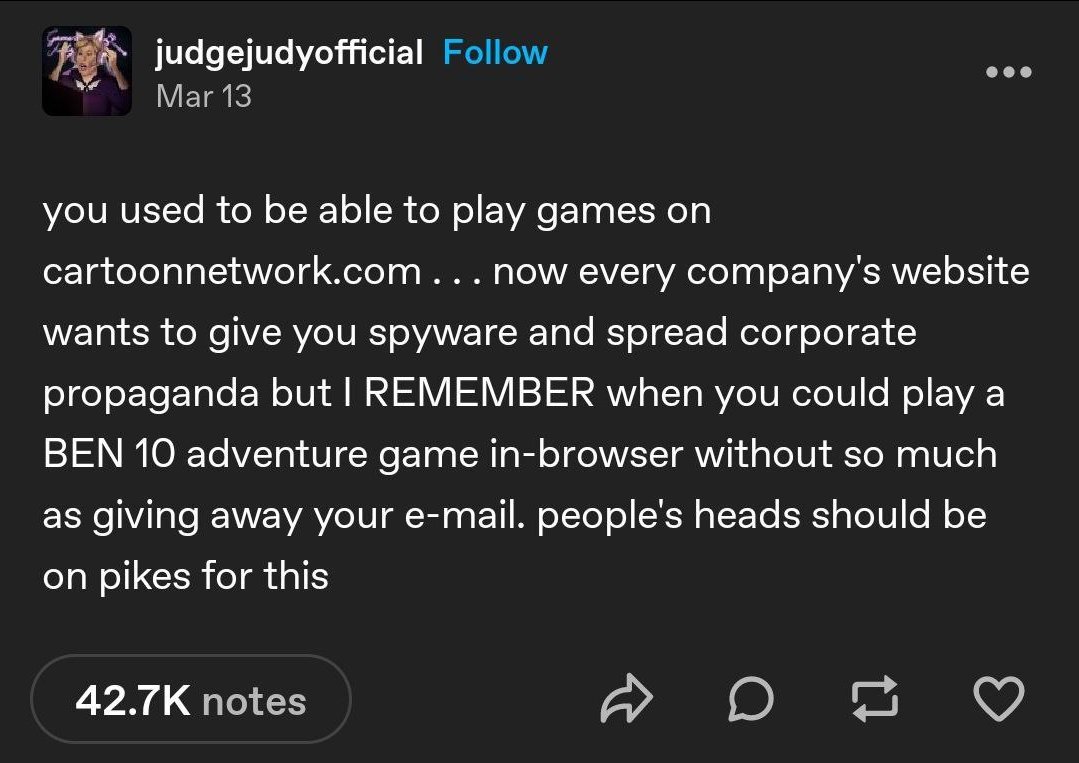
▲ 1536 ▼ I miss the era of the internet with random games on every website (lemmy.world) submitted 2 years ago by The_Picard_Maneuver@lemmy.world to c/curatedtumblr@sh.itjust.works 182 comments fedilink hide all child comments
[+] ogmios@sh.itjust.works 26 points 2 years ago* (last edited 1 year ago) (3 children) [deleted] permalink fedilink source parent hideshow 3 child comments replies: [–] Lawdoggo@lemmy.world 19 points 2 years ago I think a more accurate statement is that the internet was never safe for children, but online content was never monetized and targeted to various audiences for nefarious purposes the way that it is now (including towards children). I would also make a tangential argument that interacting with the internet used to foster a degree of technical ability, critical thinking, and reading comprehension that just isn’t necessary when “going online” can just mean downloading an app and mindlessly scrolling through an endless short-form video feed. On a macro level, today’s internet is dumbing kids down, while yesterday’s internet required (or at least encouraged) some understanding of how systems and technologies work. permalink fedilink source parent [–] Lycaon@lemm.ee 5 points 2 years ago (1 child) You're right, the word safe there was a poor choice lol. But I still do think the internet was at least better for children when there were designated sites/communities for them with appropriate moderation, instead of children being on social media. Though of course the ideal would be for them to be playing outside but that's a whole different discussion permalink fedilink source parent hideshow 1 child comment replies: [–] moonbunny@sh.itjust.works 4 points 2 years ago I believe the problem with children-oriented sites and communities were that the spaces provided a false sense of security for children and parents which led to at least the social spaces being prime targets for predators. While these communities would have strict moderation as well, I think there were some cases where some community moderators were abusing their position which can happen in any social spaces, but children’s spaces are held to a much higher level of scrutiny for obvious reasons. Then there’s the issue of scaling and regulations. As Internet usage continued to explode, it would’ve become much harder to scale up the amount of mods needed, which becomes much more expensive when it’s a full time job. Then I believe a good number of large/influential countries also moved in on regulating how companies maintain data for child accounts and I think restricting targeted advertising for children specifically, which would have made it much harder for companies to make money while also dealing with increasing expenses in moderation and hosting upkeep. It doesnt explain everything completely, but I think that’s why these places disappeared permalink fedilink source parent
[–] Lawdoggo@lemmy.world 19 points 2 years ago I think a more accurate statement is that the internet was never safe for children, but online content was never monetized and targeted to various audiences for nefarious purposes the way that it is now (including towards children). I would also make a tangential argument that interacting with the internet used to foster a degree of technical ability, critical thinking, and reading comprehension that just isn’t necessary when “going online” can just mean downloading an app and mindlessly scrolling through an endless short-form video feed. On a macro level, today’s internet is dumbing kids down, while yesterday’s internet required (or at least encouraged) some understanding of how systems and technologies work. permalink fedilink source parent
[–] Lycaon@lemm.ee 5 points 2 years ago (1 child) You're right, the word safe there was a poor choice lol. But I still do think the internet was at least better for children when there were designated sites/communities for them with appropriate moderation, instead of children being on social media. Though of course the ideal would be for them to be playing outside but that's a whole different discussion permalink fedilink source parent hideshow 1 child comment replies: [–] moonbunny@sh.itjust.works 4 points 2 years ago I believe the problem with children-oriented sites and communities were that the spaces provided a false sense of security for children and parents which led to at least the social spaces being prime targets for predators. While these communities would have strict moderation as well, I think there were some cases where some community moderators were abusing their position which can happen in any social spaces, but children’s spaces are held to a much higher level of scrutiny for obvious reasons. Then there’s the issue of scaling and regulations. As Internet usage continued to explode, it would’ve become much harder to scale up the amount of mods needed, which becomes much more expensive when it’s a full time job. Then I believe a good number of large/influential countries also moved in on regulating how companies maintain data for child accounts and I think restricting targeted advertising for children specifically, which would have made it much harder for companies to make money while also dealing with increasing expenses in moderation and hosting upkeep. It doesnt explain everything completely, but I think that’s why these places disappeared permalink fedilink source parent
[–] moonbunny@sh.itjust.works 4 points 2 years ago I believe the problem with children-oriented sites and communities were that the spaces provided a false sense of security for children and parents which led to at least the social spaces being prime targets for predators. While these communities would have strict moderation as well, I think there were some cases where some community moderators were abusing their position which can happen in any social spaces, but children’s spaces are held to a much higher level of scrutiny for obvious reasons. Then there’s the issue of scaling and regulations. As Internet usage continued to explode, it would’ve become much harder to scale up the amount of mods needed, which becomes much more expensive when it’s a full time job. Then I believe a good number of large/influential countries also moved in on regulating how companies maintain data for child accounts and I think restricting targeted advertising for children specifically, which would have made it much harder for companies to make money while also dealing with increasing expenses in moderation and hosting upkeep. It doesnt explain everything completely, but I think that’s why these places disappeared permalink fedilink source parent