Stolen Cross-posted from here: https://fosstodon.org/@foo/113731569632505985
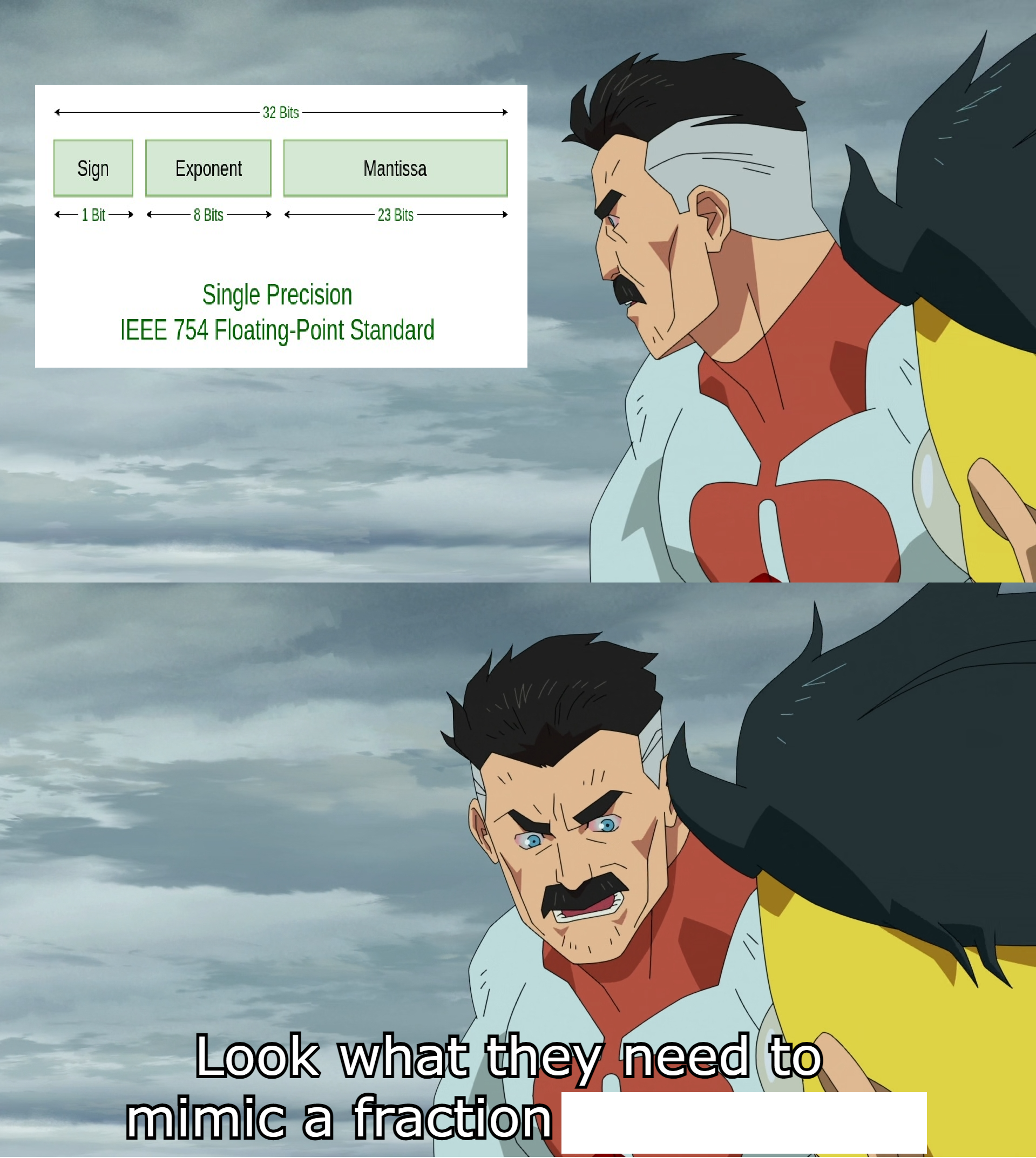
Stolen Cross-posted from here: https://fosstodon.org/@foo/113731569632505985
I' assume its because implemenring comparisons can't be done efficiently.
You'd either have to reduce a fraction every time you perform an operation. That would essentially require computing at least one prime decomposition (and the try to divide rhe other number by each prime factor) but thats just fucking expensive. And even that would just give you a quick equality check. For comparing numbers wrt </> you'd then have to actually compute the floating point number with enough percesion or scale the fractions which could easily lead to owerflows (comparing intmax/1 and 1/intmax would amount to comparing intmax^2/intmax to 1/intmax. The emcodinglengh required to store intmax^2 would be twice that of a normal int... Plus you'd have to perform that huge multiplication). But what do you consider enough? For two numbers which are essentially the same except a small epsilon you'd need infinite percision to determine their order. So would that standard then say they are equal even though they aren't exectly? If so what would be the minimal percision (that makes sense for every concievable case? If not, would you accept the comparison function having an essentially unbounded running time (wrt to a fixed encoding lengh)? Or would you allow a number to be neither smaller, nor bigger, nor equal to another number?
Edit: apparently some languages still have it: https://pkg.go.dev/math/big#Rat