▲ 2065 ▼ Stuck in the middle with you (lemmy.world) submitted 2 years ago by The_Picard_Maneuver@lemmy.world to c/whitepeopletwitter@sh.itjust.works 292 comments fedilink hide all child comments
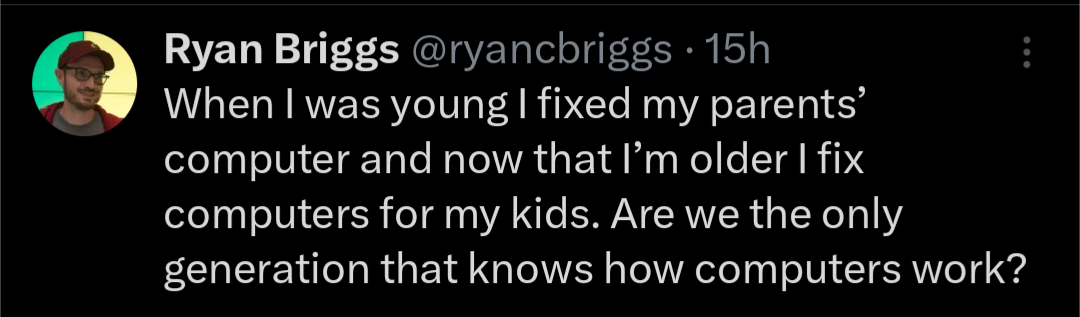
[–] sugar_in_your_tea@sh.itjust.works 2 points 2 years ago (2 children) Kids these days don't know how good they have it... permalink fedilink source parent hideshow 2 child comments replies: [–] MystikIncarnate@lemmy.ca 2 points 2 years ago (1 child) They probably never will. I don't think that's a bad thing. We made it easier, and they're reaping the benefits of our work. The only issue I see is that when it breaks, nobody will know how to fix it, since we've abstracted all the complexity away from the users, so they don't understand the underlying processes that need to work for the thing to function. Other than that, it just works. permalink fedilink source parent hideshow 1 child comment replies: [–] sugar_in_your_tea@sh.itjust.works 2 points 2 years ago The only issue I see is that when it breaks That's a pretty big issue, and that's likely a huge contributor to issues like ewaste. If someone owns a computer and the memory goes bad, they buy a new computer instead of new RAM. Likewise with batteries on phones, capacitors on appliance circuit boards, etc. There's so much that used to be regularly repairable that could still be repairable if people understood the basics of the tech they use. But when it stops working, the knee-jerk reaction is to replace it, not repair it, esp. when it's generally cheaper to replace than have a service tech come out (when 50 years ago, many would just repair it themselves using the provided service manual). I like to blame manufacturers here, but a large part of me has to acknowledge that a lot of people wouldn't bother even if they had all the documentation readily available. A little bit of knowledge about how things actually work can go a long way in reducing waste throughout society. permalink fedilink source parent
[–] MystikIncarnate@lemmy.ca 2 points 2 years ago (1 child) They probably never will. I don't think that's a bad thing. We made it easier, and they're reaping the benefits of our work. The only issue I see is that when it breaks, nobody will know how to fix it, since we've abstracted all the complexity away from the users, so they don't understand the underlying processes that need to work for the thing to function. Other than that, it just works. permalink fedilink source parent hideshow 1 child comment replies: [–] sugar_in_your_tea@sh.itjust.works 2 points 2 years ago The only issue I see is that when it breaks That's a pretty big issue, and that's likely a huge contributor to issues like ewaste. If someone owns a computer and the memory goes bad, they buy a new computer instead of new RAM. Likewise with batteries on phones, capacitors on appliance circuit boards, etc. There's so much that used to be regularly repairable that could still be repairable if people understood the basics of the tech they use. But when it stops working, the knee-jerk reaction is to replace it, not repair it, esp. when it's generally cheaper to replace than have a service tech come out (when 50 years ago, many would just repair it themselves using the provided service manual). I like to blame manufacturers here, but a large part of me has to acknowledge that a lot of people wouldn't bother even if they had all the documentation readily available. A little bit of knowledge about how things actually work can go a long way in reducing waste throughout society. permalink fedilink source parent
[–] sugar_in_your_tea@sh.itjust.works 2 points 2 years ago The only issue I see is that when it breaks That's a pretty big issue, and that's likely a huge contributor to issues like ewaste. If someone owns a computer and the memory goes bad, they buy a new computer instead of new RAM. Likewise with batteries on phones, capacitors on appliance circuit boards, etc. There's so much that used to be regularly repairable that could still be repairable if people understood the basics of the tech they use. But when it stops working, the knee-jerk reaction is to replace it, not repair it, esp. when it's generally cheaper to replace than have a service tech come out (when 50 years ago, many would just repair it themselves using the provided service manual). I like to blame manufacturers here, but a large part of me has to acknowledge that a lot of people wouldn't bother even if they had all the documentation readily available. A little bit of knowledge about how things actually work can go a long way in reducing waste throughout society. permalink fedilink source parent