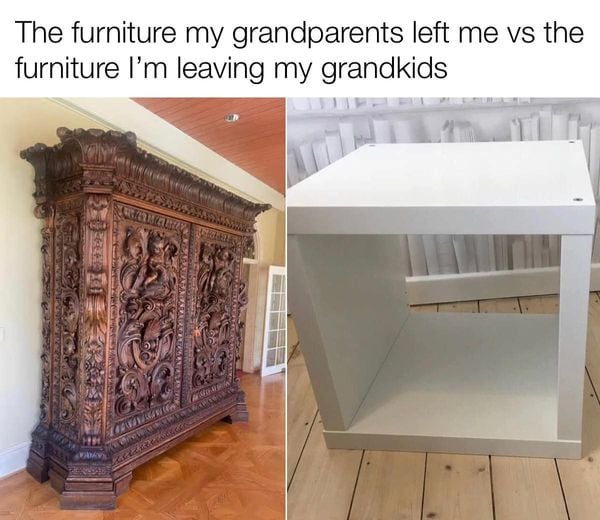
▲ 1543 ▼ I bet the one on the left doesn't even have a fake Swedish name. (lemmy.world) submitted 2 years ago by The_Picard_Maneuver@lemmy.world [M] to c/memes@lemmy.world 148 comments fedilink hide all child comments
[–] Geometrinen_Gepardi@sopuli.xyz 87 points 2 years ago* (4 children) If cheap furniture made by compressing glue and sawdust together existed 100 years ago, I bet it would have sold well. Same goes for shoes. Everyone's wearing terrible plastic stuff nowadays. permalink fedilink source hideshow 8 child comments replies: [+] oberstoffensichtlich@feddit.org 34 points 2 years ago* (last edited 2 years ago) (1 child) [removed by mod] permalink fedilink source parent hideshow 2 child comments replies: [–] Buddahriffic@lemmy.world 3 points 2 years ago (2 children) I wonder why simple shoes (like a piece of wood and some cord) picked up in the East but not in the West. permalink fedilink source parent hideshow 4 child comments replies: [–] Meron35@lemmy.world 5 points 2 years ago They were picked up in the West as well, but not as well known probably because they weren't viewed as fashionable. They're called Pattens FYI Patten (shoe) - Wikipedia - https://en.m.wikipedia.org/wiki/Patten_(shoe) permalink fedilink source parent [–] RadicalCandour@startrek.website 2 points 2 years ago (1 child) Dutch are known for their wooden clogs, no? permalink fedilink source parent hideshow 2 child comments replies: [–] Buddahriffic@lemmy.world 3 points 2 years ago Yes, but both that and the style linked in the other comment are more complex than the Japanese style sandals. They are just boards with some holes drilled and knotted cord put through the holes. Some have two other pieces of wood underneath them to raise them off the ground a bit (maybe they work better in mud?). They look like something you could take an afternoon and make enough new ones for your whole family, if you've got some wooden planks and cord. Clogs look like they'd each take a while to carve and would require more skill to craft. Though I don't know how common either of those were among the poorest of each region. permalink fedilink source parent [–] Zwiebel@feddit.org 16 points 2 years ago (1 child) My grandparents deliberately saved up for the expensive oak furniture. It was meant to last the rest of their lives (which it did). They had a different mindset than me and you who want something nice looking that doesn't burden the bank account too much permalink fedilink source parent hideshow 2 child comments replies: [–] i_dont_want_to@lemmy.blahaj.zone 39 points 2 years ago That and I didn't want to buy solid oak furniture when I lived in apartments and had to move on a dime because the landlord wanted to jack up rent or pull something... Again. permalink fedilink source parent [–] setsneedtofeed@lemmy.world 6 points 2 years ago People bought mail order houses, which I think confirms the popularity of lightweight and portable big purchase items. permalink fedilink source parent [–] captain_aggravated@sh.itjust.works 4 points 2 years ago Chipboard was one of those things invented twice simultaneously during WWII, as the Germans and Americans looked around for resources to exploit and noticed the massive amounts of sawdust they had piling up. Chipboard cabinetry and furniture starts to emerge in the 1950's. Ikea was founded in 1943 and started selling furniture in 1948. So cheap particle board furniture existed ~80 years ago, and did indeed sell well. permalink fedilink source parent
[+] oberstoffensichtlich@feddit.org 34 points 2 years ago* (last edited 2 years ago) (1 child) [removed by mod] permalink fedilink source parent hideshow 2 child comments replies: [–] Buddahriffic@lemmy.world 3 points 2 years ago (2 children) I wonder why simple shoes (like a piece of wood and some cord) picked up in the East but not in the West. permalink fedilink source parent hideshow 4 child comments replies: [–] Meron35@lemmy.world 5 points 2 years ago They were picked up in the West as well, but not as well known probably because they weren't viewed as fashionable. They're called Pattens FYI Patten (shoe) - Wikipedia - https://en.m.wikipedia.org/wiki/Patten_(shoe) permalink fedilink source parent [–] RadicalCandour@startrek.website 2 points 2 years ago (1 child) Dutch are known for their wooden clogs, no? permalink fedilink source parent hideshow 2 child comments replies: [–] Buddahriffic@lemmy.world 3 points 2 years ago Yes, but both that and the style linked in the other comment are more complex than the Japanese style sandals. They are just boards with some holes drilled and knotted cord put through the holes. Some have two other pieces of wood underneath them to raise them off the ground a bit (maybe they work better in mud?). They look like something you could take an afternoon and make enough new ones for your whole family, if you've got some wooden planks and cord. Clogs look like they'd each take a while to carve and would require more skill to craft. Though I don't know how common either of those were among the poorest of each region. permalink fedilink source parent
[–] Buddahriffic@lemmy.world 3 points 2 years ago (2 children) I wonder why simple shoes (like a piece of wood and some cord) picked up in the East but not in the West. permalink fedilink source parent hideshow 4 child comments replies: [–] Meron35@lemmy.world 5 points 2 years ago They were picked up in the West as well, but not as well known probably because they weren't viewed as fashionable. They're called Pattens FYI Patten (shoe) - Wikipedia - https://en.m.wikipedia.org/wiki/Patten_(shoe) permalink fedilink source parent [–] RadicalCandour@startrek.website 2 points 2 years ago (1 child) Dutch are known for their wooden clogs, no? permalink fedilink source parent hideshow 2 child comments replies: [–] Buddahriffic@lemmy.world 3 points 2 years ago Yes, but both that and the style linked in the other comment are more complex than the Japanese style sandals. They are just boards with some holes drilled and knotted cord put through the holes. Some have two other pieces of wood underneath them to raise them off the ground a bit (maybe they work better in mud?). They look like something you could take an afternoon and make enough new ones for your whole family, if you've got some wooden planks and cord. Clogs look like they'd each take a while to carve and would require more skill to craft. Though I don't know how common either of those were among the poorest of each region. permalink fedilink source parent
[–] Meron35@lemmy.world 5 points 2 years ago They were picked up in the West as well, but not as well known probably because they weren't viewed as fashionable. They're called Pattens FYI Patten (shoe) - Wikipedia - https://en.m.wikipedia.org/wiki/Patten_(shoe) permalink fedilink source parent
[–] RadicalCandour@startrek.website 2 points 2 years ago (1 child) Dutch are known for their wooden clogs, no? permalink fedilink source parent hideshow 2 child comments replies: [–] Buddahriffic@lemmy.world 3 points 2 years ago Yes, but both that and the style linked in the other comment are more complex than the Japanese style sandals. They are just boards with some holes drilled and knotted cord put through the holes. Some have two other pieces of wood underneath them to raise them off the ground a bit (maybe they work better in mud?). They look like something you could take an afternoon and make enough new ones for your whole family, if you've got some wooden planks and cord. Clogs look like they'd each take a while to carve and would require more skill to craft. Though I don't know how common either of those were among the poorest of each region. permalink fedilink source parent
[–] Buddahriffic@lemmy.world 3 points 2 years ago Yes, but both that and the style linked in the other comment are more complex than the Japanese style sandals. They are just boards with some holes drilled and knotted cord put through the holes. Some have two other pieces of wood underneath them to raise them off the ground a bit (maybe they work better in mud?). They look like something you could take an afternoon and make enough new ones for your whole family, if you've got some wooden planks and cord. Clogs look like they'd each take a while to carve and would require more skill to craft. Though I don't know how common either of those were among the poorest of each region. permalink fedilink source parent
[–] Zwiebel@feddit.org 16 points 2 years ago (1 child) My grandparents deliberately saved up for the expensive oak furniture. It was meant to last the rest of their lives (which it did). They had a different mindset than me and you who want something nice looking that doesn't burden the bank account too much permalink fedilink source parent hideshow 2 child comments replies: [–] i_dont_want_to@lemmy.blahaj.zone 39 points 2 years ago That and I didn't want to buy solid oak furniture when I lived in apartments and had to move on a dime because the landlord wanted to jack up rent or pull something... Again. permalink fedilink source parent
[–] i_dont_want_to@lemmy.blahaj.zone 39 points 2 years ago That and I didn't want to buy solid oak furniture when I lived in apartments and had to move on a dime because the landlord wanted to jack up rent or pull something... Again. permalink fedilink source parent
[–] setsneedtofeed@lemmy.world 6 points 2 years ago People bought mail order houses, which I think confirms the popularity of lightweight and portable big purchase items. permalink fedilink source parent
[–] captain_aggravated@sh.itjust.works 4 points 2 years ago Chipboard was one of those things invented twice simultaneously during WWII, as the Germans and Americans looked around for resources to exploit and noticed the massive amounts of sawdust they had piling up. Chipboard cabinetry and furniture starts to emerge in the 1950's. Ikea was founded in 1943 and started selling furniture in 1948. So cheap particle board furniture existed ~80 years ago, and did indeed sell well. permalink fedilink source parent