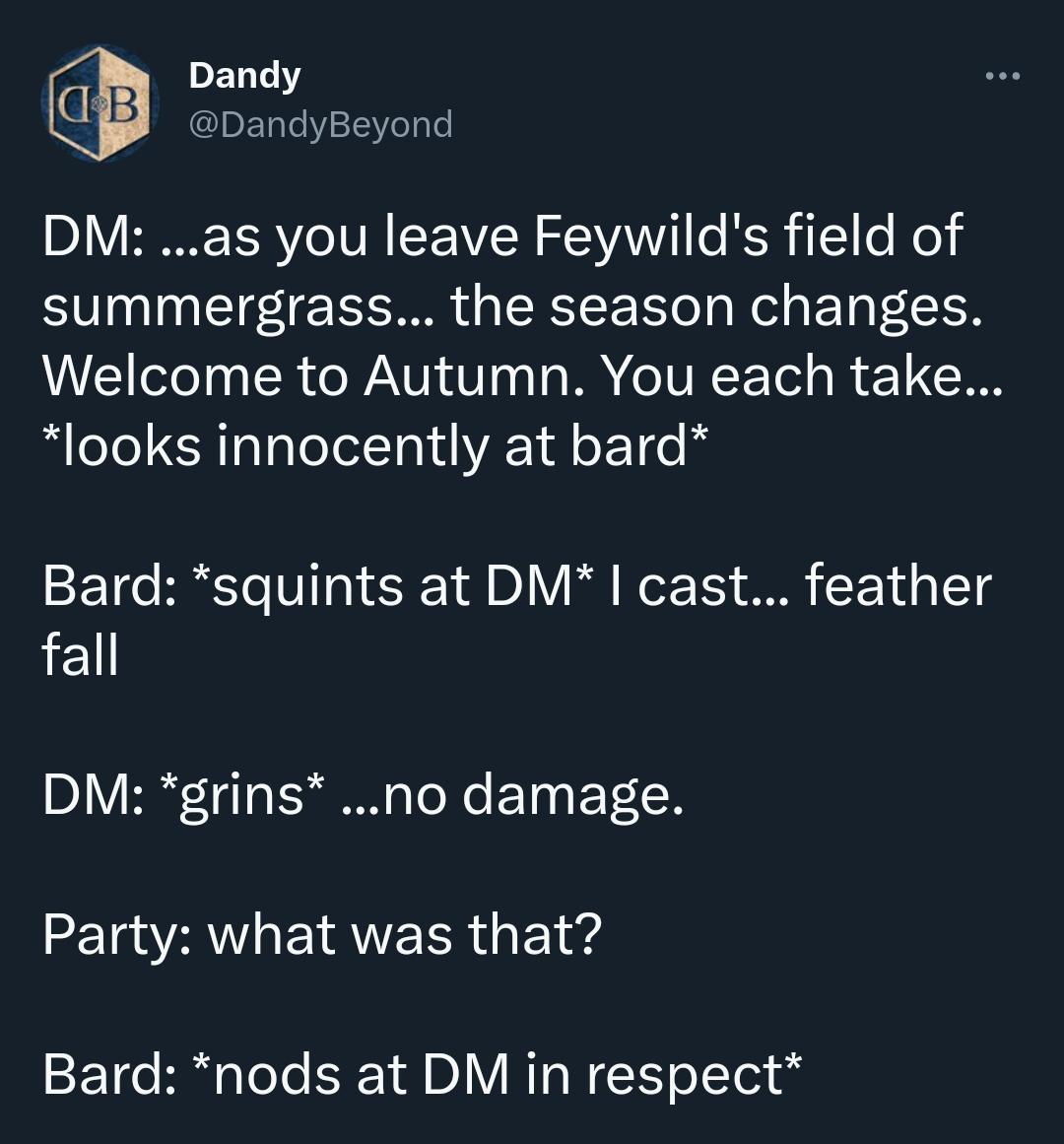
Damage taken from being the Fall season would be called "Fall damage" in English though.
If I’m in a fight, I’m fighting. If I’m on a walk, I’m walking. On a hike? Hiking. If I’m at a party, I’m partying. If there’s rain in the air, it’s raining. If I’m applying butter to my toast, I’m buttering my toast. If I’m on a boat, I’m boating. If I’m in the middle of a fall, I’m falling.
Is it hard to understand that someone is referring to the act of entering Fall (or being in the middle of Fall) when they call it “falling?”
Regardless of whether you find that difficult to understand or to accept, it’s a well-established linguistic phenomenon known as “verbification.”
You are not falling. It is fall. Falling is only from a present tense verb of fall.
You’re wrong on several counts.
First, you don’t suffer “falling damage” from falling. You suffer it from landing after falling (refer to page 183 of the PHB if you don’t believe me). However, casting Feather Fall is a reaction that you can take when you or another creature “falls,” so it was appropriate to cast it at the start of the season.
Second, “falling” is not the present tense of “fall.” The simple present tense of “fall” is “fall” or “falls,” but other “present tenses” include: the present perfect simple (“He has fallen”), present progressive/continuous, and present perfect progressive.
“Falling” is the present participle, and it can be used both as an adjective (“The falling bard”) and as part of the past continuous/progress (“The bard was falling”), present continuous/progressive (“The bard is falling”), and future continuous/progressive (“The bard will be falling”) verb tenses, as well as with their perfect variants (had been falling, has been falling, will have been falling).