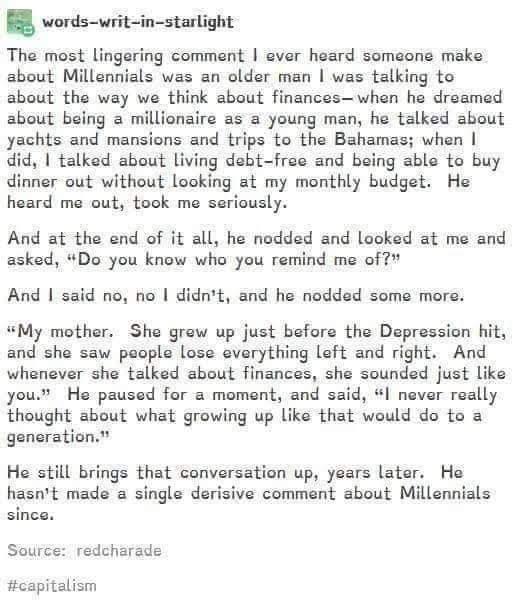
Reminds me that the whole concept of generations is something manufactured of whole cloth and meant to divide us, but more than that, that real people are compassionate and understanding. All that stuff is just fake.

It gives me hope for unity.

words-writ-in-starlight

The most lingering comment I ever heard someone make about Millennials was an older man I was talking to about the way we think about finances - when he dreamed about being a millionaire as a young man, he talked about yachts and mansions and trips to the Bahamas; when I did, I talked about living debt-free and being able to buy dinner out without looking at my monthly budget. He heard me out, took me seriously.

And at the end of it all, he nodded and looked at me and asked, "Do you know who you remind me of?"

And I said no, no I didn't, and he nodded some more.

"My mother. She grew up just before the Depression hit, and she saw people lose everything left and right. And whenever she talked about finances, she sounded just like you." He paused for a moment, and said, "I never really thought about what growing up like that would do to a generation."

He still brings that conversation up, years later. He hasn't made a single derisive comment about Millennials since.

Source: redcharade
#capitalism
you are viewing a single comment's thread
view the rest of the comments
[–] 64 points 2 years ago (20 children)

whole concept of generations is something manufactured of whole cloth

huh? generational metrics are key for all kinds of analysis and are rooted in the fact that the cadence we call human reproduction is generational.

you want to call out those that throw a fancy name on one and market it for monetary gain? go for it... but that doesnt make the quantification behind it 'fake'.

  • source
  • hideshow 20 child comments
  • [–] 48 points 2 years ago* (last edited 2 years ago) (5 children)

    There is something to be said about abandoning the generational lines though. Pew Research is doing it

    As I understand it, only baby boomers are somewhat unified on things and every generation after that drifted more and more into being less distinct, demographically speaking, as a group. The cadence you reference was unified by the end of WWII and, naturally, diffused from there.

  • source
  • parent
  • hideshow 5 child comments
  • [–] 4 points 2 years ago (1 child)

    it feels like theres more to generational computation than just a temporally-similar social group.

    ie, im sure geneticists have a differing view of 'generation' than the pew research group.

  • source
  • parent
  • hideshow 1 child comment
  • [–] 8 points 2 years ago

    Yeah, but now we're drifting into specialized fields and I would suspect that geneticists ignored all the traditional labels in the first place. I'd imagine they define things like that by the rise of a particular mutation, for example.

    Generation, as a laymen term, is exactly that. A temporally similar social group.

  • source
  • parent
  • [–] 1 point 2 years ago (2 children)

    They're unified? When I look at history, it seems to me that they were quite a rebellious generation, with the hippie movement, and the creation of metal and hard rock. Now, if we look at how they're generally represented, and if they are unified, something doesn't add up.

  • source
  • parent
  • hideshow 2 child comments
  • [–] 15 points 2 years ago (11 children)

    I never understood the generation's gap. Are there people of a certain age more frequent? Instead, I believe humans reproduce more or less at a yearly constant rate. I understand that having the categories are meaningful for many but to me it's a 'double-dipping' statistical flaw.

  • source
  • parent
  • hideshow 11 child comments
  • [–] 21 points 2 years ago* (3 children)

    There's definitely differences in birth rates -- it's where Baby Boomer got the name. Here are the CDC numbers below, but in brief, the birth rate in 1950 across all races was 24.1, while in 2019, it was 11.4, meaning people in 1950 were squirting them out at over twice the rate as those just a few years ago.

    https://www.cdc.gov/nchs/data/hus/2020-2021/brth.pdf

  • source
  • parent
  • hideshow 3 child comments
  • [–] 5 points 2 years ago (1 child)

    Ah. I was speaking of planet earth, the world is big. Americans may have their trends. Similarly, between the different states you might see trends that are masked over when taking numbers "globally".

  • source
  • parent
  • hideshow 1 child comment
  • [–] 6 points 2 years ago

    Fair enough. Looks like "According to World Bank data, the global fertility rate was 2.4 children per woman in 2019. This rate is approximately half of what it was in 1950 (4.7), and more economically developed countries such as Australia, most of Europe, and South Korea, tend to have lower rates than do less-developed or low-income countries."

    https://worldpopulationreview.com/country-rankings/total-fertility-rate#:~:text=According%20to%20World%20Bank%20data%2C%20the%20global%20fertility,lower%20rates%20than%20do%20less-developed%20or%20low-income%20countries.

  • source
  • parent
  • [–] 8 points 2 years ago

    Sort of. The second world war had a profound impact on demographics in Europe and North America. During the war birthrates were lower than average but during the postwar period there was a surge of births - the baby boom. Once everybody had a houseful if kids birthrates dropped off again - Generation X (that's me).

    You're right in that every "generation" since then has gotten fuzzier - for exactly the reasons you mention - and is defined more by cultural events than demographics. But it's also true that the baby boom and bust has had a profound impact on our society, including the invention of "teenager" as a distinct phase of life.

  • source
  • parent
  • [–] 2 points 2 years ago* (1 child)

    Other than baby boomers, people were reproducing at a near constant rate. There's no "gap" between generations, just some arbitrary year where non-scientists decided to say "group A" is different from "group B".

    https://www.census.gov/newsroom/blogs/random-samplings/2016/06/americas-age-profile-told-through-population-pyramids.html

    It's basically astrology.

  • source
  • parent
  • hideshow 1 child comment
  • [–] -1 points 2 years ago (2 children)

    Not only did baby boomers get their name from how their parents popped out babys twice as often as the generation before them but gen z has been populating way less often than their generation but it's getting to a point that it's becoming a world wide crisis I honestly hope people start having tons of kids pretty soon or else we might be facing extinction eventually

  • source
  • parent
  • hideshow 2 child comments
  • [–] 2 points 2 years ago

    People are obviously influenced by the way things were during their lives, especially when they were young and impressionable. But, the idea that there's some kind of magic dividing line between "boomer" and "gen X" is ridiculous. And, aside from the boomers, the rate of birth has been pretty constant. So, there are just as many people who are halfway between X and Boomer as there people who are exactly in the middle of the X generation.

    In addition, "Millennial but grew up in a small rural town" probably has more in common with "Gen X" than "Millennial but grew up in New York City". If you were in NYC you were almost certainly exposed to the dot-com boom, the first smartphones, etc. If you lived on a farm, that tech probably arrived years later.

    Generations are useful for rough shorthand, and are more meaningful when there's something generation-defining like a war. But, people act like the year you were born defines who you are.

  • source
  • parent
  • [–] [S] 2 points 2 years ago

    I see the concept as wholly arbitrary and while grouping cohorts into time periods is surely helpful for all manner of statistically interesting analyses, the use of generations to other and divide is just another example of a tool of class warfare. Another distraction from the wealth divide between the working class and the owning class and the brutalities that come along with it.

    I see the example that I posted as 2 humans seeing each other as humans instead of as labels that are used more often to sow division than anything else.

    I may be cynical 😁

  • source
  • parent