top 50 comments

sorted by: hot top controversial new old
[–] 103 points 1 year ago (54 children)

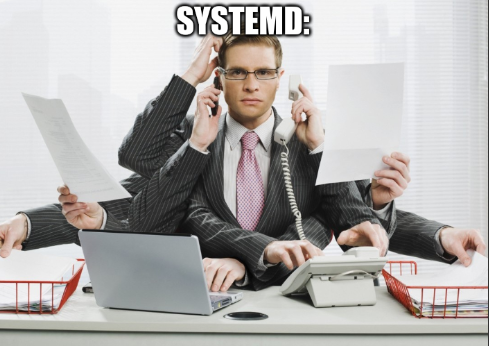
It's almost as if people think systemd is one massive executable rather than a suite of tools

  • source
  • hideshow 54 child comments
  • [–] 80 points 1 year ago (8 children)

    Nah, it's a single executable, like GNU.

  • source
  • parent
  • hideshow 8 child comments
  • [–] 57 points 1 year ago (2 children)

    All that happens at boot is that linux.exe calls systemd.exe, uses all your system resources making your machine unusable bloat.

  • source
  • parent
  • hideshow 2 child comments
  • [–] 13 points 1 year ago (21 children)

    From all the hate you see, it does look like that. It is not?

  • source
  • parent
  • hideshow 21 child comments
  • [–] 44 points 1 year ago* (last edited 1 year ago) (20 children)

    The answer is more complex than a simple yes/no. Fortunately, an actual Arch Linux maintainer shared their experience with init scripts and why it was necessary to switch to systemd: https://redlib.privacyredirect.com/r/archlinux/comments/4lzxs3/why_did_archlinux_embrace_systemd/?

    This line is particularly great:

    What most systemd critics consider "bloat", I consider necessary complexity to solve a complex problem generically.

    Other than that, and especially in the case of Arch Linux, nobody is forcing anybody to use any other component of systemd, or as proven by the likes of Artix and Devuan, systemd itself.

  • source
  • parent
  • hideshow 20 child comments
  • load more comments (20 replies)
  • [–] 4 points 1 year ago (11 children)

    An inbred set of separate entities right out of x-files "home" , that can only coexist with one another in a toxic bug-eyed gang? Yeah, it's "separate" pieces.

    Now go mount a volume the normal way.

  • source
  • parent
  • hideshow 11 child comments
  • [–] 7 points 1 year ago (10 children)

    I still write my mounts in fstab

  • source
  • parent
  • hideshow 10 child comments
  • [–] 10 points 1 year ago (9 children)
  • [–] 5 points 1 year ago (7 children)

    /etc/systemd/system/mnt-nfs.mount

    [Unit]
    Description=Mount NFS Share
    
    [Mount]
    What=server:exported_path
    Where=/mnt/nfs_share
    Type=nfs
    Options=_netdev,auto,rw
    
    [Install]
    WantedBy=multi-user.target
    
  • source
  • parent
  • hideshow 7 child comments
  • [–] 6 points 1 year ago

    And the reason you'll want to do this is that it exposes FS mounts in the service dependency tree, so e.g. you can delay starting PostgreSQL until after you've mounted the network share that it's using as a backing store, while letting unrelated tasks start concurrently.

    If all you want to do is pass some special mount flags (e.g. x-systemd.automount) then fstab is the way, after all it's still systemd that's parsing and managing it.

  • source
  • parent
  • load more comments (6 replies)
  • load more comments (1 reply)
  • OP when systemd successfully wipes his ass altr

  • source
  • [–] 33 points 1 year ago (8 children)

    I like systemd

    Awaiting the guillotine...

  • source
  • hideshow 8 child comments
  • [–] 7 points 1 year ago (5 children)

    You're not alone. For most of my career, I've only used Linux to develop software and deploy that software to production. That usually means webservers, databases, iptables/netfilter, and all the other backend processes that glue that together.

    Before systemd, I was using sysVInit. Let me say that systemd has been head-and-shoulders above the previous experience in a variety of ways, with a host of built-in features:

    • Predictable start-up order of processes
    • Configurable inter-process dependencies (for the above)
    • Restart on fail
    • PID management
    • Socket management
    • Standard config format (no more copy-pasta init scripts)
    • Clearly defined filesystem areas for package managed and user-managed services
    • Clearly defined layering of config areas (e.g. systemctl status <service> shows you exactly what files are loaded)
    • Solid CLI experience that provides detailed information about every managed service

    Bottom line: it's dead simple to add your own stuff, and just as simple to read what packaged software is doing. I also think that using a CLI (instead of poking around /var/run and ps output) is a step up in terms of system administration, given how complex all this can get.

    My only contention is the forced use of journald, where my preference would be to use the standard /var/log paradigm for all this, rather than have a doorman to a binary logging database. You can configure it to emit text logs, but that's not the system of record for logging - just a feed.

    All that said, container-based solutions have rendered both init systems irrelevant a lot of the time, with tools like Kubernetes providing just about all of the same features. Moreover, cloud solutions tend to lean into cloud-init for host startup configuration and management anyway.

  • source
  • parent
  • hideshow 5 child comments
  • load more comments (5 replies)
  • load more comments (2 replies)
    [–] 32 points 1 year ago (8 children)

    Yay another thread where a bunch of script kiddies running a homelab come shitting on a toolset that saved the professionals from the init mess. But they of course know that systemd is bloated and prefer running their node servers in dokker containers on something more lightweight

  • source
  • hideshow 8 child comments
  • load more comments (1 reply)
    [–] 28 points 1 year ago

    I still stand by my assumption that anyone complaining about systemd has never tried to configure SysVInit scripts before

  • source
  • [–] 24 points 1 year ago (4 children)

    Been using Linux as my main system for about 8 years now. I know nothing but systemd. I have never tried other init systems, so I genuinely don't know what I'm missing out on (if there is any). I don't mind systemd and I really really like services and timers. I use them all the time to automate things, but that doesn't mean I don't hate some things about systemd. One of the things that I'd love to burn to charcoal is that "a stop job for UID 1000..... 1:45 minutes", bitch? I don't have that much time on my hands, reboot right now. What are the things that other init systems have that make them better than systemd?

  • source
  • hideshow 4 child comments
  • load more comments (3 replies)
    [–] 15 points 1 year ago (1 child)

    Honestly buttctl has some nice features once you get used to it.

  • source
  • hideshow 1 child comment
  • [–] 8 points 1 year ago (1 child)
    load more comments (1 reply)

    I've always liked systemd.

    I'm learning FreeBSD and the training wheels are off having to learn RC. I should've done this years ago.

    On that, anyone know how to pull core temps off a 20 year old Celeron D in OpenBSD? That and my internal PC speaker are the only things I don't have working yet.

  • source
  • load more comments
    view more: next β€Ί