you are viewing a single comment's thread
view the rest of the comments
[–] 103 points 1 year ago (54 children)

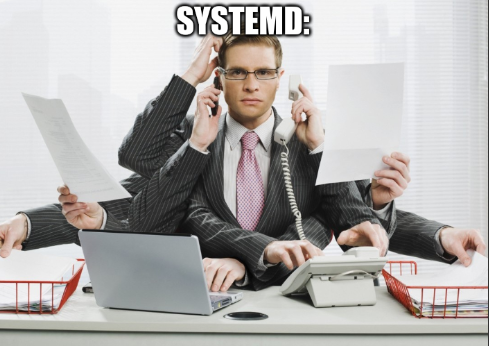
It's almost as if people think systemd is one massive executable rather than a suite of tools

  • source
  • hideshow 54 child comments
  • [–] 80 points 1 year ago (8 children)

    Nah, it's a single executable, like GNU.

  • source
  • parent
  • hideshow 8 child comments
  • [–] 57 points 1 year ago (2 children)

    All that happens at boot is that linux.exe calls systemd.exe, uses all your system resources making your machine unusable bloat.

  • source
  • parent
  • hideshow 2 child comments
  • [–] 13 points 1 year ago (21 children)

    From all the hate you see, it does look like that. It is not?

  • source
  • parent
  • hideshow 21 child comments
  • [–] 44 points 1 year ago* (last edited 1 year ago) (20 children)

    The answer is more complex than a simple yes/no. Fortunately, an actual Arch Linux maintainer shared their experience with init scripts and why it was necessary to switch to systemd: https://redlib.privacyredirect.com/r/archlinux/comments/4lzxs3/why_did_archlinux_embrace_systemd/?

    This line is particularly great:

    What most systemd critics consider "bloat", I consider necessary complexity to solve a complex problem generically.

    Other than that, and especially in the case of Arch Linux, nobody is forcing anybody to use any other component of systemd, or as proven by the likes of Artix and Devuan, systemd itself.

  • source
  • parent
  • hideshow 20 child comments
  • load more comments (19 replies)
  • [–] 6 points 1 year ago (10 children)

    Well it is also a massive executable in the mix there

  • source
  • parent
  • hideshow 10 child comments
  • [–] 4 points 1 year ago (9 children)
  • [–] 3 points 1 year ago (8 children)

    Did you accidentally forget A) the .so files these binaries link against and B) the actual systemd daemon binary?

  • source
  • parent
  • hideshow 8 child comments
  • [–] 2 points 1 year ago* (7 children)

    We're still not clearing 10 megs

  • source
  • parent
  • hideshow 7 child comments
  • [–] 2 points 1 year ago (6 children)
    [XXX@YYY]$ ls -lh /usr/lib/libsystemd.so.0.40.0 /usr/lib/systemd/libsystemd-core-257.7-1.so /usr/lib/systemd/libsystemd-shared-257.7-1.so
    -rwxr-xr-x 1 root root 1.2M Jun 25 14:42 /usr/lib/libsystemd.so.0.40.0
    -rwxr-xr-x 1 root root 2.4M Jun 25 14:42 /usr/lib/systemd/libsystemd-core-257.7-1.so
    -rwxr-xr-x 1 root root 4.5M Jun 25 14:42 /usr/lib/systemd/libsystemd-shared-257.7-1.so
    

    Are you intentionally misrepresenting this or are you actually missing these? Also: This isn't about diskspace. Obviously every halfway modern PC can provide the disk space to house the systemd binaries. Disk is cheap but crucially not necessarily tied to complexity. A simple application can take Gigs and still be simple if it includes a lot of resources (graphical, audio, whatever). And a very complex thing can "only" take a few megabytes if it only includes code. Like systemd does.

    Note that I am a (mostly) happy user of systemd. I am just annoyed at people misrepresenting facts to fight anti-systemd-bullshit.

  • source
  • parent
  • hideshow 6 child comments
  • [–] 2 points 1 year ago (5 children)

    It's weird ldd didn't find libssytemd.so ! I have an old system, apparently libsystemd-core and libsystemd-shared weren't a thing back in 2021 on ... ubuntu focal

  • source
  • parent
  • hideshow 5 child comments
  • [–] 1 point 1 year ago (4 children)

    Sorry but there is a libsystemd-shared listed in your screenshot

  • source
  • parent
  • hideshow 4 child comments
  • [–] 1 point 1 year ago (3 children)

    ok well still not over 10 meg, I don't know, doesn't seem like bloat to me still

  • source
  • parent
  • hideshow 3 child comments
  • [–] 1 point 1 year ago (2 children)

    As I said: I didn't mean massive in the sense of "disk space is an expensive resource". Disk is cheap nowadays. I meant massive as in "there is a lot of code and by that a lot of complexity in this one binary". You just inferred I meant bloat. I get that that is my fault for not specifying it the first time But I already explained I didn't mean that so I don't really get why you keep riding that 10 meg point.

  • source
  • parent
  • hideshow 2 child comments
  • [–] 1 point 1 year ago (1 child)

    Ok, sorry I don't understand the problem, beyond the loss of modularity, that you can pick and choose different components for service/network/login/logging and timers but even if they were each distinct entities, would they really be less complex as a whole ?

    These core system might even be more complex if they had to accommodate modular ways of doing things instead of relying on a uniform and consistent framework between them.

    I agree from something like an embed system, like this openwrt WAP system that has just 4 megs of flash for the entire thing including a very complete web user interface, 10 meg for just these core services is giganormous and systemd is inappropriate. But for the average server and desktop with so much as dozens of megs of disk space, I feel the single coherent, reliable, universal systemd is pretty great once you learn it's basic logic. I feel it's actually less complex to use than what came before it, more predictable, more comfortable than sysv which generally lacked structure.

  • source
  • parent
  • hideshow 1 child comment
  • [–] 1 point 1 year ago

    I dont have a problem with systemd. I have a problem with people claiming systemd doesn't have a massive non-modular blob of code at it's core. There is no need to misrepresent what systemd is to deflect systemd critics.

    Again, please read what I am writing. I don't care about the disk space. And I don't have a problem with systemd itself.

  • source
  • parent
  • [–] 4 points 1 year ago (11 children)

    An inbred set of separate entities right out of x-files "home" , that can only coexist with one another in a toxic bug-eyed gang? Yeah, it's "separate" pieces.

    Now go mount a volume the normal way.

  • source
  • parent
  • hideshow 11 child comments
  • [–] 7 points 1 year ago (10 children)

    I still write my mounts in fstab

  • source
  • parent
  • hideshow 10 child comments
  • [–] 10 points 1 year ago (9 children)
  • [–] 5 points 1 year ago (7 children)

    /etc/systemd/system/mnt-nfs.mount

    [Unit]
    Description=Mount NFS Share
    
    [Mount]
    What=server:exported_path
    Where=/mnt/nfs_share
    Type=nfs
    Options=_netdev,auto,rw
    
    [Install]
    WantedBy=multi-user.target
    
  • source
  • parent
  • hideshow 7 child comments
  • [–] 6 points 1 year ago

    And the reason you'll want to do this is that it exposes FS mounts in the service dependency tree, so e.g. you can delay starting PostgreSQL until after you've mounted the network share that it's using as a backing store, while letting unrelated tasks start concurrently.

    If all you want to do is pass some special mount flags (e.g. x-systemd.automount) then fstab is the way, after all it's still systemd that's parsing and managing it.

  • source
  • parent
  • [–] 2 points 1 year ago (5 children)

    oh! maybe it's the perfect chance to ask. what do you do with your mounted shares so that processes trying to access it do not hang when the server is unreachable?

    mostly I would prefer if that directory read would just fail but anything is better, except unmounting.

  • source
  • parent
  • hideshow 5 child comments
  • [–] 2 points 1 year ago (2 children)

    Add -o hard

    And if youre using nfsv3 add retrans=5

    Nfsv4 doesbt really need retrans but it still worls.

    That has worked perfectly for me.

  • source
  • parent
  • hideshow 2 child comments
  • [–] 1 point 1 year ago (1 child)

    does retrains have any effect with hard? this is what man nfs says:

    If neither option is specified (or if the hard option is specified), NFS requests are retried indefinitely. If the soft option is specified, then the NFS client fails an NFS request after retrans retransmissions have been sent, causing the NFS client to return an error to the calling application.

    also, do you know what can I do with CIFS/SMB? I have most of my shares through samba :/

  • source
  • parent
  • hideshow 1 child comment
  • [–] 1 point 1 year ago* (1 child)

    Good question!

    In the Home Operations Discord there's some very smart people who solved this problem inside kubernetes by checking if their NAS is online (through a Prometheus exporter named node exporter) and then scaling down their workloads that use it, automatically, using KEDA (an autoscaler for kubernetes)

    Depending on how your processes are orchestrated, you might be able to do something similar?

    Source: https://github.com/onedr0p/home-ops/pull/9334/files

  • source
  • parent
  • hideshow 1 child comment
  • [–] 2 points 1 year ago

    well that's also interesting, but I mainly experience this problem on my desktop. there was a plasma version when even the taskbar panel got frozen, and the kde file manager, double commander too for like a minute, every time they try to do anything with an unreachable network drive. and its even worse on my laptop so there I just don't mount my shares anymore.

    I have been wondering how does windows do it, and programs made for windows, because this is a nonissue there (though windows has its fair share of problems with network shares though..). maybe they just learned to do all IO ops on a different thread..

  • source
  • parent