The first two are:

1.When a distinguished but elderly scientist states that something is possible, he is almost certainly right. When he states that something is impossible, he is very probably wrong.

2.The only way of discovering the limits of the possible is to venture a little way past them into the impossible.

Arthur C. Clarke, the famed sci-fi author who penned these laws, is probably best known for co-authoring the screenplay to 2001: A Space Odyssee

all 37 comments

sorted by: hot top controversial new old
[–] 76 points 2 years ago (5 children)

There are also two variations on the third law that I like. Not sure who coined them.

Any technology distinguishable from magic is insufficiently advanced.

And for those who love crunchy magic systems:

Any sufficiently analyzed magic is indistinguishable from science.

  • source
  • hideshow 10 child comments
  • [–] 61 points 2 years ago (2 children)

    The Grey’s Law variant, “Any sufficiently advanced incompetence is indistinguishable from malice,” is how I interpret our current reality.

  • source
  • hideshow 4 child comments
  • [–] 20 points 2 years ago* (last edited 2 years ago) (6 children)

    I'd heard of that as Hanlon's razor:

    Never attribute to malice that which is adequately explained by stupidity.

    Edit: Hanlon, not Hanson

  • source
  • parent
  • hideshow 12 child comments
  • [–] 6 points 2 years ago (1 child)

    I usually agree with this, which is why i hated the r/theyknew subreddit, where people claimed everything ever was on purpose and never thought anyone could simply make a mistake however obvious it could be.

    however not only does this not apply to politics, it's almost certainly reversed every time, even if stupidity is involved. for example Republicans are stupid, but they don't do what they do because they're stupid; they do it because they're demons.

  • source
  • parent
  • hideshow 2 child comments
  • [–] 40 points 2 years ago* (2 children)

    "Magic is science you can't explain, and science is magic you can explain." - my daughter

  • source
  • hideshow 4 child comments
  • [–] 6 points 2 years ago* (last edited 2 years ago) (3 children)

    Hm, I don't care for that. Magic is flashy and fun because it's entertainment. But science doesn't look like they depict in movies and shows.

    As a process, science looks more like that nerd with the clipboard taking notes on mushrooms or nuclei whatever for 20 years. Then they edit papers from other mushroom / nuclei nerds and go to a conference to give seminars and debate the others and ultimately publish more papers and eventually some books, and if we're lucky a documentary. They're exploring hidden worlds in a way that is very opposite of the showmanship and illusions we popularly call magic.

  • source
  • parent
  • hideshow 6 child comments
  • [–] 9 points 2 years ago (1 child)

    Do you think Magicians reading through hundreds of old books is more exciting? Trying a thousand combinations of herbs to see if any one has any effects at all?

    You are just being shown the end result for magic in the movies too. Real magic is nothing like it.

  • source
  • parent
  • hideshow 2 child comments
  • [–] 2 points 2 years ago*

    You're going to have to define "real magic" here, otherwise this makes no sense IMO

    Testing herbs for effects sounds like folk medicine or alchemy at best, but those have been replaced by more rigorous fields like chemistry and pharmacology.

  • source
  • parent
  • [–] 29 points 2 years ago

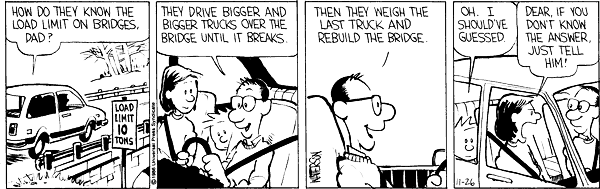
    According to Calvin's dad, bridges are built following Clarke's 2nd law:

    https://picayune.uclick.com/comics/ch/1986/ch861126.gif

  • source
  • [–] 13 points 2 years ago (2 children)

    The first law has always pissed me off: why are you wasting that elderly scientist's time when you already know in advance what answer you want to hear and will only accept that response as being true?

  • source
  • hideshow 4 child comments
  • [–] [S] 6 points 2 years ago* (1 child)

    I never actually read it as a dig at "elderly" scientists but I think you're right haha

    Tbf I think it's supposed to be understood more conceptually as seeing how many things we take for granted as being outside the realms of possibility have just not yet been tackled the right way.

  • source
  • parent
  • hideshow 2 child comments
  • [–] 5 points 2 years ago

    It's a corollary of the other famous expression that science advances one funeral at a time. This came from Max Planck and predates Clarke:

    A new scientific truth does not triumph by convincing its opponents and making them see the light, but rather because its opponents eventually die and a new generation grows up that is familiar with it ...

    An important scientific innovation rarely makes its way by gradually winning over and converting its opponents: it rarely happens that Saul becomes Paul. What does happen is that its opponents gradually die out, and that the growing generation is familiarized with the ideas from the beginning: another instance of the fact that the future lies with the youth.

    Max Planck, Scientific autobiography, 1950, p. 33, 97

  • source
  • parent
  • [–] 12 points 2 years ago

    The third law has a nice ring to it, but it has extremely deep implications when you're writing science fiction, or fantasy that has magic. Thinking about the law is very useful to keep your technology technology (and not basically magic that happens to run on electricity) and magic magic (and not technilogy that happens to run on plot holes).
  • source
  • [–] 4 points 2 years ago (1 child)

    Maxim 24 of the The Seventy Maxims of Maximally Effective Mercenaries

    1. Any sufficiently advanced technology is indistinguishable from a big gun.

    https://schlockmercenary.fandom.com/wiki/The_Seventy_Maxims_of_Maximally_Effective_Mercenaries

  • source
  • hideshow 2 child comments
  • [–] 3 points 2 years ago

    I've had so many people use the third law there in shitty arguments and acting like it's an irrefutable scientific fact it's soured that quote for me.

  • source