all 45 comments

sorted by: hot top controversial new old
[–] 120 points 3 years ago (3 children)

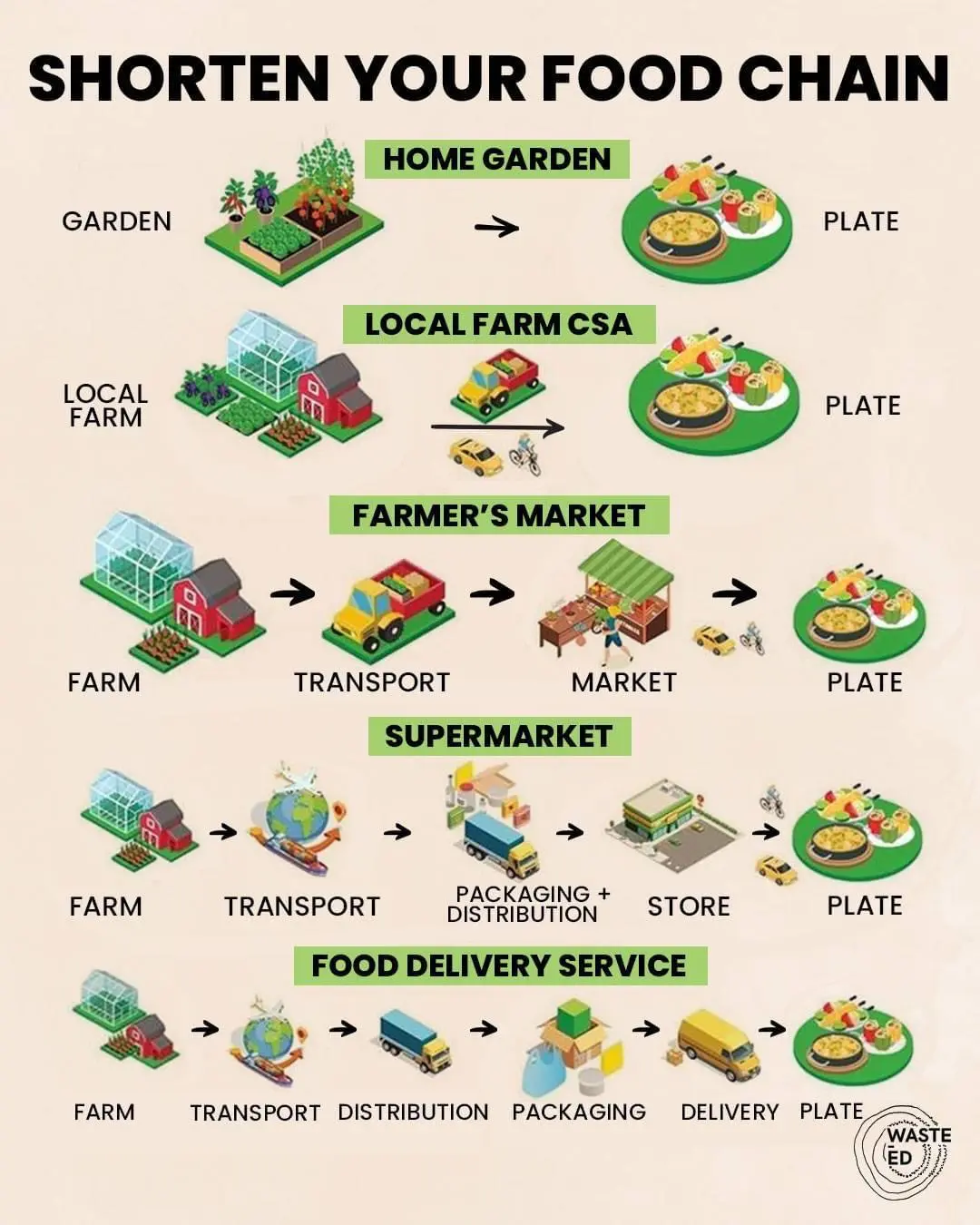
I appreciate the idea but this is a little misleading. They chose to label transportation for farmers markets but not CSA boxes. There is obviously transportation involved in both.

They highlight delivery as a step in the food delivery service, but don’t label it similarly when the consumer goes to the store to pick it up. I might argue there’s efficiency in having one delivery driver vs everyone acting as their own delivery driver.

  • source
  • hideshow 3 child comments
  • [–] 10 points 3 years ago (1 child)

    I might argue there’s efficiency in having one delivery driver vs everyone acting as their own delivery driver.

    Afaik food delivery services have drivers fulfill orders one by one. So it's essentially the same thing if you go there yourself or if the delivery driver does it.

    It's more efficient when one truck delivers to multiple people. Like CSA boxes. Instead of each of those people driving their own car to the store/market and back, there's one car that delivers to them all in a single route.

  • source
  • parent
  • hideshow 1 child comment
  • [–] 15 points 3 years ago

    Here in the UK it depends what delivery service you're using. Supermarkets have a dedicated team of staff who organise approximately 45±10 deliveries per van per day. One store I worked for had 21 vans.

    That helped save the journey of approximately 900 people. I think most would agree having 20 vans on the road is preferential to having 900 cars.

    On the flip side, we also have services which deliver from small local shops and get basic shopping supplies to you within an hour, and these are far less efficient in terms of their footprint.

  • source
  • parent
  • [–] 63 points 3 years ago (5 children)

    I think this is quite misleading in the sense that a full truck carrying goods is very efficient per good item when compared to everyone carrying a couple meals in their private cars.

  • source
  • hideshow 5 child comments
  • [–] 10 points 3 years ago (4 children)

    But what if you use your bike instead :3

  • source
  • parent
  • hideshow 4 child comments
  • [–] -1 points 3 years ago (2 children)

    I don't have a bike because if I rode a bike on these roads I'd be dead. My grown kids never even learned how to ride.

  • source
  • parent
  • hideshow 2 child comments
  • [+] 43 points 3 years ago* (last edited 1 year ago) (1 child)
  • [–] 37 points 3 years ago (2 children)

    How to shorten your free time

  • source
  • hideshow 2 child comments
  • [–] 31 points 3 years ago

    In terms of carbon emissions, WHAT you eat is far more impactful than WHERE it came from

  • source
  • [–] 25 points 3 years ago* (7 children)

    I tried to shorten my food chain. 107 degree Fahrenheit weather and $100 per month in water made it ridiculous to try to grow my own food.

  • source
  • hideshow 7 child comments
  • [–] 7 points 3 years ago (3 children)

    You could try living somewhere other than hell.

  • source
  • parent
  • hideshow 3 child comments
  • [–] [S] 2 points 3 years ago (2 children)

    There's ways to mitigate the amount of water used and it's retention in the soil.

    I also frequently have temps in the 100's in the summer here - it's meant that there's just certain things I can't grow and some that are risky. But there's plenty of veggies that can handle that kind of heat.

  • source
  • parent
  • hideshow 2 child comments
  • [–] 19 points 3 years ago (10 children)

    Meat consumption adds extra steps of growing food and feeding the animals as well

  • source
  • hideshow 10 child comments
  • [+] -14 points 3 years ago (9 children)
  • [–] 18 points 3 years ago* (8 children)

    Veganism, or at least a diet reduced in meat is one of the best ways to help offset your own carbon footprint.

    Which is what this infographic tries to promote.

    That’s just the facts, weather you or me choose to eat meat or not.

  • source
  • parent
  • hideshow 8 child comments
  • [+] -15 points 3 years ago (7 children)

    Your carbon footprint is a concept created by the oil industry.

  • source
  • parent
  • hideshow 7 child comments
  • [–] 10 points 3 years ago (4 children)

    That’s why I go on carnivore cruises to Antarctica. My individual choices can’t matter, so fuck it. Plus, there’s no littering laws in the open ocean.

  • source
  • parent
  • hideshow 4 child comments
  • [+] -11 points 3 years ago (3 children)

    Feel free to add yourself to ocean litter. Fastest way to drop your footprint to zero.

  • source
  • parent
  • hideshow 3 child comments
  • [–] 10 points 3 years ago

    Forgot the couple people at farmers markets that buy from supermarkets.

  • source
  • [–] 8 points 3 years ago (1 child)

    sure bud, just give me a garden, gardening tools, seeds and shoulder maintenance cost a vast majority cant go past supermarkets

  • source
  • hideshow 1 child comment
  • [–] 6 points 3 years ago* (1 child)

    The last two are the same. Except you are replacing 100 individual automobile trips to the grocery store at peak hours with one van driving around for 8 hours.

  • source
  • hideshow 1 child comment
  • [–] 5 points 3 years ago*

    I see most of the comments discussing efficiency, the inability to have your own garden, or other limiting factors. And I believe all of them are missing the point. There are many and good reasons to shorten your food chain, and efficiency is not one of them. I would expect to at least see some people (there was one exception) considering the value of doing so in their lives, but nope.

    So... Not very long ago, most of the people were actually living as farmers. Eric Hobsbawm, in this book, has done a great job describing what it took for the shift to happen, during the industrial revolution. For the people to actually be forced to abandon their land and start accumulating in urban environments where having your own garden is practically impossible for most of them. And it was not good. Child labor, people starving to death, extreme poverty, extreme exploitation of human labor. Many things changed, and most of them did not actually benefit the majority of the people who were forced to abandon or sell their land in order for people who could actually afford more efficient farming approaches (through machines) to replace them while accumulating wealth in an unprecedented manner. Maybe it's worth examining this shift. Both the argument of efficiency and limiting factors, are not exactly new and are not exactly serving most of us either.

    Besides the historical aspect, the how did we get here, of the long food chains. There are other aspects that make them harmful. The ones that allow for a term like "banana republic" to exist, when most of the people who use it don't pause and think what it actually means for so many people that actually get exploited so they can have their bananas, cheap and available all year (as if potassium is not abundant in every single plant food). The ones that allow for people to have access to food without actually moving at all during the day (CVD, obesity, cases where being inefficient, like... spending energy to live your life, actually improves your health, like walking, carrying some weight, cycling). The ones that allow for food to be consumed weeks, months or even years after it is produced, dramatically reducing it's quality while actually raising the cost (storage facilities, freezers, transportations through various environments).

    But still, most comments at the moment and upvotes are not about those things. Except one. Interesting..

  • source
  • [–] 4 points 3 years ago

    Unfortunately we were growing our own food but now have to move to a rental. Barely afford to live let alone buy stuff to grow at a rental.

    Real shame. I prefer my food not packaged in plastic covered in poison.

    Life aye.

  • source
  • [–] 2 points 3 years ago

    I'm thinking of a garden

  • source
  • [–] 2 points 3 years ago

    Misleading. How about adding the inputs before Garden/Farms? It makes more sense if we compare the efficiency of both generating and transporting one unit of food.

  • source
  • [+] 1 point 3 years ago* (last edited 3 years ago)