Slide with text: “Rust teams at Google are as productive as ones using Go, and more than twice as productive as teams using C++.”
In small print it says the data is collected over 2022 and 2023.
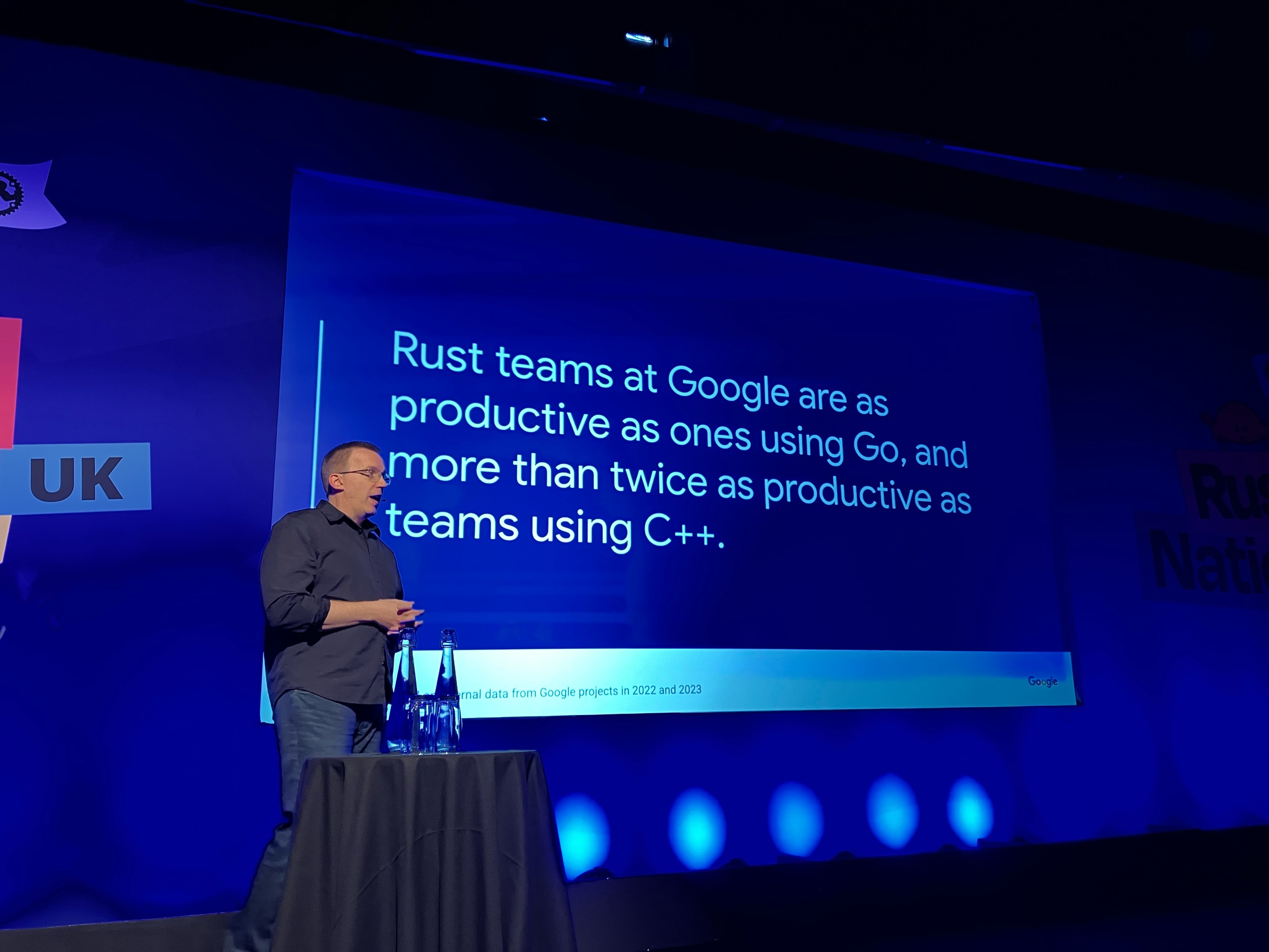
Slide with text: “Rust teams at Google are as productive as ones using Go, and more than twice as productive as teams using C++.”
In small print it says the data is collected over 2022 and 2023.
I think focusing on speed of programs is looking at the wrong thing. It's true that at the moment Rust programs are usually faster than equivalent Go programs, but it's already possible to very carefully tune a Go program to achieve similar levels of speed. The real difference is in productivity.
Go makes the tradeoff that it's much more verbose, it takes many times the lines of code to achieve in Go what's possible in either Rust or C++. This is because of their dogmatic obsession with keeping the language "simple". Yes that makes it easy to learn, but it means if you have something complex to express you need to use more of those simple building blocks to do so rather than just a handful of the more complicated ones you're provided in Rust or C++. More lines of code is more opportunity for mistakes to be made and more code to maintain. In a more powerful language you can offload much of the work to libraries that are maintained by other people and that expose powerful APIs that are safe to use. In Go because it's "simple" it's hard to write powerful APIs that aren't filled with footguns and are more complicated to use.
The problem with C++ wasn't that it was a complicated language, it's that it was an inconsistent language. There were many competing ways of accomplishing things and many of them were mutually exclusive with each other and introduced footguns. It was far far too easy to write code in C++ that looked correct but was utterly broken in very subtle and hard to detect ways. The Go guys looked at that situation and decided the problem was that the language was too complex and had too many features (arguably true), but decided to make the exact opposite mistake by designing a language that was too simple and had too few features.