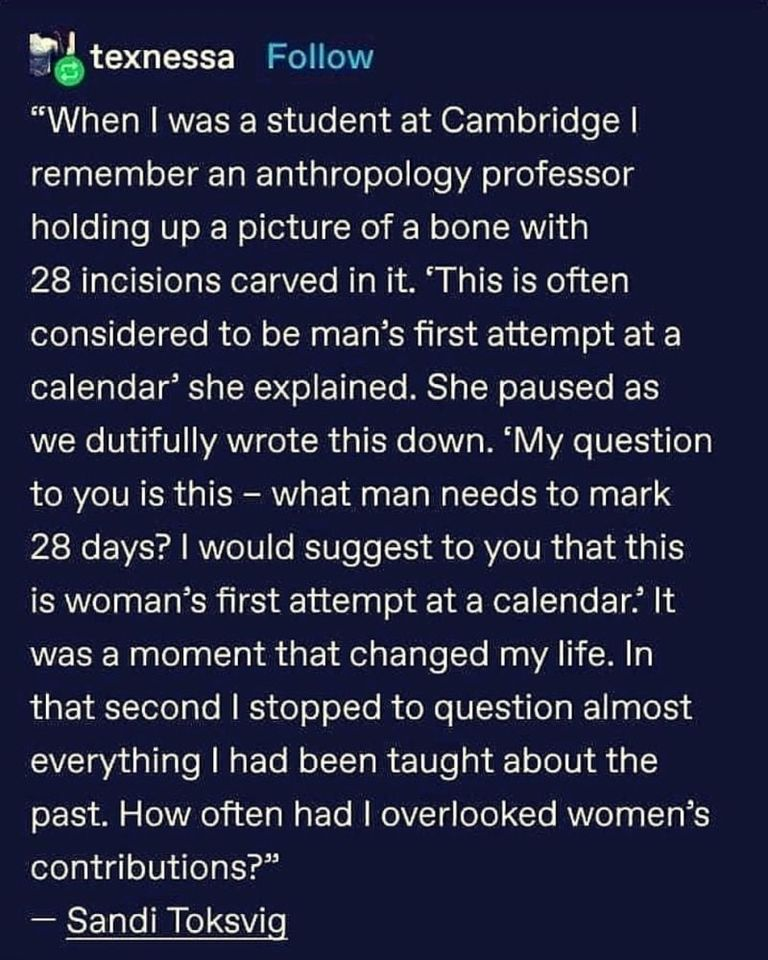
One of the comments reads : Actually, we will probably never figure out, was it man or woman. but I thought this comment of the professor was an interesting eye opener. https://mastodonapp.uk/@MarkHoltom/112070436760917344
you are viewing a single comment's thread
view the rest of the comments
[–] 87 points 2 years ago (27 children)

i think they mean 'man' as in 'mankind'. also any ideas why would they carve it into bone and not bark or something more flat?

  • source
  • hideshow 27 child comments
  • [–] 67 points 2 years ago (2 children)

    They probably did but only the bone survived time

  • source
  • parent
  • hideshow 2 child comments
  • [–] 16 points 2 years ago (4 children)

    Likely durability. A bone and a stick can both be thrown into a bag and carried with you, but a bone is much more durable than a stick. It’ll be less likely to break or wear down as it rubs against everything else in your bag.

  • source
  • parent
  • hideshow 4 child comments
  • [+] -17 points 2 years ago (3 children)

    What about blackthorn wood versus chicken bone? What's it like being wrong on the internet, champ. Adding this one to my scoreboard (dry-wipe, wall-mounted, magnetic).

  • source
  • parent
  • hideshow 3 child comments
  • [–] 7 points 2 years ago

    Likely durability and portability. Think of it as something they use month over month and just mark the day with something like a string band. Bone would be light enough to keep with you, strong enough to not break, and common enough to be available for household use.

  • source
  • parent
  • [–] -1 points 2 years ago* (last edited 2 years ago) (9 children)

    Sure, you can say "man" means "mankind", but when you use gendered language like that, most people picture a couple of caveMEN sitting around a fire carving bones rather than caveHUMANS (edited -- I think it would benefit us to picture all genders around this hypothetical fire). Even though we try to use gendered language in a neutral way, listeners will often perceive the language in a gendered way.

  • source
  • parent
  • hideshow 9 child comments
  • [–] 2 points 2 years ago (2 children)
  • [–] 0 points 2 years ago (1 child)
  • [–] -1 points 2 years ago

    Just FYI the origin of "woman" is "wife-man" which (forgive if I do these slightly out of order) was "wyfe-man" to "wife-man" to "wieman" to woman 👩

    The misogyny is built into the language. Or the common word used originates from "wife of man"

    Paraphrased source Websters word origins

  • source
  • parent
  • [+] -23 points 2 years ago (5 children)

    It seems pretty clear that they mean "male" as they follow the mention of "man" up with "woman".

  • source
  • parent
  • hideshow 5 child comments
  • [–] 28 points 2 years ago (3 children)

    no i mean, by the people 'who consider it'. i think the speaksr didnt understand that theyre saying it's mankind others are talkint abkut

  • source
  • parent
  • hideshow 3 child comments
  • [+] -23 points 2 years ago (2 children)

    Oh but the word mankind in itself overlooks women. We're all supposed to be saying humankind now.

  • source
  • parent
  • hideshow 2 child comments
  • [–] 11 points 2 years ago (1 child)

    etymologically speaking im not even sure if thats right. i heard somethibg like this and they either said woman doesnt derive from man or that man used to mean woman and man but woman became its own thing, cant recall

  • source
  • parent
  • hideshow 1 child comment
  • [–] 3 points 2 years ago

    "man" in the contexts not directly related to being a male, means human. "Man" used to have a prefix vaguely pronounced "were" and "woman" used to be "wifman". Female werewolf would be a "wifwolf" then. So anyways, "Man" never changed it's meaning, it really just gained an additional one, and yet again, whiners need to read a book.

  • source
  • parent