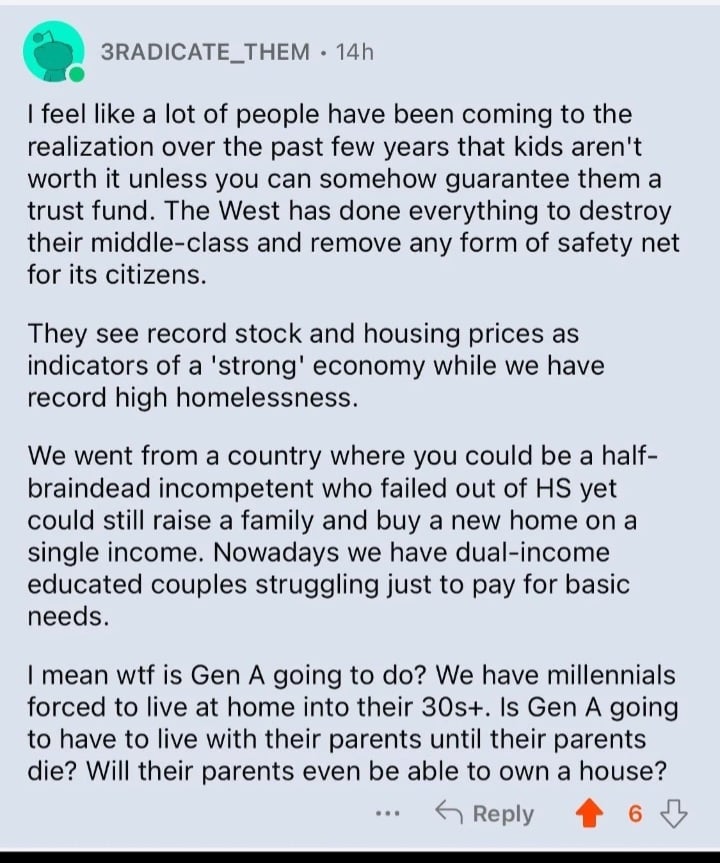
▲ 1458 ▼ Poignant post on the state of things (lemmy.world) submitted 2 years ago by STRIKINGdebate2@lemmy.world to c/aboringdystopia@lemmy.world 345 comments fedilink hide all child comments
[+] Telodzrum@lemmy.world -11 points 2 years ago* (last edited 1 month ago) (2 children) [deleted] permalink fedilink source parent hideshow 4 child comments replies: [–] Leg@lemmy.world 17 points 2 years ago* (3 children) $999,999,999 no individual wealth I don't think you have a strong enough concept of large numbers to be able to hold a respectable opinion here. permalink fedilink source parent hideshow 6 child comments replies: [–] bartolomeo@suppo.fi 4 points 2 years ago (1 child) Lmao brutal, but -1 for ad hominem. permalink fedilink source parent hideshow 2 child comments replies: [–] Leg@lemmy.world 8 points 2 years ago That's fair. I chose violence. permalink fedilink source parent [+] Lilith_the_serpent@lemmy.world 1 point 2 years ago [deleted] permalink fedilink source parent [–] Cryophilia@lemmy.world -3 points 2 years ago (1 child) You didn't answer the question though. Who owns a factory or a datacenter? These are fantastically expensive things. A chip foundry cannot exist under these conditions. permalink fedilink source parent hideshow 2 child comments replies: [–] Toine@sh.itjust.works 7 points 2 years ago (1 child) It could be owned by, like, multiple people? Also, a lot of companies in the world, and especially the ones managing costly infrastructure assets, are owned by states (which are a form of "multiple people"). permalink fedilink source parent hideshow 2 child comments replies: [–] Tankton@lemm.ee 8 points 2 years ago (1 child) Multiple people working together with 1 goal? Like a .... Company? permalink fedilink source parent hideshow 2 child comments replies: [–] TengoDosVacas@lemmy.world 2 points 2 years ago (1 child) Yes, a company which shares the results of it's efforts between all involved and not one person or family. permalink fedilink source parent hideshow 2 child comments replies: [–] Cryophilia@lemmy.world 1 point 2 years ago (5 children) So a company whose ownership is open to the public, with that ownership divided into "shares". And all the "share" holders can cooperate to decide the direction of the company...what would one call this novel form of organizing a venture...a "cooperation"? permalink fedilink source parent hideshow 10 child comments replies: [–] TengoDosVacas@lemmy.world 3 points 2 years ago (1 child) Not open to the public. Open to those who actually contribute to it's operations. And in none of your objections can you justify the CEO pay and the political power they weild. 40x the lowest paid worker, and no more. permalink fedilink source parent hideshow 2 child comments replies: [–] Cryophilia@lemmy.world 0 points 2 years ago (1 child) Ok so. Shares of ownership are open only to employees. How does this company get external investment? I suppose outside entities are allowed to invest with an expectation of a return on investment? permalink fedilink source parent hideshow 2 child comments replies: [–] TengoDosVacas@lemmy.world 1 point 2 years ago (1 child) Stock is used to raise money for investment. When that investment has been covered and profit acheived, the stock should immediately drop in value or be bought back AS OPPOSED to being used for government manipulation and golden parachutes for CEOs who did very little work in making the company successful. If the CEO fails, the company fails. Paying multiple millions to CEOs who were not involved in the building of the company but were only brought in after the company failed is a gross misappropriation of shareholder funds. The new guy should get a salary of not more than 40 times what the lowest employee gets and then get stock options only after the stock and the company has been saved. permalink fedilink source parent hideshow 2 child comments replies: [–] Cryophilia@lemmy.world 1 point 2 years ago (1 child) When that investment has been covered and profit acheived What do you mean by this? Sorry, I swear I'm not doing that Just Asking Questions thing where I keep asking questions until you get tired and leave, I'm legitimately curious. Because the way stock works now is, there's an initial offering of a company's stock, at say $1 a share. Then anyone who has a share can re-sell it to people who think the value of the company is going to go up, say someone who thinks it will be worth $1.50 a share. Anyone who buys shares hopes to re-sell them at a greater value, so as a whole, this market of investors is, in aggregate, demanding ever-increasing value from every share of every company. There's no one particular target where a company can say "we did it!" and settle the permanent value at like $3 a share or something. So I'm wondering how you would define "profit achieved" in this context, and what should happen to those shares at that point. Does the company buy them back? If the company is buying them back at $3 a share and someone just bought a share for $3.10, why would they sell it back to the company for $3? Will they be forced to sell? permalink fedilink source parent hideshow 2 child comments replies: [–] TengoDosVacas@lemmy.world 1 point 2 years ago (1 child) The stock market has repeatedly proven that it is driven by inflated and imaginary "values". Any argument in favor of unregulated stocks falls flat in the face of that evidence. At some point the company has to pick utself up by it's bootstraps and start paying it's own way instead of putting the public at risk over hyped "value". It's an entirely fraudulent system designed to crash on the reg and allow a tiny percentage of people to gather and hoard devalued property. Stocks were originally about getting businesses started and people employed. They are the opposite of that now. Some stocks are actually managed to make businesses fold and put people put of work. This is the job of hedge fund managers (a business that should not exist) and was the entire point behind the GameStop rally. permalink fedilink source parent hideshow 2 child comments replies: [–] Cryophilia@lemmy.world 1 point 2 years ago (1 child) Okay, but what sort of regulation? How would stocks work differently than they do now? permalink fedilink source parent hideshow 2 child comments replies: [–] TengoDosVacas@lemmy.world 1 point 2 years ago (1 child) The value would reflect ACTUAL productivity and not the amount that CEOs pay themselves. Watch Tesla slow burn over this exact issue. Hopefully every company engaging in greedflation has the same fate. permalink fedilink source parent hideshow 2 child comments replies: [–] Cryophilia@lemmy.world 1 point 2 years ago (1 child) How do you determine that value? Currently the value of a stock is whatever someone is willing to pay for it. Who decides what the value should be, in your scenario? A government department? permalink fedilink source parent hideshow 2 child comments replies: [–] TengoDosVacas@lemmy.world 1 point 2 years ago* (1 child) If necessary, yes. Otherwise its just fraud. "Whatever someone is willing to pay" doesnr make a thing valuable; it just makes the buyer stupid. If I sell you a rusty old tricycle for $6000 just because you have a psychotic nostalgia for it, the value of old rusty tricycles doesnt become $6000. Elon bought Xitter at what, $45/share? It was never worth that much...he tried to manipulate the stock value (i. e. commit fraud) and a government official forced him to commit. permalink fedilink source parent hideshow 2 child comments replies: [–] Cryophilia@lemmy.world 1 point 2 years ago (1 child) That would work maybe...so you'd have a government body to assess companies like houses are currently assessed. Sounds expensive though. We'd need to raise taxes, which is probably a good thing anyway permalink fedilink source parent hideshow 2 child comments replies: [–] TengoDosVacas@lemmy.world 1 point 2 years ago It wouldn't involve raising taxes as much as it would involve collecting taxes in the first place from billionaire assholes hiding their wealth. This is a recent problem and is easily fixed. permalink fedilink source parent [–] TengoDosVacas@lemmy.world 2 points 2 years ago (1 child) And also, btw: abolish corporations. permalink fedilink source parent hideshow 2 child comments replies: [–] Cryophilia@lemmy.world -1 points 2 years ago (1 child) Leftist version of "I hate Obamacare, but don't touch my ACA!" rofl permalink fedilink source parent hideshow 2 child comments replies: [–] TengoDosVacas@lemmy.world 1 point 2 years ago (1 child) My question to you then would be why would you continue to defend an entity that is controlling your government but is entirely immune of any consequences and answerable to no one? permalink fedilink source parent hideshow 2 child comments replies: [–] Cryophilia@lemmy.world 1 point 2 years ago (1 child) I don't think I want to know what conspiracy hole this weird statement crawled out of permalink fedilink source parent hideshow 2 child comments replies: [–] TengoDosVacas@lemmy.world 1 point 2 years ago (1 child) Are you saying that corporations do not buy politicians and use money to coerce legislation in their favor against the wishes of the American people? permalink fedilink source parent hideshow 2 child comments replies: [–] Cryophilia@lemmy.world 0 points 2 years ago (1 child) Oh, whew. I thought you were about to start talking about the Jews or something. I'm totally in favor of regulating corporations much more strongly. I just think that as long as we have appropriate regulation, there's no better socioeconomic system we've yet found. permalink fedilink source parent hideshow 2 child comments replies: [–] TengoDosVacas@lemmy.world 2 points 2 years ago It works great when highly regulated. The "invisible hand" is a myth, and cooperation always acheives more than competition (which wastes resources nonstop). permalink fedilink source parent [–] TengoDosVacas@lemmy.world 1 point 2 years ago Do you think shareholders want their money going to extravagent buildings, Italian desks, and billions in hoarded cash? Your view of "shareholders" is that they are just cash cows to be milked and not financial participants. As a shareholder I gained fourteen cents this year; how much did the CEO gain? permalink fedilink source parent [–] Cowbee@lemmy.ml 1 point 2 years ago Only open to the Workers, not the public, and it's a Worker Co-operative. An existing Socialist organizational structure, not new. permalink fedilink source parent [–] Tankton@lemm.ee 1 point 2 years ago Fcking lol permalink fedilink source parent [–] Nalivai@lemmy.world 9 points 2 years ago (1 child) Workers own the factory. Collectively. Through democratic process of any variety. permalink fedilink source parent hideshow 2 child comments replies: [–] bartolomeo@suppo.fi 0 points 2 years ago (2 children) In those situations what do the workers that have no interest in owning the means of production do? Like, if you just want to do your job and go home, is there still room for you under that system? Or does it require active participation from every worker? permalink fedilink source parent hideshow 4 child comments replies: [–] Cowbee@lemmy.ml 6 points 2 years ago (1 child) Do you think Capitalist owners can't just do their job and go home? Do you even think Capitalist Owners work? If Workers share ownership, they can hold electoral councils, elect a manager, or do any other form of decision making without requiring constant input. Do you actively participate in every company you own in your S&P 500 ETF? permalink fedilink source parent hideshow 2 child comments replies: [–] bartolomeo@suppo.fi -3 points 2 years ago (1 child) Ooooooookaaaaayyyyy. You are more interested in feeling attacked and defending your ego than discussing praxis. I'm not interested in that. Also lmao thinking I own stock. permalink fedilink source parent hideshow 2 child comments replies: [–] Cowbee@lemmy.ml 2 points 2 years ago (1 child) No, I'm not. I was genuinely asking questions here, I was not intending on being confrontational. I'm not even who you originally replied to. Even if you personally don't own stock, do you imagine everyone who owns a share of VOO makes decisions for every company in the S&P 500? That's my point, ownership isn't necessarily management, just entitlement to control and profit. If Workers collectively own a factory, they may choose to vote on how to produce, or vote on a manager. The point is leaving it to the Workers to decide, rather than a dictatorial owner, ie a Capitalist. permalink fedilink source parent hideshow 2 child comments replies: [–] bartolomeo@suppo.fi 1 point 2 years ago (1 child) I'm not even who you originally replied to. Yes I noticed, which makes it even weirder that you are asking about my knowledge about capitalist systems and my personal opinions, which have zero relevance to the question. do you imagine everyone who owns a share of VOO makes decisions for every company in the S&P 500? I still have no idea what this has to do with a system where the workers own the means of production. permalink fedilink source parent hideshow 2 child comments replies: [–] Cowbee@lemmy.ml 1 point 2 years ago (1 child) It is entirely relevant. By asking what a worker would do if they don't want to contribute to actively managing a company, you are demonstrating a lack of understanding how Capitalist systems function. You're implying Capitalist owners actively contribute and manage the companies they own. Owning stocks and thus a portion of companies doesn't mean you're an active manager, it just entitles you to voting power proportional to your ownership. If workers owned the Means of Production, then they collectively have voting power, but a worker that does not wish to use said voting power would act just as any other Capitalist that does not wish to exert their power would do: Collect profit and maintain their current power. permalink fedilink source parent hideshow 2 child comments replies: [–] bartolomeo@suppo.fi 1 point 2 years ago* (1 child) Collect profit and maintain their current power. XD my man... I knew you could do it! You just had to stop attacking your assumptions for 2 seconds! permalink fedilink source parent hideshow 2 child comments replies: [–] Cowbee@lemmy.ml 1 point 2 years ago Not sure what you're on about, haha. I've been entirely consistent, you've just avoided actually responding to me. permalink fedilink source parent [–] TengoDosVacas@lemmy.world 4 points 2 years ago (1 child) They get a part of the company's gains regardless because they are workers. permalink fedilink source parent hideshow 2 child comments replies: [–] bartolomeo@suppo.fi 1 point 2 years ago Simple. That sounds really good. permalink fedilink source parent
[–] Leg@lemmy.world 17 points 2 years ago* (3 children) $999,999,999 no individual wealth I don't think you have a strong enough concept of large numbers to be able to hold a respectable opinion here. permalink fedilink source parent hideshow 6 child comments replies: [–] bartolomeo@suppo.fi 4 points 2 years ago (1 child) Lmao brutal, but -1 for ad hominem. permalink fedilink source parent hideshow 2 child comments replies: [–] Leg@lemmy.world 8 points 2 years ago That's fair. I chose violence. permalink fedilink source parent [+] Lilith_the_serpent@lemmy.world 1 point 2 years ago [deleted] permalink fedilink source parent [–] Cryophilia@lemmy.world -3 points 2 years ago (1 child) You didn't answer the question though. Who owns a factory or a datacenter? These are fantastically expensive things. A chip foundry cannot exist under these conditions. permalink fedilink source parent hideshow 2 child comments replies: [–] Toine@sh.itjust.works 7 points 2 years ago (1 child) It could be owned by, like, multiple people? Also, a lot of companies in the world, and especially the ones managing costly infrastructure assets, are owned by states (which are a form of "multiple people"). permalink fedilink source parent hideshow 2 child comments replies: [–] Tankton@lemm.ee 8 points 2 years ago (1 child) Multiple people working together with 1 goal? Like a .... Company? permalink fedilink source parent hideshow 2 child comments replies: [–] TengoDosVacas@lemmy.world 2 points 2 years ago (1 child) Yes, a company which shares the results of it's efforts between all involved and not one person or family. permalink fedilink source parent hideshow 2 child comments replies: [–] Cryophilia@lemmy.world 1 point 2 years ago (5 children) So a company whose ownership is open to the public, with that ownership divided into "shares". And all the "share" holders can cooperate to decide the direction of the company...what would one call this novel form of organizing a venture...a "cooperation"? permalink fedilink source parent hideshow 10 child comments replies: [–] TengoDosVacas@lemmy.world 3 points 2 years ago (1 child) Not open to the public. Open to those who actually contribute to it's operations. And in none of your objections can you justify the CEO pay and the political power they weild. 40x the lowest paid worker, and no more. permalink fedilink source parent hideshow 2 child comments replies: [–] Cryophilia@lemmy.world 0 points 2 years ago (1 child) Ok so. Shares of ownership are open only to employees. How does this company get external investment? I suppose outside entities are allowed to invest with an expectation of a return on investment? permalink fedilink source parent hideshow 2 child comments replies: [–] TengoDosVacas@lemmy.world 1 point 2 years ago (1 child) Stock is used to raise money for investment. When that investment has been covered and profit acheived, the stock should immediately drop in value or be bought back AS OPPOSED to being used for government manipulation and golden parachutes for CEOs who did very little work in making the company successful. If the CEO fails, the company fails. Paying multiple millions to CEOs who were not involved in the building of the company but were only brought in after the company failed is a gross misappropriation of shareholder funds. The new guy should get a salary of not more than 40 times what the lowest employee gets and then get stock options only after the stock and the company has been saved. permalink fedilink source parent hideshow 2 child comments replies: [–] Cryophilia@lemmy.world 1 point 2 years ago (1 child) When that investment has been covered and profit acheived What do you mean by this? Sorry, I swear I'm not doing that Just Asking Questions thing where I keep asking questions until you get tired and leave, I'm legitimately curious. Because the way stock works now is, there's an initial offering of a company's stock, at say $1 a share. Then anyone who has a share can re-sell it to people who think the value of the company is going to go up, say someone who thinks it will be worth $1.50 a share. Anyone who buys shares hopes to re-sell them at a greater value, so as a whole, this market of investors is, in aggregate, demanding ever-increasing value from every share of every company. There's no one particular target where a company can say "we did it!" and settle the permanent value at like $3 a share or something. So I'm wondering how you would define "profit achieved" in this context, and what should happen to those shares at that point. Does the company buy them back? If the company is buying them back at $3 a share and someone just bought a share for $3.10, why would they sell it back to the company for $3? Will they be forced to sell? permalink fedilink source parent hideshow 2 child comments replies: [–] TengoDosVacas@lemmy.world 1 point 2 years ago (1 child) The stock market has repeatedly proven that it is driven by inflated and imaginary "values". Any argument in favor of unregulated stocks falls flat in the face of that evidence. At some point the company has to pick utself up by it's bootstraps and start paying it's own way instead of putting the public at risk over hyped "value". It's an entirely fraudulent system designed to crash on the reg and allow a tiny percentage of people to gather and hoard devalued property. Stocks were originally about getting businesses started and people employed. They are the opposite of that now. Some stocks are actually managed to make businesses fold and put people put of work. This is the job of hedge fund managers (a business that should not exist) and was the entire point behind the GameStop rally. permalink fedilink source parent hideshow 2 child comments replies: [–] Cryophilia@lemmy.world 1 point 2 years ago (1 child) Okay, but what sort of regulation? How would stocks work differently than they do now? permalink fedilink source parent hideshow 2 child comments replies: [–] TengoDosVacas@lemmy.world 1 point 2 years ago (1 child) The value would reflect ACTUAL productivity and not the amount that CEOs pay themselves. Watch Tesla slow burn over this exact issue. Hopefully every company engaging in greedflation has the same fate. permalink fedilink source parent hideshow 2 child comments replies: [–] Cryophilia@lemmy.world 1 point 2 years ago (1 child) How do you determine that value? Currently the value of a stock is whatever someone is willing to pay for it. Who decides what the value should be, in your scenario? A government department? permalink fedilink source parent hideshow 2 child comments replies: [–] TengoDosVacas@lemmy.world 1 point 2 years ago* (1 child) If necessary, yes. Otherwise its just fraud. "Whatever someone is willing to pay" doesnr make a thing valuable; it just makes the buyer stupid. If I sell you a rusty old tricycle for $6000 just because you have a psychotic nostalgia for it, the value of old rusty tricycles doesnt become $6000. Elon bought Xitter at what, $45/share? It was never worth that much...he tried to manipulate the stock value (i. e. commit fraud) and a government official forced him to commit. permalink fedilink source parent hideshow 2 child comments replies: [–] Cryophilia@lemmy.world 1 point 2 years ago (1 child) That would work maybe...so you'd have a government body to assess companies like houses are currently assessed. Sounds expensive though. We'd need to raise taxes, which is probably a good thing anyway permalink fedilink source parent hideshow 2 child comments replies: [–] TengoDosVacas@lemmy.world 1 point 2 years ago It wouldn't involve raising taxes as much as it would involve collecting taxes in the first place from billionaire assholes hiding their wealth. This is a recent problem and is easily fixed. permalink fedilink source parent [–] TengoDosVacas@lemmy.world 2 points 2 years ago (1 child) And also, btw: abolish corporations. permalink fedilink source parent hideshow 2 child comments replies: [–] Cryophilia@lemmy.world -1 points 2 years ago (1 child) Leftist version of "I hate Obamacare, but don't touch my ACA!" rofl permalink fedilink source parent hideshow 2 child comments replies: [–] TengoDosVacas@lemmy.world 1 point 2 years ago (1 child) My question to you then would be why would you continue to defend an entity that is controlling your government but is entirely immune of any consequences and answerable to no one? permalink fedilink source parent hideshow 2 child comments replies: [–] Cryophilia@lemmy.world 1 point 2 years ago (1 child) I don't think I want to know what conspiracy hole this weird statement crawled out of permalink fedilink source parent hideshow 2 child comments replies: [–] TengoDosVacas@lemmy.world 1 point 2 years ago (1 child) Are you saying that corporations do not buy politicians and use money to coerce legislation in their favor against the wishes of the American people? permalink fedilink source parent hideshow 2 child comments replies: [–] Cryophilia@lemmy.world 0 points 2 years ago (1 child) Oh, whew. I thought you were about to start talking about the Jews or something. I'm totally in favor of regulating corporations much more strongly. I just think that as long as we have appropriate regulation, there's no better socioeconomic system we've yet found. permalink fedilink source parent hideshow 2 child comments replies: [–] TengoDosVacas@lemmy.world 2 points 2 years ago It works great when highly regulated. The "invisible hand" is a myth, and cooperation always acheives more than competition (which wastes resources nonstop). permalink fedilink source parent [–] TengoDosVacas@lemmy.world 1 point 2 years ago Do you think shareholders want their money going to extravagent buildings, Italian desks, and billions in hoarded cash? Your view of "shareholders" is that they are just cash cows to be milked and not financial participants. As a shareholder I gained fourteen cents this year; how much did the CEO gain? permalink fedilink source parent [–] Cowbee@lemmy.ml 1 point 2 years ago Only open to the Workers, not the public, and it's a Worker Co-operative. An existing Socialist organizational structure, not new. permalink fedilink source parent [–] Tankton@lemm.ee 1 point 2 years ago Fcking lol permalink fedilink source parent
[–] bartolomeo@suppo.fi 4 points 2 years ago (1 child) Lmao brutal, but -1 for ad hominem. permalink fedilink source parent hideshow 2 child comments replies: [–] Leg@lemmy.world 8 points 2 years ago That's fair. I chose violence. permalink fedilink source parent
[–] Leg@lemmy.world 8 points 2 years ago That's fair. I chose violence. permalink fedilink source parent
[–] Cryophilia@lemmy.world -3 points 2 years ago (1 child) You didn't answer the question though. Who owns a factory or a datacenter? These are fantastically expensive things. A chip foundry cannot exist under these conditions. permalink fedilink source parent hideshow 2 child comments replies: [–] Toine@sh.itjust.works 7 points 2 years ago (1 child) It could be owned by, like, multiple people? Also, a lot of companies in the world, and especially the ones managing costly infrastructure assets, are owned by states (which are a form of "multiple people"). permalink fedilink source parent hideshow 2 child comments replies: [–] Tankton@lemm.ee 8 points 2 years ago (1 child) Multiple people working together with 1 goal? Like a .... Company? permalink fedilink source parent hideshow 2 child comments replies: [–] TengoDosVacas@lemmy.world 2 points 2 years ago (1 child) Yes, a company which shares the results of it's efforts between all involved and not one person or family. permalink fedilink source parent hideshow 2 child comments replies: [–] Cryophilia@lemmy.world 1 point 2 years ago (5 children) So a company whose ownership is open to the public, with that ownership divided into "shares". And all the "share" holders can cooperate to decide the direction of the company...what would one call this novel form of organizing a venture...a "cooperation"? permalink fedilink source parent hideshow 10 child comments replies: [–] TengoDosVacas@lemmy.world 3 points 2 years ago (1 child) Not open to the public. Open to those who actually contribute to it's operations. And in none of your objections can you justify the CEO pay and the political power they weild. 40x the lowest paid worker, and no more. permalink fedilink source parent hideshow 2 child comments replies: [–] Cryophilia@lemmy.world 0 points 2 years ago (1 child) Ok so. Shares of ownership are open only to employees. How does this company get external investment? I suppose outside entities are allowed to invest with an expectation of a return on investment? permalink fedilink source parent hideshow 2 child comments replies: [–] TengoDosVacas@lemmy.world 1 point 2 years ago (1 child) Stock is used to raise money for investment. When that investment has been covered and profit acheived, the stock should immediately drop in value or be bought back AS OPPOSED to being used for government manipulation and golden parachutes for CEOs who did very little work in making the company successful. If the CEO fails, the company fails. Paying multiple millions to CEOs who were not involved in the building of the company but were only brought in after the company failed is a gross misappropriation of shareholder funds. The new guy should get a salary of not more than 40 times what the lowest employee gets and then get stock options only after the stock and the company has been saved. permalink fedilink source parent hideshow 2 child comments replies: [–] Cryophilia@lemmy.world 1 point 2 years ago (1 child) When that investment has been covered and profit acheived What do you mean by this? Sorry, I swear I'm not doing that Just Asking Questions thing where I keep asking questions until you get tired and leave, I'm legitimately curious. Because the way stock works now is, there's an initial offering of a company's stock, at say $1 a share. Then anyone who has a share can re-sell it to people who think the value of the company is going to go up, say someone who thinks it will be worth $1.50 a share. Anyone who buys shares hopes to re-sell them at a greater value, so as a whole, this market of investors is, in aggregate, demanding ever-increasing value from every share of every company. There's no one particular target where a company can say "we did it!" and settle the permanent value at like $3 a share or something. So I'm wondering how you would define "profit achieved" in this context, and what should happen to those shares at that point. Does the company buy them back? If the company is buying them back at $3 a share and someone just bought a share for $3.10, why would they sell it back to the company for $3? Will they be forced to sell? permalink fedilink source parent hideshow 2 child comments replies: [–] TengoDosVacas@lemmy.world 1 point 2 years ago (1 child) The stock market has repeatedly proven that it is driven by inflated and imaginary "values". Any argument in favor of unregulated stocks falls flat in the face of that evidence. At some point the company has to pick utself up by it's bootstraps and start paying it's own way instead of putting the public at risk over hyped "value". It's an entirely fraudulent system designed to crash on the reg and allow a tiny percentage of people to gather and hoard devalued property. Stocks were originally about getting businesses started and people employed. They are the opposite of that now. Some stocks are actually managed to make businesses fold and put people put of work. This is the job of hedge fund managers (a business that should not exist) and was the entire point behind the GameStop rally. permalink fedilink source parent hideshow 2 child comments replies: [–] Cryophilia@lemmy.world 1 point 2 years ago (1 child) Okay, but what sort of regulation? How would stocks work differently than they do now? permalink fedilink source parent hideshow 2 child comments replies: [–] TengoDosVacas@lemmy.world 1 point 2 years ago (1 child) The value would reflect ACTUAL productivity and not the amount that CEOs pay themselves. Watch Tesla slow burn over this exact issue. Hopefully every company engaging in greedflation has the same fate. permalink fedilink source parent hideshow 2 child comments replies: [–] Cryophilia@lemmy.world 1 point 2 years ago (1 child) How do you determine that value? Currently the value of a stock is whatever someone is willing to pay for it. Who decides what the value should be, in your scenario? A government department? permalink fedilink source parent hideshow 2 child comments replies: [–] TengoDosVacas@lemmy.world 1 point 2 years ago* (1 child) If necessary, yes. Otherwise its just fraud. "Whatever someone is willing to pay" doesnr make a thing valuable; it just makes the buyer stupid. If I sell you a rusty old tricycle for $6000 just because you have a psychotic nostalgia for it, the value of old rusty tricycles doesnt become $6000. Elon bought Xitter at what, $45/share? It was never worth that much...he tried to manipulate the stock value (i. e. commit fraud) and a government official forced him to commit. permalink fedilink source parent hideshow 2 child comments replies: [–] Cryophilia@lemmy.world 1 point 2 years ago (1 child) That would work maybe...so you'd have a government body to assess companies like houses are currently assessed. Sounds expensive though. We'd need to raise taxes, which is probably a good thing anyway permalink fedilink source parent hideshow 2 child comments replies: [–] TengoDosVacas@lemmy.world 1 point 2 years ago It wouldn't involve raising taxes as much as it would involve collecting taxes in the first place from billionaire assholes hiding their wealth. This is a recent problem and is easily fixed. permalink fedilink source parent [–] TengoDosVacas@lemmy.world 2 points 2 years ago (1 child) And also, btw: abolish corporations. permalink fedilink source parent hideshow 2 child comments replies: [–] Cryophilia@lemmy.world -1 points 2 years ago (1 child) Leftist version of "I hate Obamacare, but don't touch my ACA!" rofl permalink fedilink source parent hideshow 2 child comments replies: [–] TengoDosVacas@lemmy.world 1 point 2 years ago (1 child) My question to you then would be why would you continue to defend an entity that is controlling your government but is entirely immune of any consequences and answerable to no one? permalink fedilink source parent hideshow 2 child comments replies: [–] Cryophilia@lemmy.world 1 point 2 years ago (1 child) I don't think I want to know what conspiracy hole this weird statement crawled out of permalink fedilink source parent hideshow 2 child comments replies: [–] TengoDosVacas@lemmy.world 1 point 2 years ago (1 child) Are you saying that corporations do not buy politicians and use money to coerce legislation in their favor against the wishes of the American people? permalink fedilink source parent hideshow 2 child comments replies: [–] Cryophilia@lemmy.world 0 points 2 years ago (1 child) Oh, whew. I thought you were about to start talking about the Jews or something. I'm totally in favor of regulating corporations much more strongly. I just think that as long as we have appropriate regulation, there's no better socioeconomic system we've yet found. permalink fedilink source parent hideshow 2 child comments replies: [–] TengoDosVacas@lemmy.world 2 points 2 years ago It works great when highly regulated. The "invisible hand" is a myth, and cooperation always acheives more than competition (which wastes resources nonstop). permalink fedilink source parent [–] TengoDosVacas@lemmy.world 1 point 2 years ago Do you think shareholders want their money going to extravagent buildings, Italian desks, and billions in hoarded cash? Your view of "shareholders" is that they are just cash cows to be milked and not financial participants. As a shareholder I gained fourteen cents this year; how much did the CEO gain? permalink fedilink source parent [–] Cowbee@lemmy.ml 1 point 2 years ago Only open to the Workers, not the public, and it's a Worker Co-operative. An existing Socialist organizational structure, not new. permalink fedilink source parent [–] Tankton@lemm.ee 1 point 2 years ago Fcking lol permalink fedilink source parent
[–] Toine@sh.itjust.works 7 points 2 years ago (1 child) It could be owned by, like, multiple people? Also, a lot of companies in the world, and especially the ones managing costly infrastructure assets, are owned by states (which are a form of "multiple people"). permalink fedilink source parent hideshow 2 child comments replies: [–] Tankton@lemm.ee 8 points 2 years ago (1 child) Multiple people working together with 1 goal? Like a .... Company? permalink fedilink source parent hideshow 2 child comments replies: [–] TengoDosVacas@lemmy.world 2 points 2 years ago (1 child) Yes, a company which shares the results of it's efforts between all involved and not one person or family. permalink fedilink source parent hideshow 2 child comments replies: [–] Cryophilia@lemmy.world 1 point 2 years ago (5 children) So a company whose ownership is open to the public, with that ownership divided into "shares". And all the "share" holders can cooperate to decide the direction of the company...what would one call this novel form of organizing a venture...a "cooperation"? permalink fedilink source parent hideshow 10 child comments replies: [–] TengoDosVacas@lemmy.world 3 points 2 years ago (1 child) Not open to the public. Open to those who actually contribute to it's operations. And in none of your objections can you justify the CEO pay and the political power they weild. 40x the lowest paid worker, and no more. permalink fedilink source parent hideshow 2 child comments replies: [–] Cryophilia@lemmy.world 0 points 2 years ago (1 child) Ok so. Shares of ownership are open only to employees. How does this company get external investment? I suppose outside entities are allowed to invest with an expectation of a return on investment? permalink fedilink source parent hideshow 2 child comments replies: [–] TengoDosVacas@lemmy.world 1 point 2 years ago (1 child) Stock is used to raise money for investment. When that investment has been covered and profit acheived, the stock should immediately drop in value or be bought back AS OPPOSED to being used for government manipulation and golden parachutes for CEOs who did very little work in making the company successful. If the CEO fails, the company fails. Paying multiple millions to CEOs who were not involved in the building of the company but were only brought in after the company failed is a gross misappropriation of shareholder funds. The new guy should get a salary of not more than 40 times what the lowest employee gets and then get stock options only after the stock and the company has been saved. permalink fedilink source parent hideshow 2 child comments replies: [–] Cryophilia@lemmy.world 1 point 2 years ago (1 child) When that investment has been covered and profit acheived What do you mean by this? Sorry, I swear I'm not doing that Just Asking Questions thing where I keep asking questions until you get tired and leave, I'm legitimately curious. Because the way stock works now is, there's an initial offering of a company's stock, at say $1 a share. Then anyone who has a share can re-sell it to people who think the value of the company is going to go up, say someone who thinks it will be worth $1.50 a share. Anyone who buys shares hopes to re-sell them at a greater value, so as a whole, this market of investors is, in aggregate, demanding ever-increasing value from every share of every company. There's no one particular target where a company can say "we did it!" and settle the permanent value at like $3 a share or something. So I'm wondering how you would define "profit achieved" in this context, and what should happen to those shares at that point. Does the company buy them back? If the company is buying them back at $3 a share and someone just bought a share for $3.10, why would they sell it back to the company for $3? Will they be forced to sell? permalink fedilink source parent hideshow 2 child comments replies: [–] TengoDosVacas@lemmy.world 1 point 2 years ago (1 child) The stock market has repeatedly proven that it is driven by inflated and imaginary "values". Any argument in favor of unregulated stocks falls flat in the face of that evidence. At some point the company has to pick utself up by it's bootstraps and start paying it's own way instead of putting the public at risk over hyped "value". It's an entirely fraudulent system designed to crash on the reg and allow a tiny percentage of people to gather and hoard devalued property. Stocks were originally about getting businesses started and people employed. They are the opposite of that now. Some stocks are actually managed to make businesses fold and put people put of work. This is the job of hedge fund managers (a business that should not exist) and was the entire point behind the GameStop rally. permalink fedilink source parent hideshow 2 child comments replies: [–] Cryophilia@lemmy.world 1 point 2 years ago (1 child) Okay, but what sort of regulation? How would stocks work differently than they do now? permalink fedilink source parent hideshow 2 child comments replies: [–] TengoDosVacas@lemmy.world 1 point 2 years ago (1 child) The value would reflect ACTUAL productivity and not the amount that CEOs pay themselves. Watch Tesla slow burn over this exact issue. Hopefully every company engaging in greedflation has the same fate. permalink fedilink source parent hideshow 2 child comments replies: [–] Cryophilia@lemmy.world 1 point 2 years ago (1 child) How do you determine that value? Currently the value of a stock is whatever someone is willing to pay for it. Who decides what the value should be, in your scenario? A government department? permalink fedilink source parent hideshow 2 child comments replies: [–] TengoDosVacas@lemmy.world 1 point 2 years ago* (1 child) If necessary, yes. Otherwise its just fraud. "Whatever someone is willing to pay" doesnr make a thing valuable; it just makes the buyer stupid. If I sell you a rusty old tricycle for $6000 just because you have a psychotic nostalgia for it, the value of old rusty tricycles doesnt become $6000. Elon bought Xitter at what, $45/share? It was never worth that much...he tried to manipulate the stock value (i. e. commit fraud) and a government official forced him to commit. permalink fedilink source parent hideshow 2 child comments replies: [–] Cryophilia@lemmy.world 1 point 2 years ago (1 child) That would work maybe...so you'd have a government body to assess companies like houses are currently assessed. Sounds expensive though. We'd need to raise taxes, which is probably a good thing anyway permalink fedilink source parent hideshow 2 child comments replies: [–] TengoDosVacas@lemmy.world 1 point 2 years ago It wouldn't involve raising taxes as much as it would involve collecting taxes in the first place from billionaire assholes hiding their wealth. This is a recent problem and is easily fixed. permalink fedilink source parent [–] TengoDosVacas@lemmy.world 2 points 2 years ago (1 child) And also, btw: abolish corporations. permalink fedilink source parent hideshow 2 child comments replies: [–] Cryophilia@lemmy.world -1 points 2 years ago (1 child) Leftist version of "I hate Obamacare, but don't touch my ACA!" rofl permalink fedilink source parent hideshow 2 child comments replies: [–] TengoDosVacas@lemmy.world 1 point 2 years ago (1 child) My question to you then would be why would you continue to defend an entity that is controlling your government but is entirely immune of any consequences and answerable to no one? permalink fedilink source parent hideshow 2 child comments replies: [–] Cryophilia@lemmy.world 1 point 2 years ago (1 child) I don't think I want to know what conspiracy hole this weird statement crawled out of permalink fedilink source parent hideshow 2 child comments replies: [–] TengoDosVacas@lemmy.world 1 point 2 years ago (1 child) Are you saying that corporations do not buy politicians and use money to coerce legislation in their favor against the wishes of the American people? permalink fedilink source parent hideshow 2 child comments replies: [–] Cryophilia@lemmy.world 0 points 2 years ago (1 child) Oh, whew. I thought you were about to start talking about the Jews or something. I'm totally in favor of regulating corporations much more strongly. I just think that as long as we have appropriate regulation, there's no better socioeconomic system we've yet found. permalink fedilink source parent hideshow 2 child comments replies: [–] TengoDosVacas@lemmy.world 2 points 2 years ago It works great when highly regulated. The "invisible hand" is a myth, and cooperation always acheives more than competition (which wastes resources nonstop). permalink fedilink source parent [–] TengoDosVacas@lemmy.world 1 point 2 years ago Do you think shareholders want their money going to extravagent buildings, Italian desks, and billions in hoarded cash? Your view of "shareholders" is that they are just cash cows to be milked and not financial participants. As a shareholder I gained fourteen cents this year; how much did the CEO gain? permalink fedilink source parent [–] Cowbee@lemmy.ml 1 point 2 years ago Only open to the Workers, not the public, and it's a Worker Co-operative. An existing Socialist organizational structure, not new. permalink fedilink source parent [–] Tankton@lemm.ee 1 point 2 years ago Fcking lol permalink fedilink source parent
[–] Tankton@lemm.ee 8 points 2 years ago (1 child) Multiple people working together with 1 goal? Like a .... Company? permalink fedilink source parent hideshow 2 child comments replies: [–] TengoDosVacas@lemmy.world 2 points 2 years ago (1 child) Yes, a company which shares the results of it's efforts between all involved and not one person or family. permalink fedilink source parent hideshow 2 child comments replies: [–] Cryophilia@lemmy.world 1 point 2 years ago (5 children) So a company whose ownership is open to the public, with that ownership divided into "shares". And all the "share" holders can cooperate to decide the direction of the company...what would one call this novel form of organizing a venture...a "cooperation"? permalink fedilink source parent hideshow 10 child comments replies: [–] TengoDosVacas@lemmy.world 3 points 2 years ago (1 child) Not open to the public. Open to those who actually contribute to it's operations. And in none of your objections can you justify the CEO pay and the political power they weild. 40x the lowest paid worker, and no more. permalink fedilink source parent hideshow 2 child comments replies: [–] Cryophilia@lemmy.world 0 points 2 years ago (1 child) Ok so. Shares of ownership are open only to employees. How does this company get external investment? I suppose outside entities are allowed to invest with an expectation of a return on investment? permalink fedilink source parent hideshow 2 child comments replies: [–] TengoDosVacas@lemmy.world 1 point 2 years ago (1 child) Stock is used to raise money for investment. When that investment has been covered and profit acheived, the stock should immediately drop in value or be bought back AS OPPOSED to being used for government manipulation and golden parachutes for CEOs who did very little work in making the company successful. If the CEO fails, the company fails. Paying multiple millions to CEOs who were not involved in the building of the company but were only brought in after the company failed is a gross misappropriation of shareholder funds. The new guy should get a salary of not more than 40 times what the lowest employee gets and then get stock options only after the stock and the company has been saved. permalink fedilink source parent hideshow 2 child comments replies: [–] Cryophilia@lemmy.world 1 point 2 years ago (1 child) When that investment has been covered and profit acheived What do you mean by this? Sorry, I swear I'm not doing that Just Asking Questions thing where I keep asking questions until you get tired and leave, I'm legitimately curious. Because the way stock works now is, there's an initial offering of a company's stock, at say $1 a share. Then anyone who has a share can re-sell it to people who think the value of the company is going to go up, say someone who thinks it will be worth $1.50 a share. Anyone who buys shares hopes to re-sell them at a greater value, so as a whole, this market of investors is, in aggregate, demanding ever-increasing value from every share of every company. There's no one particular target where a company can say "we did it!" and settle the permanent value at like $3 a share or something. So I'm wondering how you would define "profit achieved" in this context, and what should happen to those shares at that point. Does the company buy them back? If the company is buying them back at $3 a share and someone just bought a share for $3.10, why would they sell it back to the company for $3? Will they be forced to sell? permalink fedilink source parent hideshow 2 child comments replies: [–] TengoDosVacas@lemmy.world 1 point 2 years ago (1 child) The stock market has repeatedly proven that it is driven by inflated and imaginary "values". Any argument in favor of unregulated stocks falls flat in the face of that evidence. At some point the company has to pick utself up by it's bootstraps and start paying it's own way instead of putting the public at risk over hyped "value". It's an entirely fraudulent system designed to crash on the reg and allow a tiny percentage of people to gather and hoard devalued property. Stocks were originally about getting businesses started and people employed. They are the opposite of that now. Some stocks are actually managed to make businesses fold and put people put of work. This is the job of hedge fund managers (a business that should not exist) and was the entire point behind the GameStop rally. permalink fedilink source parent hideshow 2 child comments replies: [–] Cryophilia@lemmy.world 1 point 2 years ago (1 child) Okay, but what sort of regulation? How would stocks work differently than they do now? permalink fedilink source parent hideshow 2 child comments replies: [–] TengoDosVacas@lemmy.world 1 point 2 years ago (1 child) The value would reflect ACTUAL productivity and not the amount that CEOs pay themselves. Watch Tesla slow burn over this exact issue. Hopefully every company engaging in greedflation has the same fate. permalink fedilink source parent hideshow 2 child comments replies: [–] Cryophilia@lemmy.world 1 point 2 years ago (1 child) How do you determine that value? Currently the value of a stock is whatever someone is willing to pay for it. Who decides what the value should be, in your scenario? A government department? permalink fedilink source parent hideshow 2 child comments replies: [–] TengoDosVacas@lemmy.world 1 point 2 years ago* (1 child) If necessary, yes. Otherwise its just fraud. "Whatever someone is willing to pay" doesnr make a thing valuable; it just makes the buyer stupid. If I sell you a rusty old tricycle for $6000 just because you have a psychotic nostalgia for it, the value of old rusty tricycles doesnt become $6000. Elon bought Xitter at what, $45/share? It was never worth that much...he tried to manipulate the stock value (i. e. commit fraud) and a government official forced him to commit. permalink fedilink source parent hideshow 2 child comments replies: [–] Cryophilia@lemmy.world 1 point 2 years ago (1 child) That would work maybe...so you'd have a government body to assess companies like houses are currently assessed. Sounds expensive though. We'd need to raise taxes, which is probably a good thing anyway permalink fedilink source parent hideshow 2 child comments replies: [–] TengoDosVacas@lemmy.world 1 point 2 years ago It wouldn't involve raising taxes as much as it would involve collecting taxes in the first place from billionaire assholes hiding their wealth. This is a recent problem and is easily fixed. permalink fedilink source parent [–] TengoDosVacas@lemmy.world 2 points 2 years ago (1 child) And also, btw: abolish corporations. permalink fedilink source parent hideshow 2 child comments replies: [–] Cryophilia@lemmy.world -1 points 2 years ago (1 child) Leftist version of "I hate Obamacare, but don't touch my ACA!" rofl permalink fedilink source parent hideshow 2 child comments replies: [–] TengoDosVacas@lemmy.world 1 point 2 years ago (1 child) My question to you then would be why would you continue to defend an entity that is controlling your government but is entirely immune of any consequences and answerable to no one? permalink fedilink source parent hideshow 2 child comments replies: [–] Cryophilia@lemmy.world 1 point 2 years ago (1 child) I don't think I want to know what conspiracy hole this weird statement crawled out of permalink fedilink source parent hideshow 2 child comments replies: [–] TengoDosVacas@lemmy.world 1 point 2 years ago (1 child) Are you saying that corporations do not buy politicians and use money to coerce legislation in their favor against the wishes of the American people? permalink fedilink source parent hideshow 2 child comments replies: [–] Cryophilia@lemmy.world 0 points 2 years ago (1 child) Oh, whew. I thought you were about to start talking about the Jews or something. I'm totally in favor of regulating corporations much more strongly. I just think that as long as we have appropriate regulation, there's no better socioeconomic system we've yet found. permalink fedilink source parent hideshow 2 child comments replies: [–] TengoDosVacas@lemmy.world 2 points 2 years ago It works great when highly regulated. The "invisible hand" is a myth, and cooperation always acheives more than competition (which wastes resources nonstop). permalink fedilink source parent [–] TengoDosVacas@lemmy.world 1 point 2 years ago Do you think shareholders want their money going to extravagent buildings, Italian desks, and billions in hoarded cash? Your view of "shareholders" is that they are just cash cows to be milked and not financial participants. As a shareholder I gained fourteen cents this year; how much did the CEO gain? permalink fedilink source parent [–] Cowbee@lemmy.ml 1 point 2 years ago Only open to the Workers, not the public, and it's a Worker Co-operative. An existing Socialist organizational structure, not new. permalink fedilink source parent [–] Tankton@lemm.ee 1 point 2 years ago Fcking lol permalink fedilink source parent
[–] TengoDosVacas@lemmy.world 2 points 2 years ago (1 child) Yes, a company which shares the results of it's efforts between all involved and not one person or family. permalink fedilink source parent hideshow 2 child comments replies: [–] Cryophilia@lemmy.world 1 point 2 years ago (5 children) So a company whose ownership is open to the public, with that ownership divided into "shares". And all the "share" holders can cooperate to decide the direction of the company...what would one call this novel form of organizing a venture...a "cooperation"? permalink fedilink source parent hideshow 10 child comments replies: [–] TengoDosVacas@lemmy.world 3 points 2 years ago (1 child) Not open to the public. Open to those who actually contribute to it's operations. And in none of your objections can you justify the CEO pay and the political power they weild. 40x the lowest paid worker, and no more. permalink fedilink source parent hideshow 2 child comments replies: [–] Cryophilia@lemmy.world 0 points 2 years ago (1 child) Ok so. Shares of ownership are open only to employees. How does this company get external investment? I suppose outside entities are allowed to invest with an expectation of a return on investment? permalink fedilink source parent hideshow 2 child comments replies: [–] TengoDosVacas@lemmy.world 1 point 2 years ago (1 child) Stock is used to raise money for investment. When that investment has been covered and profit acheived, the stock should immediately drop in value or be bought back AS OPPOSED to being used for government manipulation and golden parachutes for CEOs who did very little work in making the company successful. If the CEO fails, the company fails. Paying multiple millions to CEOs who were not involved in the building of the company but were only brought in after the company failed is a gross misappropriation of shareholder funds. The new guy should get a salary of not more than 40 times what the lowest employee gets and then get stock options only after the stock and the company has been saved. permalink fedilink source parent hideshow 2 child comments replies: [–] Cryophilia@lemmy.world 1 point 2 years ago (1 child) When that investment has been covered and profit acheived What do you mean by this? Sorry, I swear I'm not doing that Just Asking Questions thing where I keep asking questions until you get tired and leave, I'm legitimately curious. Because the way stock works now is, there's an initial offering of a company's stock, at say $1 a share. Then anyone who has a share can re-sell it to people who think the value of the company is going to go up, say someone who thinks it will be worth $1.50 a share. Anyone who buys shares hopes to re-sell them at a greater value, so as a whole, this market of investors is, in aggregate, demanding ever-increasing value from every share of every company. There's no one particular target where a company can say "we did it!" and settle the permanent value at like $3 a share or something. So I'm wondering how you would define "profit achieved" in this context, and what should happen to those shares at that point. Does the company buy them back? If the company is buying them back at $3 a share and someone just bought a share for $3.10, why would they sell it back to the company for $3? Will they be forced to sell? permalink fedilink source parent hideshow 2 child comments replies: [–] TengoDosVacas@lemmy.world 1 point 2 years ago (1 child) The stock market has repeatedly proven that it is driven by inflated and imaginary "values". Any argument in favor of unregulated stocks falls flat in the face of that evidence. At some point the company has to pick utself up by it's bootstraps and start paying it's own way instead of putting the public at risk over hyped "value". It's an entirely fraudulent system designed to crash on the reg and allow a tiny percentage of people to gather and hoard devalued property. Stocks were originally about getting businesses started and people employed. They are the opposite of that now. Some stocks are actually managed to make businesses fold and put people put of work. This is the job of hedge fund managers (a business that should not exist) and was the entire point behind the GameStop rally. permalink fedilink source parent hideshow 2 child comments replies: [–] Cryophilia@lemmy.world 1 point 2 years ago (1 child) Okay, but what sort of regulation? How would stocks work differently than they do now? permalink fedilink source parent hideshow 2 child comments replies: [–] TengoDosVacas@lemmy.world 1 point 2 years ago (1 child) The value would reflect ACTUAL productivity and not the amount that CEOs pay themselves. Watch Tesla slow burn over this exact issue. Hopefully every company engaging in greedflation has the same fate. permalink fedilink source parent hideshow 2 child comments replies: [–] Cryophilia@lemmy.world 1 point 2 years ago (1 child) How do you determine that value? Currently the value of a stock is whatever someone is willing to pay for it. Who decides what the value should be, in your scenario? A government department? permalink fedilink source parent hideshow 2 child comments replies: [–] TengoDosVacas@lemmy.world 1 point 2 years ago* (1 child) If necessary, yes. Otherwise its just fraud. "Whatever someone is willing to pay" doesnr make a thing valuable; it just makes the buyer stupid. If I sell you a rusty old tricycle for $6000 just because you have a psychotic nostalgia for it, the value of old rusty tricycles doesnt become $6000. Elon bought Xitter at what, $45/share? It was never worth that much...he tried to manipulate the stock value (i. e. commit fraud) and a government official forced him to commit. permalink fedilink source parent hideshow 2 child comments replies: [–] Cryophilia@lemmy.world 1 point 2 years ago (1 child) That would work maybe...so you'd have a government body to assess companies like houses are currently assessed. Sounds expensive though. We'd need to raise taxes, which is probably a good thing anyway permalink fedilink source parent hideshow 2 child comments replies: [–] TengoDosVacas@lemmy.world 1 point 2 years ago It wouldn't involve raising taxes as much as it would involve collecting taxes in the first place from billionaire assholes hiding their wealth. This is a recent problem and is easily fixed. permalink fedilink source parent [–] TengoDosVacas@lemmy.world 2 points 2 years ago (1 child) And also, btw: abolish corporations. permalink fedilink source parent hideshow 2 child comments replies: [–] Cryophilia@lemmy.world -1 points 2 years ago (1 child) Leftist version of "I hate Obamacare, but don't touch my ACA!" rofl permalink fedilink source parent hideshow 2 child comments replies: [–] TengoDosVacas@lemmy.world 1 point 2 years ago (1 child) My question to you then would be why would you continue to defend an entity that is controlling your government but is entirely immune of any consequences and answerable to no one? permalink fedilink source parent hideshow 2 child comments replies: [–] Cryophilia@lemmy.world 1 point 2 years ago (1 child) I don't think I want to know what conspiracy hole this weird statement crawled out of permalink fedilink source parent hideshow 2 child comments replies: [–] TengoDosVacas@lemmy.world 1 point 2 years ago (1 child) Are you saying that corporations do not buy politicians and use money to coerce legislation in their favor against the wishes of the American people? permalink fedilink source parent hideshow 2 child comments replies: [–] Cryophilia@lemmy.world 0 points 2 years ago (1 child) Oh, whew. I thought you were about to start talking about the Jews or something. I'm totally in favor of regulating corporations much more strongly. I just think that as long as we have appropriate regulation, there's no better socioeconomic system we've yet found. permalink fedilink source parent hideshow 2 child comments replies: [–] TengoDosVacas@lemmy.world 2 points 2 years ago It works great when highly regulated. The "invisible hand" is a myth, and cooperation always acheives more than competition (which wastes resources nonstop). permalink fedilink source parent [–] TengoDosVacas@lemmy.world 1 point 2 years ago Do you think shareholders want their money going to extravagent buildings, Italian desks, and billions in hoarded cash? Your view of "shareholders" is that they are just cash cows to be milked and not financial participants. As a shareholder I gained fourteen cents this year; how much did the CEO gain? permalink fedilink source parent [–] Cowbee@lemmy.ml 1 point 2 years ago Only open to the Workers, not the public, and it's a Worker Co-operative. An existing Socialist organizational structure, not new. permalink fedilink source parent [–] Tankton@lemm.ee 1 point 2 years ago Fcking lol permalink fedilink source parent
[–] Cryophilia@lemmy.world 1 point 2 years ago (5 children) So a company whose ownership is open to the public, with that ownership divided into "shares". And all the "share" holders can cooperate to decide the direction of the company...what would one call this novel form of organizing a venture...a "cooperation"? permalink fedilink source parent hideshow 10 child comments replies: [–] TengoDosVacas@lemmy.world 3 points 2 years ago (1 child) Not open to the public. Open to those who actually contribute to it's operations. And in none of your objections can you justify the CEO pay and the political power they weild. 40x the lowest paid worker, and no more. permalink fedilink source parent hideshow 2 child comments replies: [–] Cryophilia@lemmy.world 0 points 2 years ago (1 child) Ok so. Shares of ownership are open only to employees. How does this company get external investment? I suppose outside entities are allowed to invest with an expectation of a return on investment? permalink fedilink source parent hideshow 2 child comments replies: [–] TengoDosVacas@lemmy.world 1 point 2 years ago (1 child) Stock is used to raise money for investment. When that investment has been covered and profit acheived, the stock should immediately drop in value or be bought back AS OPPOSED to being used for government manipulation and golden parachutes for CEOs who did very little work in making the company successful. If the CEO fails, the company fails. Paying multiple millions to CEOs who were not involved in the building of the company but were only brought in after the company failed is a gross misappropriation of shareholder funds. The new guy should get a salary of not more than 40 times what the lowest employee gets and then get stock options only after the stock and the company has been saved. permalink fedilink source parent hideshow 2 child comments replies: [–] Cryophilia@lemmy.world 1 point 2 years ago (1 child) When that investment has been covered and profit acheived What do you mean by this? Sorry, I swear I'm not doing that Just Asking Questions thing where I keep asking questions until you get tired and leave, I'm legitimately curious. Because the way stock works now is, there's an initial offering of a company's stock, at say $1 a share. Then anyone who has a share can re-sell it to people who think the value of the company is going to go up, say someone who thinks it will be worth $1.50 a share. Anyone who buys shares hopes to re-sell them at a greater value, so as a whole, this market of investors is, in aggregate, demanding ever-increasing value from every share of every company. There's no one particular target where a company can say "we did it!" and settle the permanent value at like $3 a share or something. So I'm wondering how you would define "profit achieved" in this context, and what should happen to those shares at that point. Does the company buy them back? If the company is buying them back at $3 a share and someone just bought a share for $3.10, why would they sell it back to the company for $3? Will they be forced to sell? permalink fedilink source parent hideshow 2 child comments replies: [–] TengoDosVacas@lemmy.world 1 point 2 years ago (1 child) The stock market has repeatedly proven that it is driven by inflated and imaginary "values". Any argument in favor of unregulated stocks falls flat in the face of that evidence. At some point the company has to pick utself up by it's bootstraps and start paying it's own way instead of putting the public at risk over hyped "value". It's an entirely fraudulent system designed to crash on the reg and allow a tiny percentage of people to gather and hoard devalued property. Stocks were originally about getting businesses started and people employed. They are the opposite of that now. Some stocks are actually managed to make businesses fold and put people put of work. This is the job of hedge fund managers (a business that should not exist) and was the entire point behind the GameStop rally. permalink fedilink source parent hideshow 2 child comments replies: [–] Cryophilia@lemmy.world 1 point 2 years ago (1 child) Okay, but what sort of regulation? How would stocks work differently than they do now? permalink fedilink source parent hideshow 2 child comments replies: [–] TengoDosVacas@lemmy.world 1 point 2 years ago (1 child) The value would reflect ACTUAL productivity and not the amount that CEOs pay themselves. Watch Tesla slow burn over this exact issue. Hopefully every company engaging in greedflation has the same fate. permalink fedilink source parent hideshow 2 child comments replies: [–] Cryophilia@lemmy.world 1 point 2 years ago (1 child) How do you determine that value? Currently the value of a stock is whatever someone is willing to pay for it. Who decides what the value should be, in your scenario? A government department? permalink fedilink source parent hideshow 2 child comments replies: [–] TengoDosVacas@lemmy.world 1 point 2 years ago* (1 child) If necessary, yes. Otherwise its just fraud. "Whatever someone is willing to pay" doesnr make a thing valuable; it just makes the buyer stupid. If I sell you a rusty old tricycle for $6000 just because you have a psychotic nostalgia for it, the value of old rusty tricycles doesnt become $6000. Elon bought Xitter at what, $45/share? It was never worth that much...he tried to manipulate the stock value (i. e. commit fraud) and a government official forced him to commit. permalink fedilink source parent hideshow 2 child comments replies: [–] Cryophilia@lemmy.world 1 point 2 years ago (1 child) That would work maybe...so you'd have a government body to assess companies like houses are currently assessed. Sounds expensive though. We'd need to raise taxes, which is probably a good thing anyway permalink fedilink source parent hideshow 2 child comments replies: [–] TengoDosVacas@lemmy.world 1 point 2 years ago It wouldn't involve raising taxes as much as it would involve collecting taxes in the first place from billionaire assholes hiding their wealth. This is a recent problem and is easily fixed. permalink fedilink source parent [–] TengoDosVacas@lemmy.world 2 points 2 years ago (1 child) And also, btw: abolish corporations. permalink fedilink source parent hideshow 2 child comments replies: [–] Cryophilia@lemmy.world -1 points 2 years ago (1 child) Leftist version of "I hate Obamacare, but don't touch my ACA!" rofl permalink fedilink source parent hideshow 2 child comments replies: [–] TengoDosVacas@lemmy.world 1 point 2 years ago (1 child) My question to you then would be why would you continue to defend an entity that is controlling your government but is entirely immune of any consequences and answerable to no one? permalink fedilink source parent hideshow 2 child comments replies: [–] Cryophilia@lemmy.world 1 point 2 years ago (1 child) I don't think I want to know what conspiracy hole this weird statement crawled out of permalink fedilink source parent hideshow 2 child comments replies: [–] TengoDosVacas@lemmy.world 1 point 2 years ago (1 child) Are you saying that corporations do not buy politicians and use money to coerce legislation in their favor against the wishes of the American people? permalink fedilink source parent hideshow 2 child comments replies: [–] Cryophilia@lemmy.world 0 points 2 years ago (1 child) Oh, whew. I thought you were about to start talking about the Jews or something. I'm totally in favor of regulating corporations much more strongly. I just think that as long as we have appropriate regulation, there's no better socioeconomic system we've yet found. permalink fedilink source parent hideshow 2 child comments replies: [–] TengoDosVacas@lemmy.world 2 points 2 years ago It works great when highly regulated. The "invisible hand" is a myth, and cooperation always acheives more than competition (which wastes resources nonstop). permalink fedilink source parent [–] TengoDosVacas@lemmy.world 1 point 2 years ago Do you think shareholders want their money going to extravagent buildings, Italian desks, and billions in hoarded cash? Your view of "shareholders" is that they are just cash cows to be milked and not financial participants. As a shareholder I gained fourteen cents this year; how much did the CEO gain? permalink fedilink source parent [–] Cowbee@lemmy.ml 1 point 2 years ago Only open to the Workers, not the public, and it's a Worker Co-operative. An existing Socialist organizational structure, not new. permalink fedilink source parent [–] Tankton@lemm.ee 1 point 2 years ago Fcking lol permalink fedilink source parent
[–] TengoDosVacas@lemmy.world 3 points 2 years ago (1 child) Not open to the public. Open to those who actually contribute to it's operations. And in none of your objections can you justify the CEO pay and the political power they weild. 40x the lowest paid worker, and no more. permalink fedilink source parent hideshow 2 child comments replies: [–] Cryophilia@lemmy.world 0 points 2 years ago (1 child) Ok so. Shares of ownership are open only to employees. How does this company get external investment? I suppose outside entities are allowed to invest with an expectation of a return on investment? permalink fedilink source parent hideshow 2 child comments replies: [–] TengoDosVacas@lemmy.world 1 point 2 years ago (1 child) Stock is used to raise money for investment. When that investment has been covered and profit acheived, the stock should immediately drop in value or be bought back AS OPPOSED to being used for government manipulation and golden parachutes for CEOs who did very little work in making the company successful. If the CEO fails, the company fails. Paying multiple millions to CEOs who were not involved in the building of the company but were only brought in after the company failed is a gross misappropriation of shareholder funds. The new guy should get a salary of not more than 40 times what the lowest employee gets and then get stock options only after the stock and the company has been saved. permalink fedilink source parent hideshow 2 child comments replies: [–] Cryophilia@lemmy.world 1 point 2 years ago (1 child) When that investment has been covered and profit acheived What do you mean by this? Sorry, I swear I'm not doing that Just Asking Questions thing where I keep asking questions until you get tired and leave, I'm legitimately curious. Because the way stock works now is, there's an initial offering of a company's stock, at say $1 a share. Then anyone who has a share can re-sell it to people who think the value of the company is going to go up, say someone who thinks it will be worth $1.50 a share. Anyone who buys shares hopes to re-sell them at a greater value, so as a whole, this market of investors is, in aggregate, demanding ever-increasing value from every share of every company. There's no one particular target where a company can say "we did it!" and settle the permanent value at like $3 a share or something. So I'm wondering how you would define "profit achieved" in this context, and what should happen to those shares at that point. Does the company buy them back? If the company is buying them back at $3 a share and someone just bought a share for $3.10, why would they sell it back to the company for $3? Will they be forced to sell? permalink fedilink source parent hideshow 2 child comments replies: [–] TengoDosVacas@lemmy.world 1 point 2 years ago (1 child) The stock market has repeatedly proven that it is driven by inflated and imaginary "values". Any argument in favor of unregulated stocks falls flat in the face of that evidence. At some point the company has to pick utself up by it's bootstraps and start paying it's own way instead of putting the public at risk over hyped "value". It's an entirely fraudulent system designed to crash on the reg and allow a tiny percentage of people to gather and hoard devalued property. Stocks were originally about getting businesses started and people employed. They are the opposite of that now. Some stocks are actually managed to make businesses fold and put people put of work. This is the job of hedge fund managers (a business that should not exist) and was the entire point behind the GameStop rally. permalink fedilink source parent hideshow 2 child comments replies: [–] Cryophilia@lemmy.world 1 point 2 years ago (1 child) Okay, but what sort of regulation? How would stocks work differently than they do now? permalink fedilink source parent hideshow 2 child comments replies: [–] TengoDosVacas@lemmy.world 1 point 2 years ago (1 child) The value would reflect ACTUAL productivity and not the amount that CEOs pay themselves. Watch Tesla slow burn over this exact issue. Hopefully every company engaging in greedflation has the same fate. permalink fedilink source parent hideshow 2 child comments replies: [–] Cryophilia@lemmy.world 1 point 2 years ago (1 child) How do you determine that value? Currently the value of a stock is whatever someone is willing to pay for it. Who decides what the value should be, in your scenario? A government department? permalink fedilink source parent hideshow 2 child comments replies: [–] TengoDosVacas@lemmy.world 1 point 2 years ago* (1 child) If necessary, yes. Otherwise its just fraud. "Whatever someone is willing to pay" doesnr make a thing valuable; it just makes the buyer stupid. If I sell you a rusty old tricycle for $6000 just because you have a psychotic nostalgia for it, the value of old rusty tricycles doesnt become $6000. Elon bought Xitter at what, $45/share? It was never worth that much...he tried to manipulate the stock value (i. e. commit fraud) and a government official forced him to commit. permalink fedilink source parent hideshow 2 child comments replies: [–] Cryophilia@lemmy.world 1 point 2 years ago (1 child) That would work maybe...so you'd have a government body to assess companies like houses are currently assessed. Sounds expensive though. We'd need to raise taxes, which is probably a good thing anyway permalink fedilink source parent hideshow 2 child comments replies: [–] TengoDosVacas@lemmy.world 1 point 2 years ago It wouldn't involve raising taxes as much as it would involve collecting taxes in the first place from billionaire assholes hiding their wealth. This is a recent problem and is easily fixed. permalink fedilink source parent
[–] Cryophilia@lemmy.world 0 points 2 years ago (1 child) Ok so. Shares of ownership are open only to employees. How does this company get external investment? I suppose outside entities are allowed to invest with an expectation of a return on investment? permalink fedilink source parent hideshow 2 child comments replies: [–] TengoDosVacas@lemmy.world 1 point 2 years ago (1 child) Stock is used to raise money for investment. When that investment has been covered and profit acheived, the stock should immediately drop in value or be bought back AS OPPOSED to being used for government manipulation and golden parachutes for CEOs who did very little work in making the company successful. If the CEO fails, the company fails. Paying multiple millions to CEOs who were not involved in the building of the company but were only brought in after the company failed is a gross misappropriation of shareholder funds. The new guy should get a salary of not more than 40 times what the lowest employee gets and then get stock options only after the stock and the company has been saved. permalink fedilink source parent hideshow 2 child comments replies: [–] Cryophilia@lemmy.world 1 point 2 years ago (1 child) When that investment has been covered and profit acheived What do you mean by this? Sorry, I swear I'm not doing that Just Asking Questions thing where I keep asking questions until you get tired and leave, I'm legitimately curious. Because the way stock works now is, there's an initial offering of a company's stock, at say $1 a share. Then anyone who has a share can re-sell it to people who think the value of the company is going to go up, say someone who thinks it will be worth $1.50 a share. Anyone who buys shares hopes to re-sell them at a greater value, so as a whole, this market of investors is, in aggregate, demanding ever-increasing value from every share of every company. There's no one particular target where a company can say "we did it!" and settle the permanent value at like $3 a share or something. So I'm wondering how you would define "profit achieved" in this context, and what should happen to those shares at that point. Does the company buy them back? If the company is buying them back at $3 a share and someone just bought a share for $3.10, why would they sell it back to the company for $3? Will they be forced to sell? permalink fedilink source parent hideshow 2 child comments replies: [–] TengoDosVacas@lemmy.world 1 point 2 years ago (1 child) The stock market has repeatedly proven that it is driven by inflated and imaginary "values". Any argument in favor of unregulated stocks falls flat in the face of that evidence. At some point the company has to pick utself up by it's bootstraps and start paying it's own way instead of putting the public at risk over hyped "value". It's an entirely fraudulent system designed to crash on the reg and allow a tiny percentage of people to gather and hoard devalued property. Stocks were originally about getting businesses started and people employed. They are the opposite of that now. Some stocks are actually managed to make businesses fold and put people put of work. This is the job of hedge fund managers (a business that should not exist) and was the entire point behind the GameStop rally. permalink fedilink source parent hideshow 2 child comments replies: [–] Cryophilia@lemmy.world 1 point 2 years ago (1 child) Okay, but what sort of regulation? How would stocks work differently than they do now? permalink fedilink source parent hideshow 2 child comments replies: [–] TengoDosVacas@lemmy.world 1 point 2 years ago (1 child) The value would reflect ACTUAL productivity and not the amount that CEOs pay themselves. Watch Tesla slow burn over this exact issue. Hopefully every company engaging in greedflation has the same fate. permalink fedilink source parent hideshow 2 child comments replies: [–] Cryophilia@lemmy.world 1 point 2 years ago (1 child) How do you determine that value? Currently the value of a stock is whatever someone is willing to pay for it. Who decides what the value should be, in your scenario? A government department? permalink fedilink source parent hideshow 2 child comments replies: [–] TengoDosVacas@lemmy.world 1 point 2 years ago* (1 child) If necessary, yes. Otherwise its just fraud. "Whatever someone is willing to pay" doesnr make a thing valuable; it just makes the buyer stupid. If I sell you a rusty old tricycle for $6000 just because you have a psychotic nostalgia for it, the value of old rusty tricycles doesnt become $6000. Elon bought Xitter at what, $45/share? It was never worth that much...he tried to manipulate the stock value (i. e. commit fraud) and a government official forced him to commit. permalink fedilink source parent hideshow 2 child comments replies: [–] Cryophilia@lemmy.world 1 point 2 years ago (1 child) That would work maybe...so you'd have a government body to assess companies like houses are currently assessed. Sounds expensive though. We'd need to raise taxes, which is probably a good thing anyway permalink fedilink source parent hideshow 2 child comments replies: [–] TengoDosVacas@lemmy.world 1 point 2 years ago It wouldn't involve raising taxes as much as it would involve collecting taxes in the first place from billionaire assholes hiding their wealth. This is a recent problem and is easily fixed. permalink fedilink source parent
[–] TengoDosVacas@lemmy.world 1 point 2 years ago (1 child) Stock is used to raise money for investment. When that investment has been covered and profit acheived, the stock should immediately drop in value or be bought back AS OPPOSED to being used for government manipulation and golden parachutes for CEOs who did very little work in making the company successful. If the CEO fails, the company fails. Paying multiple millions to CEOs who were not involved in the building of the company but were only brought in after the company failed is a gross misappropriation of shareholder funds. The new guy should get a salary of not more than 40 times what the lowest employee gets and then get stock options only after the stock and the company has been saved. permalink fedilink source parent hideshow 2 child comments replies: [–] Cryophilia@lemmy.world 1 point 2 years ago (1 child) When that investment has been covered and profit acheived What do you mean by this? Sorry, I swear I'm not doing that Just Asking Questions thing where I keep asking questions until you get tired and leave, I'm legitimately curious. Because the way stock works now is, there's an initial offering of a company's stock, at say $1 a share. Then anyone who has a share can re-sell it to people who think the value of the company is going to go up, say someone who thinks it will be worth $1.50 a share. Anyone who buys shares hopes to re-sell them at a greater value, so as a whole, this market of investors is, in aggregate, demanding ever-increasing value from every share of every company. There's no one particular target where a company can say "we did it!" and settle the permanent value at like $3 a share or something. So I'm wondering how you would define "profit achieved" in this context, and what should happen to those shares at that point. Does the company buy them back? If the company is buying them back at $3 a share and someone just bought a share for $3.10, why would they sell it back to the company for $3? Will they be forced to sell? permalink fedilink source parent hideshow 2 child comments replies: [–] TengoDosVacas@lemmy.world 1 point 2 years ago (1 child) The stock market has repeatedly proven that it is driven by inflated and imaginary "values". Any argument in favor of unregulated stocks falls flat in the face of that evidence. At some point the company has to pick utself up by it's bootstraps and start paying it's own way instead of putting the public at risk over hyped "value". It's an entirely fraudulent system designed to crash on the reg and allow a tiny percentage of people to gather and hoard devalued property. Stocks were originally about getting businesses started and people employed. They are the opposite of that now. Some stocks are actually managed to make businesses fold and put people put of work. This is the job of hedge fund managers (a business that should not exist) and was the entire point behind the GameStop rally. permalink fedilink source parent hideshow 2 child comments replies: [–] Cryophilia@lemmy.world 1 point 2 years ago (1 child) Okay, but what sort of regulation? How would stocks work differently than they do now? permalink fedilink source parent hideshow 2 child comments replies: [–] TengoDosVacas@lemmy.world 1 point 2 years ago (1 child) The value would reflect ACTUAL productivity and not the amount that CEOs pay themselves. Watch Tesla slow burn over this exact issue. Hopefully every company engaging in greedflation has the same fate. permalink fedilink source parent hideshow 2 child comments replies: [–] Cryophilia@lemmy.world 1 point 2 years ago (1 child) How do you determine that value? Currently the value of a stock is whatever someone is willing to pay for it. Who decides what the value should be, in your scenario? A government department? permalink fedilink source parent hideshow 2 child comments replies: [–] TengoDosVacas@lemmy.world 1 point 2 years ago* (1 child) If necessary, yes. Otherwise its just fraud. "Whatever someone is willing to pay" doesnr make a thing valuable; it just makes the buyer stupid. If I sell you a rusty old tricycle for $6000 just because you have a psychotic nostalgia for it, the value of old rusty tricycles doesnt become $6000. Elon bought Xitter at what, $45/share? It was never worth that much...he tried to manipulate the stock value (i. e. commit fraud) and a government official forced him to commit. permalink fedilink source parent hideshow 2 child comments replies: [–] Cryophilia@lemmy.world 1 point 2 years ago (1 child) That would work maybe...so you'd have a government body to assess companies like houses are currently assessed. Sounds expensive though. We'd need to raise taxes, which is probably a good thing anyway permalink fedilink source parent hideshow 2 child comments replies: [–] TengoDosVacas@lemmy.world 1 point 2 years ago It wouldn't involve raising taxes as much as it would involve collecting taxes in the first place from billionaire assholes hiding their wealth. This is a recent problem and is easily fixed. permalink fedilink source parent
[–] Cryophilia@lemmy.world 1 point 2 years ago (1 child) When that investment has been covered and profit acheived What do you mean by this? Sorry, I swear I'm not doing that Just Asking Questions thing where I keep asking questions until you get tired and leave, I'm legitimately curious. Because the way stock works now is, there's an initial offering of a company's stock, at say $1 a share. Then anyone who has a share can re-sell it to people who think the value of the company is going to go up, say someone who thinks it will be worth $1.50 a share. Anyone who buys shares hopes to re-sell them at a greater value, so as a whole, this market of investors is, in aggregate, demanding ever-increasing value from every share of every company. There's no one particular target where a company can say "we did it!" and settle the permanent value at like $3 a share or something. So I'm wondering how you would define "profit achieved" in this context, and what should happen to those shares at that point. Does the company buy them back? If the company is buying them back at $3 a share and someone just bought a share for $3.10, why would they sell it back to the company for $3? Will they be forced to sell? permalink fedilink source parent hideshow 2 child comments replies: [–] TengoDosVacas@lemmy.world 1 point 2 years ago (1 child) The stock market has repeatedly proven that it is driven by inflated and imaginary "values". Any argument in favor of unregulated stocks falls flat in the face of that evidence. At some point the company has to pick utself up by it's bootstraps and start paying it's own way instead of putting the public at risk over hyped "value". It's an entirely fraudulent system designed to crash on the reg and allow a tiny percentage of people to gather and hoard devalued property. Stocks were originally about getting businesses started and people employed. They are the opposite of that now. Some stocks are actually managed to make businesses fold and put people put of work. This is the job of hedge fund managers (a business that should not exist) and was the entire point behind the GameStop rally. permalink fedilink source parent hideshow 2 child comments replies: [–] Cryophilia@lemmy.world 1 point 2 years ago (1 child) Okay, but what sort of regulation? How would stocks work differently than they do now? permalink fedilink source parent hideshow 2 child comments replies: [–] TengoDosVacas@lemmy.world 1 point 2 years ago (1 child) The value would reflect ACTUAL productivity and not the amount that CEOs pay themselves. Watch Tesla slow burn over this exact issue. Hopefully every company engaging in greedflation has the same fate. permalink fedilink source parent hideshow 2 child comments replies: [–] Cryophilia@lemmy.world 1 point 2 years ago (1 child) How do you determine that value? Currently the value of a stock is whatever someone is willing to pay for it. Who decides what the value should be, in your scenario? A government department? permalink fedilink source parent hideshow 2 child comments replies: [–] TengoDosVacas@lemmy.world 1 point 2 years ago* (1 child) If necessary, yes. Otherwise its just fraud. "Whatever someone is willing to pay" doesnr make a thing valuable; it just makes the buyer stupid. If I sell you a rusty old tricycle for $6000 just because you have a psychotic nostalgia for it, the value of old rusty tricycles doesnt become $6000. Elon bought Xitter at what, $45/share? It was never worth that much...he tried to manipulate the stock value (i. e. commit fraud) and a government official forced him to commit. permalink fedilink source parent hideshow 2 child comments replies: [–] Cryophilia@lemmy.world 1 point 2 years ago (1 child) That would work maybe...so you'd have a government body to assess companies like houses are currently assessed. Sounds expensive though. We'd need to raise taxes, which is probably a good thing anyway permalink fedilink source parent hideshow 2 child comments replies: [–] TengoDosVacas@lemmy.world 1 point 2 years ago It wouldn't involve raising taxes as much as it would involve collecting taxes in the first place from billionaire assholes hiding their wealth. This is a recent problem and is easily fixed. permalink fedilink source parent
[–] TengoDosVacas@lemmy.world 1 point 2 years ago (1 child) The stock market has repeatedly proven that it is driven by inflated and imaginary "values". Any argument in favor of unregulated stocks falls flat in the face of that evidence. At some point the company has to pick utself up by it's bootstraps and start paying it's own way instead of putting the public at risk over hyped "value". It's an entirely fraudulent system designed to crash on the reg and allow a tiny percentage of people to gather and hoard devalued property. Stocks were originally about getting businesses started and people employed. They are the opposite of that now. Some stocks are actually managed to make businesses fold and put people put of work. This is the job of hedge fund managers (a business that should not exist) and was the entire point behind the GameStop rally. permalink fedilink source parent hideshow 2 child comments replies: [–] Cryophilia@lemmy.world 1 point 2 years ago (1 child) Okay, but what sort of regulation? How would stocks work differently than they do now? permalink fedilink source parent hideshow 2 child comments replies: [–] TengoDosVacas@lemmy.world 1 point 2 years ago (1 child) The value would reflect ACTUAL productivity and not the amount that CEOs pay themselves. Watch Tesla slow burn over this exact issue. Hopefully every company engaging in greedflation has the same fate. permalink fedilink source parent hideshow 2 child comments replies: [–] Cryophilia@lemmy.world 1 point 2 years ago (1 child) How do you determine that value? Currently the value of a stock is whatever someone is willing to pay for it. Who decides what the value should be, in your scenario? A government department? permalink fedilink source parent hideshow 2 child comments replies: [–] TengoDosVacas@lemmy.world 1 point 2 years ago* (1 child) If necessary, yes. Otherwise its just fraud. "Whatever someone is willing to pay" doesnr make a thing valuable; it just makes the buyer stupid. If I sell you a rusty old tricycle for $6000 just because you have a psychotic nostalgia for it, the value of old rusty tricycles doesnt become $6000. Elon bought Xitter at what, $45/share? It was never worth that much...he tried to manipulate the stock value (i. e. commit fraud) and a government official forced him to commit. permalink fedilink source parent hideshow 2 child comments replies: [–] Cryophilia@lemmy.world 1 point 2 years ago (1 child) That would work maybe...so you'd have a government body to assess companies like houses are currently assessed. Sounds expensive though. We'd need to raise taxes, which is probably a good thing anyway permalink fedilink source parent hideshow 2 child comments replies: [–] TengoDosVacas@lemmy.world 1 point 2 years ago It wouldn't involve raising taxes as much as it would involve collecting taxes in the first place from billionaire assholes hiding their wealth. This is a recent problem and is easily fixed. permalink fedilink source parent
[–] Cryophilia@lemmy.world 1 point 2 years ago (1 child) Okay, but what sort of regulation? How would stocks work differently than they do now? permalink fedilink source parent hideshow 2 child comments replies: [–] TengoDosVacas@lemmy.world 1 point 2 years ago (1 child) The value would reflect ACTUAL productivity and not the amount that CEOs pay themselves. Watch Tesla slow burn over this exact issue. Hopefully every company engaging in greedflation has the same fate. permalink fedilink source parent hideshow 2 child comments replies: [–] Cryophilia@lemmy.world 1 point 2 years ago (1 child) How do you determine that value? Currently the value of a stock is whatever someone is willing to pay for it. Who decides what the value should be, in your scenario? A government department? permalink fedilink source parent hideshow 2 child comments replies: [–] TengoDosVacas@lemmy.world 1 point 2 years ago* (1 child) If necessary, yes. Otherwise its just fraud. "Whatever someone is willing to pay" doesnr make a thing valuable; it just makes the buyer stupid. If I sell you a rusty old tricycle for $6000 just because you have a psychotic nostalgia for it, the value of old rusty tricycles doesnt become $6000. Elon bought Xitter at what, $45/share? It was never worth that much...he tried to manipulate the stock value (i. e. commit fraud) and a government official forced him to commit. permalink fedilink source parent hideshow 2 child comments replies: [–] Cryophilia@lemmy.world 1 point 2 years ago (1 child) That would work maybe...so you'd have a government body to assess companies like houses are currently assessed. Sounds expensive though. We'd need to raise taxes, which is probably a good thing anyway permalink fedilink source parent hideshow 2 child comments replies: [–] TengoDosVacas@lemmy.world 1 point 2 years ago It wouldn't involve raising taxes as much as it would involve collecting taxes in the first place from billionaire assholes hiding their wealth. This is a recent problem and is easily fixed. permalink fedilink source parent
[–] TengoDosVacas@lemmy.world 1 point 2 years ago (1 child) The value would reflect ACTUAL productivity and not the amount that CEOs pay themselves. Watch Tesla slow burn over this exact issue. Hopefully every company engaging in greedflation has the same fate. permalink fedilink source parent hideshow 2 child comments replies: [–] Cryophilia@lemmy.world 1 point 2 years ago (1 child) How do you determine that value? Currently the value of a stock is whatever someone is willing to pay for it. Who decides what the value should be, in your scenario? A government department? permalink fedilink source parent hideshow 2 child comments replies: [–] TengoDosVacas@lemmy.world 1 point 2 years ago* (1 child) If necessary, yes. Otherwise its just fraud. "Whatever someone is willing to pay" doesnr make a thing valuable; it just makes the buyer stupid. If I sell you a rusty old tricycle for $6000 just because you have a psychotic nostalgia for it, the value of old rusty tricycles doesnt become $6000. Elon bought Xitter at what, $45/share? It was never worth that much...he tried to manipulate the stock value (i. e. commit fraud) and a government official forced him to commit. permalink fedilink source parent hideshow 2 child comments replies: [–] Cryophilia@lemmy.world 1 point 2 years ago (1 child) That would work maybe...so you'd have a government body to assess companies like houses are currently assessed. Sounds expensive though. We'd need to raise taxes, which is probably a good thing anyway permalink fedilink source parent hideshow 2 child comments replies: [–] TengoDosVacas@lemmy.world 1 point 2 years ago It wouldn't involve raising taxes as much as it would involve collecting taxes in the first place from billionaire assholes hiding their wealth. This is a recent problem and is easily fixed. permalink fedilink source parent
[–] Cryophilia@lemmy.world 1 point 2 years ago (1 child) How do you determine that value? Currently the value of a stock is whatever someone is willing to pay for it. Who decides what the value should be, in your scenario? A government department? permalink fedilink source parent hideshow 2 child comments replies: [–] TengoDosVacas@lemmy.world 1 point 2 years ago* (1 child) If necessary, yes. Otherwise its just fraud. "Whatever someone is willing to pay" doesnr make a thing valuable; it just makes the buyer stupid. If I sell you a rusty old tricycle for $6000 just because you have a psychotic nostalgia for it, the value of old rusty tricycles doesnt become $6000. Elon bought Xitter at what, $45/share? It was never worth that much...he tried to manipulate the stock value (i. e. commit fraud) and a government official forced him to commit. permalink fedilink source parent hideshow 2 child comments replies: [–] Cryophilia@lemmy.world 1 point 2 years ago (1 child) That would work maybe...so you'd have a government body to assess companies like houses are currently assessed. Sounds expensive though. We'd need to raise taxes, which is probably a good thing anyway permalink fedilink source parent hideshow 2 child comments replies: [–] TengoDosVacas@lemmy.world 1 point 2 years ago It wouldn't involve raising taxes as much as it would involve collecting taxes in the first place from billionaire assholes hiding their wealth. This is a recent problem and is easily fixed. permalink fedilink source parent
[–] TengoDosVacas@lemmy.world 1 point 2 years ago* (1 child) If necessary, yes. Otherwise its just fraud. "Whatever someone is willing to pay" doesnr make a thing valuable; it just makes the buyer stupid. If I sell you a rusty old tricycle for $6000 just because you have a psychotic nostalgia for it, the value of old rusty tricycles doesnt become $6000. Elon bought Xitter at what, $45/share? It was never worth that much...he tried to manipulate the stock value (i. e. commit fraud) and a government official forced him to commit. permalink fedilink source parent hideshow 2 child comments replies: [–] Cryophilia@lemmy.world 1 point 2 years ago (1 child) That would work maybe...so you'd have a government body to assess companies like houses are currently assessed. Sounds expensive though. We'd need to raise taxes, which is probably a good thing anyway permalink fedilink source parent hideshow 2 child comments replies: [–] TengoDosVacas@lemmy.world 1 point 2 years ago It wouldn't involve raising taxes as much as it would involve collecting taxes in the first place from billionaire assholes hiding their wealth. This is a recent problem and is easily fixed. permalink fedilink source parent
[–] Cryophilia@lemmy.world 1 point 2 years ago (1 child) That would work maybe...so you'd have a government body to assess companies like houses are currently assessed. Sounds expensive though. We'd need to raise taxes, which is probably a good thing anyway permalink fedilink source parent hideshow 2 child comments replies: [–] TengoDosVacas@lemmy.world 1 point 2 years ago It wouldn't involve raising taxes as much as it would involve collecting taxes in the first place from billionaire assholes hiding their wealth. This is a recent problem and is easily fixed. permalink fedilink source parent
[–] TengoDosVacas@lemmy.world 1 point 2 years ago It wouldn't involve raising taxes as much as it would involve collecting taxes in the first place from billionaire assholes hiding their wealth. This is a recent problem and is easily fixed. permalink fedilink source parent
[–] TengoDosVacas@lemmy.world 2 points 2 years ago (1 child) And also, btw: abolish corporations. permalink fedilink source parent hideshow 2 child comments replies: [–] Cryophilia@lemmy.world -1 points 2 years ago (1 child) Leftist version of "I hate Obamacare, but don't touch my ACA!" rofl permalink fedilink source parent hideshow 2 child comments replies: [–] TengoDosVacas@lemmy.world 1 point 2 years ago (1 child) My question to you then would be why would you continue to defend an entity that is controlling your government but is entirely immune of any consequences and answerable to no one? permalink fedilink source parent hideshow 2 child comments replies: [–] Cryophilia@lemmy.world 1 point 2 years ago (1 child) I don't think I want to know what conspiracy hole this weird statement crawled out of permalink fedilink source parent hideshow 2 child comments replies: [–] TengoDosVacas@lemmy.world 1 point 2 years ago (1 child) Are you saying that corporations do not buy politicians and use money to coerce legislation in their favor against the wishes of the American people? permalink fedilink source parent hideshow 2 child comments replies: [–] Cryophilia@lemmy.world 0 points 2 years ago (1 child) Oh, whew. I thought you were about to start talking about the Jews or something. I'm totally in favor of regulating corporations much more strongly. I just think that as long as we have appropriate regulation, there's no better socioeconomic system we've yet found. permalink fedilink source parent hideshow 2 child comments replies: [–] TengoDosVacas@lemmy.world 2 points 2 years ago It works great when highly regulated. The "invisible hand" is a myth, and cooperation always acheives more than competition (which wastes resources nonstop). permalink fedilink source parent
[–] Cryophilia@lemmy.world -1 points 2 years ago (1 child) Leftist version of "I hate Obamacare, but don't touch my ACA!" rofl permalink fedilink source parent hideshow 2 child comments replies: [–] TengoDosVacas@lemmy.world 1 point 2 years ago (1 child) My question to you then would be why would you continue to defend an entity that is controlling your government but is entirely immune of any consequences and answerable to no one? permalink fedilink source parent hideshow 2 child comments replies: [–] Cryophilia@lemmy.world 1 point 2 years ago (1 child) I don't think I want to know what conspiracy hole this weird statement crawled out of permalink fedilink source parent hideshow 2 child comments replies: [–] TengoDosVacas@lemmy.world 1 point 2 years ago (1 child) Are you saying that corporations do not buy politicians and use money to coerce legislation in their favor against the wishes of the American people? permalink fedilink source parent hideshow 2 child comments replies: [–] Cryophilia@lemmy.world 0 points 2 years ago (1 child) Oh, whew. I thought you were about to start talking about the Jews or something. I'm totally in favor of regulating corporations much more strongly. I just think that as long as we have appropriate regulation, there's no better socioeconomic system we've yet found. permalink fedilink source parent hideshow 2 child comments replies: [–] TengoDosVacas@lemmy.world 2 points 2 years ago It works great when highly regulated. The "invisible hand" is a myth, and cooperation always acheives more than competition (which wastes resources nonstop). permalink fedilink source parent
[–] TengoDosVacas@lemmy.world 1 point 2 years ago (1 child) My question to you then would be why would you continue to defend an entity that is controlling your government but is entirely immune of any consequences and answerable to no one? permalink fedilink source parent hideshow 2 child comments replies: [–] Cryophilia@lemmy.world 1 point 2 years ago (1 child) I don't think I want to know what conspiracy hole this weird statement crawled out of permalink fedilink source parent hideshow 2 child comments replies: [–] TengoDosVacas@lemmy.world 1 point 2 years ago (1 child) Are you saying that corporations do not buy politicians and use money to coerce legislation in their favor against the wishes of the American people? permalink fedilink source parent hideshow 2 child comments replies: [–] Cryophilia@lemmy.world 0 points 2 years ago (1 child) Oh, whew. I thought you were about to start talking about the Jews or something. I'm totally in favor of regulating corporations much more strongly. I just think that as long as we have appropriate regulation, there's no better socioeconomic system we've yet found. permalink fedilink source parent hideshow 2 child comments replies: [–] TengoDosVacas@lemmy.world 2 points 2 years ago It works great when highly regulated. The "invisible hand" is a myth, and cooperation always acheives more than competition (which wastes resources nonstop). permalink fedilink source parent
[–] Cryophilia@lemmy.world 1 point 2 years ago (1 child) I don't think I want to know what conspiracy hole this weird statement crawled out of permalink fedilink source parent hideshow 2 child comments replies: [–] TengoDosVacas@lemmy.world 1 point 2 years ago (1 child) Are you saying that corporations do not buy politicians and use money to coerce legislation in their favor against the wishes of the American people? permalink fedilink source parent hideshow 2 child comments replies: [–] Cryophilia@lemmy.world 0 points 2 years ago (1 child) Oh, whew. I thought you were about to start talking about the Jews or something. I'm totally in favor of regulating corporations much more strongly. I just think that as long as we have appropriate regulation, there's no better socioeconomic system we've yet found. permalink fedilink source parent hideshow 2 child comments replies: [–] TengoDosVacas@lemmy.world 2 points 2 years ago It works great when highly regulated. The "invisible hand" is a myth, and cooperation always acheives more than competition (which wastes resources nonstop). permalink fedilink source parent
[–] TengoDosVacas@lemmy.world 1 point 2 years ago (1 child) Are you saying that corporations do not buy politicians and use money to coerce legislation in their favor against the wishes of the American people? permalink fedilink source parent hideshow 2 child comments replies: [–] Cryophilia@lemmy.world 0 points 2 years ago (1 child) Oh, whew. I thought you were about to start talking about the Jews or something. I'm totally in favor of regulating corporations much more strongly. I just think that as long as we have appropriate regulation, there's no better socioeconomic system we've yet found. permalink fedilink source parent hideshow 2 child comments replies: [–] TengoDosVacas@lemmy.world 2 points 2 years ago It works great when highly regulated. The "invisible hand" is a myth, and cooperation always acheives more than competition (which wastes resources nonstop). permalink fedilink source parent
[–] Cryophilia@lemmy.world 0 points 2 years ago (1 child) Oh, whew. I thought you were about to start talking about the Jews or something. I'm totally in favor of regulating corporations much more strongly. I just think that as long as we have appropriate regulation, there's no better socioeconomic system we've yet found. permalink fedilink source parent hideshow 2 child comments replies: [–] TengoDosVacas@lemmy.world 2 points 2 years ago It works great when highly regulated. The "invisible hand" is a myth, and cooperation always acheives more than competition (which wastes resources nonstop). permalink fedilink source parent
[–] TengoDosVacas@lemmy.world 2 points 2 years ago It works great when highly regulated. The "invisible hand" is a myth, and cooperation always acheives more than competition (which wastes resources nonstop). permalink fedilink source parent
[–] TengoDosVacas@lemmy.world 1 point 2 years ago Do you think shareholders want their money going to extravagent buildings, Italian desks, and billions in hoarded cash? Your view of "shareholders" is that they are just cash cows to be milked and not financial participants. As a shareholder I gained fourteen cents this year; how much did the CEO gain? permalink fedilink source parent
[–] Cowbee@lemmy.ml 1 point 2 years ago Only open to the Workers, not the public, and it's a Worker Co-operative. An existing Socialist organizational structure, not new. permalink fedilink source parent
[–] Nalivai@lemmy.world 9 points 2 years ago (1 child) Workers own the factory. Collectively. Through democratic process of any variety. permalink fedilink source parent hideshow 2 child comments replies: [–] bartolomeo@suppo.fi 0 points 2 years ago (2 children) In those situations what do the workers that have no interest in owning the means of production do? Like, if you just want to do your job and go home, is there still room for you under that system? Or does it require active participation from every worker? permalink fedilink source parent hideshow 4 child comments replies: [–] Cowbee@lemmy.ml 6 points 2 years ago (1 child) Do you think Capitalist owners can't just do their job and go home? Do you even think Capitalist Owners work? If Workers share ownership, they can hold electoral councils, elect a manager, or do any other form of decision making without requiring constant input. Do you actively participate in every company you own in your S&P 500 ETF? permalink fedilink source parent hideshow 2 child comments replies: [–] bartolomeo@suppo.fi -3 points 2 years ago (1 child) Ooooooookaaaaayyyyy. You are more interested in feeling attacked and defending your ego than discussing praxis. I'm not interested in that. Also lmao thinking I own stock. permalink fedilink source parent hideshow 2 child comments replies: [–] Cowbee@lemmy.ml 2 points 2 years ago (1 child) No, I'm not. I was genuinely asking questions here, I was not intending on being confrontational. I'm not even who you originally replied to. Even if you personally don't own stock, do you imagine everyone who owns a share of VOO makes decisions for every company in the S&P 500? That's my point, ownership isn't necessarily management, just entitlement to control and profit. If Workers collectively own a factory, they may choose to vote on how to produce, or vote on a manager. The point is leaving it to the Workers to decide, rather than a dictatorial owner, ie a Capitalist. permalink fedilink source parent hideshow 2 child comments replies: [–] bartolomeo@suppo.fi 1 point 2 years ago (1 child) I'm not even who you originally replied to. Yes I noticed, which makes it even weirder that you are asking about my knowledge about capitalist systems and my personal opinions, which have zero relevance to the question. do you imagine everyone who owns a share of VOO makes decisions for every company in the S&P 500? I still have no idea what this has to do with a system where the workers own the means of production. permalink fedilink source parent hideshow 2 child comments replies: [–] Cowbee@lemmy.ml 1 point 2 years ago (1 child) It is entirely relevant. By asking what a worker would do if they don't want to contribute to actively managing a company, you are demonstrating a lack of understanding how Capitalist systems function. You're implying Capitalist owners actively contribute and manage the companies they own. Owning stocks and thus a portion of companies doesn't mean you're an active manager, it just entitles you to voting power proportional to your ownership. If workers owned the Means of Production, then they collectively have voting power, but a worker that does not wish to use said voting power would act just as any other Capitalist that does not wish to exert their power would do: Collect profit and maintain their current power. permalink fedilink source parent hideshow 2 child comments replies: [–] bartolomeo@suppo.fi 1 point 2 years ago* (1 child) Collect profit and maintain their current power. XD my man... I knew you could do it! You just had to stop attacking your assumptions for 2 seconds! permalink fedilink source parent hideshow 2 child comments replies: [–] Cowbee@lemmy.ml 1 point 2 years ago Not sure what you're on about, haha. I've been entirely consistent, you've just avoided actually responding to me. permalink fedilink source parent [–] TengoDosVacas@lemmy.world 4 points 2 years ago (1 child) They get a part of the company's gains regardless because they are workers. permalink fedilink source parent hideshow 2 child comments replies: [–] bartolomeo@suppo.fi 1 point 2 years ago Simple. That sounds really good. permalink fedilink source parent
[–] bartolomeo@suppo.fi 0 points 2 years ago (2 children) In those situations what do the workers that have no interest in owning the means of production do? Like, if you just want to do your job and go home, is there still room for you under that system? Or does it require active participation from every worker? permalink fedilink source parent hideshow 4 child comments replies: [–] Cowbee@lemmy.ml 6 points 2 years ago (1 child) Do you think Capitalist owners can't just do their job and go home? Do you even think Capitalist Owners work? If Workers share ownership, they can hold electoral councils, elect a manager, or do any other form of decision making without requiring constant input. Do you actively participate in every company you own in your S&P 500 ETF? permalink fedilink source parent hideshow 2 child comments replies: [–] bartolomeo@suppo.fi -3 points 2 years ago (1 child) Ooooooookaaaaayyyyy. You are more interested in feeling attacked and defending your ego than discussing praxis. I'm not interested in that. Also lmao thinking I own stock. permalink fedilink source parent hideshow 2 child comments replies: [–] Cowbee@lemmy.ml 2 points 2 years ago (1 child) No, I'm not. I was genuinely asking questions here, I was not intending on being confrontational. I'm not even who you originally replied to. Even if you personally don't own stock, do you imagine everyone who owns a share of VOO makes decisions for every company in the S&P 500? That's my point, ownership isn't necessarily management, just entitlement to control and profit. If Workers collectively own a factory, they may choose to vote on how to produce, or vote on a manager. The point is leaving it to the Workers to decide, rather than a dictatorial owner, ie a Capitalist. permalink fedilink source parent hideshow 2 child comments replies: [–] bartolomeo@suppo.fi 1 point 2 years ago (1 child) I'm not even who you originally replied to. Yes I noticed, which makes it even weirder that you are asking about my knowledge about capitalist systems and my personal opinions, which have zero relevance to the question. do you imagine everyone who owns a share of VOO makes decisions for every company in the S&P 500? I still have no idea what this has to do with a system where the workers own the means of production. permalink fedilink source parent hideshow 2 child comments replies: [–] Cowbee@lemmy.ml 1 point 2 years ago (1 child) It is entirely relevant. By asking what a worker would do if they don't want to contribute to actively managing a company, you are demonstrating a lack of understanding how Capitalist systems function. You're implying Capitalist owners actively contribute and manage the companies they own. Owning stocks and thus a portion of companies doesn't mean you're an active manager, it just entitles you to voting power proportional to your ownership. If workers owned the Means of Production, then they collectively have voting power, but a worker that does not wish to use said voting power would act just as any other Capitalist that does not wish to exert their power would do: Collect profit and maintain their current power. permalink fedilink source parent hideshow 2 child comments replies: [–] bartolomeo@suppo.fi 1 point 2 years ago* (1 child) Collect profit and maintain their current power. XD my man... I knew you could do it! You just had to stop attacking your assumptions for 2 seconds! permalink fedilink source parent hideshow 2 child comments replies: [–] Cowbee@lemmy.ml 1 point 2 years ago Not sure what you're on about, haha. I've been entirely consistent, you've just avoided actually responding to me. permalink fedilink source parent [–] TengoDosVacas@lemmy.world 4 points 2 years ago (1 child) They get a part of the company's gains regardless because they are workers. permalink fedilink source parent hideshow 2 child comments replies: [–] bartolomeo@suppo.fi 1 point 2 years ago Simple. That sounds really good. permalink fedilink source parent
[–] Cowbee@lemmy.ml 6 points 2 years ago (1 child) Do you think Capitalist owners can't just do their job and go home? Do you even think Capitalist Owners work? If Workers share ownership, they can hold electoral councils, elect a manager, or do any other form of decision making without requiring constant input. Do you actively participate in every company you own in your S&P 500 ETF? permalink fedilink source parent hideshow 2 child comments replies: [–] bartolomeo@suppo.fi -3 points 2 years ago (1 child) Ooooooookaaaaayyyyy. You are more interested in feeling attacked and defending your ego than discussing praxis. I'm not interested in that. Also lmao thinking I own stock. permalink fedilink source parent hideshow 2 child comments replies: [–] Cowbee@lemmy.ml 2 points 2 years ago (1 child) No, I'm not. I was genuinely asking questions here, I was not intending on being confrontational. I'm not even who you originally replied to. Even if you personally don't own stock, do you imagine everyone who owns a share of VOO makes decisions for every company in the S&P 500? That's my point, ownership isn't necessarily management, just entitlement to control and profit. If Workers collectively own a factory, they may choose to vote on how to produce, or vote on a manager. The point is leaving it to the Workers to decide, rather than a dictatorial owner, ie a Capitalist. permalink fedilink source parent hideshow 2 child comments replies: [–] bartolomeo@suppo.fi 1 point 2 years ago (1 child) I'm not even who you originally replied to. Yes I noticed, which makes it even weirder that you are asking about my knowledge about capitalist systems and my personal opinions, which have zero relevance to the question. do you imagine everyone who owns a share of VOO makes decisions for every company in the S&P 500? I still have no idea what this has to do with a system where the workers own the means of production. permalink fedilink source parent hideshow 2 child comments replies: [–] Cowbee@lemmy.ml 1 point 2 years ago (1 child) It is entirely relevant. By asking what a worker would do if they don't want to contribute to actively managing a company, you are demonstrating a lack of understanding how Capitalist systems function. You're implying Capitalist owners actively contribute and manage the companies they own. Owning stocks and thus a portion of companies doesn't mean you're an active manager, it just entitles you to voting power proportional to your ownership. If workers owned the Means of Production, then they collectively have voting power, but a worker that does not wish to use said voting power would act just as any other Capitalist that does not wish to exert their power would do: Collect profit and maintain their current power. permalink fedilink source parent hideshow 2 child comments replies: [–] bartolomeo@suppo.fi 1 point 2 years ago* (1 child) Collect profit and maintain their current power. XD my man... I knew you could do it! You just had to stop attacking your assumptions for 2 seconds! permalink fedilink source parent hideshow 2 child comments replies: [–] Cowbee@lemmy.ml 1 point 2 years ago Not sure what you're on about, haha. I've been entirely consistent, you've just avoided actually responding to me. permalink fedilink source parent
[–] bartolomeo@suppo.fi -3 points 2 years ago (1 child) Ooooooookaaaaayyyyy. You are more interested in feeling attacked and defending your ego than discussing praxis. I'm not interested in that. Also lmao thinking I own stock. permalink fedilink source parent hideshow 2 child comments replies: [–] Cowbee@lemmy.ml 2 points 2 years ago (1 child) No, I'm not. I was genuinely asking questions here, I was not intending on being confrontational. I'm not even who you originally replied to. Even if you personally don't own stock, do you imagine everyone who owns a share of VOO makes decisions for every company in the S&P 500? That's my point, ownership isn't necessarily management, just entitlement to control and profit. If Workers collectively own a factory, they may choose to vote on how to produce, or vote on a manager. The point is leaving it to the Workers to decide, rather than a dictatorial owner, ie a Capitalist. permalink fedilink source parent hideshow 2 child comments replies: [–] bartolomeo@suppo.fi 1 point 2 years ago (1 child) I'm not even who you originally replied to. Yes I noticed, which makes it even weirder that you are asking about my knowledge about capitalist systems and my personal opinions, which have zero relevance to the question. do you imagine everyone who owns a share of VOO makes decisions for every company in the S&P 500? I still have no idea what this has to do with a system where the workers own the means of production. permalink fedilink source parent hideshow 2 child comments replies: [–] Cowbee@lemmy.ml 1 point 2 years ago (1 child) It is entirely relevant. By asking what a worker would do if they don't want to contribute to actively managing a company, you are demonstrating a lack of understanding how Capitalist systems function. You're implying Capitalist owners actively contribute and manage the companies they own. Owning stocks and thus a portion of companies doesn't mean you're an active manager, it just entitles you to voting power proportional to your ownership. If workers owned the Means of Production, then they collectively have voting power, but a worker that does not wish to use said voting power would act just as any other Capitalist that does not wish to exert their power would do: Collect profit and maintain their current power. permalink fedilink source parent hideshow 2 child comments replies: [–] bartolomeo@suppo.fi 1 point 2 years ago* (1 child) Collect profit and maintain their current power. XD my man... I knew you could do it! You just had to stop attacking your assumptions for 2 seconds! permalink fedilink source parent hideshow 2 child comments replies: [–] Cowbee@lemmy.ml 1 point 2 years ago Not sure what you're on about, haha. I've been entirely consistent, you've just avoided actually responding to me. permalink fedilink source parent
[–] Cowbee@lemmy.ml 2 points 2 years ago (1 child) No, I'm not. I was genuinely asking questions here, I was not intending on being confrontational. I'm not even who you originally replied to. Even if you personally don't own stock, do you imagine everyone who owns a share of VOO makes decisions for every company in the S&P 500? That's my point, ownership isn't necessarily management, just entitlement to control and profit. If Workers collectively own a factory, they may choose to vote on how to produce, or vote on a manager. The point is leaving it to the Workers to decide, rather than a dictatorial owner, ie a Capitalist. permalink fedilink source parent hideshow 2 child comments replies: [–] bartolomeo@suppo.fi 1 point 2 years ago (1 child) I'm not even who you originally replied to. Yes I noticed, which makes it even weirder that you are asking about my knowledge about capitalist systems and my personal opinions, which have zero relevance to the question. do you imagine everyone who owns a share of VOO makes decisions for every company in the S&P 500? I still have no idea what this has to do with a system where the workers own the means of production. permalink fedilink source parent hideshow 2 child comments replies: [–] Cowbee@lemmy.ml 1 point 2 years ago (1 child) It is entirely relevant. By asking what a worker would do if they don't want to contribute to actively managing a company, you are demonstrating a lack of understanding how Capitalist systems function. You're implying Capitalist owners actively contribute and manage the companies they own. Owning stocks and thus a portion of companies doesn't mean you're an active manager, it just entitles you to voting power proportional to your ownership. If workers owned the Means of Production, then they collectively have voting power, but a worker that does not wish to use said voting power would act just as any other Capitalist that does not wish to exert their power would do: Collect profit and maintain their current power. permalink fedilink source parent hideshow 2 child comments replies: [–] bartolomeo@suppo.fi 1 point 2 years ago* (1 child) Collect profit and maintain their current power. XD my man... I knew you could do it! You just had to stop attacking your assumptions for 2 seconds! permalink fedilink source parent hideshow 2 child comments replies: [–] Cowbee@lemmy.ml 1 point 2 years ago Not sure what you're on about, haha. I've been entirely consistent, you've just avoided actually responding to me. permalink fedilink source parent
[–] bartolomeo@suppo.fi 1 point 2 years ago (1 child) I'm not even who you originally replied to. Yes I noticed, which makes it even weirder that you are asking about my knowledge about capitalist systems and my personal opinions, which have zero relevance to the question. do you imagine everyone who owns a share of VOO makes decisions for every company in the S&P 500? I still have no idea what this has to do with a system where the workers own the means of production. permalink fedilink source parent hideshow 2 child comments replies: [–] Cowbee@lemmy.ml 1 point 2 years ago (1 child) It is entirely relevant. By asking what a worker would do if they don't want to contribute to actively managing a company, you are demonstrating a lack of understanding how Capitalist systems function. You're implying Capitalist owners actively contribute and manage the companies they own. Owning stocks and thus a portion of companies doesn't mean you're an active manager, it just entitles you to voting power proportional to your ownership. If workers owned the Means of Production, then they collectively have voting power, but a worker that does not wish to use said voting power would act just as any other Capitalist that does not wish to exert their power would do: Collect profit and maintain their current power. permalink fedilink source parent hideshow 2 child comments replies: [–] bartolomeo@suppo.fi 1 point 2 years ago* (1 child) Collect profit and maintain their current power. XD my man... I knew you could do it! You just had to stop attacking your assumptions for 2 seconds! permalink fedilink source parent hideshow 2 child comments replies: [–] Cowbee@lemmy.ml 1 point 2 years ago Not sure what you're on about, haha. I've been entirely consistent, you've just avoided actually responding to me. permalink fedilink source parent
[–] Cowbee@lemmy.ml 1 point 2 years ago (1 child) It is entirely relevant. By asking what a worker would do if they don't want to contribute to actively managing a company, you are demonstrating a lack of understanding how Capitalist systems function. You're implying Capitalist owners actively contribute and manage the companies they own. Owning stocks and thus a portion of companies doesn't mean you're an active manager, it just entitles you to voting power proportional to your ownership. If workers owned the Means of Production, then they collectively have voting power, but a worker that does not wish to use said voting power would act just as any other Capitalist that does not wish to exert their power would do: Collect profit and maintain their current power. permalink fedilink source parent hideshow 2 child comments replies: [–] bartolomeo@suppo.fi 1 point 2 years ago* (1 child) Collect profit and maintain their current power. XD my man... I knew you could do it! You just had to stop attacking your assumptions for 2 seconds! permalink fedilink source parent hideshow 2 child comments replies: [–] Cowbee@lemmy.ml 1 point 2 years ago Not sure what you're on about, haha. I've been entirely consistent, you've just avoided actually responding to me. permalink fedilink source parent
[–] bartolomeo@suppo.fi 1 point 2 years ago* (1 child) Collect profit and maintain their current power. XD my man... I knew you could do it! You just had to stop attacking your assumptions for 2 seconds! permalink fedilink source parent hideshow 2 child comments replies: [–] Cowbee@lemmy.ml 1 point 2 years ago Not sure what you're on about, haha. I've been entirely consistent, you've just avoided actually responding to me. permalink fedilink source parent
[–] Cowbee@lemmy.ml 1 point 2 years ago Not sure what you're on about, haha. I've been entirely consistent, you've just avoided actually responding to me. permalink fedilink source parent
[–] TengoDosVacas@lemmy.world 4 points 2 years ago (1 child) They get a part of the company's gains regardless because they are workers. permalink fedilink source parent hideshow 2 child comments replies: [–] bartolomeo@suppo.fi 1 point 2 years ago Simple. That sounds really good. permalink fedilink source parent
[–] bartolomeo@suppo.fi 1 point 2 years ago Simple. That sounds really good. permalink fedilink source parent