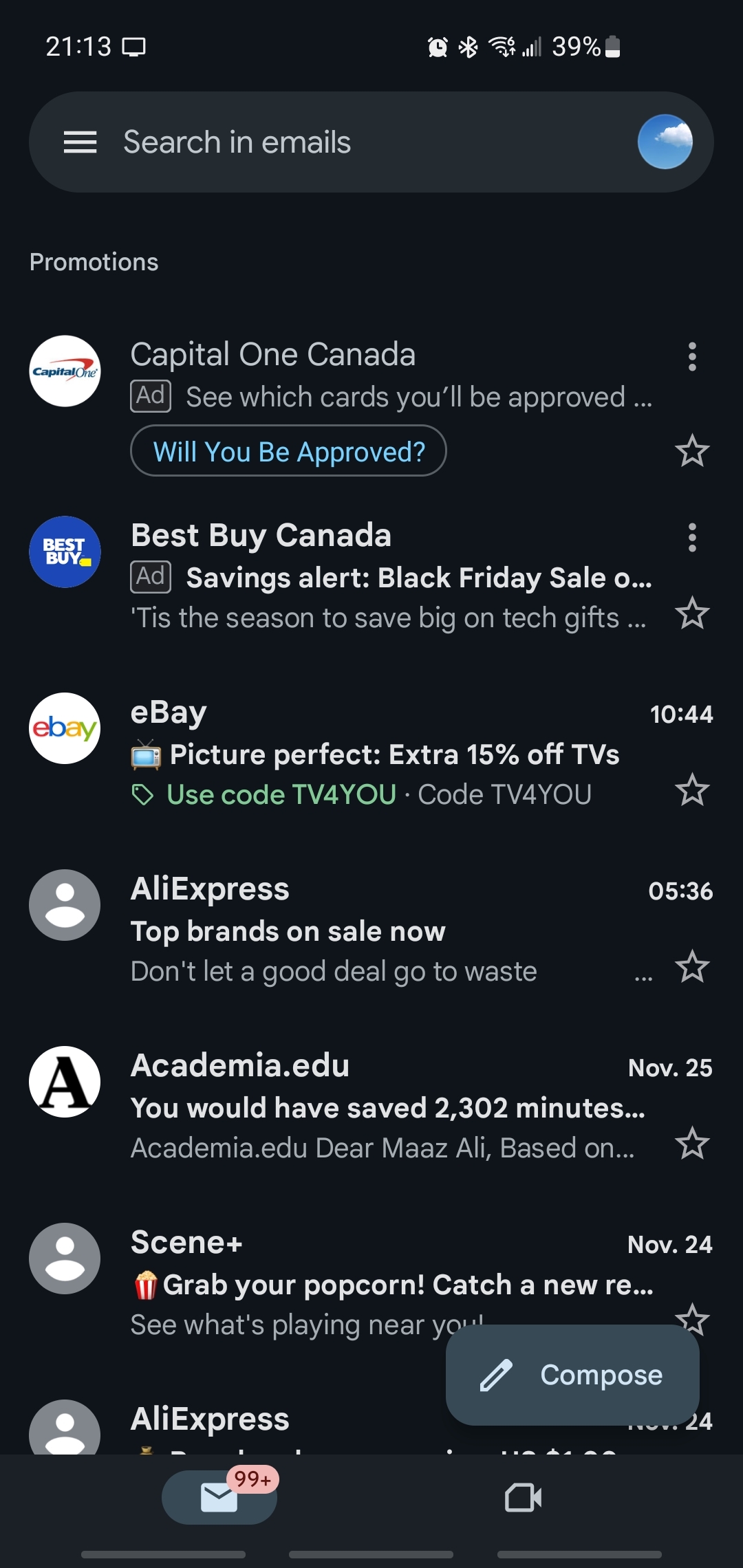
▲ 543 ▼ Google is putting ads in gmail. WTF? (sh.itjust.works) submitted 2 years ago by 257m@sh.itjust.works to c/degoogle@lemmy.ml 222 comments fedilink hide all child comments Why would anyone use this over Proton Mail or the gazillion alternatives if it treats people like shit.
[–] lepinkainen@lemmy.world 25 points 2 years ago (2 children) If the service is free, you are the product. It's not complicated. Pay for email, get no ads. permalink fedilink source hideshow 4 child comments replies: [–] miss_brainfart@lemmy.ml 45 points 2 years ago* (4 children) That statement just makes all of FOSS sound bad, and then people have even less of an idea what alternatives they could be using permalink fedilink source parent hideshow 8 child comments replies: [–] SeekPie@lemmy.world 5 points 2 years ago Mailbox.org is 1€ / month for 2GB with first month free (with limitations), I don't think it's too much to ask for because Google has other ways of making money. permalink fedilink source parent [–] towerful@programming.dev 5 points 2 years ago (2 children) If you are self hosting, you are still paying in your time to set up, host and manage it. And with FOSS, you are still the product. You are providing bug testing, there are no guarantees, and the idea is you contribute back by investigating bugs you find and submit them to the project. permalink fedilink source parent hideshow 4 child comments replies: [–] miss_brainfart@lemmy.ml 5 points 2 years ago The saying still has a very negative connotation, that's all I'm saying permalink fedilink source parent [–] bane_killgrind@lemmy.ml 4 points 2 years ago (1 child) So many paid products are buggy, get EOL with some small notice, or pad their bottom line selling user data. At least with FOSS you have the option of picking up maintenance yourself if the corp drops that product. Support for mission critical infrastructure will only last as long as your support contract with closed software. That's a huge risk. permalink fedilink source parent hideshow 2 child comments replies: [–] towerful@programming.dev 1 point 2 years ago (1 child) Oh yeh. I know a few companies stung by this! permalink fedilink source parent hideshow 2 child comments replies: [–] bane_killgrind@lemmy.ml 3 points 2 years ago I disagree that the users are the product with FOSS is what I was getting at. Major contributions being done by individuals is a special case, with little regard for business continuity. There are obvious examples of people that do it, but the real value regardless of the quality of the individual contributors is the ability to fork your own if the contributions stop aligning with your business plan. That ability to bring the software in house is a guarantee. permalink fedilink source parent [–] problematicPanther@lemmy.world 3 points 2 years ago (1 child) I'm just over here using mutt in my terminal and sipping my tea. permalink fedilink source parent hideshow 2 child comments replies: [–] squeakycat@lemmy.ml 3 points 2 years ago Try aerc! I sip my coffee even more happily nowadays :) permalink fedilink source parent [–] Atemu@lemmy.ml 0 points 2 years ago (1 child) There's no such thing as a FOSS service. The software they use might be FOSS but a service cannot be. There are free services that are genuinely free but they have nothing to do with FOSS. permalink fedilink source parent hideshow 2 child comments replies: [–] Claidheamh@slrpnk.net 11 points 2 years ago (2 children) Ok, so what do you call Bitwarden, matrix, openstreetmaps, Mastodon, or Lemmy? permalink fedilink source parent hideshow 4 child comments replies: [–] uis@lemmy.world 5 points 2 years ago OSM is database permalink fedilink source parent [–] Atemu@lemmy.ml 1 point 2 years ago (1 child) The code? Free and Open Source Software. An instance of the software running as a service? A service. The official Bitwarden service has a free and a more featureful paid tier. Element offers paid hosting as a service with a limited free tier. OSM isn't software? Mastodon and Lemmy are hosted and financed by individuals or organisations who usually choose to offer their service free of charge. All of these are FOSS underneath but have very different costs. There is a difference between commercial for-profit services (BW, Element) and non-profit/public benefit ones (Lemmy, Mastodon) with the latter usually being free of charge. There's very little difference between a commercial FOSS application as a service and a commercial non-free software as a service. For example, you could also buy Slack as a service as opposed to Element. In the end it's a bill of $x/user/month. Nothing "free" about that other than the hosted software's source code. permalink fedilink source parent hideshow 2 child comments replies: [–] Claidheamh@slrpnk.net 4 points 2 years ago (1 child) The free in FOSS doesn't mean free of charge. All those paid services are still FOSS. permalink fedilink source parent hideshow 2 child comments replies: [–] Atemu@lemmy.ml 1 point 2 years ago (1 child) That doesn't change the fact that they're services, not software. These are fundamentally different things. permalink fedilink source parent hideshow 2 child comments replies: [–] Claidheamh@slrpnk.net 1 point 2 years ago (1 child) No, they're not mutually exclusive. These services are software. permalink fedilink source parent hideshow 2 child comments replies: [–] Atemu@lemmy.ml 3 points 2 years ago (1 child) The software is the "primary component" but a service is far more than just a piece of software. It's providing infrastructure for the software to run in, maintaining said infrastructure, providing support to customers, billing/accounting, hiring people to do all of that etc. I'd even go as far as saying that the software being hosted ifself plays no major role in the service part. permalink fedilink source parent hideshow 2 child comments replies: [–] Claidheamh@slrpnk.net 0 points 2 years ago (1 child) Sure, but that's exactly what people mean when they say FOSS service. Regardless, that's not the discussion we're having. The point is that those services are free of charge, and you're not the product. And that a big reason for that is that they are FOSS services. permalink fedilink source parent hideshow 2 child comments replies: [–] el_abuelo@lemmy.ml 0 points 2 years ago (1 child) Arguing about what people mean is futile. The point the other poster is making, and you've now agreed to be true, is that FOSS is software and a service is a service. Most services powered by FOSS offer a free service as a taster for the paid service. The money made in the paid service tiers pay for the free tiers. Hopefully. permalink fedilink source parent hideshow 2 child comments replies: [–] Claidheamh@slrpnk.net 1 point 2 years ago So, do we agree that saying that "if a service is free, you are the product" doesn't apply to FOSS services? permalink fedilink source parent [–] LWD@lemm.ee 3 points 2 years ago* (last edited 2 years ago) deleted permalink fedilink source parent
[–] miss_brainfart@lemmy.ml 45 points 2 years ago* (4 children) That statement just makes all of FOSS sound bad, and then people have even less of an idea what alternatives they could be using permalink fedilink source parent hideshow 8 child comments replies: [–] SeekPie@lemmy.world 5 points 2 years ago Mailbox.org is 1€ / month for 2GB with first month free (with limitations), I don't think it's too much to ask for because Google has other ways of making money. permalink fedilink source parent [–] towerful@programming.dev 5 points 2 years ago (2 children) If you are self hosting, you are still paying in your time to set up, host and manage it. And with FOSS, you are still the product. You are providing bug testing, there are no guarantees, and the idea is you contribute back by investigating bugs you find and submit them to the project. permalink fedilink source parent hideshow 4 child comments replies: [–] miss_brainfart@lemmy.ml 5 points 2 years ago The saying still has a very negative connotation, that's all I'm saying permalink fedilink source parent [–] bane_killgrind@lemmy.ml 4 points 2 years ago (1 child) So many paid products are buggy, get EOL with some small notice, or pad their bottom line selling user data. At least with FOSS you have the option of picking up maintenance yourself if the corp drops that product. Support for mission critical infrastructure will only last as long as your support contract with closed software. That's a huge risk. permalink fedilink source parent hideshow 2 child comments replies: [–] towerful@programming.dev 1 point 2 years ago (1 child) Oh yeh. I know a few companies stung by this! permalink fedilink source parent hideshow 2 child comments replies: [–] bane_killgrind@lemmy.ml 3 points 2 years ago I disagree that the users are the product with FOSS is what I was getting at. Major contributions being done by individuals is a special case, with little regard for business continuity. There are obvious examples of people that do it, but the real value regardless of the quality of the individual contributors is the ability to fork your own if the contributions stop aligning with your business plan. That ability to bring the software in house is a guarantee. permalink fedilink source parent [–] problematicPanther@lemmy.world 3 points 2 years ago (1 child) I'm just over here using mutt in my terminal and sipping my tea. permalink fedilink source parent hideshow 2 child comments replies: [–] squeakycat@lemmy.ml 3 points 2 years ago Try aerc! I sip my coffee even more happily nowadays :) permalink fedilink source parent [–] Atemu@lemmy.ml 0 points 2 years ago (1 child) There's no such thing as a FOSS service. The software they use might be FOSS but a service cannot be. There are free services that are genuinely free but they have nothing to do with FOSS. permalink fedilink source parent hideshow 2 child comments replies: [–] Claidheamh@slrpnk.net 11 points 2 years ago (2 children) Ok, so what do you call Bitwarden, matrix, openstreetmaps, Mastodon, or Lemmy? permalink fedilink source parent hideshow 4 child comments replies: [–] uis@lemmy.world 5 points 2 years ago OSM is database permalink fedilink source parent [–] Atemu@lemmy.ml 1 point 2 years ago (1 child) The code? Free and Open Source Software. An instance of the software running as a service? A service. The official Bitwarden service has a free and a more featureful paid tier. Element offers paid hosting as a service with a limited free tier. OSM isn't software? Mastodon and Lemmy are hosted and financed by individuals or organisations who usually choose to offer their service free of charge. All of these are FOSS underneath but have very different costs. There is a difference between commercial for-profit services (BW, Element) and non-profit/public benefit ones (Lemmy, Mastodon) with the latter usually being free of charge. There's very little difference between a commercial FOSS application as a service and a commercial non-free software as a service. For example, you could also buy Slack as a service as opposed to Element. In the end it's a bill of $x/user/month. Nothing "free" about that other than the hosted software's source code. permalink fedilink source parent hideshow 2 child comments replies: [–] Claidheamh@slrpnk.net 4 points 2 years ago (1 child) The free in FOSS doesn't mean free of charge. All those paid services are still FOSS. permalink fedilink source parent hideshow 2 child comments replies: [–] Atemu@lemmy.ml 1 point 2 years ago (1 child) That doesn't change the fact that they're services, not software. These are fundamentally different things. permalink fedilink source parent hideshow 2 child comments replies: [–] Claidheamh@slrpnk.net 1 point 2 years ago (1 child) No, they're not mutually exclusive. These services are software. permalink fedilink source parent hideshow 2 child comments replies: [–] Atemu@lemmy.ml 3 points 2 years ago (1 child) The software is the "primary component" but a service is far more than just a piece of software. It's providing infrastructure for the software to run in, maintaining said infrastructure, providing support to customers, billing/accounting, hiring people to do all of that etc. I'd even go as far as saying that the software being hosted ifself plays no major role in the service part. permalink fedilink source parent hideshow 2 child comments replies: [–] Claidheamh@slrpnk.net 0 points 2 years ago (1 child) Sure, but that's exactly what people mean when they say FOSS service. Regardless, that's not the discussion we're having. The point is that those services are free of charge, and you're not the product. And that a big reason for that is that they are FOSS services. permalink fedilink source parent hideshow 2 child comments replies: [–] el_abuelo@lemmy.ml 0 points 2 years ago (1 child) Arguing about what people mean is futile. The point the other poster is making, and you've now agreed to be true, is that FOSS is software and a service is a service. Most services powered by FOSS offer a free service as a taster for the paid service. The money made in the paid service tiers pay for the free tiers. Hopefully. permalink fedilink source parent hideshow 2 child comments replies: [–] Claidheamh@slrpnk.net 1 point 2 years ago So, do we agree that saying that "if a service is free, you are the product" doesn't apply to FOSS services? permalink fedilink source parent
[–] SeekPie@lemmy.world 5 points 2 years ago Mailbox.org is 1€ / month for 2GB with first month free (with limitations), I don't think it's too much to ask for because Google has other ways of making money. permalink fedilink source parent
[–] towerful@programming.dev 5 points 2 years ago (2 children) If you are self hosting, you are still paying in your time to set up, host and manage it. And with FOSS, you are still the product. You are providing bug testing, there are no guarantees, and the idea is you contribute back by investigating bugs you find and submit them to the project. permalink fedilink source parent hideshow 4 child comments replies: [–] miss_brainfart@lemmy.ml 5 points 2 years ago The saying still has a very negative connotation, that's all I'm saying permalink fedilink source parent [–] bane_killgrind@lemmy.ml 4 points 2 years ago (1 child) So many paid products are buggy, get EOL with some small notice, or pad their bottom line selling user data. At least with FOSS you have the option of picking up maintenance yourself if the corp drops that product. Support for mission critical infrastructure will only last as long as your support contract with closed software. That's a huge risk. permalink fedilink source parent hideshow 2 child comments replies: [–] towerful@programming.dev 1 point 2 years ago (1 child) Oh yeh. I know a few companies stung by this! permalink fedilink source parent hideshow 2 child comments replies: [–] bane_killgrind@lemmy.ml 3 points 2 years ago I disagree that the users are the product with FOSS is what I was getting at. Major contributions being done by individuals is a special case, with little regard for business continuity. There are obvious examples of people that do it, but the real value regardless of the quality of the individual contributors is the ability to fork your own if the contributions stop aligning with your business plan. That ability to bring the software in house is a guarantee. permalink fedilink source parent
[–] miss_brainfart@lemmy.ml 5 points 2 years ago The saying still has a very negative connotation, that's all I'm saying permalink fedilink source parent
[–] bane_killgrind@lemmy.ml 4 points 2 years ago (1 child) So many paid products are buggy, get EOL with some small notice, or pad their bottom line selling user data. At least with FOSS you have the option of picking up maintenance yourself if the corp drops that product. Support for mission critical infrastructure will only last as long as your support contract with closed software. That's a huge risk. permalink fedilink source parent hideshow 2 child comments replies: [–] towerful@programming.dev 1 point 2 years ago (1 child) Oh yeh. I know a few companies stung by this! permalink fedilink source parent hideshow 2 child comments replies: [–] bane_killgrind@lemmy.ml 3 points 2 years ago I disagree that the users are the product with FOSS is what I was getting at. Major contributions being done by individuals is a special case, with little regard for business continuity. There are obvious examples of people that do it, but the real value regardless of the quality of the individual contributors is the ability to fork your own if the contributions stop aligning with your business plan. That ability to bring the software in house is a guarantee. permalink fedilink source parent
[–] towerful@programming.dev 1 point 2 years ago (1 child) Oh yeh. I know a few companies stung by this! permalink fedilink source parent hideshow 2 child comments replies: [–] bane_killgrind@lemmy.ml 3 points 2 years ago I disagree that the users are the product with FOSS is what I was getting at. Major contributions being done by individuals is a special case, with little regard for business continuity. There are obvious examples of people that do it, but the real value regardless of the quality of the individual contributors is the ability to fork your own if the contributions stop aligning with your business plan. That ability to bring the software in house is a guarantee. permalink fedilink source parent
[–] bane_killgrind@lemmy.ml 3 points 2 years ago I disagree that the users are the product with FOSS is what I was getting at. Major contributions being done by individuals is a special case, with little regard for business continuity. There are obvious examples of people that do it, but the real value regardless of the quality of the individual contributors is the ability to fork your own if the contributions stop aligning with your business plan. That ability to bring the software in house is a guarantee. permalink fedilink source parent
[–] problematicPanther@lemmy.world 3 points 2 years ago (1 child) I'm just over here using mutt in my terminal and sipping my tea. permalink fedilink source parent hideshow 2 child comments replies: [–] squeakycat@lemmy.ml 3 points 2 years ago Try aerc! I sip my coffee even more happily nowadays :) permalink fedilink source parent
[–] squeakycat@lemmy.ml 3 points 2 years ago Try aerc! I sip my coffee even more happily nowadays :) permalink fedilink source parent
[–] Atemu@lemmy.ml 0 points 2 years ago (1 child) There's no such thing as a FOSS service. The software they use might be FOSS but a service cannot be. There are free services that are genuinely free but they have nothing to do with FOSS. permalink fedilink source parent hideshow 2 child comments replies: [–] Claidheamh@slrpnk.net 11 points 2 years ago (2 children) Ok, so what do you call Bitwarden, matrix, openstreetmaps, Mastodon, or Lemmy? permalink fedilink source parent hideshow 4 child comments replies: [–] uis@lemmy.world 5 points 2 years ago OSM is database permalink fedilink source parent [–] Atemu@lemmy.ml 1 point 2 years ago (1 child) The code? Free and Open Source Software. An instance of the software running as a service? A service. The official Bitwarden service has a free and a more featureful paid tier. Element offers paid hosting as a service with a limited free tier. OSM isn't software? Mastodon and Lemmy are hosted and financed by individuals or organisations who usually choose to offer their service free of charge. All of these are FOSS underneath but have very different costs. There is a difference between commercial for-profit services (BW, Element) and non-profit/public benefit ones (Lemmy, Mastodon) with the latter usually being free of charge. There's very little difference between a commercial FOSS application as a service and a commercial non-free software as a service. For example, you could also buy Slack as a service as opposed to Element. In the end it's a bill of $x/user/month. Nothing "free" about that other than the hosted software's source code. permalink fedilink source parent hideshow 2 child comments replies: [–] Claidheamh@slrpnk.net 4 points 2 years ago (1 child) The free in FOSS doesn't mean free of charge. All those paid services are still FOSS. permalink fedilink source parent hideshow 2 child comments replies: [–] Atemu@lemmy.ml 1 point 2 years ago (1 child) That doesn't change the fact that they're services, not software. These are fundamentally different things. permalink fedilink source parent hideshow 2 child comments replies: [–] Claidheamh@slrpnk.net 1 point 2 years ago (1 child) No, they're not mutually exclusive. These services are software. permalink fedilink source parent hideshow 2 child comments replies: [–] Atemu@lemmy.ml 3 points 2 years ago (1 child) The software is the "primary component" but a service is far more than just a piece of software. It's providing infrastructure for the software to run in, maintaining said infrastructure, providing support to customers, billing/accounting, hiring people to do all of that etc. I'd even go as far as saying that the software being hosted ifself plays no major role in the service part. permalink fedilink source parent hideshow 2 child comments replies: [–] Claidheamh@slrpnk.net 0 points 2 years ago (1 child) Sure, but that's exactly what people mean when they say FOSS service. Regardless, that's not the discussion we're having. The point is that those services are free of charge, and you're not the product. And that a big reason for that is that they are FOSS services. permalink fedilink source parent hideshow 2 child comments replies: [–] el_abuelo@lemmy.ml 0 points 2 years ago (1 child) Arguing about what people mean is futile. The point the other poster is making, and you've now agreed to be true, is that FOSS is software and a service is a service. Most services powered by FOSS offer a free service as a taster for the paid service. The money made in the paid service tiers pay for the free tiers. Hopefully. permalink fedilink source parent hideshow 2 child comments replies: [–] Claidheamh@slrpnk.net 1 point 2 years ago So, do we agree that saying that "if a service is free, you are the product" doesn't apply to FOSS services? permalink fedilink source parent
[–] Claidheamh@slrpnk.net 11 points 2 years ago (2 children) Ok, so what do you call Bitwarden, matrix, openstreetmaps, Mastodon, or Lemmy? permalink fedilink source parent hideshow 4 child comments replies: [–] uis@lemmy.world 5 points 2 years ago OSM is database permalink fedilink source parent [–] Atemu@lemmy.ml 1 point 2 years ago (1 child) The code? Free and Open Source Software. An instance of the software running as a service? A service. The official Bitwarden service has a free and a more featureful paid tier. Element offers paid hosting as a service with a limited free tier. OSM isn't software? Mastodon and Lemmy are hosted and financed by individuals or organisations who usually choose to offer their service free of charge. All of these are FOSS underneath but have very different costs. There is a difference between commercial for-profit services (BW, Element) and non-profit/public benefit ones (Lemmy, Mastodon) with the latter usually being free of charge. There's very little difference between a commercial FOSS application as a service and a commercial non-free software as a service. For example, you could also buy Slack as a service as opposed to Element. In the end it's a bill of $x/user/month. Nothing "free" about that other than the hosted software's source code. permalink fedilink source parent hideshow 2 child comments replies: [–] Claidheamh@slrpnk.net 4 points 2 years ago (1 child) The free in FOSS doesn't mean free of charge. All those paid services are still FOSS. permalink fedilink source parent hideshow 2 child comments replies: [–] Atemu@lemmy.ml 1 point 2 years ago (1 child) That doesn't change the fact that they're services, not software. These are fundamentally different things. permalink fedilink source parent hideshow 2 child comments replies: [–] Claidheamh@slrpnk.net 1 point 2 years ago (1 child) No, they're not mutually exclusive. These services are software. permalink fedilink source parent hideshow 2 child comments replies: [–] Atemu@lemmy.ml 3 points 2 years ago (1 child) The software is the "primary component" but a service is far more than just a piece of software. It's providing infrastructure for the software to run in, maintaining said infrastructure, providing support to customers, billing/accounting, hiring people to do all of that etc. I'd even go as far as saying that the software being hosted ifself plays no major role in the service part. permalink fedilink source parent hideshow 2 child comments replies: [–] Claidheamh@slrpnk.net 0 points 2 years ago (1 child) Sure, but that's exactly what people mean when they say FOSS service. Regardless, that's not the discussion we're having. The point is that those services are free of charge, and you're not the product. And that a big reason for that is that they are FOSS services. permalink fedilink source parent hideshow 2 child comments replies: [–] el_abuelo@lemmy.ml 0 points 2 years ago (1 child) Arguing about what people mean is futile. The point the other poster is making, and you've now agreed to be true, is that FOSS is software and a service is a service. Most services powered by FOSS offer a free service as a taster for the paid service. The money made in the paid service tiers pay for the free tiers. Hopefully. permalink fedilink source parent hideshow 2 child comments replies: [–] Claidheamh@slrpnk.net 1 point 2 years ago So, do we agree that saying that "if a service is free, you are the product" doesn't apply to FOSS services? permalink fedilink source parent
[–] Atemu@lemmy.ml 1 point 2 years ago (1 child) The code? Free and Open Source Software. An instance of the software running as a service? A service. The official Bitwarden service has a free and a more featureful paid tier. Element offers paid hosting as a service with a limited free tier. OSM isn't software? Mastodon and Lemmy are hosted and financed by individuals or organisations who usually choose to offer their service free of charge. All of these are FOSS underneath but have very different costs. There is a difference between commercial for-profit services (BW, Element) and non-profit/public benefit ones (Lemmy, Mastodon) with the latter usually being free of charge. There's very little difference between a commercial FOSS application as a service and a commercial non-free software as a service. For example, you could also buy Slack as a service as opposed to Element. In the end it's a bill of $x/user/month. Nothing "free" about that other than the hosted software's source code. permalink fedilink source parent hideshow 2 child comments replies: [–] Claidheamh@slrpnk.net 4 points 2 years ago (1 child) The free in FOSS doesn't mean free of charge. All those paid services are still FOSS. permalink fedilink source parent hideshow 2 child comments replies: [–] Atemu@lemmy.ml 1 point 2 years ago (1 child) That doesn't change the fact that they're services, not software. These are fundamentally different things. permalink fedilink source parent hideshow 2 child comments replies: [–] Claidheamh@slrpnk.net 1 point 2 years ago (1 child) No, they're not mutually exclusive. These services are software. permalink fedilink source parent hideshow 2 child comments replies: [–] Atemu@lemmy.ml 3 points 2 years ago (1 child) The software is the "primary component" but a service is far more than just a piece of software. It's providing infrastructure for the software to run in, maintaining said infrastructure, providing support to customers, billing/accounting, hiring people to do all of that etc. I'd even go as far as saying that the software being hosted ifself plays no major role in the service part. permalink fedilink source parent hideshow 2 child comments replies: [–] Claidheamh@slrpnk.net 0 points 2 years ago (1 child) Sure, but that's exactly what people mean when they say FOSS service. Regardless, that's not the discussion we're having. The point is that those services are free of charge, and you're not the product. And that a big reason for that is that they are FOSS services. permalink fedilink source parent hideshow 2 child comments replies: [–] el_abuelo@lemmy.ml 0 points 2 years ago (1 child) Arguing about what people mean is futile. The point the other poster is making, and you've now agreed to be true, is that FOSS is software and a service is a service. Most services powered by FOSS offer a free service as a taster for the paid service. The money made in the paid service tiers pay for the free tiers. Hopefully. permalink fedilink source parent hideshow 2 child comments replies: [–] Claidheamh@slrpnk.net 1 point 2 years ago So, do we agree that saying that "if a service is free, you are the product" doesn't apply to FOSS services? permalink fedilink source parent
[–] Claidheamh@slrpnk.net 4 points 2 years ago (1 child) The free in FOSS doesn't mean free of charge. All those paid services are still FOSS. permalink fedilink source parent hideshow 2 child comments replies: [–] Atemu@lemmy.ml 1 point 2 years ago (1 child) That doesn't change the fact that they're services, not software. These are fundamentally different things. permalink fedilink source parent hideshow 2 child comments replies: [–] Claidheamh@slrpnk.net 1 point 2 years ago (1 child) No, they're not mutually exclusive. These services are software. permalink fedilink source parent hideshow 2 child comments replies: [–] Atemu@lemmy.ml 3 points 2 years ago (1 child) The software is the "primary component" but a service is far more than just a piece of software. It's providing infrastructure for the software to run in, maintaining said infrastructure, providing support to customers, billing/accounting, hiring people to do all of that etc. I'd even go as far as saying that the software being hosted ifself plays no major role in the service part. permalink fedilink source parent hideshow 2 child comments replies: [–] Claidheamh@slrpnk.net 0 points 2 years ago (1 child) Sure, but that's exactly what people mean when they say FOSS service. Regardless, that's not the discussion we're having. The point is that those services are free of charge, and you're not the product. And that a big reason for that is that they are FOSS services. permalink fedilink source parent hideshow 2 child comments replies: [–] el_abuelo@lemmy.ml 0 points 2 years ago (1 child) Arguing about what people mean is futile. The point the other poster is making, and you've now agreed to be true, is that FOSS is software and a service is a service. Most services powered by FOSS offer a free service as a taster for the paid service. The money made in the paid service tiers pay for the free tiers. Hopefully. permalink fedilink source parent hideshow 2 child comments replies: [–] Claidheamh@slrpnk.net 1 point 2 years ago So, do we agree that saying that "if a service is free, you are the product" doesn't apply to FOSS services? permalink fedilink source parent
[–] Atemu@lemmy.ml 1 point 2 years ago (1 child) That doesn't change the fact that they're services, not software. These are fundamentally different things. permalink fedilink source parent hideshow 2 child comments replies: [–] Claidheamh@slrpnk.net 1 point 2 years ago (1 child) No, they're not mutually exclusive. These services are software. permalink fedilink source parent hideshow 2 child comments replies: [–] Atemu@lemmy.ml 3 points 2 years ago (1 child) The software is the "primary component" but a service is far more than just a piece of software. It's providing infrastructure for the software to run in, maintaining said infrastructure, providing support to customers, billing/accounting, hiring people to do all of that etc. I'd even go as far as saying that the software being hosted ifself plays no major role in the service part. permalink fedilink source parent hideshow 2 child comments replies: [–] Claidheamh@slrpnk.net 0 points 2 years ago (1 child) Sure, but that's exactly what people mean when they say FOSS service. Regardless, that's not the discussion we're having. The point is that those services are free of charge, and you're not the product. And that a big reason for that is that they are FOSS services. permalink fedilink source parent hideshow 2 child comments replies: [–] el_abuelo@lemmy.ml 0 points 2 years ago (1 child) Arguing about what people mean is futile. The point the other poster is making, and you've now agreed to be true, is that FOSS is software and a service is a service. Most services powered by FOSS offer a free service as a taster for the paid service. The money made in the paid service tiers pay for the free tiers. Hopefully. permalink fedilink source parent hideshow 2 child comments replies: [–] Claidheamh@slrpnk.net 1 point 2 years ago So, do we agree that saying that "if a service is free, you are the product" doesn't apply to FOSS services? permalink fedilink source parent
[–] Claidheamh@slrpnk.net 1 point 2 years ago (1 child) No, they're not mutually exclusive. These services are software. permalink fedilink source parent hideshow 2 child comments replies: [–] Atemu@lemmy.ml 3 points 2 years ago (1 child) The software is the "primary component" but a service is far more than just a piece of software. It's providing infrastructure for the software to run in, maintaining said infrastructure, providing support to customers, billing/accounting, hiring people to do all of that etc. I'd even go as far as saying that the software being hosted ifself plays no major role in the service part. permalink fedilink source parent hideshow 2 child comments replies: [–] Claidheamh@slrpnk.net 0 points 2 years ago (1 child) Sure, but that's exactly what people mean when they say FOSS service. Regardless, that's not the discussion we're having. The point is that those services are free of charge, and you're not the product. And that a big reason for that is that they are FOSS services. permalink fedilink source parent hideshow 2 child comments replies: [–] el_abuelo@lemmy.ml 0 points 2 years ago (1 child) Arguing about what people mean is futile. The point the other poster is making, and you've now agreed to be true, is that FOSS is software and a service is a service. Most services powered by FOSS offer a free service as a taster for the paid service. The money made in the paid service tiers pay for the free tiers. Hopefully. permalink fedilink source parent hideshow 2 child comments replies: [–] Claidheamh@slrpnk.net 1 point 2 years ago So, do we agree that saying that "if a service is free, you are the product" doesn't apply to FOSS services? permalink fedilink source parent
[–] Atemu@lemmy.ml 3 points 2 years ago (1 child) The software is the "primary component" but a service is far more than just a piece of software. It's providing infrastructure for the software to run in, maintaining said infrastructure, providing support to customers, billing/accounting, hiring people to do all of that etc. I'd even go as far as saying that the software being hosted ifself plays no major role in the service part. permalink fedilink source parent hideshow 2 child comments replies: [–] Claidheamh@slrpnk.net 0 points 2 years ago (1 child) Sure, but that's exactly what people mean when they say FOSS service. Regardless, that's not the discussion we're having. The point is that those services are free of charge, and you're not the product. And that a big reason for that is that they are FOSS services. permalink fedilink source parent hideshow 2 child comments replies: [–] el_abuelo@lemmy.ml 0 points 2 years ago (1 child) Arguing about what people mean is futile. The point the other poster is making, and you've now agreed to be true, is that FOSS is software and a service is a service. Most services powered by FOSS offer a free service as a taster for the paid service. The money made in the paid service tiers pay for the free tiers. Hopefully. permalink fedilink source parent hideshow 2 child comments replies: [–] Claidheamh@slrpnk.net 1 point 2 years ago So, do we agree that saying that "if a service is free, you are the product" doesn't apply to FOSS services? permalink fedilink source parent
[–] Claidheamh@slrpnk.net 0 points 2 years ago (1 child) Sure, but that's exactly what people mean when they say FOSS service. Regardless, that's not the discussion we're having. The point is that those services are free of charge, and you're not the product. And that a big reason for that is that they are FOSS services. permalink fedilink source parent hideshow 2 child comments replies: [–] el_abuelo@lemmy.ml 0 points 2 years ago (1 child) Arguing about what people mean is futile. The point the other poster is making, and you've now agreed to be true, is that FOSS is software and a service is a service. Most services powered by FOSS offer a free service as a taster for the paid service. The money made in the paid service tiers pay for the free tiers. Hopefully. permalink fedilink source parent hideshow 2 child comments replies: [–] Claidheamh@slrpnk.net 1 point 2 years ago So, do we agree that saying that "if a service is free, you are the product" doesn't apply to FOSS services? permalink fedilink source parent
[–] el_abuelo@lemmy.ml 0 points 2 years ago (1 child) Arguing about what people mean is futile. The point the other poster is making, and you've now agreed to be true, is that FOSS is software and a service is a service. Most services powered by FOSS offer a free service as a taster for the paid service. The money made in the paid service tiers pay for the free tiers. Hopefully. permalink fedilink source parent hideshow 2 child comments replies: [–] Claidheamh@slrpnk.net 1 point 2 years ago So, do we agree that saying that "if a service is free, you are the product" doesn't apply to FOSS services? permalink fedilink source parent
[–] Claidheamh@slrpnk.net 1 point 2 years ago So, do we agree that saying that "if a service is free, you are the product" doesn't apply to FOSS services? permalink fedilink source parent
[–] LWD@lemm.ee 3 points 2 years ago* (last edited 2 years ago) deleted permalink fedilink source parent