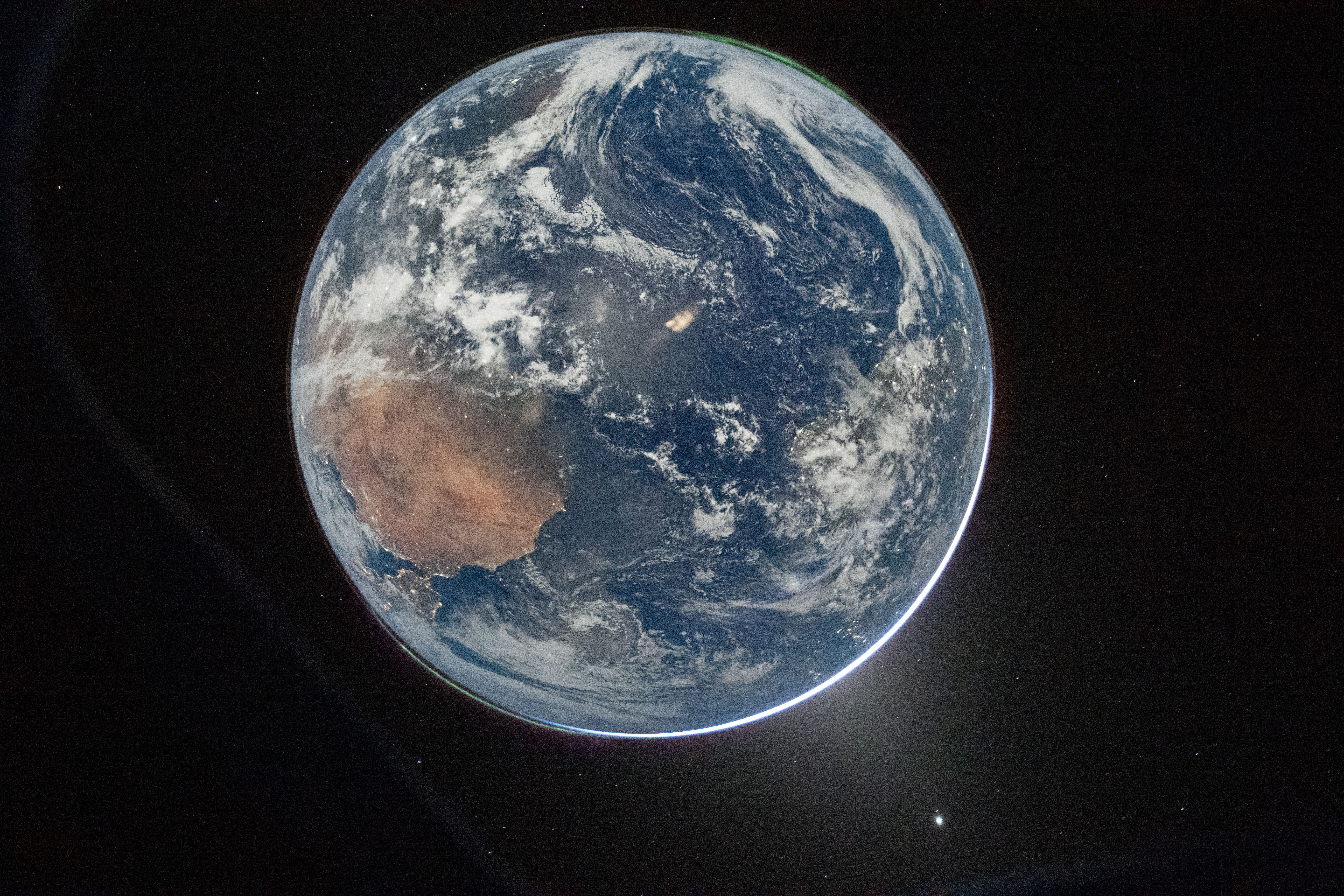
This image of home just came down from the Artemis II crew.

Taken after their translunar injection burn, there are aurorae at top right and lower left, and zodiacal light at lower right.

Credit: NASA/Reid Wiseman

// That's home. That's us.

Source

---

Alternative references of better image quality mentioned in comments by @baguette@piefed.social:
- https://images.nasa.gov/details/art002e000192;
- https://images-assets.nasa.gov/image/art002e000192/art002e000192~orig.jpg [5568 x 3712]
you are viewing a single comment's thread
view the rest of the comments
[–] 23 points 5 months ago (9 children)

ISO 51200

I didn't even know it could go that high. 🤣

  • source
  • parent
  • hideshow 9 child comments
  • [–] 12 points 5 months ago (8 children)

    Sony A1 MKii can hit 102,400 for stills.

  • source
  • parent
  • hideshow 8 child comments
  • [–] 7 points 5 months ago* (last edited 5 months ago) (7 children)

    AFAIK anything past 32,000 is digitally expanded (which could be done with RAW post-processing).

    EDIT:

    See: https://www.photonstophotos.net/Charts/RN_ADU.htm#Nikon%20D5_14,Sony%20ILCE-1M2_14

    The old Nikon D5, impressively, doesn't seem to post-scale even at ISO 102400

  • source
  • parent
  • hideshow 7 child comments
  • [–] 5 points 5 months ago* (1 child)

    My 2015 Sony a7s2 has “native” iso to 102400, and expanded to 409600, but it was a special full frame low light sensor and it’s only 12MP (most from back then were 20-30MP with the same sized sensor.

    From Wikipedia:

    For still images, the α7S II's ISO is 100–102400 with expansion down to ISO 50 and up to ISO 409600 equivalent. For movies, the α7S II's ISO is 100-102400 equivalent with expansion down to ISO 100 and up to ISO 409600 equivalent. For still images or movies on auto setting, the camera's ISO is 100–12800 with selectable lower and upper limits.[2]

    Also apparently one was installed on the ISS

  • source
  • parent
  • hideshow 1 child comment
  • [–] 3 points 5 months ago* (4 children)

    "Old" high-end DSLRs are aging well, digital photography has been in the diminishing returns for a while now. You're almost surely getting better pictures out of a 10 year old flagship than a brand new mid-level camera, and the "thoroughly tested" part matters a lot in spaceflight

  • source
  • parent
  • hideshow 4 child comments
  • [–] 2 points 5 months ago (2 children)

    Still surprises me that it's a D5 of all things, but then my main camera is only a year newer than that one. Not sure I'd use a DSLR at this point though.

  • source
  • parent
  • hideshow 2 child comments
  • [–] 1 point 5 months ago*

    Fairly well. The newest sensors do have better dynamic range, with some exceptions (like the fully stacked ones).

    TBH they should probably take a medium-format Fuji with a brighter lens to space. Or an A7S like someone had above.

  • source
  • parent