submitted 3 years ago* (last edited 3 years ago) by to c/memes@lemmy.ml
 

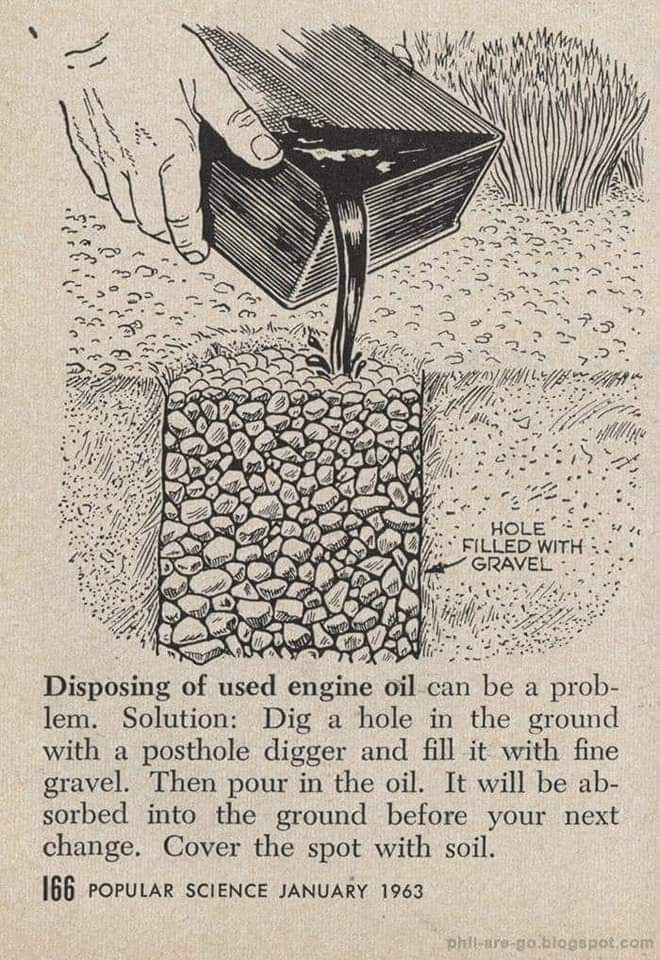
edit: Don't do this. Embrace modernity and don't pollute the soil.
you are viewing a single comment's thread
view the rest of the comments
[–] 233 points 3 years ago (37 children)

I'm sure there will be people that take this seriously lol, PSA to others don't do this. It fucks up the land and nearby water sources as it spreads out. In the US you can be forced to replace the contaminated soil

  • source
  • hideshow 37 child comments
  • [–] 69 points 3 years ago (26 children)

    When I was a yout, they had trucks with a huge tank and a sprayer on the back. The truck would drive all the country roads spraying the dirt with waste oils. This was done to keep the dust down. Smelled terrible. Miles and miles of dirt roads that ran all around by rivers and lakes.

    It is crazy to think about that now.

  • source
  • parent
  • hideshow 26 child comments
  • [–] 37 points 3 years ago (1 child)

    I'm sure you know this, but that's exactly how a town got turned in to a EPA superfund site due to Dioxin contamination, because of a fuck up over chain of command for waste oil from the creation of napalm or pesticides(IIRC?). The guy running the spraying business didn't know, which I can believe, but the company that paid for him to dispose of it should've informed him.

  • source
  • parent
  • hideshow 1 child comment
  • [–] 12 points 3 years ago (4 children)

    I assure you they still do that, source: my dad still lived on a back country road that they regularly tarred until they finally paved it about two or three years ago. When I lived there I hated when they did it because I had a white car and didn’t want all the oil on it since it was so hard to wash off and I had to go to the car wash every time I left the house

  • source
  • parent
  • hideshow 4 child comments
  • [–] 21 points 3 years ago (2 children)

    I was reading about one where the oil was contaminated with some truly terrible shit, dioxin maybe? Several people died. They turned that whole area into a Superfund site.

    https://en.m.wikipedia.org/wiki/Times_Beach,_Missouri

  • source
  • parent
  • hideshow 2 child comments
  • [–] 9 points 3 years ago (4 children)

    There are still places which basically make rural roads like this. They spray down a layer of heavy oil and then scatter small rock chips and recycled asphalt on top of of the sticky layer to make a roadway. Obviously it's not suitable for heavy use, but it's way faster than actually paving the surface.

  • source
  • parent
  • hideshow 4 child comments
  • [–] 15 points 3 years ago (3 children)

    Chip sealing! I know the process as they still do this for neighborhood streets around here. The oil is more like a tar and solidifies as it cools thus 'gluing' the chips to the older road surface. Sort of a stopgap before having to repave completely. I don't think this is done on dirt surfaces as it doesn't seem workable.

    This process is pretty different than what I described originally. The dirt roads only hold those oils for a relatively short period.

  • source
  • parent
  • hideshow 3 child comments
  • [–] 6 points 3 years ago (1 child)

    Highway engineer here. It's asphalt (or bitumen), which is a product of crude oil refining. It's all the stuff that stays at the bottom when you heat crude up to over 1000°F. Because it's so sticky & viscous, it has to be heated up to around 300°F in order to be used. Asphalt is the "binder" in a pavement mixture that includes silt, sand, and rocks in various quantities and sizes, and these days the asphalt binder is usually modified in some way to improve its performance in the climate or application it's going to be used in.

    A chipseal is made by spreading a continuous layer of small rocks on a prepared surface and spraying the hot asphalt over it after, which binds the rocks together. It's similar to Macadam pavement which was developed in the early 1800s and continued to be used well into the 1900s, often as a base layer for a more modern hot-mix asphalt pavement. Tar used to be used in paving a lot, but tar is made from coal and environmental regulations don't allow it anywhere that I know of. There's also a more state of the art technique that involves a looser layer of slightly larger stones, sprayed with a modified asphalt emulsion (modified in this case meaning with rubber or polymer for elasticity, and emulsion meaning it's mixed with water to make it easier to work with), called a stress-absorbing membrane interlayer, used for reducing reflective cracking from an existing pavement surface into a new overlay surface. Modified asphalts & emulsions are often used for chipseals these days, too.

    Lecture over.

  • source
  • parent
  • hideshow 1 child comment
  • [–] 2 points 3 years ago

    Hey, thanks for that thorough explanation! I only have vague hand-waving knowledge, so this is nice to understand. I will probably forget most of it by the next time the topic comes up, but I (and others) appreciate the details provided!

  • source
  • parent
  • [–] 7 points 3 years ago (3 children)

    They still do that on sites with dirt tracks that get dusty. Only, they spray with water.

    It's pretty shitty and foul smelling water, mind.

  • source
  • parent
  • hideshow 3 child comments
  • [–] 1 point 3 years ago

    Many moons ago, my family went to a cottage every summer where they would oil the roads to keep them from wearing. I'm not sure what it was exactly but it was for sure a petroleum product by the smell.

  • source
  • parent
  • [–] 5 points 3 years ago (7 children)
  • [–] 6 points 3 years ago* (last edited 3 years ago) (2 children)

    youth

    edit: I did not recognize the reference 🫠

  • source
  • parent
  • hideshow 2 child comments
  • [–] 4 points 3 years ago (3 children)
  • [–] 11 points 3 years ago (3 children)

    The solution to pollution is dilution

  • source
  • parent
  • hideshow 3 child comments