view the rest of the comments
Science Memes
Welcome to c/science_memes @ Mander.xyz!
A place for majestic STEMLORD peacocking, as well as memes about the realities of working in a lab.

Meta Post Tags
Rules
- Don't throw mud. Behave like an intellectual and remember the human.
- Keep it rooted (on topic).
- No spam.
- Infographics welcome, get schooled.
If you are here asking: "Is this a science meme?"
Probably, yes. We use the Dawkins definition of meme: a replicating idea, not just an image macro with a fact on it. A good post here doesn't need to teach you something. It needs to make you ask something: who, what, where, when, and especially why or how.
Science isn't a filing cabinet of facts, it's a conversation. For example, a photo of an eel or other localized wildlife counts because most people never see one, and wonder is the first step of inquiry. A car meme counts if it makes you curious about what's under the bonnet. If you want to talk about something you noticed in the world, chances are someone else wants to talk about it too.
We moderate for vibe, not category. Pruning is light, especially where a post creates interesting discussion. Experimenting is encouraged.
See the pinned paper on Shitposting as Public Pedagogy if you want the academic case for why this works.
Research Committee
Other Mander Communities
Science and Research
Biology and Life Sciences
- !abiogenesis@mander.xyz
- !animal-behavior@mander.xyz
- !anthropology@mander.xyz
- !arachnology@mander.xyz
- !balconygardening@slrpnk.net
- !biodiversity@mander.xyz
- !biology@mander.xyz
- !biophysics@mander.xyz
- !botany@mander.xyz
- !ecology@mander.xyz
- !entomology@mander.xyz
- !fermentation@mander.xyz
- !herpetology@mander.xyz
- !houseplants@mander.xyz
- !medicine@mander.xyz
- !microscopy@mander.xyz
- !mycology@mander.xyz
- !nudibranchs@mander.xyz
- !nutrition@mander.xyz
- !palaeoecology@mander.xyz
- !palaeontology@mander.xyz
- !photosynthesis@mander.xyz
- !plantid@mander.xyz
- !plants@mander.xyz
- !reptiles and amphibians@mander.xyz
Physical Sciences
- !astronomy@mander.xyz
- !chemistry@mander.xyz
- !earthscience@mander.xyz
- !geography@mander.xyz
- !geospatial@mander.xyz
- !nuclear@mander.xyz
- !physics@mander.xyz
- !quantum-computing@mander.xyz
- !spectroscopy@mander.xyz
Humanities and Social Sciences
Practical and Applied Sciences
- !exercise-and sports-science@mander.xyz
- !gardening@mander.xyz
- !self sufficiency@mander.xyz
- !soilscience@slrpnk.net
- !terrariums@mander.xyz
- !timelapse@mander.xyz
When referencing another person's comment, it can be helpful to link to that comment or the article you mentioned.
I'd also like to point out that many Wikipedia articles, particularly those written by experts on a given scientific subject, tend to be daunting rather than helpful for people not yet familiar with that subject.
Explanations like the one you offered in this comment and the next reply can help make topics more approachable, so I very much appreciate that.
To illustrate my point:
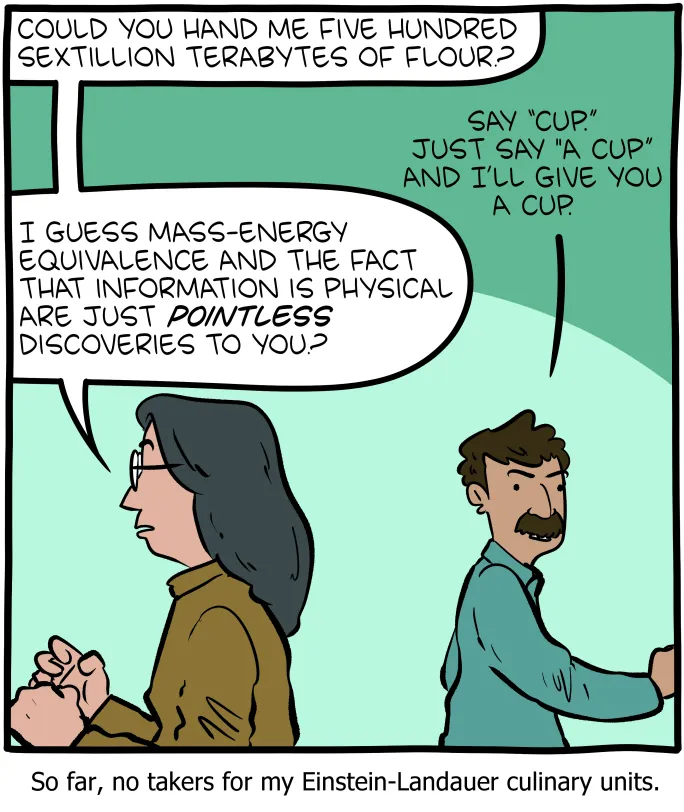
In this case, the article first describes the principle as "pertaining to a lower theoretical limit of energy consumption of computation", which doesn't directly highlight the connection to information storage. The next sentence then mentions "irreversible change in information" and "merging two computational paths", both of which are non-trivial.
From a brief glance at the article on reversible computing linked further on, I gather that "irreversible" here doesn't mean "you can't flip the bit again" but rather something like "you can't deterministically figure out the previous calculation from its result", so the phrase boils down to "storing a piece of information" for our context. The example of "merging computational paths" probably has no particular bearing on the energy value of information either and can be ignored as well.
Figuring out the resulting logic that you so kindly laid out – again, thank you for that! – requires a degree of subject-specific understanding to know what parts of the explanation can be safely ignored.
Of course, experts want to be accurate and tend to think in terms they're familiar with, so I don't fault them for that. The unfortunate result is that their writings are often rather intransparent to laypeople and linking to Wikipedia articles isn't always the best way to convey an understanding.