It's getting more and more unhinged on LinkedIn.
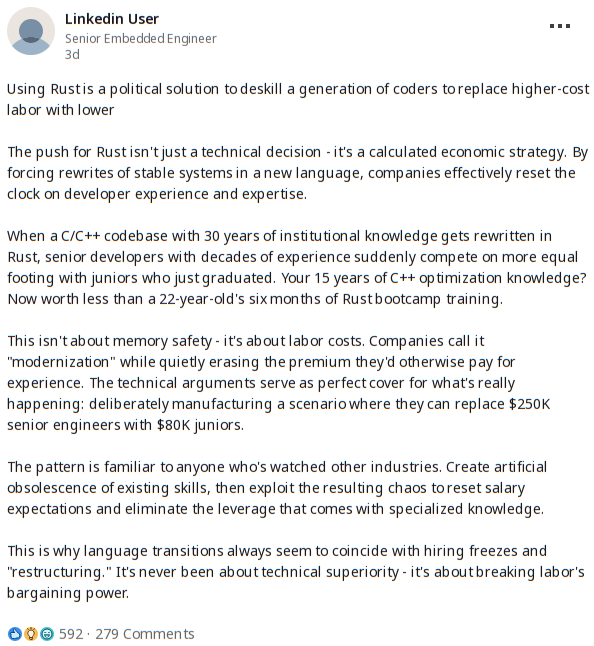
A linkedin post by a Senior Embedded Engineer stating: Using Rust is a political solution to deskill a generation of coders to replace higher-cost labor with lower  The push for Rust isn't just a technical decision - it's a calculated economic strategy. By forcing rewrites of stable systems in a new language, companies effectively reset the clock on developer experience and expertise.  When a C/C++ codebase with 30 years of institutional knowledge gets rewritten in Rust, senior developers with decades of experience suddenly compete on more equal footing with juniors who just graduated. Your 15 years of C++ optimization knowledge? Now worth less than a 22-year-old's six months of Rust bootcamp training.  This isn't about memory safety - it's about labor costs. Companies call it "modernization" while quietly erasing the premium they'd otherwise pay for experience. The technical arguments serve as perfect cover for what's really happening: deliberately manufacturing a scenario where they can replace $250K senior engineers with $80K juniors.  The pattern is familiar to anyone who's watched other industries. Create artificial obsolescence of existing skills, then exploit the resulting chaos to reset salary expectations and eliminate the leverage that comes with specialized knowledge.  This is why language transitions always seem to coincide with hiring freezes and "restructuring." It's never been about technical superiority - it's about breaking labor's bargaining power.
you are viewing a single comment's thread
view the rest of the comments

Then how would you define OOP and FP?

Wikipedia claims it supports OOP:

Rust does not enforce a programming paradigm, but was influenced by ideas from functional programming, including immutability, higher-order functions, algebraic data types, and pattern matching. It also supports object-oriented programming via structs, enums, traits, and methods.

I wouldn't say Rust is an OOP language though, because that absolutely gives the wrong impression since that evokes ideas of classical inheritance as in C++ or Java. But I do very much believe it supports object oriented programming as a paradigm, since you can model things with objects at the core.

That said, I think Rust is best used with less emphasis on OOP, since it's pretty easy to get into trouble modeling things that way when it comes to lifetimes. I use OOP-style in Rust when it makes sense, and the rest is as close to functional as I can get it.

object orientation is classes done wrong

I think classical inheritance is object oriented programming done wrong. Go had the start of a good idea with composition and interfaces, and I think Rust's traits + generics improved on it.

  • source
  • parent