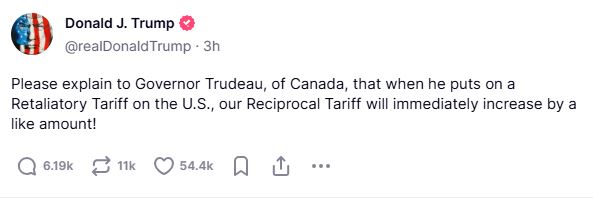
▲ 1158 ▼ Trump, the dumbest man on earth, just doubled down on his dumb. (lemmy.ca) submitted 2 years ago by imvii@lemmy.ca to c/canada@lemmy.ca 279 comments fedilink hide all child comments
[–] pseudo@jlai.lu 1 point 2 years ago (4 children) I see. Since the tarif is proportionate to the final price, the final price needs even higher than the initial price times (1 + tarif) in order to keep the profit the same. permalink fedilink source parent hideshow 4 child comments replies: [–] Sludgeyy@lemmy.world 2 points 2 years ago Starting Price / (1-Tariff %) = Final Price Needed to Break Even $5 / (1-.25) = 5/.75 = $6.67 If an item was $5 and there was a 30% tariff 5 / (1-.30) = $7.14 If there was a 30% tariff and the syrup company wanted to keep same profit they would have to sell each bottle for $7.14. $7.14 × .30 = $2.14 $7.14 - $2.14 = $5 permalink fedilink source parent [–] Sludgeyy@lemmy.world 2 points 2 years ago (2 children) No, because (1 + tariff) isn't enough to keep up with the tariff because as the price goes up, the tariff also goes up. Like in the example going from $5 to $6.25 (5 × (1+.25)). Would result in 31 cents less per bottle. It needs to be ~33% more or $6.67 for the syrup company to keep the same profit with a 25% tariff. Final Price × Tariff % = Tariff Amount Final Price - Tariff Amount = Cost of Good Sold Cost of Good Sold - Expenses = Profit So if you need $2 profit $2 = (Final Price - (Final Price × Tariff %)) - Expenses $2 = (X - (X×.25)) - $3 $5 = X - .25X $5 = .75X X = $6.67 Formula would be Profit = (Final Price - (Final Price × Tariff %)) - Expenses permalink fedilink source parent hideshow 2 child comments replies: [–] pseudo@jlai.lu 2 points 2 years ago (1 child) Thanks ! permalink fedilink source parent hideshow 1 child comment replies: [–] Sludgeyy@lemmy.world 2 points 2 years ago No problem! permalink fedilink source parent
[–] Sludgeyy@lemmy.world 2 points 2 years ago Starting Price / (1-Tariff %) = Final Price Needed to Break Even $5 / (1-.25) = 5/.75 = $6.67 If an item was $5 and there was a 30% tariff 5 / (1-.30) = $7.14 If there was a 30% tariff and the syrup company wanted to keep same profit they would have to sell each bottle for $7.14. $7.14 × .30 = $2.14 $7.14 - $2.14 = $5 permalink fedilink source parent
[–] Sludgeyy@lemmy.world 2 points 2 years ago (2 children) No, because (1 + tariff) isn't enough to keep up with the tariff because as the price goes up, the tariff also goes up. Like in the example going from $5 to $6.25 (5 × (1+.25)). Would result in 31 cents less per bottle. It needs to be ~33% more or $6.67 for the syrup company to keep the same profit with a 25% tariff. Final Price × Tariff % = Tariff Amount Final Price - Tariff Amount = Cost of Good Sold Cost of Good Sold - Expenses = Profit So if you need $2 profit $2 = (Final Price - (Final Price × Tariff %)) - Expenses $2 = (X - (X×.25)) - $3 $5 = X - .25X $5 = .75X X = $6.67 Formula would be Profit = (Final Price - (Final Price × Tariff %)) - Expenses permalink fedilink source parent hideshow 2 child comments replies: [–] pseudo@jlai.lu 2 points 2 years ago (1 child) Thanks ! permalink fedilink source parent hideshow 1 child comment replies: [–] Sludgeyy@lemmy.world 2 points 2 years ago No problem! permalink fedilink source parent
[–] pseudo@jlai.lu 2 points 2 years ago (1 child) Thanks ! permalink fedilink source parent hideshow 1 child comment replies: [–] Sludgeyy@lemmy.world 2 points 2 years ago No problem! permalink fedilink source parent