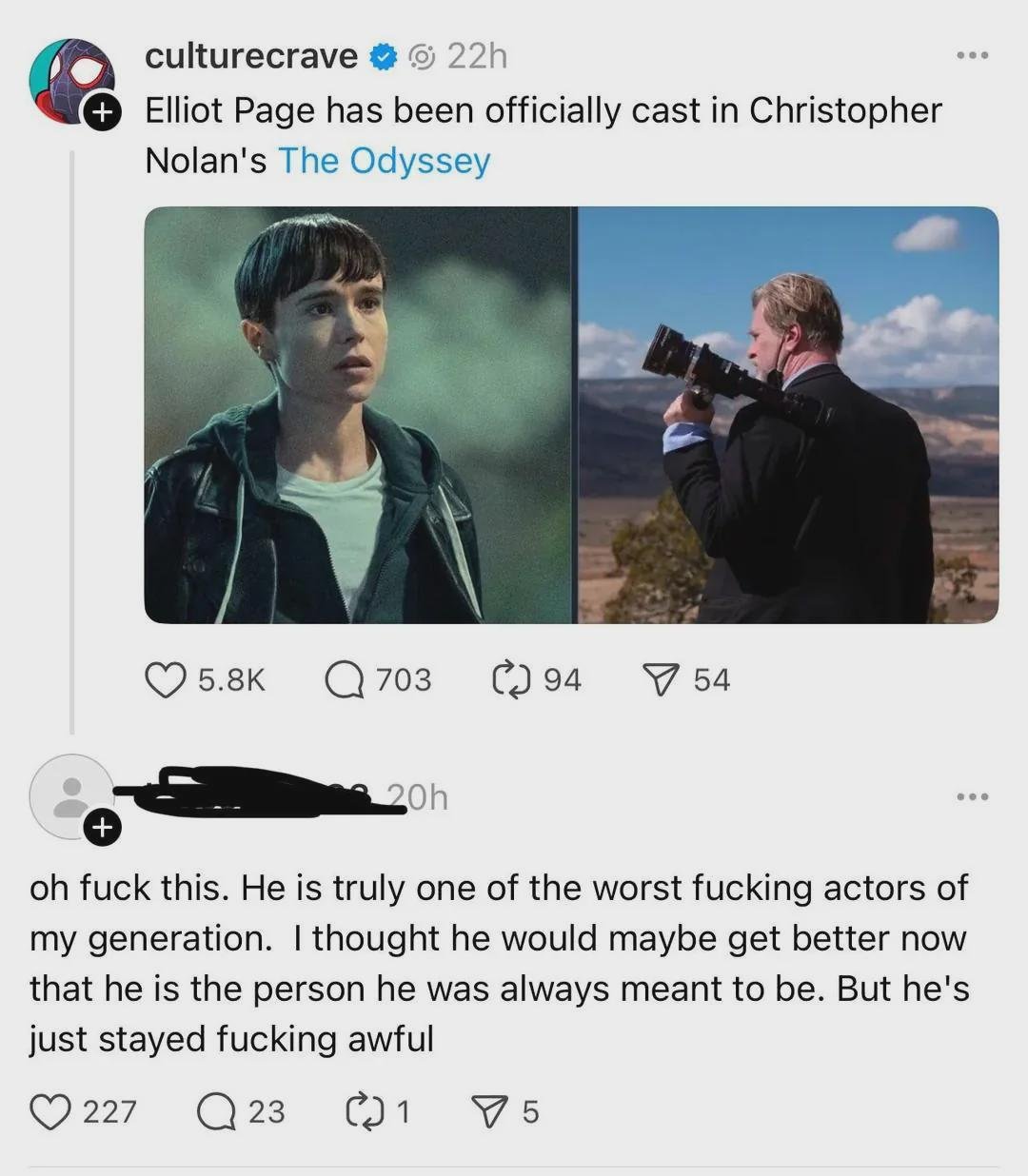
▲ 551 ▼ Trans inclusive hater (lemmy.world) submitted 2 years ago by Elrecoal19_0@lemmy.world to c/traaaaaaannnnnnnnnns@lemmy.ca 80 comments fedilink hide all child comments
[–] finitebanjo@lemmy.world 20 points 2 years ago (1 child) I kind of get it. Their awkwardness may or may not be some sort of comedic relief in Umbrella Academy. Hard Candy was an okay movie I guess. permalink fedilink source hideshow 2 child comments replies: [+] intensely_human@lemm.ee -22 points 2 years ago (4 children) I think Eliott Page is a he permalink fedilink source parent hideshow 8 child comments replies: [–] finitebanjo@lemmy.world 19 points 2 years ago (2 children) I used zero gendered terms in my comment. permalink fedilink source parent hideshow 4 child comments replies: [–] MBM@lemmings.world 1 point 2 years ago* (1 child) It can come across as weird/deliberate if you're using "they" for trans people but "he"/"she" for cis people (obviously, not gendering is still miles better than misgendering though) permalink fedilink source parent hideshow 2 child comments replies: [–] finitebanjo@lemmy.world -1 points 2 years ago Ratio'd permalink fedilink source parent [+] match@pawb.social -12 points 2 years ago (2 children) "their awkwardness"? permalink fedilink source parent hideshow 4 child comments replies: [–] DeRp_DaWg@lemmy.world 22 points 2 years ago "their" is literally a gender neutral pronoun. permalink fedilink source parent [–] finitebanjo@lemmy.world 3 points 2 years ago Idk about your native language but English does not rely on gender for grammar and therefor you can create sentences describing anything and anyone without assigning gendered pronouns. "They/them" are not terms assigning no gender, they are terms devoid of assignment. permalink fedilink source parent [–] nyamlae@lemmy.world 8 points 2 years ago Elliott uses he/they pronouns! permalink fedilink source parent [–] roguetrick@lemmy.world 6 points 2 years ago (1 child) Using they conveys a detached tone which matches the detached and ambivalent nature of the comment. See similarly "I don't care what they think" or "I don't know why they act that way" which would normally be used in informal conversation to signify a lack of engagement with the subject. permalink fedilink source parent hideshow 2 child comments replies: [–] Dragonstaff@leminal.space -2 points 2 years ago (1 child) Using "they" conveys that you don't know their gender, such as in your examples. It is often misused for trans people, but seldom do people refer to specific cis people as "they". permalink fedilink source parent hideshow 2 child comments replies: [–] roguetrick@lemmy.world 6 points 2 years ago* (last edited 2 years ago) (2 children) Correct. But it's often used for specific cis people when you are trying to create a detached or dismissive tone about those cis people. That's what the poster was doing. They were being very ambivlant and detached about Page's motivations and abilities. It's sensitive because in both cases it's being used to distance yourself from their identity. "I don't care what he thinks" is less dismissive and more confrontational than "I don't care what they think." See similarly "they can do what they want" used when the gender is known, implying you've washed your hands completely of a person vs assigning them agency. permalink fedilink source parent hideshow 4 child comments replies: [–] intensely_human@lemm.ee 3 points 2 years ago But it's often used for specific cis people when you are trying to create a detached or dismissive tone about those cis people No? I’ve never seen that before and it seems like you’re making this up as you go. permalink fedilink source parent [–] Drivebyhaiku@lemmy.world 1 point 2 years ago* The above poster used "Their awkwardness" as well which isn't a confrontational use of singular they and establishes a habit for distancing themselves from using the known correct pronouns. In the trans community this is sometimes known as "The coward's they". A soft form of transphobic behavior that refuses someone's gender when a trans person is well known enough or their gender is self evident by their presentation and behaviour but the person referring to them really doesn't want to use the correct pronoun. Sometimes it's a not intentional thing the brain does when outright transphobia mashes up against the brain coding someone they see as passing so "they" starts getting used so the speaker doesn't trip up and accidentally use the correct pronoun. When done intentionally it's designed to be subtle enough to not be caught by people just on the outside edge of trans inclusive communities but to trans people and their nearest and dearest it's usually pretty obvious. Basically a dogwhistle. You do not need to be a white knight for this person by trying to pour over their diction to try and find some pretext to defend them. Challenges to a coward's they are usually no more than a reminder of a person's actual pronouns. Short and sweet and over with quickly. Either the person gets the hint or they don't care. It's only when this response starts happening that people think using "they" dismissively to trans people works the same way as using "they" dismissively to cis people and the coward's they finds the camouflage it needs to live on because even if this was not a coward's they it functions exactly the same to a trans listener. permalink fedilink source parent [–] Gladaed@feddit.org 3 points 2 years ago Quoting November Kelly, "She, but they if you are mad at me" permalink fedilink source parent
[+] intensely_human@lemm.ee -22 points 2 years ago (4 children) I think Eliott Page is a he permalink fedilink source parent hideshow 8 child comments replies: [–] finitebanjo@lemmy.world 19 points 2 years ago (2 children) I used zero gendered terms in my comment. permalink fedilink source parent hideshow 4 child comments replies: [–] MBM@lemmings.world 1 point 2 years ago* (1 child) It can come across as weird/deliberate if you're using "they" for trans people but "he"/"she" for cis people (obviously, not gendering is still miles better than misgendering though) permalink fedilink source parent hideshow 2 child comments replies: [–] finitebanjo@lemmy.world -1 points 2 years ago Ratio'd permalink fedilink source parent [+] match@pawb.social -12 points 2 years ago (2 children) "their awkwardness"? permalink fedilink source parent hideshow 4 child comments replies: [–] DeRp_DaWg@lemmy.world 22 points 2 years ago "their" is literally a gender neutral pronoun. permalink fedilink source parent [–] finitebanjo@lemmy.world 3 points 2 years ago Idk about your native language but English does not rely on gender for grammar and therefor you can create sentences describing anything and anyone without assigning gendered pronouns. "They/them" are not terms assigning no gender, they are terms devoid of assignment. permalink fedilink source parent [–] nyamlae@lemmy.world 8 points 2 years ago Elliott uses he/they pronouns! permalink fedilink source parent [–] roguetrick@lemmy.world 6 points 2 years ago (1 child) Using they conveys a detached tone which matches the detached and ambivalent nature of the comment. See similarly "I don't care what they think" or "I don't know why they act that way" which would normally be used in informal conversation to signify a lack of engagement with the subject. permalink fedilink source parent hideshow 2 child comments replies: [–] Dragonstaff@leminal.space -2 points 2 years ago (1 child) Using "they" conveys that you don't know their gender, such as in your examples. It is often misused for trans people, but seldom do people refer to specific cis people as "they". permalink fedilink source parent hideshow 2 child comments replies: [–] roguetrick@lemmy.world 6 points 2 years ago* (last edited 2 years ago) (2 children) Correct. But it's often used for specific cis people when you are trying to create a detached or dismissive tone about those cis people. That's what the poster was doing. They were being very ambivlant and detached about Page's motivations and abilities. It's sensitive because in both cases it's being used to distance yourself from their identity. "I don't care what he thinks" is less dismissive and more confrontational than "I don't care what they think." See similarly "they can do what they want" used when the gender is known, implying you've washed your hands completely of a person vs assigning them agency. permalink fedilink source parent hideshow 4 child comments replies: [–] intensely_human@lemm.ee 3 points 2 years ago But it's often used for specific cis people when you are trying to create a detached or dismissive tone about those cis people No? I’ve never seen that before and it seems like you’re making this up as you go. permalink fedilink source parent [–] Drivebyhaiku@lemmy.world 1 point 2 years ago* The above poster used "Their awkwardness" as well which isn't a confrontational use of singular they and establishes a habit for distancing themselves from using the known correct pronouns. In the trans community this is sometimes known as "The coward's they". A soft form of transphobic behavior that refuses someone's gender when a trans person is well known enough or their gender is self evident by their presentation and behaviour but the person referring to them really doesn't want to use the correct pronoun. Sometimes it's a not intentional thing the brain does when outright transphobia mashes up against the brain coding someone they see as passing so "they" starts getting used so the speaker doesn't trip up and accidentally use the correct pronoun. When done intentionally it's designed to be subtle enough to not be caught by people just on the outside edge of trans inclusive communities but to trans people and their nearest and dearest it's usually pretty obvious. Basically a dogwhistle. You do not need to be a white knight for this person by trying to pour over their diction to try and find some pretext to defend them. Challenges to a coward's they are usually no more than a reminder of a person's actual pronouns. Short and sweet and over with quickly. Either the person gets the hint or they don't care. It's only when this response starts happening that people think using "they" dismissively to trans people works the same way as using "they" dismissively to cis people and the coward's they finds the camouflage it needs to live on because even if this was not a coward's they it functions exactly the same to a trans listener. permalink fedilink source parent [–] Gladaed@feddit.org 3 points 2 years ago Quoting November Kelly, "She, but they if you are mad at me" permalink fedilink source parent
[–] finitebanjo@lemmy.world 19 points 2 years ago (2 children) I used zero gendered terms in my comment. permalink fedilink source parent hideshow 4 child comments replies: [–] MBM@lemmings.world 1 point 2 years ago* (1 child) It can come across as weird/deliberate if you're using "they" for trans people but "he"/"she" for cis people (obviously, not gendering is still miles better than misgendering though) permalink fedilink source parent hideshow 2 child comments replies: [–] finitebanjo@lemmy.world -1 points 2 years ago Ratio'd permalink fedilink source parent [+] match@pawb.social -12 points 2 years ago (2 children) "their awkwardness"? permalink fedilink source parent hideshow 4 child comments replies: [–] DeRp_DaWg@lemmy.world 22 points 2 years ago "their" is literally a gender neutral pronoun. permalink fedilink source parent [–] finitebanjo@lemmy.world 3 points 2 years ago Idk about your native language but English does not rely on gender for grammar and therefor you can create sentences describing anything and anyone without assigning gendered pronouns. "They/them" are not terms assigning no gender, they are terms devoid of assignment. permalink fedilink source parent
[–] MBM@lemmings.world 1 point 2 years ago* (1 child) It can come across as weird/deliberate if you're using "they" for trans people but "he"/"she" for cis people (obviously, not gendering is still miles better than misgendering though) permalink fedilink source parent hideshow 2 child comments replies: [–] finitebanjo@lemmy.world -1 points 2 years ago Ratio'd permalink fedilink source parent
[+] match@pawb.social -12 points 2 years ago (2 children) "their awkwardness"? permalink fedilink source parent hideshow 4 child comments replies: [–] DeRp_DaWg@lemmy.world 22 points 2 years ago "their" is literally a gender neutral pronoun. permalink fedilink source parent [–] finitebanjo@lemmy.world 3 points 2 years ago Idk about your native language but English does not rely on gender for grammar and therefor you can create sentences describing anything and anyone without assigning gendered pronouns. "They/them" are not terms assigning no gender, they are terms devoid of assignment. permalink fedilink source parent
[–] DeRp_DaWg@lemmy.world 22 points 2 years ago "their" is literally a gender neutral pronoun. permalink fedilink source parent
[–] finitebanjo@lemmy.world 3 points 2 years ago Idk about your native language but English does not rely on gender for grammar and therefor you can create sentences describing anything and anyone without assigning gendered pronouns. "They/them" are not terms assigning no gender, they are terms devoid of assignment. permalink fedilink source parent
[–] nyamlae@lemmy.world 8 points 2 years ago Elliott uses he/they pronouns! permalink fedilink source parent
[–] roguetrick@lemmy.world 6 points 2 years ago (1 child) Using they conveys a detached tone which matches the detached and ambivalent nature of the comment. See similarly "I don't care what they think" or "I don't know why they act that way" which would normally be used in informal conversation to signify a lack of engagement with the subject. permalink fedilink source parent hideshow 2 child comments replies: [–] Dragonstaff@leminal.space -2 points 2 years ago (1 child) Using "they" conveys that you don't know their gender, such as in your examples. It is often misused for trans people, but seldom do people refer to specific cis people as "they". permalink fedilink source parent hideshow 2 child comments replies: [–] roguetrick@lemmy.world 6 points 2 years ago* (last edited 2 years ago) (2 children) Correct. But it's often used for specific cis people when you are trying to create a detached or dismissive tone about those cis people. That's what the poster was doing. They were being very ambivlant and detached about Page's motivations and abilities. It's sensitive because in both cases it's being used to distance yourself from their identity. "I don't care what he thinks" is less dismissive and more confrontational than "I don't care what they think." See similarly "they can do what they want" used when the gender is known, implying you've washed your hands completely of a person vs assigning them agency. permalink fedilink source parent hideshow 4 child comments replies: [–] intensely_human@lemm.ee 3 points 2 years ago But it's often used for specific cis people when you are trying to create a detached or dismissive tone about those cis people No? I’ve never seen that before and it seems like you’re making this up as you go. permalink fedilink source parent [–] Drivebyhaiku@lemmy.world 1 point 2 years ago* The above poster used "Their awkwardness" as well which isn't a confrontational use of singular they and establishes a habit for distancing themselves from using the known correct pronouns. In the trans community this is sometimes known as "The coward's they". A soft form of transphobic behavior that refuses someone's gender when a trans person is well known enough or their gender is self evident by their presentation and behaviour but the person referring to them really doesn't want to use the correct pronoun. Sometimes it's a not intentional thing the brain does when outright transphobia mashes up against the brain coding someone they see as passing so "they" starts getting used so the speaker doesn't trip up and accidentally use the correct pronoun. When done intentionally it's designed to be subtle enough to not be caught by people just on the outside edge of trans inclusive communities but to trans people and their nearest and dearest it's usually pretty obvious. Basically a dogwhistle. You do not need to be a white knight for this person by trying to pour over their diction to try and find some pretext to defend them. Challenges to a coward's they are usually no more than a reminder of a person's actual pronouns. Short and sweet and over with quickly. Either the person gets the hint or they don't care. It's only when this response starts happening that people think using "they" dismissively to trans people works the same way as using "they" dismissively to cis people and the coward's they finds the camouflage it needs to live on because even if this was not a coward's they it functions exactly the same to a trans listener. permalink fedilink source parent
[–] Dragonstaff@leminal.space -2 points 2 years ago (1 child) Using "they" conveys that you don't know their gender, such as in your examples. It is often misused for trans people, but seldom do people refer to specific cis people as "they". permalink fedilink source parent hideshow 2 child comments replies: [–] roguetrick@lemmy.world 6 points 2 years ago* (last edited 2 years ago) (2 children) Correct. But it's often used for specific cis people when you are trying to create a detached or dismissive tone about those cis people. That's what the poster was doing. They were being very ambivlant and detached about Page's motivations and abilities. It's sensitive because in both cases it's being used to distance yourself from their identity. "I don't care what he thinks" is less dismissive and more confrontational than "I don't care what they think." See similarly "they can do what they want" used when the gender is known, implying you've washed your hands completely of a person vs assigning them agency. permalink fedilink source parent hideshow 4 child comments replies: [–] intensely_human@lemm.ee 3 points 2 years ago But it's often used for specific cis people when you are trying to create a detached or dismissive tone about those cis people No? I’ve never seen that before and it seems like you’re making this up as you go. permalink fedilink source parent [–] Drivebyhaiku@lemmy.world 1 point 2 years ago* The above poster used "Their awkwardness" as well which isn't a confrontational use of singular they and establishes a habit for distancing themselves from using the known correct pronouns. In the trans community this is sometimes known as "The coward's they". A soft form of transphobic behavior that refuses someone's gender when a trans person is well known enough or their gender is self evident by their presentation and behaviour but the person referring to them really doesn't want to use the correct pronoun. Sometimes it's a not intentional thing the brain does when outright transphobia mashes up against the brain coding someone they see as passing so "they" starts getting used so the speaker doesn't trip up and accidentally use the correct pronoun. When done intentionally it's designed to be subtle enough to not be caught by people just on the outside edge of trans inclusive communities but to trans people and their nearest and dearest it's usually pretty obvious. Basically a dogwhistle. You do not need to be a white knight for this person by trying to pour over their diction to try and find some pretext to defend them. Challenges to a coward's they are usually no more than a reminder of a person's actual pronouns. Short and sweet and over with quickly. Either the person gets the hint or they don't care. It's only when this response starts happening that people think using "they" dismissively to trans people works the same way as using "they" dismissively to cis people and the coward's they finds the camouflage it needs to live on because even if this was not a coward's they it functions exactly the same to a trans listener. permalink fedilink source parent
[–] roguetrick@lemmy.world 6 points 2 years ago* (last edited 2 years ago) (2 children) Correct. But it's often used for specific cis people when you are trying to create a detached or dismissive tone about those cis people. That's what the poster was doing. They were being very ambivlant and detached about Page's motivations and abilities. It's sensitive because in both cases it's being used to distance yourself from their identity. "I don't care what he thinks" is less dismissive and more confrontational than "I don't care what they think." See similarly "they can do what they want" used when the gender is known, implying you've washed your hands completely of a person vs assigning them agency. permalink fedilink source parent hideshow 4 child comments replies: [–] intensely_human@lemm.ee 3 points 2 years ago But it's often used for specific cis people when you are trying to create a detached or dismissive tone about those cis people No? I’ve never seen that before and it seems like you’re making this up as you go. permalink fedilink source parent [–] Drivebyhaiku@lemmy.world 1 point 2 years ago* The above poster used "Their awkwardness" as well which isn't a confrontational use of singular they and establishes a habit for distancing themselves from using the known correct pronouns. In the trans community this is sometimes known as "The coward's they". A soft form of transphobic behavior that refuses someone's gender when a trans person is well known enough or their gender is self evident by their presentation and behaviour but the person referring to them really doesn't want to use the correct pronoun. Sometimes it's a not intentional thing the brain does when outright transphobia mashes up against the brain coding someone they see as passing so "they" starts getting used so the speaker doesn't trip up and accidentally use the correct pronoun. When done intentionally it's designed to be subtle enough to not be caught by people just on the outside edge of trans inclusive communities but to trans people and their nearest and dearest it's usually pretty obvious. Basically a dogwhistle. You do not need to be a white knight for this person by trying to pour over their diction to try and find some pretext to defend them. Challenges to a coward's they are usually no more than a reminder of a person's actual pronouns. Short and sweet and over with quickly. Either the person gets the hint or they don't care. It's only when this response starts happening that people think using "they" dismissively to trans people works the same way as using "they" dismissively to cis people and the coward's they finds the camouflage it needs to live on because even if this was not a coward's they it functions exactly the same to a trans listener. permalink fedilink source parent
[–] intensely_human@lemm.ee 3 points 2 years ago But it's often used for specific cis people when you are trying to create a detached or dismissive tone about those cis people No? I’ve never seen that before and it seems like you’re making this up as you go. permalink fedilink source parent
[–] Drivebyhaiku@lemmy.world 1 point 2 years ago* The above poster used "Their awkwardness" as well which isn't a confrontational use of singular they and establishes a habit for distancing themselves from using the known correct pronouns. In the trans community this is sometimes known as "The coward's they". A soft form of transphobic behavior that refuses someone's gender when a trans person is well known enough or their gender is self evident by their presentation and behaviour but the person referring to them really doesn't want to use the correct pronoun. Sometimes it's a not intentional thing the brain does when outright transphobia mashes up against the brain coding someone they see as passing so "they" starts getting used so the speaker doesn't trip up and accidentally use the correct pronoun. When done intentionally it's designed to be subtle enough to not be caught by people just on the outside edge of trans inclusive communities but to trans people and their nearest and dearest it's usually pretty obvious. Basically a dogwhistle. You do not need to be a white knight for this person by trying to pour over their diction to try and find some pretext to defend them. Challenges to a coward's they are usually no more than a reminder of a person's actual pronouns. Short and sweet and over with quickly. Either the person gets the hint or they don't care. It's only when this response starts happening that people think using "they" dismissively to trans people works the same way as using "they" dismissively to cis people and the coward's they finds the camouflage it needs to live on because even if this was not a coward's they it functions exactly the same to a trans listener. permalink fedilink source parent
[–] Gladaed@feddit.org 3 points 2 years ago Quoting November Kelly, "She, but they if you are mad at me" permalink fedilink source parent