▲ 578 ▼ pringles (mander.xyz) submitted 2 years ago by fossilesque@mander.xyz to c/science_memes@mander.xyz 80 comments fedilink hide all child comments
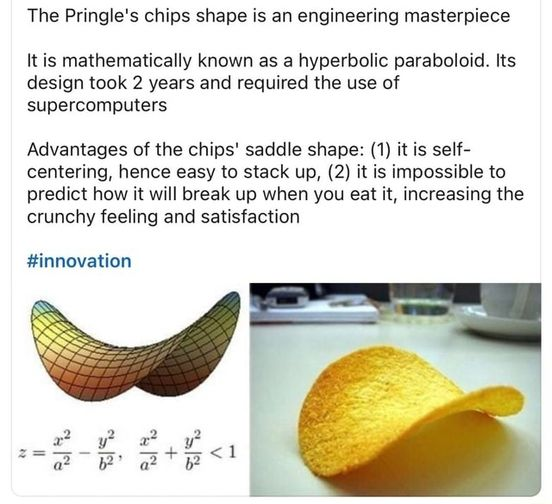
[–] zerakith@lemmy.ml 46 points 2 years ago (6 children) It is quite hard to track down but here's it being reported by the head of modelling at P&G in 2006 https://www.hpcwire.com/2006/05/05/high_performance_potato_chips/ permalink fedilink source parent hideshow 6 child comments replies: [–] SweetCitrusBuzz@beehaw.org 28 points 2 years ago (2 children) [Sincere] Thanks a lot! permalink fedilink source parent hideshow 2 child comments replies: [–] Track_Shovel@slrpnk.net 12 points 2 years ago (1 child) [Condescending answer]: I am programmed to burn holes in meatbags, master. permalink fedilink source parent hideshow 1 child comment replies: [–] SweetCitrusBuzz@beehaw.org 3 points 2 years ago Nice reference. permalink fedilink source parent [–] zerakith@lemmy.ml 17 points 2 years ago Though worth saying that the link suggests the computing was used for aerodynamics for ensuring production wouldn't destroy them not. For the shape as such. I've also seem it said that the can is part of that too. permalink fedilink source parent [–] pineapplelover@lemm.ee 5 points 2 years ago (1 child) Is this real or am I being trolled permalink fedilink source parent hideshow 1 child comment replies: [–] zerakith@lemmy.ml 4 points 2 years ago I'm pretty sure it's real. I met someone once who worked in materials research for food and they said that modelling was big there because the scope for experimentation is more limited. In materials for construction where they wanted to change a property they could play around with adding new additives and seeing what happens. For food though you can't add anything beyond a limited set of chemicals that already have approval from the various agencies* and therefore they look at trying to fine tune in other ways. So for chocolate, for example, they control lots of material properties by very careful control of temperature and pressure as it solidifies. This is why if chocolate melts and resolidifies you see the white bits of milk that don't remain within the materia. *Okay you can add a new chemical but that means a time frame of over a decade to then get approval. I think the number of chemicals that's happened to is very very small and that's partly because the innovation framework of capitalism is very short term. permalink fedilink source parent
[–] SweetCitrusBuzz@beehaw.org 28 points 2 years ago (2 children) [Sincere] Thanks a lot! permalink fedilink source parent hideshow 2 child comments replies: [–] Track_Shovel@slrpnk.net 12 points 2 years ago (1 child) [Condescending answer]: I am programmed to burn holes in meatbags, master. permalink fedilink source parent hideshow 1 child comment replies: [–] SweetCitrusBuzz@beehaw.org 3 points 2 years ago Nice reference. permalink fedilink source parent
[–] Track_Shovel@slrpnk.net 12 points 2 years ago (1 child) [Condescending answer]: I am programmed to burn holes in meatbags, master. permalink fedilink source parent hideshow 1 child comment replies: [–] SweetCitrusBuzz@beehaw.org 3 points 2 years ago Nice reference. permalink fedilink source parent
[–] zerakith@lemmy.ml 17 points 2 years ago Though worth saying that the link suggests the computing was used for aerodynamics for ensuring production wouldn't destroy them not. For the shape as such. I've also seem it said that the can is part of that too. permalink fedilink source parent
[–] pineapplelover@lemm.ee 5 points 2 years ago (1 child) Is this real or am I being trolled permalink fedilink source parent hideshow 1 child comment replies: [–] zerakith@lemmy.ml 4 points 2 years ago I'm pretty sure it's real. I met someone once who worked in materials research for food and they said that modelling was big there because the scope for experimentation is more limited. In materials for construction where they wanted to change a property they could play around with adding new additives and seeing what happens. For food though you can't add anything beyond a limited set of chemicals that already have approval from the various agencies* and therefore they look at trying to fine tune in other ways. So for chocolate, for example, they control lots of material properties by very careful control of temperature and pressure as it solidifies. This is why if chocolate melts and resolidifies you see the white bits of milk that don't remain within the materia. *Okay you can add a new chemical but that means a time frame of over a decade to then get approval. I think the number of chemicals that's happened to is very very small and that's partly because the innovation framework of capitalism is very short term. permalink fedilink source parent
[–] zerakith@lemmy.ml 4 points 2 years ago I'm pretty sure it's real. I met someone once who worked in materials research for food and they said that modelling was big there because the scope for experimentation is more limited. In materials for construction where they wanted to change a property they could play around with adding new additives and seeing what happens. For food though you can't add anything beyond a limited set of chemicals that already have approval from the various agencies* and therefore they look at trying to fine tune in other ways. So for chocolate, for example, they control lots of material properties by very careful control of temperature and pressure as it solidifies. This is why if chocolate melts and resolidifies you see the white bits of milk that don't remain within the materia. *Okay you can add a new chemical but that means a time frame of over a decade to then get approval. I think the number of chemicals that's happened to is very very small and that's partly because the innovation framework of capitalism is very short term. permalink fedilink source parent