Reminds me that the whole concept of generations is something manufactured of whole cloth and meant to divide us, but more than that, that real people are compassionate and understanding. All that stuff is just fake.
It gives me hope for unity.
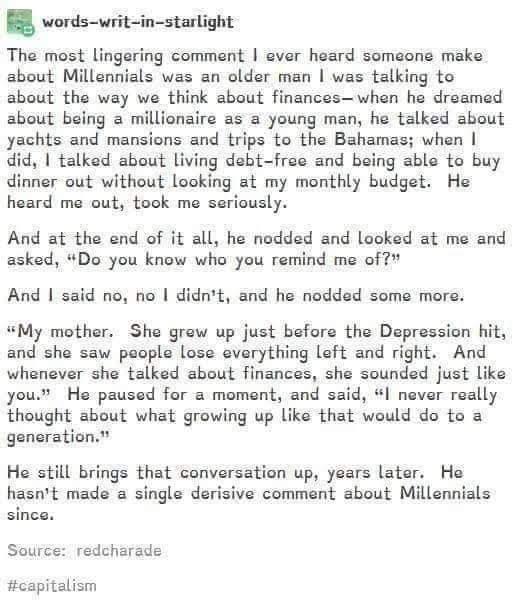
Reminds me that the whole concept of generations is something manufactured of whole cloth and meant to divide us, but more than that, that real people are compassionate and understanding. All that stuff is just fake.
It gives me hope for unity.
something manufactured of whole cloth and meant to divide us
I'm not so sure about that.
My parents grew up in London during WWII. My father told me that, on any given day, at least one or two of the kids in his school had recently received a letter from the government telling them that their father, uncle or brother had died in the war. Not to mention other deaths from bombings that happen on and off for years. For the most part, the rest of the kids in school never knew who had just had someone killed in the war, although I suppose it eventually came out to become public knowledge. The point being that you could be playing ball with some kid who had just lost a family member, and you wouldn't necessarily know it. He said that this shaped his attitude that death is just a part of life, and something that (in true British fashion) you accepted and moved on with.
This came up when my sister-in-law lost her adult daughter some years back and she was (and is) still struggling with it. My father has a hard time understanding her feelings. The two of them are just 22 years apart in age.
WWII is something that casts a pretty big shadow. But when I was born, it was less than 20 years later and its influence on my attitudes is several orders of magnitude smaller than on my parents.
At the other end. It's hard for anyone much less than 25 years old today to remember life before modern smart phones (if you assume the start of that as the iPhone in 2008). It's hard to deny that the smart phone has radically changed the way that we interact with each other and the world. Yes, old farts like me have adapted to it, but young people today have these things hard-wired in from the beginning.
So far, in this century, it's changing technology that casts the big shadow.
The point being that, while society changes in a continuum, big things that cast big shadows tend to define "eras" that shape the way that young people develop. And those big shadows are what cause "generations" to tend to clump together in attitudes and behaviours. And, no, I don't think this is made up just to divide us.